A match can turn on two players who barely touch the final shot. The goal arrives from a winger or a striker, but the platform often comes from the pair underneath the play, closing passing lanes, recycling possession, and making the next phase possible.
That is the key appeal of double pivot football. It looks simple on a tactics board, yet its value only becomes clear when pressure rises, spaces shrink, and one central midfielder is no longer enough.
Table of Contents
- INTRODUCTION
- DEFINING THE DOUBLE PIVOT IN FOOTBALL
- THE HISTORICAL EVOLUTION OF THE PIVOT PAIR
- PIVOT PROFILES AND KEY PARTNERSHIPS
- THE CORE TACTICAL FUNCTIONS OF A DOUBLE PIVOT
- HOW MODERN TEAMS USE AND COUNTER THE DOUBLE PIVOT
- THE ENDURING RELEVANCE OF THE DOUBLE PIVOT
INTRODUCTION
A good midfield base rarely announces itself. It appears in the moments when a centre-back needs one more safe pass, when a full-back has already advanced, or when a counter-attack has to be slowed before it reaches the penalty area.
That is why the double pivot keeps returning across eras. Coaches use it because it solves several problems at once. It protects the centre, improves access in build-up, and gives the team a second reference point under pressure. In modern football, that matters even more because pressing structures are sharper and more man-oriented than many older systems had to face.
The interesting question isn't whether the shape exists. It clearly does. The more useful question is when a double pivot works, and when it becomes a trap for the team using it.
Manchester City make that tension especially clear. Guardiola's sides often create the effect of a double pivot through rotation rather than by naming two fixed holders from kick-off. That detail changes everything. The strongest version of the structure is dynamic. The weakest version is flat, static, and easy to mark.
DEFINING THE DOUBLE PIVOT IN FOOTBALL
TWO GATEKEEPERS IN FRONT OF THE BACK LINE
A double pivot is a withdrawn central-midfield pairing placed in front of the centre-backs, inside the full-backs or wing-backs, and behind the more attacking midfielders. According to Coaches' Voice on the double pivot, its main structural value is that it increases central coverage, improves screening of passing lanes into opposition forwards, and gives the team a second build-up outlet under pressure.
The easiest way to picture it is as two gatekeepers. One can move toward the ball while the other protects the space behind. One can receive under pressure while the other offers the next angle. That split of labour is the core advantage.
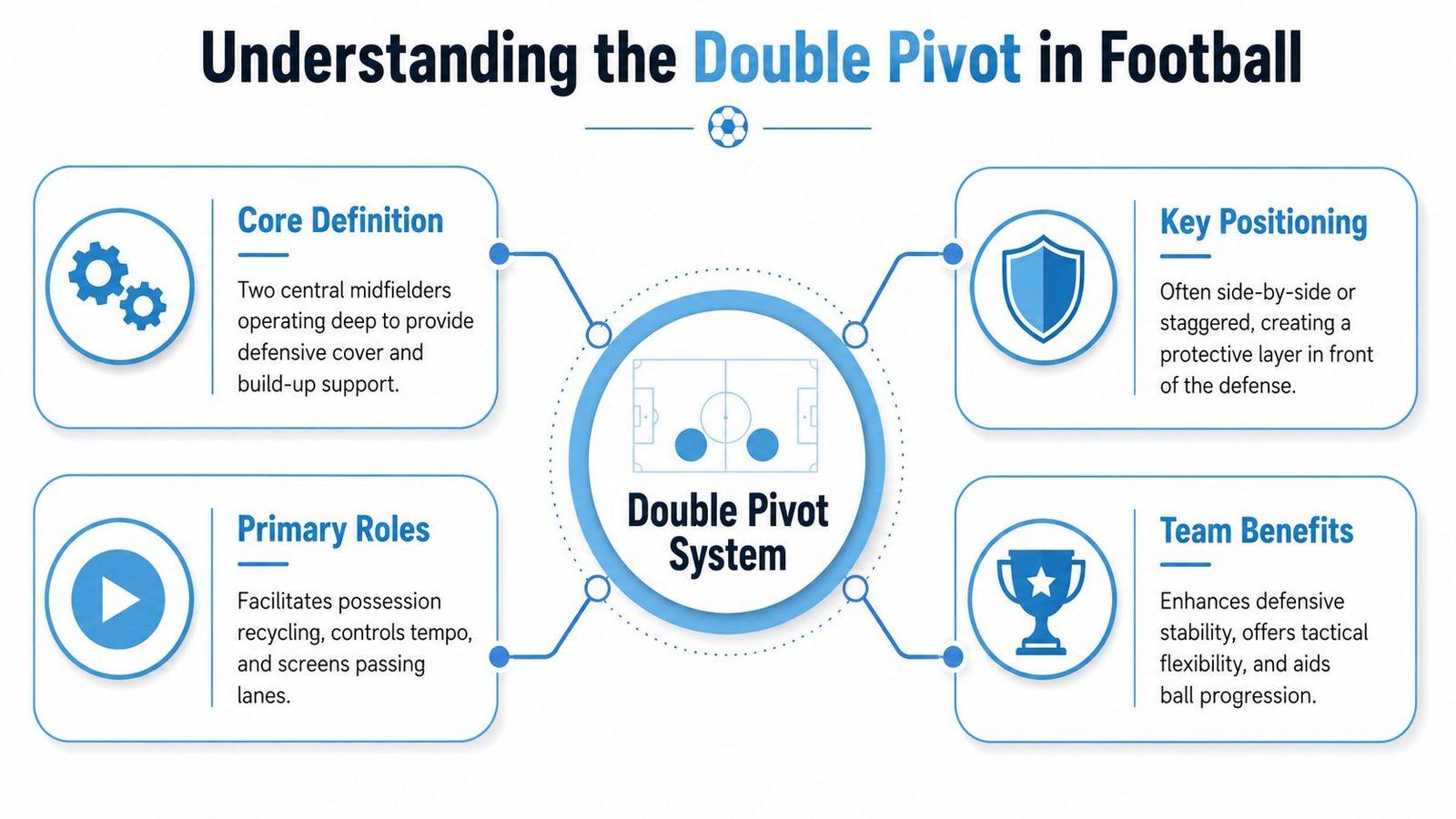
On paper, the pair often sits side by side. On the pitch, that picture is usually too neat. Good double pivots slide, rotate, and stagger their heights depending on the ball location. If both stay on the same horizontal line for too long, the shape becomes easier to close.
A familiar home for the role is the 4-2-3-1 structure in this Manchester City Analysis guide. That formation makes the pairing easy to identify because the two midfielders sit behind a single No. 10 and ahead of a back four.
A short visual explainer helps fix the idea before the deeper tactical detail:
Practical rule: A double pivot isn't defined by two names on a teamsheet. It's defined by two players sharing the deepest central responsibilities in the same phase.
DOUBLE PIVOT VERSUS SINGLE PIVOT
The contrast with a single pivot matters because the difference isn't cosmetic. A lone No. 6 must screen the centre, connect build-up, and defend transitions with less nearby support. A double pivot spreads those duties across two players.
That creates three immediate consequences:
- More central security: The team can close the lane into opposition forwards with two players instead of one.
- Safer circulation: Centre-backs and goalkeepers usually have another short passing option if the first one is blocked.
- Better cover logic: One pivot can step out while the other holds position.
The trade-off appears elsewhere. A team using two deeper midfielders often gives up one player higher between the lines compared with a midfield that uses only one holder. That means the structure can become secure without becoming threatening.
This is why analysts should treat the double pivot as a balance choice rather than a universal upgrade. It gives more protection and more support in the first phase. It can also lower attacking occupation if the spacing ahead of it isn't good enough.
THE HISTORICAL EVOLUTION OF THE PIVOT PAIR
WHY THE SECOND MIDFIELDER APPEARED
The double pivot is old football logic wearing modern language. The idea can be traced to the 1920s, when Herbert Chapman's teams explored using a second player in front of the defensive line so a lone pivot would not be overrun, as outlined in Football DNA's explanation of the double pivot.
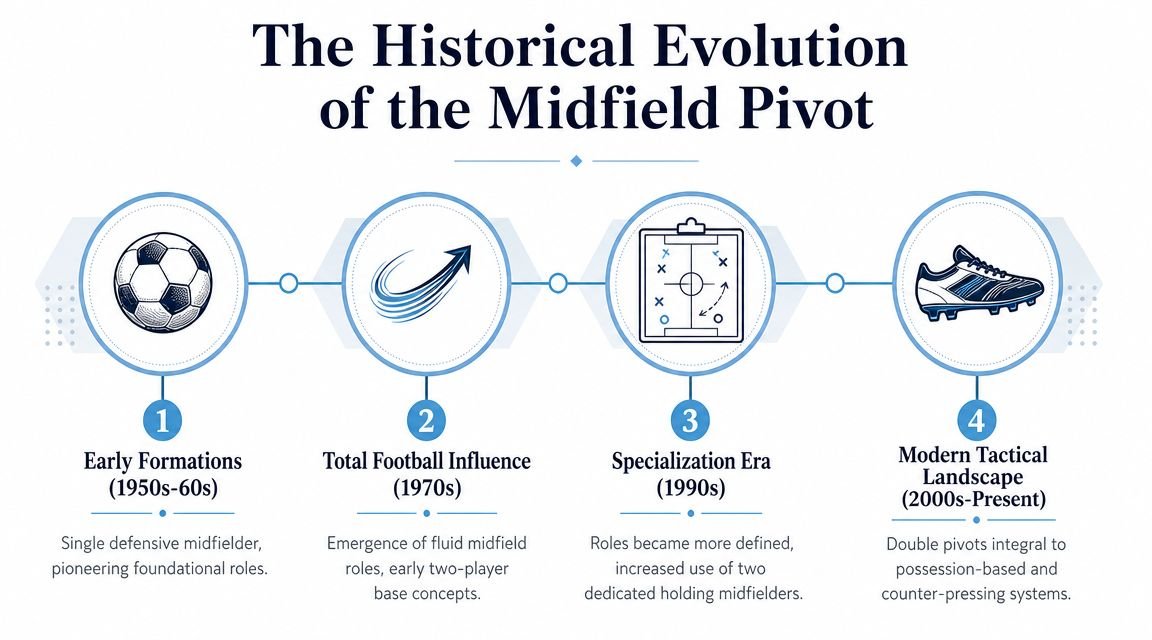
That origin matters because it shows the first purpose of the role. The pairing was not created to look elegant in possession. It was created to stop the centre from collapsing under direct pressure. Two players could share ball-winning, screening, and cover duties in a way one player often couldn't.
The historical lesson is straightforward. Football keeps changing shape, but central overloads remain one of the game's oldest problems. The double pivot survives because it answers that problem without forcing a team into an all-out defensive posture.
The role started as insurance. It later became a platform.
FROM DEFENSIVE INSURANCE TO BUILD-UP TOOL
As tactical systems became more organized, the pair gained a second life. It was no longer only a shield in front of defenders. It became a first-phase mechanism for constructing possession.
That shift explains why the role became especially visible in systems built around a line of three attacking midfielders ahead of two deeper players. In those structures, the double pivot gave defenders a stable exit route while allowing the advanced line to stay higher.
The key evolution wasn't the number of players. It was the change in responsibilities. Earlier versions focused heavily on resisting direct central attacks. Modern versions still do that, but they also have to receive facing their own goal, bounce pressure, and create the next lane for progression.
A useful way to read this history is through function rather than formation:
- Early logic: protect the vulnerable central zone
- Transitional logic: divide defensive and distribution work more clearly
- Modern logic: help the team survive the first press without losing central compactness
That timeline also reveals why the structure remains relevant even in possession-dominant football. Teams don't only need midfielders who can tackle. They need midfielders who can absorb pressure without freezing the build-up.
PIVOT PROFILES AND KEY PARTNERSHIPS
SYMMETRIC AND ASYMMETRIC PAIRS
Not every double pivot behaves the same way. The main divide is between symmetric and asymmetric pairings.
A symmetric pair uses two midfielders with similar starting responsibilities. Both screen, both offer short support, and both can hold their zones. This setup can make a team stable, but it can also make the first phase predictable if neither player changes height or angle.
An asymmetric pair is usually richer. One midfielder might act as the main distributor while the other covers larger defensive spaces. One may drop closer to the centre-backs while the partner stays slightly ahead. This creates natural staggering, which gives the team more than one lane out of pressure.
That difference shapes the whole match. A symmetric pivot often controls space through balance. An asymmetric pivot often controls it through contrast.
ARCHETYPES INSIDE THE PAIR
Several recurring player types appear in double pivot football. They are useful labels if they remain flexible.
- The destroyer: prioritises duels, second balls, and direct defensive coverage.
- The deep-lying playmaker: receives to dictate circulation, switch play, and calm the first phase.
- The shuttler: moves laterally to support full-backs, press outward, and connect central and wide zones.
- The box-to-box partner: carries the game forward in moments, but still recovers quickly enough to protect transitions.
The strongest pairings usually combine jobs rather than isolate them. A destroyer who can't circulate at all becomes a pressing target. A playmaker who can't defend the space behind the ball becomes a transition risk.
Here, recruitment and coaching meet. The coach doesn't just need two good midfielders. The coach needs two midfielders whose habits solve each other's problems.
A pivot partnership should be judged less by talent in isolation and more by whether each player improves the other player's access to the game.
The same issue appears in Manchester City's own discussions around central control. A useful related reference is this analysis of Rodri's absence and City's midfield struggles, which focuses on what happens when the base of midfield loses its stabilising presence.
COMMON DOUBLE PIVOT PARTNERSHIPS
| Partnership Type | Role 1 (Archetype) | Role 2 (Archetype) | Primary Function | Classic Example |
|---|---|---|---|---|
| Symmetric shield | Destroyer | Destroyer | Protect the centre and defend transitions | Two holding midfielders in a cautious 4-4-2 |
| Playmaker plus ball-winner | Deep-lying playmaker | Destroyer | Build securely while preserving defensive bite | Xabi Alonso and Javier Mascherano |
| Controller plus runner | Deep-lying playmaker | Box-to-box midfielder | Maintain circulation and add forward support | A possession side with one sitter and one carrier |
| Shuttler pair | Shuttler | Shuttler | Cover width, support pressing, and keep compactness | Midfields built for intense lateral work |
| Hybrid asymmetry | Regista | Shuttler | Create angles through staggered movement | Many modern 4-2-3-1 structures |
| Counter-balance pair | Destroyer | Shuttler | Protect against transitions and close wide gaps | Teams with attacking full-backs |
The table matters because it reframes the role. A double pivot isn't one thing. It is a partnership mechanism. The exact effect depends on whether the pair offers duplication or complementarity.
THE CORE TACTICAL FUNCTIONS OF A DOUBLE PIVOT
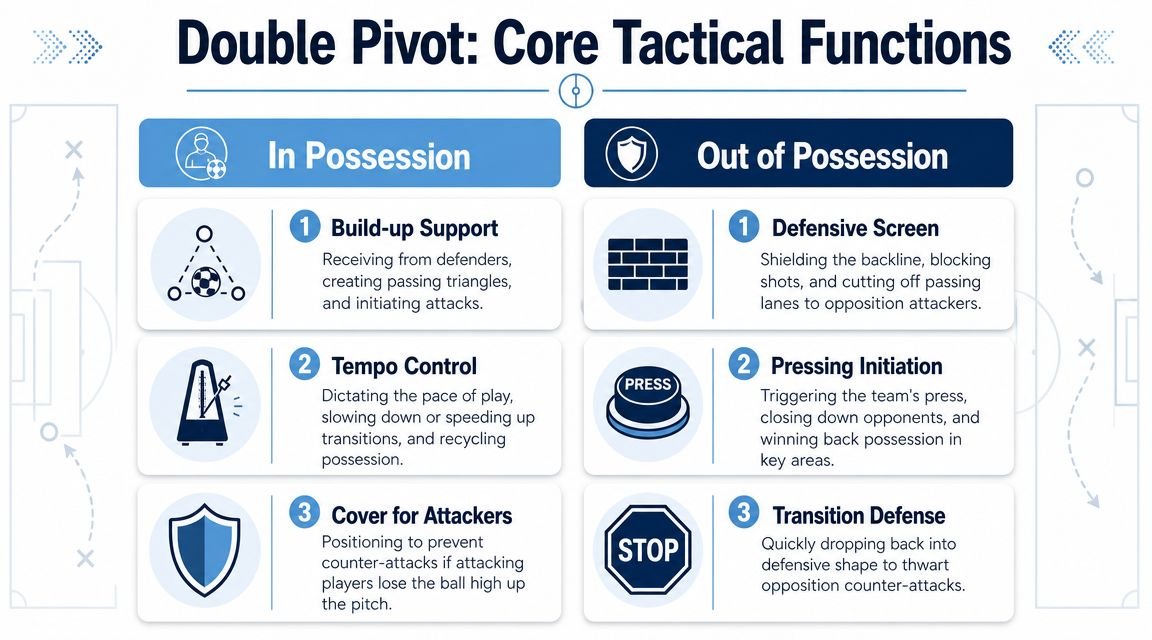
IN POSSESSION
The most visible benefit of a double pivot comes in build-up. Two deep midfielders give defenders more than one safe connection and reduce the risk that the first pressing line shuts the whole centre.
Their in-possession jobs usually include:
- Receiving under pressure: One pivot can show short while the other adjusts his angle behind the first line.
- Creating triangles: The pair helps connect centre-back, full-back, and attacking midfielder without forcing vertical passes too early.
- Recycling possession: If the progressive lane is closed, the ball can still move through the pair without losing structure.
- Supporting rest defence: Because two players remain near the ball, the team is better placed to react if possession is lost.
A subtle point often gets missed. The pair does not only offer more passing options. It changes the geometry of the first phase. Opponents now have to decide whether to press both, block one and jump late to the other, or lock the centre and invite passes wide.
That decision can buy time for the attacking line. If the pivot pair controls the first phase, the higher players receive against a disorganised second line rather than a settled block.
OUT OF POSSESSION
The same structure carries different value once the ball is lost. Out of possession, the pair forms the first protective layer in front of the defence.
Its main defensive functions include:
- Screening forwards: The pivots position themselves to block direct access into strikers or attacking midfielders.
- Delaying counters: If one midfielder steps to the ball, the other can hold the central lane and stop immediate penetration.
- Covering advanced full-backs: When the full-backs attack, the pivots often slide across to protect the half-spaces left behind.
- Supporting pressure: One can jump toward the receiver while the partner secures the space the jump leaves open.
This is why coaches often trust the structure in unstable matches. It gives a team a built-in answer to both circulation and collapse.
Key takeaway: The best double pivots don't just help a team start attacks. They shape how the team survives the moment after the attack breaks down.
A useful match-reading habit follows from that. When evaluating a double pivot, the analyst should watch the three seconds after a turnover. If the pair cannot either delay or direct the transition, the structure may look sound in possession while failing at one of its deepest tasks.
HOW MODERN TEAMS USE AND COUNTER THE DOUBLE PIVOT
MANCHESTER CITY AND THE FLUID SECOND PIVOT
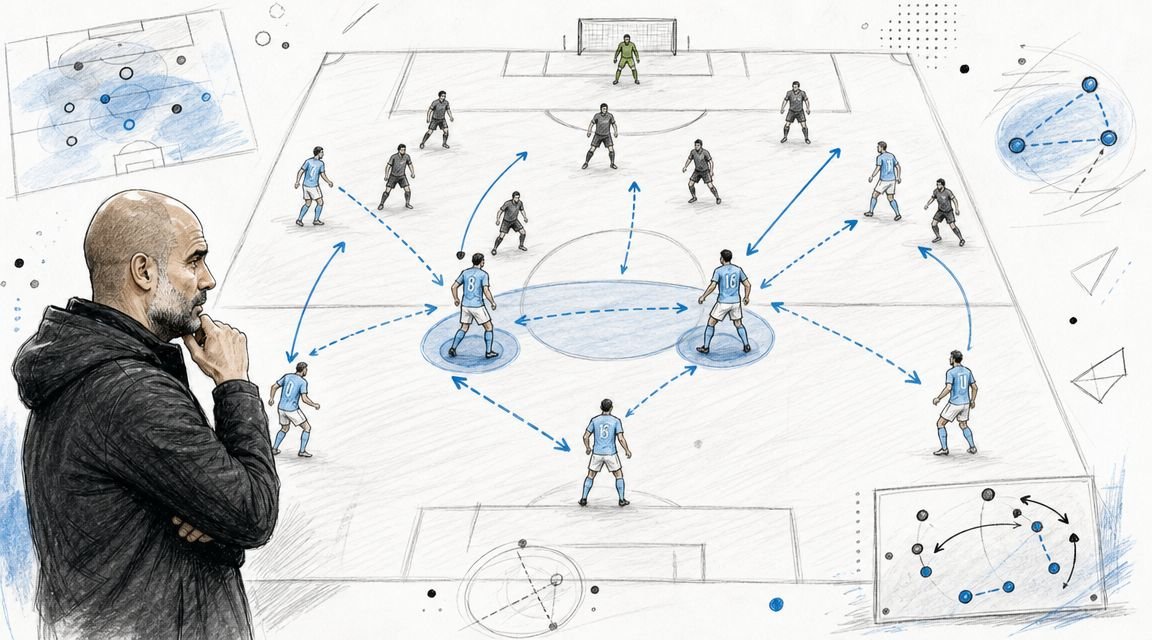
Manchester City are useful because they often use the logic of a double pivot without always locking into a fixed pair from the start. One midfielder may hold while a full-back inverts, or an advanced player drops temporarily to form the second central base.
That detail matters more than the lineup graphic. A rigid pair can become easy to map. A fluid pair asks the opponent to keep redefining who the second pivot is.
In Guardiola's version, the best rotations usually do three things at once:
- They give the ball carrier a short central option.
- They prevent both pivots from standing on the same line.
- They shift the opponent's first press before the progressive pass is attempted.
This is where double pivot football becomes less about labels and more about timing. The second pivot should appear where pressure is strongest, not where convention says the role belongs. That is one reason Guardiola's positional structures often look different from week to week while preserving the same central logic.
A related discussion appears in this look at Guardiola's tactical tinkering and structural inconsistency, especially where changing support patterns alter the reliability of City's base.
WHEN THE STRUCTURE BREAKS DOWN
The common assumption is that a double pivot is automatically safer against pressure. That is only partly true. According to Total Football Analysis on the role of a double pivot in build-up, the key weakness is its vulnerability to a well-coached man-marking press. If both pivots are marked, the structure can become static and lose the safe passing angles it was supposed to create.
That is the central modern problem. Two midfielders are only an advantage if they create different references. If they stand flat and close together, the press can pin both at once.
The best solutions are structural rather than heroic:
- Stagger the pair: one deeper, one slightly higher
- Widen one pivot: stretch the first line horizontally
- Drop one late, not early: force the marker to decide
- Rotate with a full-back or No. 10: change who occupies the second pivot slot
A static double pivot often fails for a simple reason. It offers two players but only one idea. A dynamic double pivot offers two players and several possible routes out.
That is also why some teams appear to dominate one opponent and struggle badly against another. The issue isn't whether the double pivot exists. The issue is whether the pair can keep moving the reference points of the press.
For match analysts, a clear warning sign is easy to spot. If the centre-backs keep circulating the ball around the first line while the pivots remain visible but unusable, the structure has not created access. It has only created the illusion of control.
THE ENDURING RELEVANCE OF THE DOUBLE PIVOT
The double pivot remains relevant because it is not a fixed formation trick. It is a flexible answer to one persistent football problem. How does a team protect the centre while still building through it?
Its value still rests on the same core ideas: central coverage, screening, support under pressure, and cover against transitions. What has changed is the level of precision required. In the modern high-press game, the pair can't just exist. It has to move, stagger, rotate, and change the opponent's picture.
That is why the role keeps surviving tactical fashion. A team may call it a 4-2-3-1, a 4-4-2, or a back-three structure with two central supports. The language shifts. The logic doesn't.
The strongest reading of double pivot football is not that it guarantees security. It is that it offers a framework for creating security, if the two players behave as a partnership rather than as a static pair. That distinction will only matter more as pressing systems become smarter and build-up space becomes even harder to find.
For readers who want more team-specific tactical breakdowns, Manchester City Analysis publishes match-focused work on City's midfield structures, build-up patterns, and positional changes in and out of possession.