Why does one Premier League side look dominant for half an hour, then suddenly lose control without making a substitution? Most match reports answer with familiar words like intensity, momentum, or desire. Those labels describe the feeling of a game. They rarely explain the mechanism.
That gap is where premier league tactical analysis becomes useful. It asks different questions. Where was the space? Which pressing trigger changed? Why did one full-back start moving inside instead of staying wide? Why did a team stop building short and start going longer? Once those questions become habitual, matches stop looking chaotic. Patterns begin to repeat.
Modern football isn't just about who had the better players. It's about how coaches organize space, how players interpret roles, and how teams react across changing game states. The Premier League is especially rich for this kind of study because the league combines elite coaching, varied styles, and constant tactical adaptation.
A smart fan doesn't need a coaching license to read the game better. What matters is having a framework. The same framework helps a supporter understand why a performance felt flat, helps a writer build a stronger argument, and helps an aspiring analyst turn observations into evidence. The details are there in every match. The challenge is learning where to look.
Table of Contents
- INTRODUCTION WHY TACTICS MATTER
- THE FOUR PILLARS OF MODERN FOOTBALL TACTICS
- READING THE GAME FORMATIONS AND STRUCTURES
- FRAMEWORKS AND METRICS FOR MODERN ANALYSIS
- DATA SOURCES AND VISUALIZATION METHODS
- A STEP-BY-STEP TACTICAL CASE STUDY MANCHESTER CITY
- APPLYING TACTICAL INSIGHTS FOR FANS AND ANALYSTS
- CONCLUSION FROM SPECTATOR TO STRATEGIST
INTRODUCTION WHY TACTICS MATTER
Premier League matches move too quickly for the eye to catch everything live. The ball travels, players rotate, lines shift, and one small movement can open a lane that changes the whole attack. Tactical analysis slows that picture down. It turns a fast event into a readable sequence.
Many viewers focus only on visible outcomes. A winger beat a defender. A striker missed a chance. A centre-back made an error. Those things matter, but they sit at the end of a chain. Tactical reading starts earlier, at the structure that created the duel or mistake in the first place.
A useful way to think about tactics is to treat football like traffic flow rather than isolated moments. The ball is the vehicle everyone sees. Yet, the story is the road network: where lanes are open, where pressure narrows the route, and where one detour creates another.
Practical rule: Don't start by asking who played well. Start by asking which spaces each team tried to control.
That single shift improves how a match is read. Instead of reacting to highlights, the viewer starts tracking patterns. Was a team trying to build through midfield or around it? Was the press meant to win the ball or only force play wide? Was a long pass a panic clearance or a planned way to bypass pressure?
Three habits sharpen analysis quickly:
- Watch the player away from the ball: The most important movement often happens before the pass.
- Track repeated actions: If the same passing lane appears three times, it's probably coached.
- Separate result from process: A failed move can still be the right tactical idea.
That's why premier league tactical analysis matters. It gives language to what sharp viewers already sense, then adds enough structure to explain why it happened.
THE FOUR PILLARS OF MODERN FOOTBALL TACTICS
Why does one match feel calm and controlled, while another with the same formation labels turns chaotic within minutes? The answer usually sits in the game state, not the team sheet.
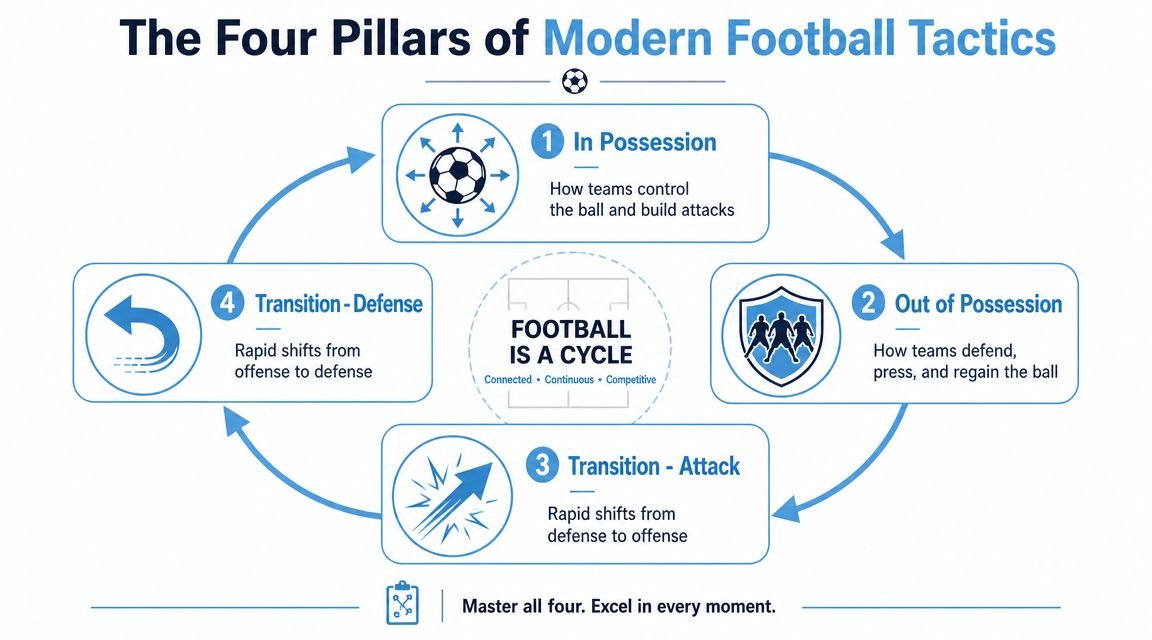
Professional analysts often sort a match into four pillars: in possession, out of possession, transition to attack, and transition to defense. That framework gives order to what can otherwise look like noise. It also helps readers move beyond description. Instead of saying a team "played well," you can ask which phase it controlled, and how.
IN POSSESSION MEANS SHAPING THE OPPONENT
Possession matters because it changes the opponent's shape. A pass is useful when it pulls a midfielder out of line, pins a full-back, or opens the lane into a forward between the lines. The ball is the tool. The primary target is the defense.
That is why two spells of 60 percent possession can mean different things. One side may circulate the ball across the back line without shifting the block. Another may use the same number of passes to drag the press to one side, then attack the weak side with speed. The surface stat is the same. The tactical effect is not.
Recent Premier League trends point in that direction. Analysts have noted a league-wide shift toward faster, more direct use of the ball in early build-up, even among sides that still value control. For the viewer, the simplest clue comes right after a goalkeeper restart. Watch the first two passes. Short circulation often aims to attract pressure and open central space. An earlier long ball often aims to skip the first pressing line and contest the second.
OUT OF POSSESSION MEANS DIRECTING PLAY
Defending starts with steering the opponent.
A compact block works like a funnel. It leaves one route open, closes another, and tries to guide possession toward the zone the defending team has prepared to trap. That is why pressing is about more than effort. It is an exercise in direction, timing, and cover.
Watch the first presser closely. If the run curves to block the inside pass, the team is usually trying to force play wide. If the press starts only after a backward pass or a poor first touch, the trigger is coordinated rather than constant. Those details show the defensive plan far better than tackle counts do.
This is one of the habits that separates active interpreters from passive viewers. You stop asking, "Why aren't they pressing?" and start asking, "Which pass are they inviting?"
TRANSITIONS SHOW HOW STABLE A TEAM REALLY IS
The seconds after possession changes are often the clearest test of structure. Teams attack against disorder or defend while disorganized. That is why transitions reveal risk better than possession totals do.
A side can dominate the ball and still look vulnerable if its rest defense is weak. Rest defense means the positions left behind the attack to deal with a turnover, usually the covering defenders and midfielders who protect the center and control the first counter. If those players are too flat, too wide, or too far from the ball, one lost pass can turn control into panic.
The same principle applies in the other direction. A team that regains possession may have only two or three seconds before the opponent rebuilds its block. Analysts look for the first forward run, the support angle under the ball, and whether the pass goes into space or into feet. Those choices tell you if the team is coached to counter quickly or secure the ball first.
SET-PIECES ARE PART OF THE TACTICAL PICTURE
Set-pieces deserve a place inside this framework because they are rehearsed solutions to organized defenses.
In the Premier League, non-penalty set-pieces accounted for 25% of goals after Matchday 5 in 2025/26, according to the league's own analysis of four tactical trends redefining the Premier League. The same analysis noted that long throws rose from 0.89 per game in 2020/21 to 3.03 per game in 2025/26.
Those numbers matter because they reflect coaching intent. A long throw, a near-post screen, or a blocker freeing the far-post runner is not a break from tactics. It is tactics in concentrated form. Every player has a role, every movement is timed, and the defense is forced to solve a problem in a crowded area with little time.
A strong tactical read starts with one question in every phase: what problem is this team trying to solve?
A simple match-viewing checklist helps:
| Game State | What To Watch | Why It Matters |
|---|---|---|
| In possession | First pass, spacing, width | Reveals the build-up plan |
| Out of possession | Pressing trigger, line height, cover shadows | Reveals defensive intent |
| Transition to attack | Forward runs, support angles | Shows how the team exploits disorder |
| Transition to defense | Counter-press or retreat | Shows risk management |
READING THE GAME FORMATIONS AND STRUCTURES
Most fans learn football through formation labels. 4-3-3. 4-2-3-1. 3-4-2-1. Those labels are useful, but only as a starting point. They describe where players begin, not what the team really becomes once the match starts.
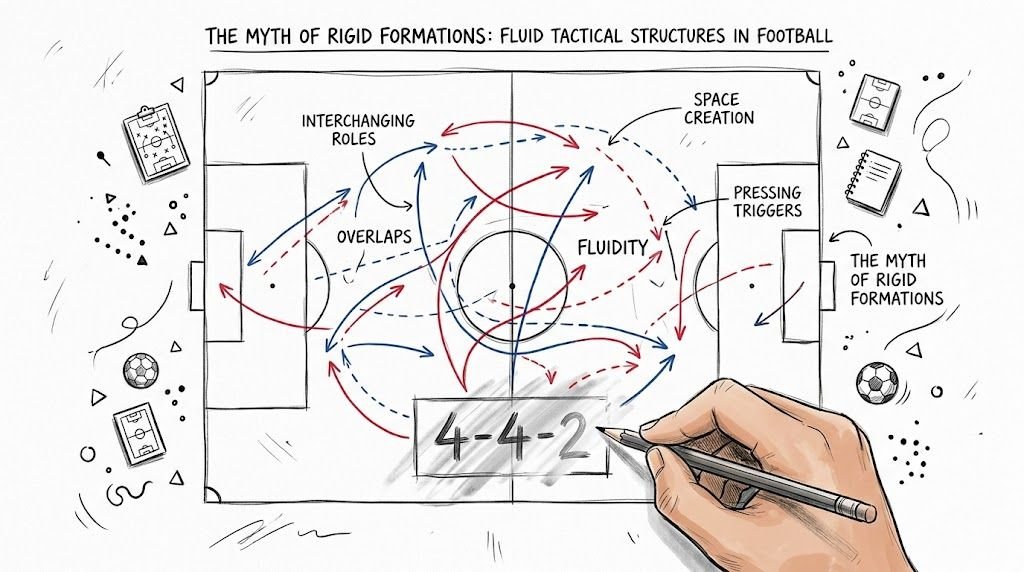
FORMATIONS ARE THE TEAM SHEET VERSION
A formation is like an architectural blueprint. It gives the outline. The building only makes sense once walls, doors, and movement patterns are added. Football works the same way. Two teams can both be listed as 4-3-3 and look nothing alike.
One may build with a full-back stepping into midfield, turning the shape into a box in the centre. Another may keep both full-backs wide and ask the wingers to move inside. On paper, both remain 4-3-3. In practice, one attacks with central density and the other with touchline width.
This is why shape must be read in at least three versions:
- Base shape: the starting formation on the team sheet
- In-possession shape: where players move when building and attacking
- Defensive shape: where they settle once the opponent has control
Anyone studying common systems can compare those differences through breakdowns of shapes like the 4-2-3-1 formation in modern football. The label matters less than the relationships inside it.
ROLES CHANGE THE MEANING OF THE SHAPE
A role can rewrite a formation. A false nine drops away from the centre-backs and invites midfield runners beyond. A target man pins defenders and gives the team a direct outlet. An inverted full-back leaves the flank to create an extra midfielder. The shape on the board stays similar, but the actual game changes.
That's where many readers get stuck with terms like half-space. The half-space is the channel between the central lane and the wing. Coaches love it because players receiving there can pass, shoot, or dribble without being trapped against the touchline. When a winger comes inside or a midfielder drifts out, they're often trying to occupy that zone.
A formation isn't a picture. It's a set of movement instructions.
The easiest way to see fluid structure is to stop following the ball and start following one role for five minutes. Watch only the right-back. Then only the striker. Then only the deepest midfielder. The team's logic appears much faster that way.
Video helps because repeated frames make shape changes obvious. This breakdown format is especially useful for learning how positions morph across phases:
Three common structural cues deserve attention:
- Inverted full-backs: They step inside to support build-up and protect central transitions.
- Wide wingers with interior midfielders: They stretch the back line while others attack pockets inside.
- Split centre-backs with a dropping pivot: They widen the first line to escape pressure.
Once formations are treated as living structures rather than fixed numbers, the game becomes much easier to decode.
FRAMEWORKS AND METRICS FOR MODERN ANALYSIS
The eye catches patterns. Metrics test whether those patterns hold up. Good analysis uses both. Numbers don't replace tactical understanding, but they can confirm, challenge, or sharpen what the match seemed to show.
METRICS SHOULD ANSWER A TACTICAL QUESTION
A common mistake is collecting data before deciding what problem needs solving. That produces lists, not insight. A stronger method starts with a football question.
If a team looked dangerous without creating clear shots, expected goals, usually shortened to xG, helps evaluate chance quality rather than raw shot count. If a creator seemed influential without piling up assists, expected assists, or xA, can reflect the quality of passes that led to shots. If one side appeared to pin the opponent back for long periods, a territorial measure such as field tilt can help explain that pressure.
These metrics work best when tied to visible moments:
- xG: How dangerous were the shots that were taken?
- xA: Did the final pass create a strong shooting situation?
- Field tilt: Which team kept play in the attacking end more often?
- Pass map: Which connections drove possession forward?
None of those numbers should be read in isolation. A side can record healthy territorial pressure and still struggle if attacks remain predictable. Another can post modest possession numbers but create the better openings by attacking disorganized moments.
PPDA GIVES PRESSING A NUMBER
One of the most useful tools in premier league tactical analysis is PPDA, or passes per defensive action. The idea is simple. It estimates how many passes a team allows before making a defensive action. Lower values usually indicate a more aggressive press.
A clear example comes from the pressing comparison highlighted in SportbotAI's guide to analyzing Premier League matches. Liverpool posted an 8.3 PPDA in 2023/24, while Burnley recorded 15.2. That gap reflects two different defensive ecosystems. Liverpool pressed earlier and more aggressively. Burnley allowed more circulation before engaging.
That number becomes much more useful when paired with location. A low PPDA matters most if the ball is being won in zones where the team can attack immediately. A high press that forces play backward is helpful. A high press that wins the ball near the box is even more dangerous.
Analyst's note: PPDA describes pressure volume. It doesn't fully explain pressing quality unless turnover location is added.
NUMBERS NEED VIDEO AND CONTEXT
Metrics can mislead when detached from role and game plan. A team protecting a lead may accept a higher PPDA because it wants compactness, not chaos. A side facing elite pressure may go longer by design and finish with fewer passes, even if its underlying control was still strong.
That's why analysts usually work in layers:
- Watch the match once for flow
- Rewatch key phases
- Check the data for support or contradiction
- Return to the clips with a sharper question
A quick reference table helps keep the toolkit honest:
| Metric | Best Use | Main Limitation |
|---|---|---|
| xG | Evaluating shot quality | Doesn't explain build-up |
| xA | Evaluating chance creation | Depends on the shooter taking the shot |
| PPDA | Estimating pressing intensity | Needs turnover context |
| Field tilt | Measuring territorial control | Can flatter sterile possession |
The smartest use of data is modest and precise. It should answer a football question that the eye already raised.
DATA SOURCES AND VISUALIZATION METHODS
Tactical analysis becomes practical once the viewer knows where evidence comes from and how to display it clearly. Raw event logs, tracking feeds, and video clips all matter. The core skill lies in turning them into a readable picture.
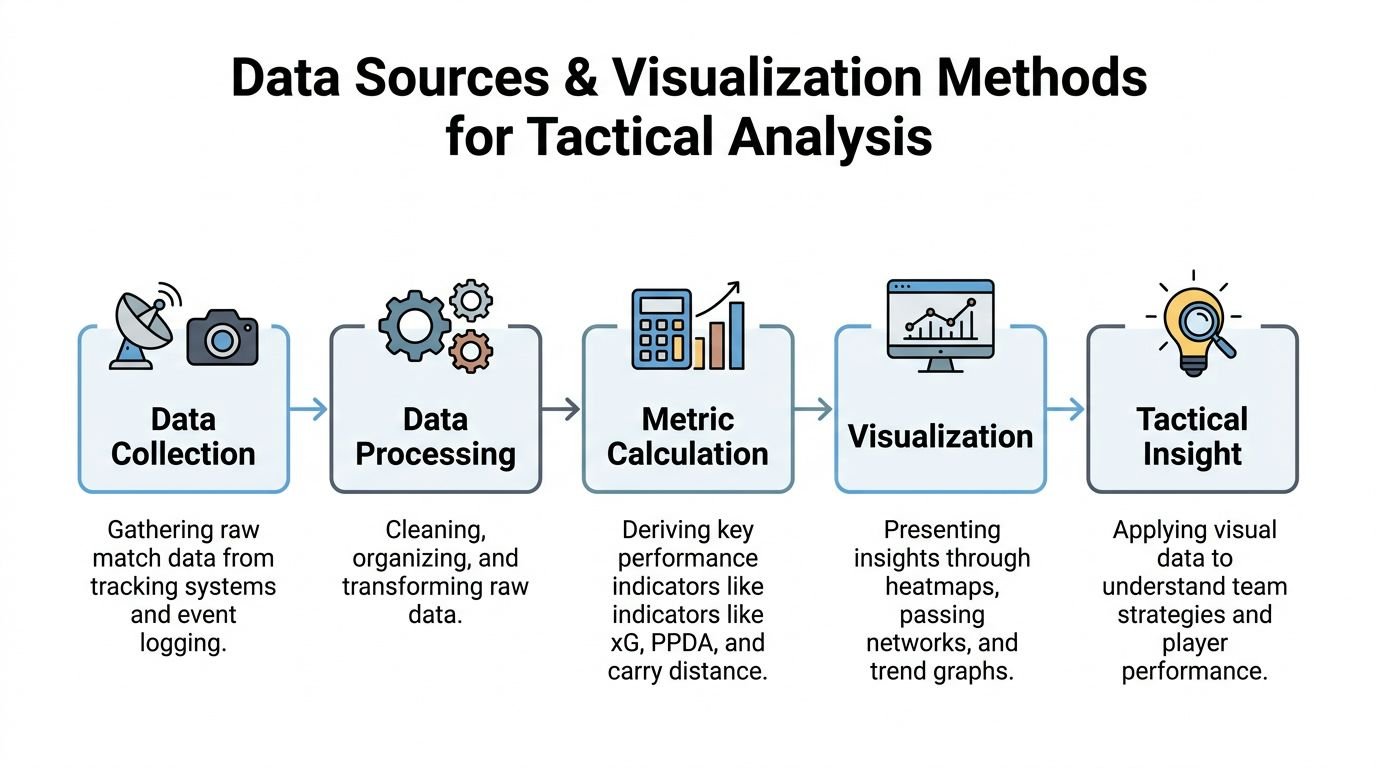
WHERE TACTICAL DATA COMES FROM
Public-facing sites often provide enough material for a good independent review. Analysts also work with professional platforms such as Wyscout and StatsBomb, which combine video with rich event data. Some projects rely more heavily on tracking information, especially when studying spacing, speed of movement, or team compactness.
The important point isn't owning the most expensive tool. It's understanding what each source can and can't show. Event data is excellent for passes, shots, carries, pressures, and set-piece patterns. Video is still essential for body shape, timing, communication, and off-ball occupation of space.
A reader looking for organized reference points can use curated football analysis hubs such as this collection of tactical and analytical resources. A resource page helps shorten the gap between curiosity and actual study.
HOW TO READ COMMON VISUALS
Visuals work because football is spatial. A pass map can reveal who a team trusts in build-up. A heat map can show where a midfielder lived, rather than where the lineup graphic placed him. A shot chart can expose whether territory turned into real threat.
The best graphics are simple. They answer one question well. Anyone trying to improve presentation can learn from broader principles of effective data visualization, especially the idea that design should reduce friction rather than impress for its own sake.
Three visuals appear again and again in premier league tactical analysis:
- Pass maps: Useful for spotting build-up routes, overloaded zones, and isolated players.
- Heat maps: Useful for understanding role interpretation and territorial occupation.
- Shot charts: Useful for separating volume from genuine chance quality.
Clean visuals don't create insight by themselves. They make it easier to see a pattern that coaching logic already explains.
A good working method looks like this:
| Visual | Best Question |
|---|---|
| Pass map | How did the team progress the ball? |
| Heat map | Where did this player or team actually operate? |
| Shot chart | Were chances central, wide, close, or speculative? |
| Set-piece map | Which routines targeted which zones? |
When visuals are chosen carefully, they stop being decoration and start acting like evidence.
A STEP-BY-STEP TACTICAL CASE STUDY MANCHESTER CITY
How do you watch Manchester City without getting lost in the blur of passes?
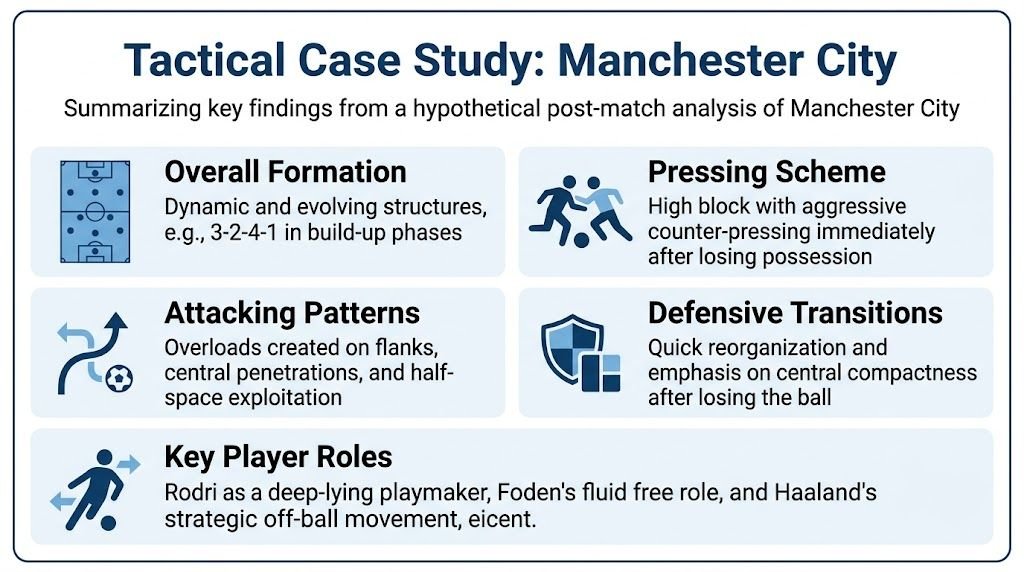
A useful case study starts with a method. City are such a strong teaching example because their matches expose the main problems an analyst must solve: how a team builds under pressure, how it protects itself while attacking, and how small structural tweaks change the rhythm of a game. If you can read City clearly, you can read much of the modern Premier League more clearly too.
START WITH THE MATCH STORY
Begin with the opponent, not with the team in blue.
That sounds simple, but many readers skip it. They see City dominate the ball and assume the tactical story starts there. It usually starts with the resistance. Against City, opponents often crowd central lanes, block easy passes into midfield, and wait for moments when City have committed enough players forward to leave space behind the ball. So the first question is not "What shape did City use?" It is "What problem were they trying to solve?"
Then ask a second question. Did City try to calm the game through short circulation, or did they change tempo to beat the press before it could settle? Earlier in the article, we noted that City shifted between shorter and more direct possession patterns across the season. That matters because it tells you not to treat them as a team with only one answer. Their structure may look stable, but their tempo often is not.
From there, watch the first phase of build-up like a coach studying an exit route from a crowded room. Does the goalkeeper split the centre-backs? Does a full-back step inside to add one more passing angle in midfield? Does the holding midfielder drop into the back line, or stay higher to receive behind the first press? Those details show where City expect the free man to appear.
THEN TEST THE STORY AGAINST THE PHASES
Once you have the opening problem, test it across the rest of the match.
In possession, City usually try to create one spare player near the ball, draw pressure toward that zone, then find the next receiver facing forward. On the pitch, this can look patient, almost repetitive. The point is not sterile possession. The point is to move the opponent one line at a time until a gap opens. If City go longer earlier than expected, that can still fit the same logic. A clipped pass into a striker or winger is often just a faster way to reach the next zone when the short route is blocked.
Out of possession, look at the direction of the press. City often press like a team herding play toward a wall rather than chasing the ball at random. The front line may block the return pass, screen the central option, and force the opponent toward the touchline. If the trap works, the regain looks easy. If you only watch the final tackle, you miss the work that made it possible.
In defensive transition, focus on the seconds after possession is lost. Many casual readings of a match often become vague at this stage. If City lose the ball high, the nearest players usually react first, either to win it back at once or to slow the counter long enough for the structure behind them to reset. The central corridor becomes the emergency area. If that space is exposed, the counterattack can reach the back line too cleanly.
A simple working grid helps keep those observations disciplined:
- Build-up clue: Who became the spare man against the first press?
- Progression clue: Which pass broke the line. A central bounce pass, a switch wide, or a direct ball into feet?
- Chance creation clue: Did attacks end with cut-backs, crosses, combinations in the half-space, or shots after second balls?
- Pressing clue: Which pass or body shape triggered City to jump?
- Transition clue: Did the nearest players counter-press, or did they drop to protect central space first?
That grid helps readers move from description to explanation. It also trains the habit professional analysts use most often. They do not collect moments at random. They sort them by function.
FINISH WITH THE COACHING INTERPRETATION
The last step is the one that separates a match report from tactical analysis. Explain why the choice made sense.
If City played more directly for a stretch, the likely reason is not impatience. It is often that the opponent made short circulation costly, so the better option was to reach the next line faster. If wide overloads kept appearing, the flank may have been the access point because central lanes were crowded. If City looked vulnerable after losing the ball, the issue may have been their rest defense. Too few players, or the wrong players, were protecting the centre when possession broke down.
That is how analysts turn visible actions into coaching logic. What happened matters. Why it happened matters more.
Readers who want more club-specific context can add that longer view with this analysis of Guardiola's winning philosophy and elite squad structure. A single match always makes more sense when you can place it inside the team's broader ideas.
A clear City case study usually answers five questions:
| Question | Why It Matters |
|---|---|
| How did City escape pressure? | Shows the build-up solution |
| Where did they create superiority? | Shows the attacking focus |
| How did they react after losing it? | Shows their control of transitions |
| Which spaces did the opponent reach? | Shows the structural weakness |
| What changed the match rhythm? | Shows adaptation |
Watch the pattern. Test the explanation. Then decide whether the interpretation fits the evidence. That is the habit that turns a passive viewer into an active reader of the game.
APPLYING TACTICAL INSIGHTS FOR FANS AND ANALYSTS
Tactical understanding matters because it changes decisions. The same observation can sharpen a fan's debate, improve a coach's planning, and help an analyst explain a match with more precision.
FOR FANS FANTASY PLAYERS AND WRITERS
For supporters, the biggest gain is clarity. Instead of arguing only about effort or individual quality, they can discuss spacing, roles, pressing choices, and matchup problems. A winger might look quiet not because he played poorly, but because his team never isolated the opposing full-back. A striker might touch the ball less because the build-up never reached the right zones.
Fantasy players benefit from system awareness. A midfielder arriving late into the box in a well-structured attack can be more interesting than a bigger name stuck receiving with his back to goal. The same applies to defenders on attacking set-pieces or full-backs in teams that dominate territory.
Writers also gain sharper language. “They wanted it more” tells the reader very little. “They forced play wide, regained second balls, and attacked the channel behind the advanced full-back” tells the reader what took place.
FOR COACHES SCOUTS AND ANALYSTS
For practitioners, tactical analysis supports planning and evaluation. Coaches can study how an opponent reacts when the first press is bypassed. Scouts can look for players whose role execution fits a desired structure. Performance analysts can separate recurring problems from one-off errors.
One especially useful modern question concerns direct play. Reports from 2025/26 noted by Total Football Analysis on direct passing as a response to elite pressing argue that longer progression isn't necessarily primitive or anti-possession. In many cases, it's the rational response to aggressive pressure. That changes how good analysis should judge a long pass. The issue isn't whether the ball went long. The issue is whether it solved the tactical problem.
That perspective helps in betting and opponent study too. If one team's press leaves large spaces behind and the other is comfortable bypassing pressure quickly, the matchup may matter more than average possession share.
Useful application usually starts with three questions:
- What repeated pattern created the result?
- Which player roles made that pattern possible?
- Would the same idea work against a different opponent?
Better tactical reading doesn't make football colder. It makes every decision on the pitch more meaningful.
CONCLUSION FROM SPECTATOR TO STRATEGIST
A Premier League match always contains more than the scoreline. Under the visible drama sits a constant battle over space, timing, and structure. Once those layers come into focus, football becomes easier to read and much harder to oversimplify.
The strongest foundation is simple. Read the game through the four pillars. Treat formations as flexible structures, not fixed labels. Use metrics to test what the eye noticed. Use visuals to make patterns easier to see. Then bring it all together in a case study that explains causes instead of just listing events.
That approach changes how matches are watched. A short goal-kick routine becomes a pressing test. A winger staying wide becomes a space-creating instruction. A direct pass becomes a tactical choice, not a stylistic accident. Even dead-ball situations look different once their strategic weight is understood.
That is the essential value of premier league tactical analysis. It turns passive viewing into active interpretation. It gives intelligent fans a method for seeing what coaches plan, what players adjust, and what opponents try to prevent.
Football doesn't become less enjoyable when it's studied more closely. It becomes richer. Every match offers another chance to spot a pattern earlier, ask a better question, and explain the game with more honesty and more precision.
For readers who want club-specific tactical writing, match breakdowns, and deeper Manchester City context, Manchester City Analysis offers detailed coverage built for supporters, coaches, analysts, and anyone who wants to understand how elite football is being played.