A familiar scene keeps showing up in elite football. The ball cycles across the back line, the opponent jumps to press, and the centre-back doesn't just release a safe sideways pass. He steps forward, carries into midfield, commits a marker, and opens the lane that breaks the press. For many viewers, that moment still feels like a bonus. At the top level, it's become part of the job.
That shift is why the CB position in football needs a more precise reading than the old stereotype allows. The classic image is a rugged defender who heads crosses away, blocks shots, and wins duels. Those actions still matter. But in possession-heavy teams, especially those built around territorial control, the centre-back now helps dictate tempo, manipulate the first line of pressure, and stabilize the entire structure behind the ball.
Manchester City offers the clearest modern case study. When a centre-back such as John Stones moves into midfield zones, the role stops looking like a static defensive post and starts looking like a tactical hinge. The same player may defend central space out of possession, then form part of the midfield box once City has controlled the ball. Anyone trying to understand why certain systems function, or why some defenders thrive in one setup and struggle in another, has to start there.
That's also why formation diagrams can mislead. A back four on paper often behaves very differently once possession is established, as shown in analyses of structures such as the 4-2-3-1 and its shifting build-up patterns. The centre-back role sits at the heart of those transformations. It protects the goal, yes. It also organizes space, supports progression, and increasingly decides whether a team can control the match rather than merely survive it.
Table of Contents
- INTRODUCTION
- THE EVOLUTION OF THE CENTRE-BACK
- CORE RESPONSIBILITIES OF THE MODERN CENTRE-BACK
- A SPECTRUM OF ROLES KEY CENTRE-BACK VARIANTS
- THE GUARDIOLA BLUEPRINT CENTRE-BACKS AT MANCHESTER CITY
- ANALYZING PERFORMANCE METRICS AND VISUALS THAT MATTER
- CONCLUSION COACHING DRILLS AND KEY TAKEAWAYS
INTRODUCTION
The modern centre-back is judged on actions that older coaching language barely discussed. Defensive quality still starts with protecting the penalty area, controlling the striker, and managing the space between full-back and centre-back. But the role has widened because the game has widened. Teams press higher, build shorter, and attack with more fluid rotations, so central defenders are forced to solve more than one problem per phase.
A useful contrast comes from another code of football. In gridiron, the cornerback is one of the most specialized roles on the field, with responsibility for pass coverage, route recognition, gaining a positional advantage, and reacting to both quarterback and receiver while still supporting against the run, as outlined in this explanation of the cornerback's tactical role in American football. Association football's centre-back has moved in the opposite direction. Rather than becoming more isolated, the role has become more hybrid.
That hybrid nature explains why elite teams value defenders who can protect depth and start attacks from the same touch. Coaches' Voice notes that a modern centre-back is no longer just a pure stopper. Elite teams expect defensive security and meaningful in-possession contribution, with the player stepping in, breaking lines, and supporting the structure underneath the ball through modern centre-back positioning and build-up actions.
The centre-back now influences where the next pass goes, where the midfield receives, and how much risk the team can absorb behind the ball.
That changes how the position should be watched. A clean tackle is obvious. A centre-back's body shape before receiving, his timing when stepping in, or his choice to hold rather than chase often tells far more about his level. Those details separate a defender who survives the game from one who controls it.
THE EVOLUTION OF THE CENTRE-BACK
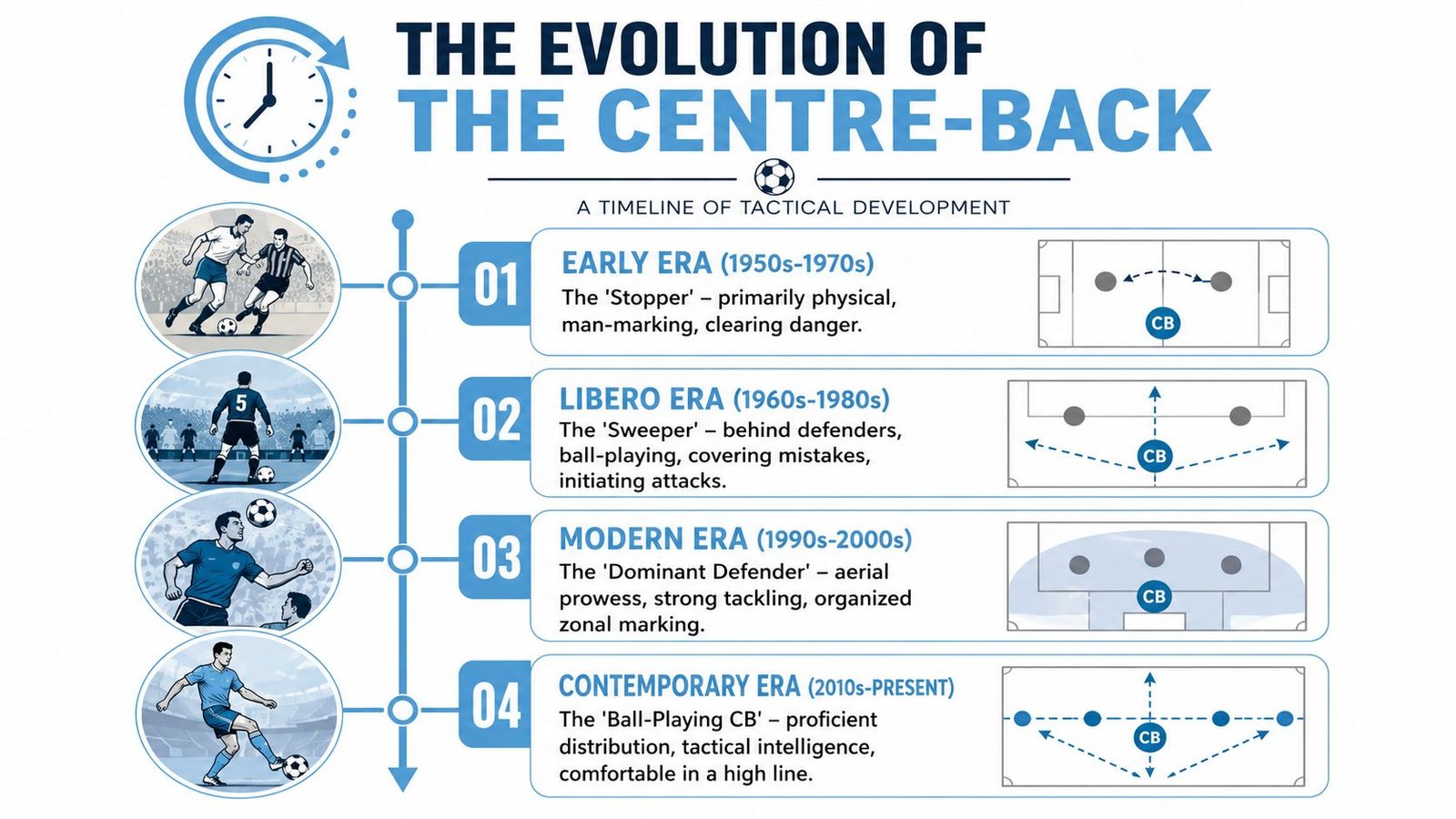
The centre-back role didn't become complex by accident. Every major change answered a tactical problem. When attackers roamed more freely, defenders needed clearer assignments. When teams began building with more control, the defender nearest the ball had to offer more than clearances.
The Stopper And The Cover Defender
Early centre-back play leaned heavily on direct confrontation. One defender attacked the striker, often tightly and physically, while the rest of the line dealt with second balls and recovery runs. The emphasis sat on duel-winning and danger removal. If the ball went forward, the defender met it. If the striker checked short, the defender followed.
The major tactical turn came with the stopper and sweeper distinction. The analysis of Inter Milan's catenaccio period identifies Helenio Herrera's use of specialized man-marking and covering roles as a key evolutionary step in central defence. Instead of a flat unit doing the same job, one player could engage while another protected the space behind.
That solved two issues. First, it reduced the cost of a lost duel because cover existed. Second, it gave one defender a broader reading role, which laid the groundwork for the libero.
From Sweeper To Ball-Playing Defender
The sweeper changed the intellectual demands of the position. Rather than merely marking, the player interpreted danger before it fully formed. He covered depth, collected loose possession, and could start attacks after regains. That was a structural shift, not just a stylistic one.
Practical rule: Every major evolution of the centre-back role has followed the same pattern. The defender gains new freedom only when the team trusts his reading of space.
Modern football kept that logic but removed some of the old man-marking rigidity. Zonal defending, compact block management, and controlled possession made the centre-back less of a pure chaser and more of a reference point for the whole team. In many top sides, the role became central to circulation, not just resistance.
Three broad eras stand out:
- Early central defending: physical engagement, direct marking, quick clearances.
- Libero influence: spare man coverage, anticipatory defending, cleaner first pass after recovery.
- Contemporary central defending: line control, press resistance, progression into midfield, and comfort in a high defensive line.
The modern game didn't erase the old requirements. It stacked new ones on top. The best centre-backs still defend first. They just can't stop there.
CORE RESPONSIBILITIES OF THE MODERN CENTRE-BACK
A centre-back in a top side can defend three different moments inside the same sequence. He may hold the line against a striker checking short, protect the box when the ball goes wide, then receive under pressure to start the next attack. That workload explains why the position is harder to assess now than a textbook job description suggests.
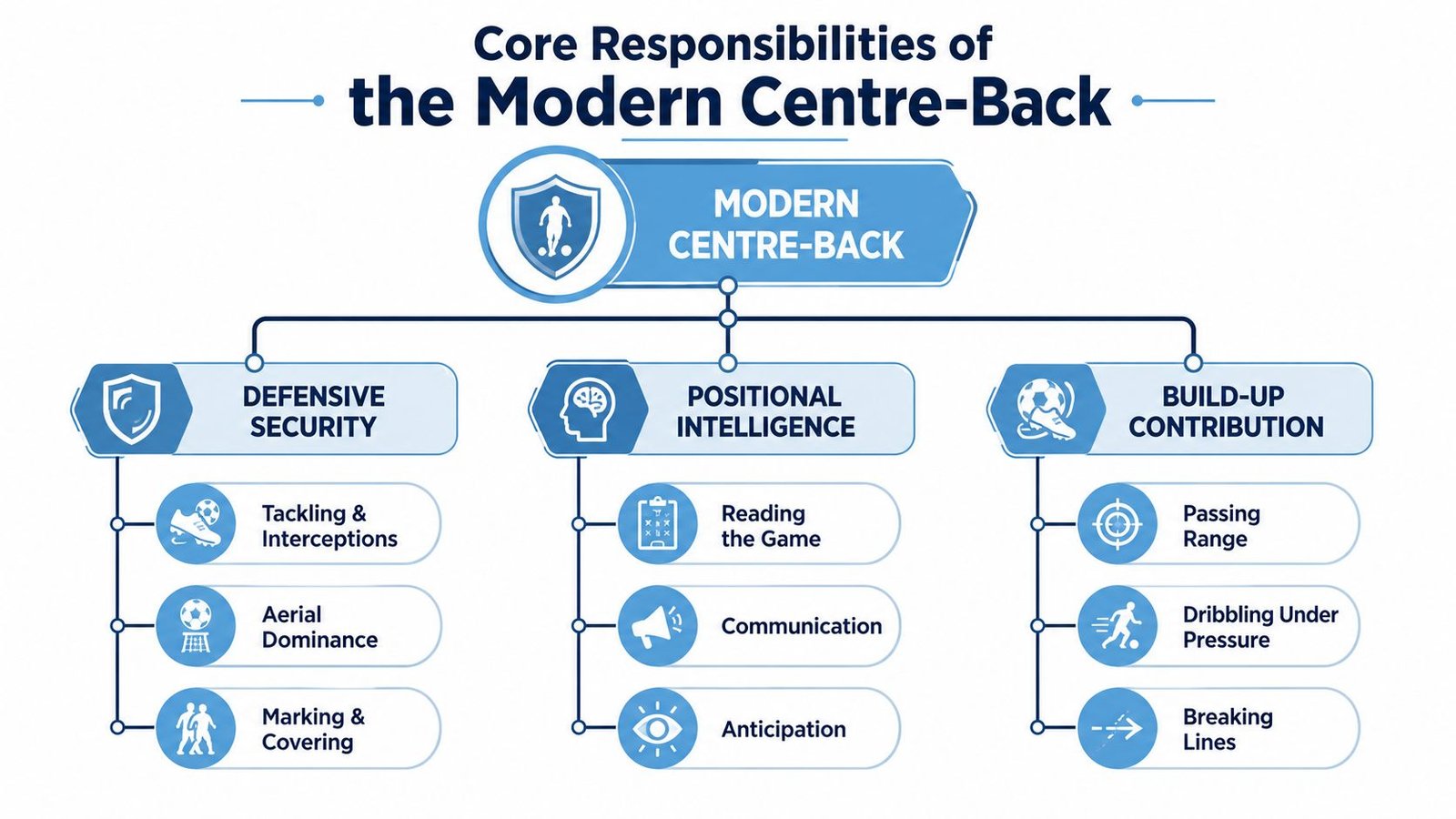
Three responsibilities sit at the center of the role. The defender must protect goal-side space, coordinate the structure around him, and help the team progress possession in a way that changes the opponent's shape. Manchester City offer a clear case study here. Their centre-backs are judged less by tackle counts than by whether the team can stay compact, circulate cleanly, and defend transition space after losing the ball.
Defensive Security
Everything starts with control of the penalty-area corridor. If the centre-back cannot defend the space between ball and goal, the rest of his skill set has limited value.
That job involves more than winning duels. The main question is whether the defender chooses the right duel, in the right zone, at the right moment. Ruben Dias is a useful example. His defending often looks simple because he closes the forward only when the structure behind him is stable. If cover is set, he can step in. If the midfield line has been stretched, he delays and protects depth.
Coaching staffs usually assess a few repeatable actions here:
- Body shape in 1v1 defending: staying half-turned to show the attacker away from the central lane
- First contact timing: disrupting the striker before the turn, without opening a path behind
- Aerial positioning: arriving early under the ball instead of contesting from a flat-footed start
- Recovery runs: protecting the center first, then adjusting to the ball if support arrives
The common thread is economy. Top centre-backs reduce the number of last-ditch actions because their spacing and timing prevent the emergency from developing.
Positional Intelligence
The position is still defined by tackles in public analysis, but matches are often decided by the movements that remove the need for a tackle. A centre-back manages reference points constantly: the ball, the striker, the nearest runner, the full-back's height, and the distance to his partner.
That is where elite defenders separate themselves.
A strong positional centre-back reads which attacking movement carries real danger. If a number 10 drifts wide to pull attention, the defender does not follow on instinct and empty the middle. He passes the movement on if the structure allows it, keeps access to the central channel, and protects the space the opponent wants to attack next, not the space they have only visited.
Good centre-backs defend the next pass as much as the current ball.
This matters even more against rotational teams. City face this problem often in training and in matches against possession-heavy opponents. When a forward drops and a midfielder runs beyond, the centre-back cannot react to both with the same intensity. He must identify the higher-value threat early, communicate it, and keep the back line connected. One defender stepping out at the wrong moment can turn a controlled high line into a footrace toward goal.
Build-Up Contribution
Possession has changed the role in a practical way. The centre-back is no longer just the player who restarts attacks after danger has passed. In elite teams, he helps create the opening before the attack has formed.
The value of that contribution is tactical, not cosmetic. A forward pass matters when it dislocates the press. A carry matters when it forces a midfielder to leave his line. John Stones has shown this clearly for Manchester City. When opponents refuse to jump to him, his carry into midfield changes the problem for the block. If a midfielder steps out, space opens behind him. If nobody engages, City gain territory and improve their next passing angle.
Three habits tend to separate high-level centre-backs in possession:
Receiving on the correct angle
An open body shape keeps the return pass, the switch, and the vertical lane available. A square reception narrows the field before pressure even arrives.Carrying with a purpose
The carry should provoke a defensive decision. If it does not force pressure or improve the angle into midfield, it is only safe movement.Passing through pressure
Recycling the ball has value, but the best centre-backs can find the pass that removes one or two defenders from the play.
A useful coaching checklist is straightforward:
- Before receiving: scan the first presser and the next line behind him
- On the first touch: protect access to the forward option
- On the next action: either fix the presser with a carry or release the free player beyond him
- After the pass: hold a support angle for the reset and prepare for transition if possession is lost
That is the modern brief. The centre-back still defends the box first, but the elite version of the role is broader and more fluid. He protects space, directs teammates, and starts advantages that show up two passes later.
A SPECTRUM OF ROLES KEY CENTRE-BACK VARIANTS
The position carries one title but several distinct job descriptions. Two centre-backs may both start in the same back four and still solve completely different tactical problems. One attacks the striker. One protects the space behind. One starts possession. One secures the box after the ball has already bypassed midfield.
That's why player evaluation often goes wrong. A defender can look elite in one role and merely serviceable in another. Team context decides which strengths matter most.
Comparison Of Centre-Back Role Variants
| Role Variant | Primary Function | Key Attributes | Classic Example |
|---|---|---|---|
| Stopper | Engage the striker early, win duels, disrupt direct attacks | Physicality, timing in contact, aggression, aerial command | Traditional man-marking centre-back |
| Ball-Playing Defender | Start attacks, break lines with passing, carry into open space | Composure, passing range, receiving angle, press resistance | Modern possession-side central defender |
| Sweeper | Cover behind the line, read danger, collect second balls, organize recovery | Anticipation, spatial reading, communication, mobility across depth | Libero-type cover defender |
The stopper is still useful against direct teams or strikers who want constant contact. This player steps in, contests early, and tries to prevent the forward from setting cleanly. In a low or mid block, that role can stabilize the whole defence because it stops the opponent from establishing territory in the central lane.
The ball-playing defender matters most when the opponent presses with intent. He doesn't just circulate. He manipulates. If the first line jumps to close the full-back, he can carry inside. If the midfield line narrows, he can split it with a pass. For a current City-focused example, a profile such as Joško Gvardiol's blend of defensive and progression traits shows why the role is so attractive in possession-dominant systems.
The sweeper survives in modified form even when teams don't use an old-school libero. Any centre-back who drops to protect the line while his partner engages is performing a covering function. The label has changed more than the underlying logic.
The key question isn't which variant is best. It's which variant solves the match in front of the team.
A balanced pairing often includes role asymmetry. One defender attacks the problem. The other secures the consequences. Coaches rarely need two players making the same read at the same time. They need complementary decisions.
THE GUARDIOLA BLUEPRINT CENTRE-BACKS AT MANCHESTER CITY
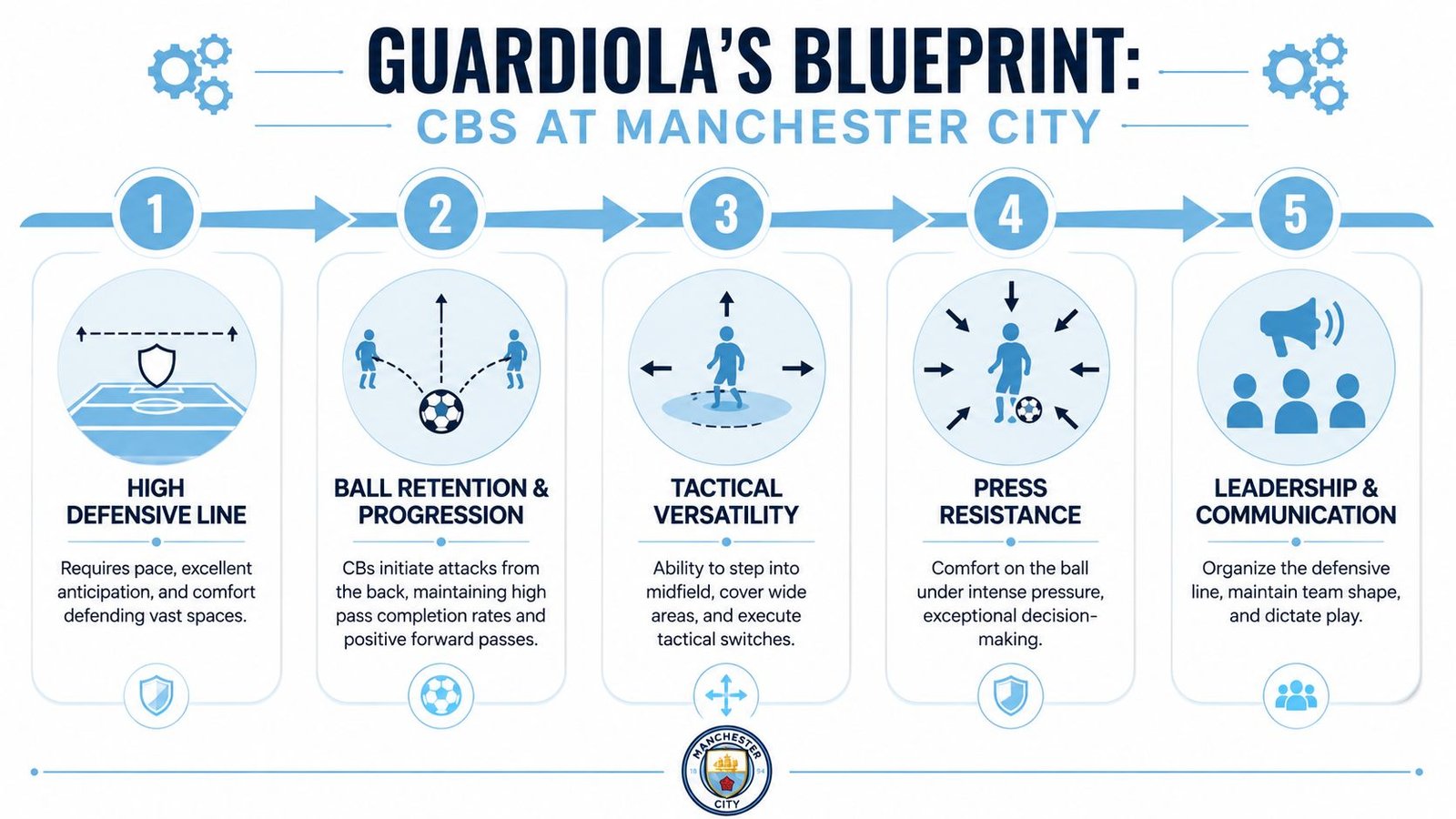
Manchester City's centre-backs operate inside one of the most demanding positional systems in the game. The job starts with the usual central defensive tasks, but Guardiola's structure asks for much more. The centre-back must help maintain a high line, support possession under pressure, and often shift into a different zone entirely once City has established control.
Why The Role Changes At City
The defining feature is functional fluidity. A City centre-back can begin the phase as part of the back line and finish it as a midfielder. That movement changes the geometry of the press. If the opposition front line closes the centre-backs and holds midfield shape behind, the defender who steps in creates a new spare man. If the midfield jumps to him, space opens behind that jump.
John Stones became so significant. During City's treble-winning 2022-23 season, FBref's Manchester City squad data shows that Stones completed more progressive carries per 90 minutes than many elite midfielders. That isn't a novelty stat. It captures a tactical transformation. City used a nominal centre-back to alter midfield numbers without sacrificing rest defence.
A detailed player view appears in this John Stones tactical and statistical analysis, which helps explain why Guardiola trusted him with that hybrid role. The key wasn't only technical quality. It was decision quality. Stones stepped in at the right moments, not all moments.
A short visual breakdown helps clarify the pattern:
Partnership Logic And Structural Trade-Offs
No centre-back performs this role alone. The freedom of one defender depends on the discipline of the others. When one City centre-back advances, the remaining defenders must hold stable distances, protect central transitions, and be ready to defend wide channels if possession turns over.
That's why partnership logic matters. A more aggressive ball-carrier often benefits from a partner whose first instinct is line security. The conservative defender doesn't become less important in a possession team. He becomes the platform that allows the adventurous action to happen.
Three recurring demands define the Guardiola blueprint:
- High-line defending: the centre-back must judge depth quickly because space behind is large and exposed.
- Press resistance: receiving under pressure can't trigger panic touches or rushed clearances.
- Zone switching: the player may defend centrally, then build from a wider lane, then appear in midfield during the same sequence.
A City centre-back has to process the game like a midfielder while defending it like a centre-back.
This is also why simple labels can mislead. Calling Stones a centre-back or midfielder misses the core point. Guardiola used him as a structural adapter. His starting position mattered less than the problem he was solving. If the match needed another calm body in midfield, Stones stepped in. If the transition threat increased, he could reset the back line and restore defensive balance.
The lesson for coaches is clear. The modern CB position in football isn't just about role expansion. It's about role timing. The defender who moves well but moves at the wrong moment destabilizes the team. The elite one changes zones without changing the team's control.
ANALYZING PERFORMANCE METRICS AND VISUALS THAT MATTER
A centre-back on a low-block team can finish with a strong defensive stat line and still be less useful to an elite possession side than a defender with fewer tackles, blocks, and clearances. Game state shapes the numbers. If a team defends its own box for long stretches, the centre-back gets repeated chances to rack up reactive actions. If a team controls territory, the centre-back's value often appears earlier in the sequence, in the pass that breaks a press, the carry that changes the angle, or the positioning that kills a counter before it starts.
That distinction matters when assessing the modern CB position in football, especially through a Manchester City lens. City's centre-backs are rarely judged only by what they survive. They are judged by how much control they create.
That is why event data and video need to work together. Metrics should narrow the question. Film should test whether the answer holds under pressure.
Which Numbers Help
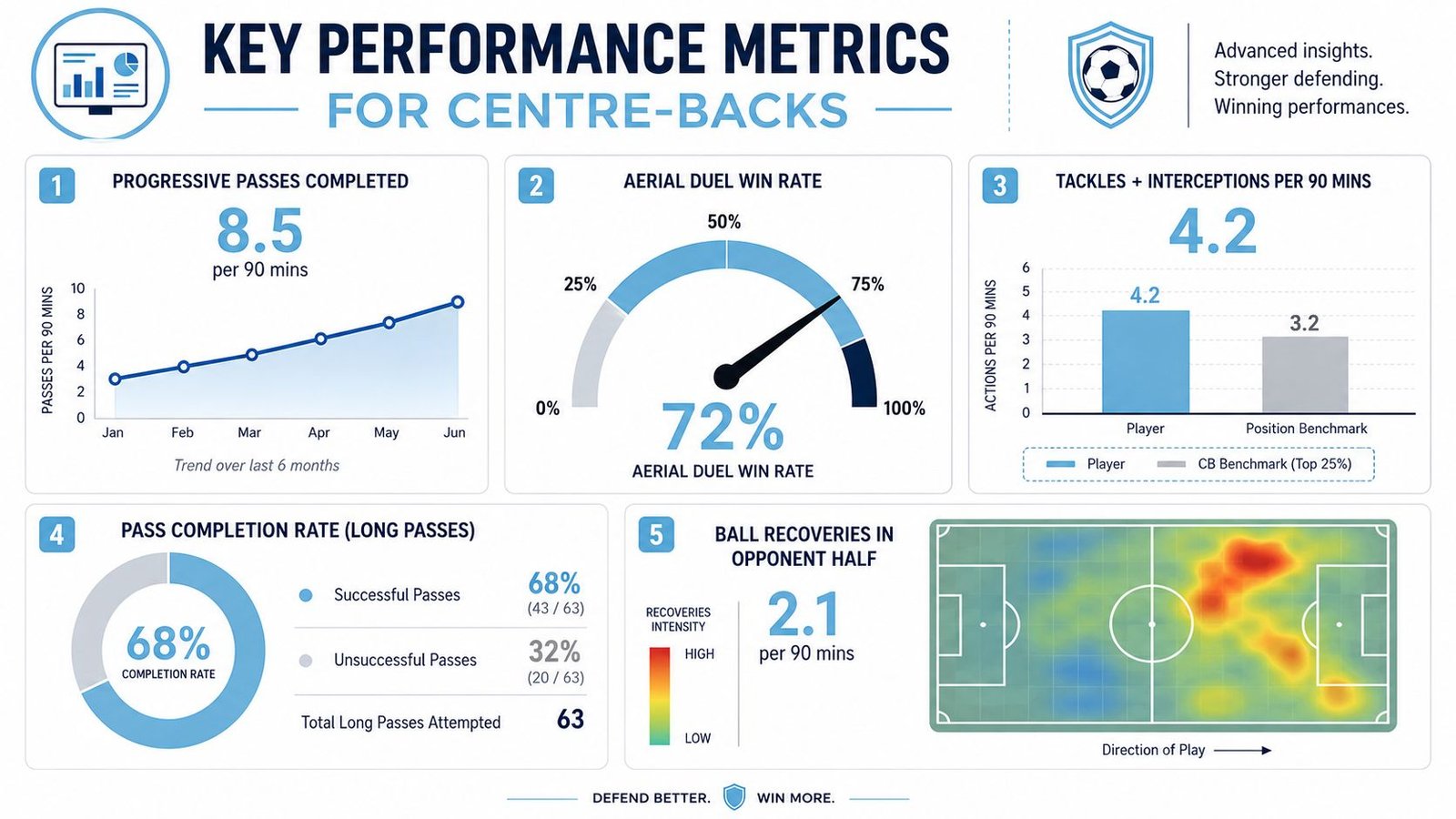
For elite centre-backs, progression metrics usually explain more than raw pass volume. StatsBomb's overview of pass data highlights per-90 measures such as Progressive Passes and Passes into the Final Third as useful ways to separate harmless circulation from possession that changes the opponent's shape in modern passing analysis for centre-backs.
The coaching value is straightforward. A centre-back can complete 70 simple passes and leave the midfield marked out of the game. Another can complete fewer passes but repeatedly find the next line, forcing the opponent's block to turn and recover. Those are not equal possessions.
The most useful categories usually include:
- Progressive passing: shows whether the defender advances possession into zones that strain the opposition structure.
- Passes into the final third: helps identify who can connect beyond the first press and feed the attacking platform.
- Progressive carries: captures defenders who can drive into space when the press protects passing lanes too aggressively.
- Aerial duel profile: matters for teams that must control direct balls, second phases, and rest-defense clearances.
- Turnovers under pressure: gives context on whether the player's distribution survives the type of stress he would face in a high-possession side.
The interpretation matters as much as the category. Progressive passes from an unpressed back three slot do not carry the same weight as a line-breaking ball played with a forward closing the near shoulder. Aerial wins also need context. Winning headers on long, uncontested clearances is different from defending a striker who pins, rolls, and competes for second contact.
A practical scouting process combines data with accessible film sources. Club analysts use proprietary platforms. Public analysts, including our work at Manchester City Analysis, try to translate role-specific footage into tactical language that coaches, journalists, and serious supporters can apply.
What To Watch That Data Misses
Film becomes more useful when the analyst studies the action before the action. The pass itself is often the least informative part of the sequence. The important detail is whether the centre-back created a better picture before receiving.
A strong viewing checklist includes:
Scanning frequency
Does the centre-back check both shoulders early enough to map pressure and the next pass?Body orientation
Can he receive half-open and keep the far-side option available, or does his first touch lock play back toward pressure?Speed of reset decisions
When the vertical lane closes, does he recycle quickly enough to preserve spacing and rhythm?Recovery running line
In transition, does he protect the central lane first, or does he get drawn toward the ball and expose the cutback zone?Communication effect
When he steps or drops, does the rest of the line react with him?
One clip can reveal more than ten completed passes. Watch Ruben Dias when City lose the ball after a full-back has advanced. The key point is not only whether he wins the next duel. It is whether his first recovery steps close the central route, buy time for the midfield to recover, and keep the back line connected. The same applies in possession with John Stones. The pass into midfield matters, but the earlier scan and body shape often determine whether that pass is available at all.
The clearest visual marker is composure under a bad picture. If the press arrives, the options narrow, and the centre-back still exits the moment with balance, he is not just technically clean. He is processing the game at the speed the level demands.
Use the numbers to find the profile. Use the film to test the profile in the moments that decide whether a centre-back can function for a side that wants control rather than survival.
CONCLUSION COACHING DRILLS AND KEY TAKEAWAYS
The centre-back has moved from defensive anchor to tactical fulcrum. The old demands haven't disappeared. The player still has to win duels, protect the box, and manage the line. What's changed is the amount of structure he now controls with the ball, without the ball, and in the split second between the two.
That's the clearest lesson from modern elite football and from Manchester City in particular. A top centre-back doesn't merely end attacks. He shapes the next phase. He decides whether the team exits pressure cleanly, whether midfield receives facing forward, and whether the defensive line can hold aggressive territory without breaking.
For coaches, the training ground should reflect that wider job description:
- Scanning and play-forward rondo: Set a centre-back in the middle build-up line with pressure arriving from one shoulder. Score the exercise only when the defender scans early and finds the forward option after the first or second touch.
- Wide-channel 1v1 recovery drill: Start the defender slightly inside and force him to defend the channel without overcommitting. The coaching point is body shape, delaying technique, and protecting the inside lane.
- Step-in decision game: Build a positional game where the centre-back can carry into midfield only when the opponent leaves the lane free. That trains recognition, not just bravery.
- Cover-and-engage pairing work: Use two centre-backs with alternating instructions. One attacks the striker, the other drops to secure depth. Then reverse the roles so both learn the partnership logic.
A better understanding of the CB position in football starts by dropping the old assumption that defending and playmaking sit in separate boxes. At the top level, the centre-back now does both. The strongest teams are often the ones whose defenders understand exactly when to become more than defenders.
Manchester City supporters, coaches, and analysts looking for more role-specific breakdowns can explore Manchester City Analysis for tactical coverage focused on player functions, team structures, and match-level detail.