
A familiar scene plays out an hour before kickoff. Guardiola labels one player "not ready," another "much better," and a third "we will decide tomorrow." Those phrases look minor. In practice, they often point to changes in City's build-up structure, pressing scheme, and substitution plan.
Manchester City's team news matters because the squad is built around role coverage rather than a fixed best XI. Across their modern title-winning cycle, City have collected multiple Premier League crowns and competed deep into several competitions in the same season. That context changes how official updates should be read. A status line is rarely just medical information. It is often a clue about selection risk, load management, and the tactical priorities for the next match.
The useful question is not merely whether a player is fit. It is what that player allows City to do. If a touchline winger returns, City can stretch a compact block and create clearer isolation patterns. If a holding midfielder is rested, the replacement may change the tempo of circulation, the quality of counterpressure, and the security of rest defence. If a centre-back is missing late, the issue is not only personnel. It can affect which full-back inverts, how City progress through the first phase, and whether they defend transitions with the same aggression.
That is the edge serious readers should look for.
Official team news, coach comments, and training-ground hints become more useful when they are sorted into a framework. Start with availability. Then assess role, matchup, schedule pressure, and likely rotation logic. Read that way, and Manchester City team news stops being a list of names and starts functioning as a forecast of how the game may be played.
Table of Contents
- INTRODUCTION
- DECODING OFFICIAL SOURCES AND SIGNALS
- THE TACTICAL IMPLICATIONS OF PLAYER AVAILABILITY
- PREDICTING THE STARTING XI AND ROTATION PATTERNS
- BEYOND THE INJURY LIST WHAT MOST ANALYSTS MISS
- FREQUENTLY ASKED QUESTIONS ABOUT MAN CITY TEAM NEWS
- HOW RELIABLE ARE EARLY LEAKS
- WHAT IS THE MOST IMPORTANT OFFICIAL SOURCE
- HOW SHOULD A VAGUE COMMENT LIKE HE HAS A NIGGLE BE READ
- WHY DOES MANCHESTER CITY TEAM NEWS MATTER MORE THAN IT DOES FOR MANY OTHER CLUBS
- SHOULD FANTASY AND BETTING AUDIENCES FOCUS ONLY ON WHO STARTS
- WHAT IS THE BEST WAY TO PREDICT ROTATION
- CAN TEAM NEWS REVEAL THE GAME PLAN BEFORE KICKOFF
- CONCLUSION
INTRODUCTION
An hour before kickoff, City release a squad update that looks routine. A midfielder is being assessed, a full-back has returned to training, and one forward is absent. For anyone trying to predict the match, those lines are not administrative detail. They are clues about structure, tempo, and risk.
Manchester City team news matters because Guardiola rarely builds games around fixed names alone. He builds them around functions inside possession and out of it. A missing player can change rest defence, pressing triggers, buildup angles, or the width of the front line without changing the quality of the XI on paper. That is why a simple availability update often carries more tactical information than a headline suggests.
City's success over multiple title-winning seasons has reinforced the same squad logic. Depth matters, but role precision matters more. The team can absorb one absence if another player can reproduce the same job. It becomes harder when the missing player performs a specialist function, such as receiving under pressure in the first phase, attacking the far post from wide, or defending large spaces after turnovers.
That is the framework for reading manchester city team news well. Start with the role, then assess the alternatives, then ask what the coach may protect or attack in the next game. Readers following the latest updates from the Etihad should use each status change as the start of an analysis, not the end of one.
Analyst's rule: Manchester City team news is a pre-match tactical briefing disguised as a squad update.
Read that way, official news stops being a list of names and becomes a method. The aim is not just to know who is available. The aim is to infer how City are likely to play.
DECODING OFFICIAL SOURCES AND SIGNALS
The first edge comes from source discipline. Most confusion around Manchester City team news doesn't come from lack of information. It comes from mixing high-value signals with noise.
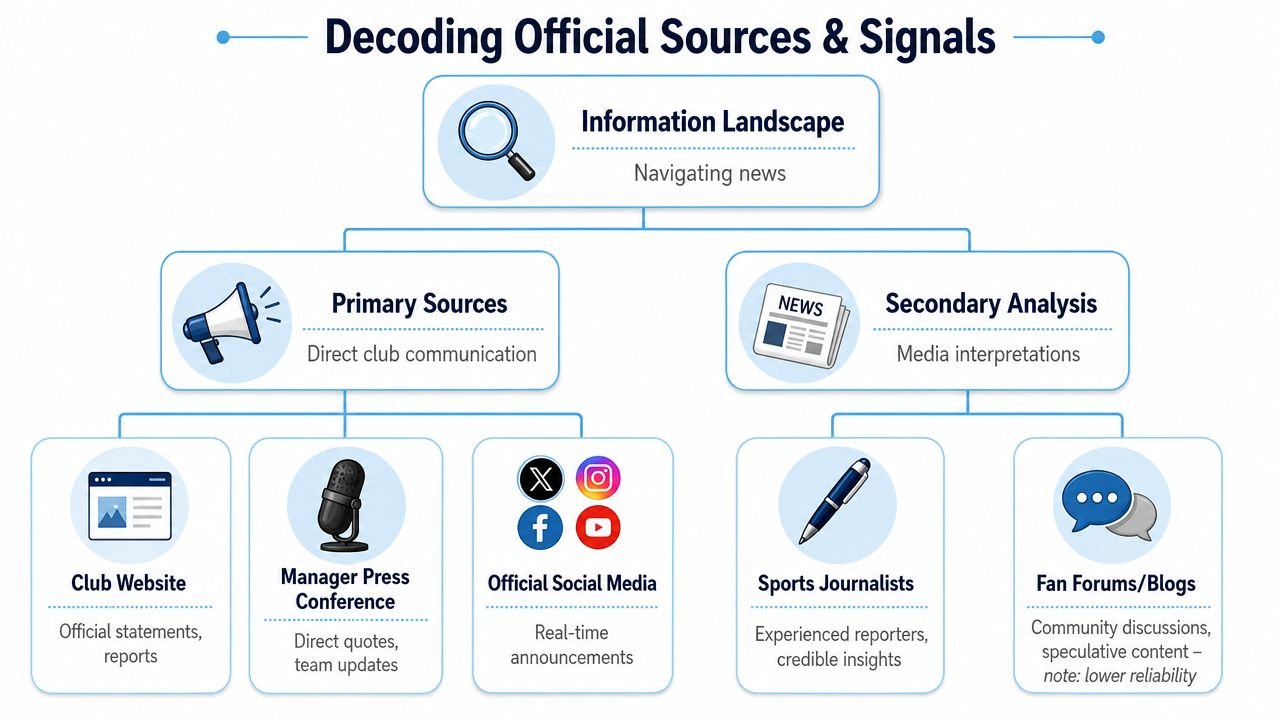
PRIMARY SOURCES CARRY THE EARLIEST USEFUL CLUES
Manchester City's official men's team news feed is the primary source for immediate squad-status signals. Those posts often appear before lineup confirmation and can help separate load management from injury when read alongside press-conference context, as noted on the club's official men's news page. For readers tracking updates day by day, a specialist outlet such as the latest updates from the Etihad can also help organise the flow of match-adjacent reporting.
Three source types matter most:
- Official club posts: These usually provide the cleanest baseline. They won't always disclose everything, but they establish whether a player trained, travelled, or remains under assessment.
- Manager press conferences: These add tone and subtext. Guardiola's phrasing matters because he often distinguishes between readiness to play and readiness to start.
- Official social channels: These are useful for real-time visuals. Training-ground footage can indicate reintegration, though it shouldn't be treated as proof of selection.
For FPL decisions, test those availability signals against actual playing time. Jeremy Doku’s match history and FPL stats show the minutes behind his attacking returns, while Josko Gvardiol’s player profile provides a defender’s season record and upcoming fixtures. Check the date of the data snapshot and pair it with the latest club update: past starts and an FPL availability flag do not confirm the next lineup.
WHAT THE WORDING USUALLY TELLS AN ANALYST
Official language is rarely random. If a player is described as being assessed, managed, or returning to training, each phrase carries a different tactical implication.
A practical reading looks like this:
- Training return: Encouraging for squad inclusion, less reliable for a start.
- Late fitness test: Greater uncertainty around minutes than around outright availability.
- Managed workload: Often points to fixture prioritisation rather than a fresh problem.
- No mention at all: Sometimes the most important signal, especially when a player had been publicly discussed earlier in the week.
Official silence can be informative. Clubs often speak clearly when a player is fully back. Ambiguity usually means the decision remains conditional.
SECONDARY REPORTING IS MOST USEFUL WHEN IT ADDS TACTICAL CONTEXT
Secondary reporting matters when it moves beyond gossip and explains consequence. The strongest coverage doesn't just say a player may miss out. It asks what that does to build-up, defensive coverage, or chance creation. That distinction is what separates useful reporting from transfer-window-style speculation.
For City, the best reading habit is hierarchical. Start with the club. Add Guardiola's words. Then use media analysis only if it sharpens the tactical picture rather than merely extending the rumor cycle.
THE TACTICAL IMPLICATIONS OF PLAYER AVAILABILITY
A Manchester City absence is rarely one-for-one. It is usually one role removed, followed by two or three structural adjustments.
Independent reporting around City becomes actionable when it is tied to role-specific tactical consequences. A single update can materially change expected build-up shape and pressing resistance, which is why late team news should be treated as a tactical input rather than simple trivia, as highlighted in Sky Sports' Manchester City coverage. Readers looking for a role-based view of those shifts can compare that logic with Manchester City's tactical flexibility against West Ham.
WHY ROLE MATTERS MORE THAN NAME
If a wide creator is absent, City may lose isolation threat and dribble pressure on the outside. That changes how they attack low blocks. The issue isn't only reduced one-versus-one quality. It can also narrow the whole attacking shape, pulling play toward central combinations and making defensive blocks easier to compress.
If a central controller is missing, the effect can be more subtle but larger. Build-up may become slower, the spacing between lines may shift, and defensive rest structure may become less secure when attacks break down. In practical terms, one absence can alter both how City create chances and how they protect themselves against transitions.
If a defender drops out late, the consequences depend on profile. Some defenders stabilize the first pass. Others allow a more aggressive line because of recovery speed. Others support inverted movements that free a midfielder higher up. A headline saying “defender unavailable” tells very little until the role is identified.
Working principle: The farther a player's role reaches into multiple phases, the more misleading the injury list becomes.
A PRACTICAL READING TABLE
| Player Role | Primary Tactical Impact | Likely Systemic Adjustment |
|---|---|---|
| Pivot or central controller | Alters first-phase circulation, press resistance, and transition protection | Extra support in build-up, different spacing in midfield, more conservative rest defence |
| Wide creator | Reduces touchline threat and ability to stretch a compact block | More central combinations, full-backs or interiors asked to provide width |
| Center-back | Changes passing angles, defensive line comfort, and recovery structure | Different build-up side preference, altered rest-defence balance |
| Attacking runner or finisher | Affects penalty-box occupation and how City attack the last line | More patient possession, greater crossing reliance, or deeper combinations |
Many match previews stay too shallow. They identify who is unavailable but don't model the chain reaction. For City, that chain reaction is usually the whole story.
PREDICTING THE STARTING XI AND ROTATION PATTERNS
An hour before kickoff, City release the team sheet and one change can alter the whole match plan. A winger replacing an extra midfielder can mean more isolation against a full-back. A more conservative full-back can signal concern about transition defence. Reading team news well means treating selection as a tactical message.
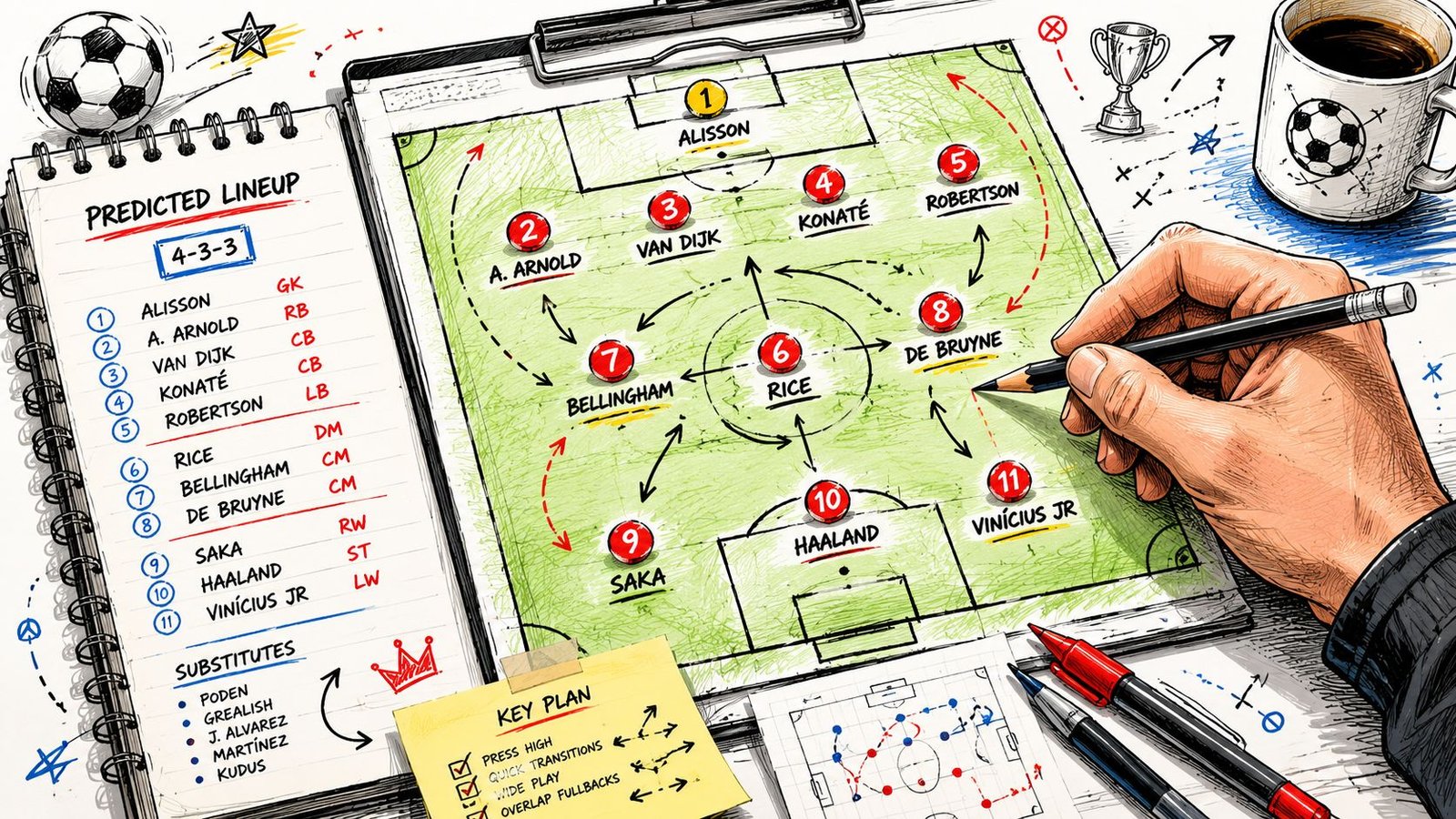
A BETTER PREDICTION MODEL
A reliable forecast starts by asking what problem Guardiola is trying to solve.
The strongest predictions usually combine four inputs rather than one headline status update:
- Official availability signals: Open training appearances, travelling squads, bench returns, and the exact wording used in press conferences
- Opponent demands: Whether the match is likely to require touchline width, extra press resistance, aerial security, or recovery pace
- Role fit: Which profiles can execute the likely plan, not just which names carry the highest status
- Minute management: Whether City need to protect a player physically, restore rhythm after absence, or keep legs fresh across multiple fixtures
That method improves accuracy because Guardiola rarely selects by hierarchy alone. He selects for function. Against a deep block, the priority may be one-v-one threat and penalty-box delivery. Against an aggressive press, the preference may shift toward cleaner first-phase circulation and midfield security. Against a transition side, the trade-off can favour control and rest-defence balance over one more attacker.
The point is practical. Predicted lineups should be built from likely match conditions, then checked against availability news.
HOW TO READ ROTATION PROPERLY
Rotation at City is not random squad churn. It usually falls into three buckets: protection, preparation, or exploitation.
Protection is the easiest to spot. A player returns to the bench before returning to the XI. Minutes come in a controlled sequence, often with the game state reducing physical stress.
Preparation is subtler. A player may start the match before a bigger fixture because the staff want rhythm, not rest. That often applies to positions where timing matters, especially in midfield and the front line.
Exploitation is the tactical layer many previews miss. If the opponent leaves space wide, City can bring in a direct winger. If the opponent presses with two forwards, City may prefer a defender or midfielder who improves the spare-man structure in buildup.
For readers building projections over a longer horizon, how Manchester City might line up next season is a useful companion because it frames selection through role combinations rather than a simple depth chart.
WHAT WIDE-CREATOR AVAILABILITY CHANGES
A natural winger changes more than the position map. He changes the geometry of the attack.
When Jérémy Doku is available, the selection question is not only whether he starts. It is what his presence allows elsewhere. A true dribbler can pin a full-back wider, create longer recovery runs for the opponent, and open cleaner central lanes for Haaland and the advanced midfielders. If he is absent, City may still control territory, but they often need chance creation from different sources, such as underlapping midfield runs, higher full-back positioning, or longer spells of circulation to move the block first.
That is why official team news should be read in combinations. One winger starting can increase the value of a striker. One ball-secure midfielder can make a more aggressive full-back viable. One defensive absence can force the entire right or left side to behave differently.
A video review can sharpen that habit by showing how shape and personnel interact on the pitch:
A SIMPLE FORECASTING CHECKLIST
Before kickoff, a strong City lineup forecast should pass three tests:
- Does the XI solve the opponent's main tactical problem?
- Does the bench make sense if certain players are being reintroduced carefully?
- Do the selected profiles produce a coherent balance of width, control, and defensive cover?
A predicted XI should read like a tactical argument grounded in role fit, not a list of the biggest names.
BEYOND THE INJURY LIST WHAT MOST ANALYSTS MISS
At 1pm, the squad list says a player is available. By 3pm, he is on the bench, replaced after 55 minutes, or used in a role that looks nothing like his usual one. The gap between official availability and actual match function is where team news becomes analysis rather than transcription.
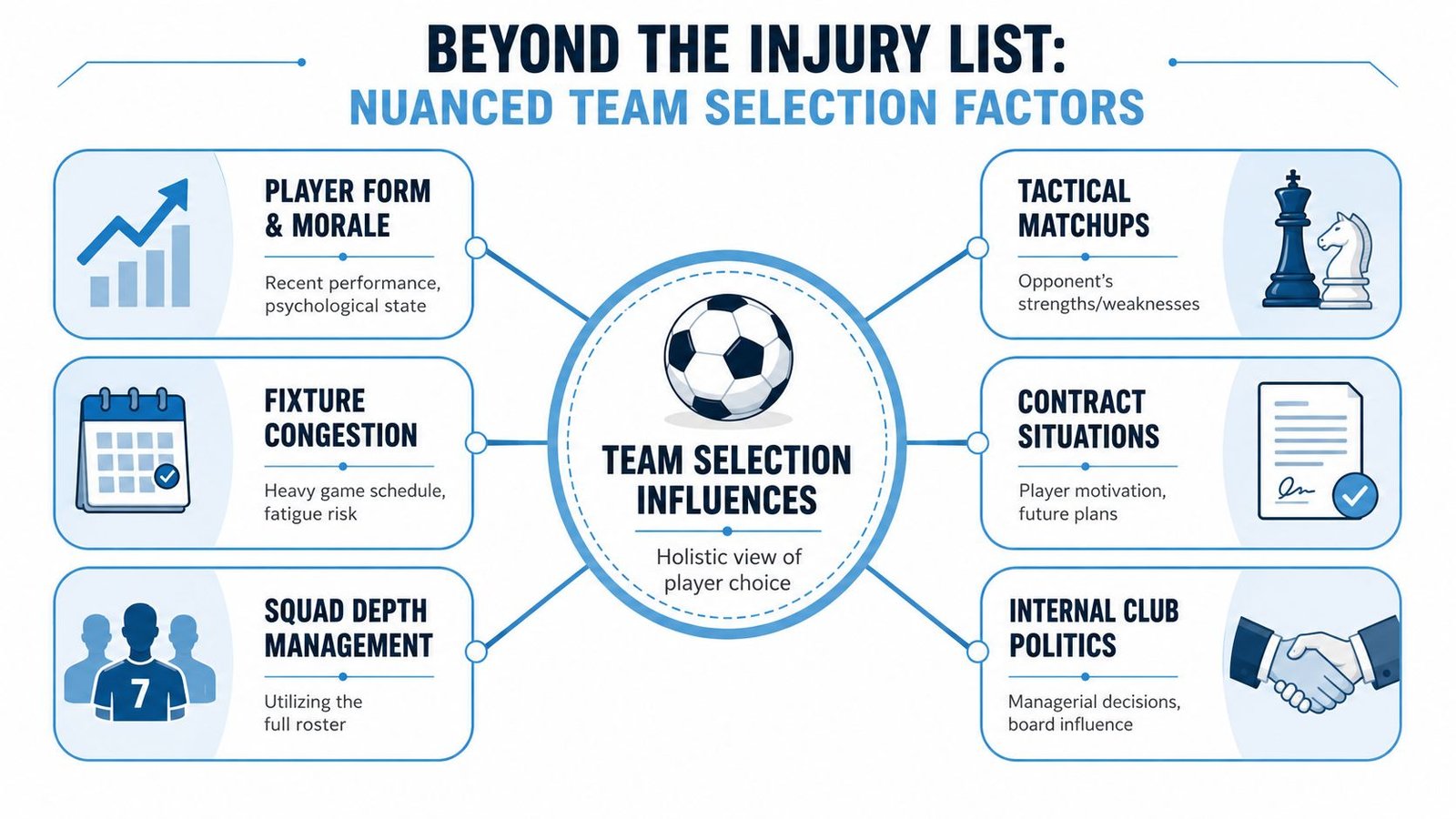
COACHING COMMUNICATION IS TEAM NEWS
Selection is not only about who is fit enough to be named. It is also about whether the coaching environment gives players clear instructions, stable expectations, and enough role detail to execute at City's level of positional precision.
A useful case study came during the 2024-25 season, when reporting said some players were left “bemused” by a lack of communication from backroom staff, before City added new assistants, according to City Xtra's report on coaching communication concerns. For analysts, the point is not dressing-room gossip. It is that staff changes can alter selection outcomes even when the injury list stays the same.
That shows up in three ways:
- Role clarity: A player is more likely to start if the staff trust him to carry out a specific brief with minimal hesitation.
- Selection stability: Fringe options become easier to use when they understand exactly why they are in the side and what the trade-off is elsewhere.
- Execution quality: Better communication often appears as cleaner occupation of zones, quicker support angles, and fewer pauses before the next pass or press.
This matters more at City than at many clubs because City ask players to interpret space, not just fill positions. If the messaging around those tasks is uneven, an analyst can mistake structural confusion for individual decline.
Team news is not only medical information. It also includes the level of tactical clarity surrounding the squad.
FITNESS, FORM, AND MENTAL LOAD ARE DIFFERENT SIGNALS
A player can be available and still be a weak starting bet.
That is the distinction casual coverage often misses. Availability answers one question. It does not answer whether a player can sustain pressing volume, repeat accelerations, make sharp decisions under pressure, or carry the emotional load of consecutive high-demand matches.
An older Phil Foden example shows why this framework matters. Back in the 2023-24 period, reporting stated that he had acknowledged “mental fatigue” and was also described as dealing with a “secretive physical issue”, according to Sports Mole's coverage of concerns around Foden. Read in 2026, that should be treated as a case study in classification, not as current form evidence.
The analytical value is in separating four different states:
- Injured: Medical limitation restricts inclusion or removes it entirely.
- Short of full fitness: A start is possible, but intensity, dueling strength, or expected minutes may be lower.
- Out of form: The body is available, but recent execution does not support a central role.
- Mentally fatigued: Decision speed, off-ball sharpness, and repeated high-intensity actions can all decline without a formal injury report.
Those categories lead to better forecasts. A medically cleared player with mental or physical load concerns is often more likely to appear from the bench, have his minutes managed, or be given a simpler role within the same shape. That is why the public status line can be the least informative part of team news. The sharper question is what kind of readiness City are managing.
FREQUENTLY ASKED QUESTIONS ABOUT MAN CITY TEAM NEWS
HOW RELIABLE ARE EARLY LEAKS
Early leaks should be treated as prompts, not conclusions. They are useful only when they match the official picture, recent training signals, and the tactical needs of the fixture. If a leak names a player but the surrounding evidence points the other way, the leak is weak.
WHAT IS THE MOST IMPORTANT OFFICIAL SOURCE
The club's men's news feed is the strongest starting point because it provides the cleanest baseline on squad status. Press-conference comments add context, especially when the staff distinguish between training, readiness, and likely minutes.
HOW SHOULD A VAGUE COMMENT LIKE HE HAS A NIGGLE BE READ
That phrase usually tells less about severity than about uncertainty. The practical interpretation is that availability may still be live, but workload and start probability are harder to trust. For prediction purposes, it often lowers confidence in a full-match role more than in simple squad inclusion.
WHY DOES MANCHESTER CITY TEAM NEWS MATTER MORE THAN IT DOES FOR MANY OTHER CLUBS
Because City's structure is highly role-dependent. A change in one position can reshape build-up, pressing resistance, wing occupation, or rest defence. At clubs with less positional complexity, absences can be more linear. At City, they often trigger redesign.
SHOULD FANTASY AND BETTING AUDIENCES FOCUS ONLY ON WHO STARTS
No. Minutes profile matters almost as much as the start itself. A returning player can start but still carry managed workload. A bench player can be tactically decisive if the opponent is likely to defend deep late on. The sharper question is who fits the likely match script.
WHAT IS THE BEST WAY TO PREDICT ROTATION
Use a layered approach:
- Read the role demand: What does the opponent force City to solve?
- Check the recent wording: Has the manager hinted at caution or reintegration?
- Map the alternatives: Which available profiles solve the same problem differently?
- Watch for asymmetry: Sometimes only one flank or one midfield slot is the primary selection battle.
CAN TEAM NEWS REVEAL THE GAME PLAN BEFORE KICKOFF
Often, yes. If the squad includes specific creator profiles, secure build-up options, or extra defensive recovery tools, the staff are usually signalling how they expect the game to unfold. The lineup rarely gives the whole script, but it often reveals the genre.
CONCLUSION
Reading Manchester City team news properly means treating every update as evidence of an intended match design. The injury list still matters. It just isn't enough on its own.
A stronger method starts with source hierarchy. Official club updates and manager comments establish the baseline. The next step is role analysis. Which tactical function is present, reduced, or missing altogether? From there, lineup prediction becomes far more precise because the forecast is tied to opponent demands, not guesswork. The final edge comes from looking past formal availability and asking whether communication, form, mental load, or reintegration status are shaping selection behind the scenes.
That mindset changes the viewing experience. It makes the pre-match period more than rumor management. It turns it into tactical interpretation. For a club built on elite depth, role precision, and constant adaptation, that is the only level at which the news really starts to make sense.
The next time a headline says a player is doubtful, managed, or back in training, the useful question won't be whether he is in or out. It will be what City gain, lose, or redesign because of it.
For readers who want more tactical context around selection, shape, and squad trends, Manchester City Analysis publishes Manchester City-focused news, opinion, and match analysis that can help place weekly team updates inside a broader football framework.