For long stretches, the 3-4-3 looks simple. Then one wing-back jumps, one center-back steps into midfield, one wide forward narrows into the half-space, and the whole match changes.
That's why the 343 soccer formation still matters at elite level. Johan Cruyff's Barcelona “Dream Team” made the shape highly visible in the late 1980s and early 1990s, helping popularize the idea of a back three supporting a fluid, possession-oriented attack, as outlined by Sportmonks' explanation of the 3-4-3. What endured wasn't a static picture on a teamsheet. It was the logic behind it: stretch the pitch, protect the center, and give the coach multiple structures without changing personnel.
For coaches and analytically minded supporters, the value of the system lies in its ability to become something else during the game. One team starts in a nominal 3-4-3 and attacks as a front five. Another starts in the same shape and spends most of the match as a 3-4-2-1 with narrow creators behind a striker. Manchester City's opponents have used both approaches, and City themselves have often borrowed the build-up principles without committing to the full formation label.
Table of Contents
- INTRODUCTION
- DECODING THE 3-4-3 FORMATION STRUCTURE AND PLAYER ROLES
- ATTACKING PRINCIPLES IN A 3-4-3 SYSTEM
- DEFENSIVE ORGANIZATION AND PRESSING IN THE 3-4-3
- COMMON 3-4-3 VARIATIONS AND TACTICAL FLEXIBILITY
- HOW TO EXPLOIT AND DEFEND AGAINST THE 3-4-3
- TRAINING THE 3-4-3 WITH A MANCHESTER CITY CASE STUDY
- CONCLUSION KEY TACTICAL TAKEAWAYS FOR COACHES
INTRODUCTION
The modern 3-4-3 survives because it solves more than one problem at once. It gives a team a stable first line in build-up, enough width to stretch a back four, and enough central presence to protect against transition if the spacing is right. That combination is rare.
Its importance also comes from the way coaches reinterpret it. A classic reading gives three defenders, four midfielders, and three forwards. A modern reading treats the shape as a framework that can become a 3-4-2-1, a front five, or a narrow central overload depending on where the wing-backs and inside attackers stand. That's why discussion of the 343 soccer formation often becomes a discussion about space management rather than formation diagrams.
The teams that use the system best don't keep the same picture for long. They keep the same relationships.
At elite level, the shape asks for role intelligence more than positional obedience. The wing-backs must judge whether they're wingers, full-backs, or pressing references. The outside center-backs must know when to hold the line and when to step into midfield. The double pivot must connect the structure without getting stretched horizontally.
Manchester City provide a useful lens here. Even when City don't line up in a textbook 3-4-3, many of the questions they face are the same ones this system creates. How does a team defend a front five without opening central lanes? How does it press a back three without losing midfield control? Those are the questions that separate a label from a tactical model.
DECODING THE 3-4-3 FORMATION STRUCTURE AND PLAYER ROLES
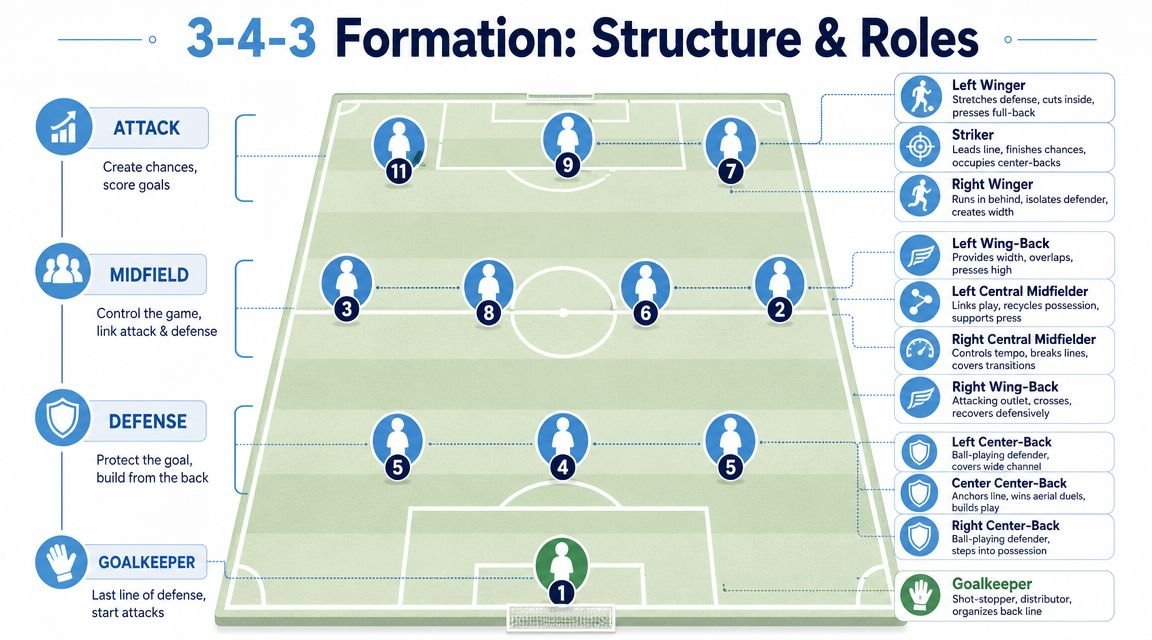
THE BASE SHAPE ON PAPER
In its clearest form, the 3-4-3 uses three center-backs, two central midfielders, two wing-backs, and a front three. The diagram is simple. The coaching challenge is not.
What separates a functioning 3-4-3 from a cosmetic one is the distribution of space across the width of the pitch. The back three give stable access against a first press, but only if the central defender holds depth and the two outside center-backs are willing to defend larger spaces than they would in a back four. The wing-backs then determine whether the shape stretches the opponent or collapses into congestion.
The goalkeeper has a structural role here. Against two pressing forwards, the keeper creates the spare player and changes the angle of the first pass. That often decides whether possession reaches midfield under control or whether the team is forced into a direct ball toward the front line.
The back three are not interchangeable. The middle center-back protects the space behind the line, manages cover, and keeps the unit compact when one of the wider defenders steps out. The outside center-backs need different instincts. They must defend the channel, support circulation into wide areas, and recognize when to carry the ball forward if the opposition midfield line refuses to jump.
That last point matters against teams such as Manchester City. City often defend with aggressive access from the front and tight coverage behind it. If the outside center-back cannot drive into the free lane, the double pivot receives under pressure and the whole structure starts playing backwards.
ROLE PROFILES THAT MAKE IT WORK
The double pivot is the control point. One midfielder usually offers beneath the ball to secure circulation. The other can position higher or wider to connect the next pass, especially in a 3-4-2-1 where the two attacking midfielders occupy the half-spaces and crowd the opponent's central defenders. If both pivots stay on the same line, pressing becomes easier to read. If both leave the center, transition protection disappears.
The wing-backs often decide the quality of the system more than the nominal front three. Their starting height affects everything. High wing-backs pin the opposition full-backs and create room inside for the two narrow attackers. Deeper wing-backs help progression but can leave the team attacking with only three players against an organized back line.
A practical reading of the roles looks like this:
| Unit | Main task | Common risk |
|---|---|---|
| Goalkeeper | Create the spare player in build-up and vary the first pass | Holding the ball too long and triggering a pressed clearance |
| Central center-back | Protect depth, cover both sides, organize line spacing | Stepping out and leaving the back line without cover |
| Outside center-backs | Defend channels, support wide progression, break lines by carrying | Exposing space behind them after an aggressive jump |
| Double pivot | Connect phases and protect central transition lanes | Getting separated vertically or pulled too wide |
| Wing-backs | Provide width, arrive into the press, recover into the back line | Starting from the wrong height for the phase |
| Front three | Occupy the last line, combine between lines, set pressing direction | Becoming detached from midfield support |
Coaching rule: If the wing-backs cannot arrive on the same timing as the ball, the shape loses both width in possession and coverage after the loss.
The front line is where the variation becomes visible. In a flatter 3-4-3, the wide forwards stay outside longer and attack the opposing full-backs directly. In a 3-4-2-1, those two players move inside, often between full-back and center-back, leaving the touchline to the wing-backs. The numbers on the teamsheet barely change. The reference points for the opponent change completely.
That is why player roles matter more than labels. A winger used to receiving on the chalk may struggle as an inside forward who must scan for midfield traffic and counterpress in central spaces. A full-back with recovery speed but limited final-third timing may not give enough as a wing-back. Coaches usually discover whether the system fits their squad from these role details, not from the board.
The historical reference to Cruyff still holds, but the modern lesson is sharper. The best 3-4-3 sides do not use the back three as a passive shield. They use it as a platform for access into midfield and for aggressive coverage of the spaces that open when five players attack the last line.
ATTACKING PRINCIPLES IN A 3-4-3 SYSTEM
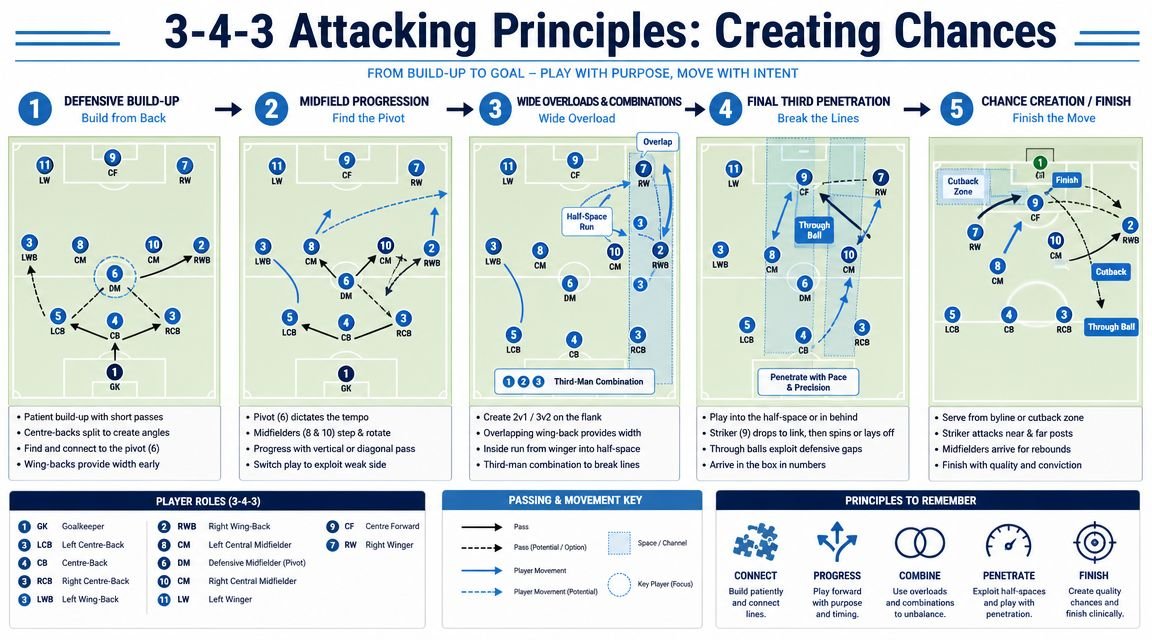
A 3-4-3 attacks best when it can change the opponent's reference points during the same possession. The starting shape matters less than the sequence of movements that follows the first clean pass. In practice, that usually means one line holds width, another occupies the half-spaces, and the last line is pinned long enough for the free player to appear.
HOW THE SHAPE CREATES WIDTH AND DEPTH
The attacking logic starts with lane occupation. A well-coached 3-4-3 can place a player on each vertical lane without stretching the team so far that rest defense disappears. That is why the system has remained useful across different interpretations, from a flatter front three to the narrower 3-4-2-1 used by sides that want more combinations between the lines.
The distinction matters. In the flatter version, the wide forwards stay high and outside for longer, which fixes the opposition full-backs and opens direct dribbling situations. In the 3-4-2-1, the two attacking midfielders begin inside, often in the spaces just outside the opposing pivot, while the wing-backs own the touchline. The shirt numbers barely change. The defensive questions change immediately.
Against a back four, the most common objective is to force one defender to leave the line early. If the full-back jumps to press the wing-back, the near inside forward can run into the channel between full-back and center-back. If the full-back protects that channel, the wing-back receives facing forward and can carry the attack into the final third. If the wide center-back steps out to help, the front line has already created a new gap on the last line.
Manchester City have faced this problem repeatedly against back-three structures that become a 3-4-2-1 in possession. The issue is rarely the nominal shape. It is the timing of the inside attackers arriving behind City's midfield line while the wing-back pins the outside defender. Once that inside player receives on the half-turn, the defending side is no longer dealing with width alone. It is dealing with width and interior access at the same time.
The double pivot makes that possible. One midfielder supports circulation and protects the switch. The other positions for second balls, counterpressure, or a disguised pass into the front line. Coaches often describe the front three as the attacking unit, but the quality of the attack is usually decided by the pivots' spacing and body shape.
A common progression has four clear steps:
Access through the outside center-back
The pass into the wide center-back invites pressure from the opponent's winger or advanced midfielder and changes the angle of the block.Connection into the near pivot or inside attacker
That short pass draws a central defender or midfielder toward the ball and narrows the defending team.Release to the wing-back or underlapping runner
Once the block shifts, the free player appears either outside on the line or inside the full-back.Attack the box with staggered runs
The striker pins the central defender, the ball-side attacker threatens the near channel, and the far-side attacker arrives at the back post or for the cutback zone.
A visual example helps clarify those movements.
FINAL THIRD PATTERNS THAT MATTER
The strongest 3-4-3 attacks are built on coordinated occupations, not isolated actions. If the front players all ask for the ball to feet, the shape becomes flat and easy to defend. If one pins, one drops, and one threatens the far side, the back line has to pass runners across zones under pressure.
Three final-third patterns appear consistently.
Wide triangle to break the full-back's decision
The outside center-back, wing-back, and narrow forward form a triangle near the touchline. If the defender presses the wing-back, the inside pass opens. If the defender protects inside, the wing-back can advance and cross from a higher starting point. This pattern is especially effective when the near pivot stays close enough to recycle possession and hold the opponent on that side.Inside underlap from the 3-4-2-1 line
In the 3-4-2-1 variant, the two narrow attackers are placed to run inside the opposition full-backs rather than outside them. That movement is difficult to track because it comes from the defender's blind side and usually starts after the wing-back has fixed the wide defender. Teams that defend the box well against crosses can still be exposed by this run because it attacks the seam before the cross is delivered.Third-man access through the striker
The central forward drops just enough to connect, sets the ball into a supporting runner, then spins back toward goal. This sequence pulls a center-back out or forces a holding midfielder to defend backward. Either outcome helps the attackers reach the area in front of the penalty spot, which is often the primary target of the move.
One detail separates average use of the system from high-level use. The far-side wing-back and far-side attacker cannot switch off when the ball goes wide. Their positions determine whether the attack ends with a hopeful delivery or with a cutback to a free runner on the weak side.
That is where Manchester City's matches against back-three teams offer a useful lesson. City are usually comfortable defending the first cross because their rest defense and box occupation are strong. The bigger threat comes after the first defensive action, when a 3-4-3 side keeps the far-side attacker alive for the second phase and attacks the space City's midfield has left while shifting. The first action bends the block. The second action breaks it.
So the attacking phase in a 3-4-3 is not defined by width alone. It is defined by the order of width, interior occupation, and weak-side arrival. Coaches who train those relationships get more than possession and more than crossing volume. They get repeatable entries into the box against settled defenses.
DEFENSIVE ORGANIZATION AND PRESSING IN THE 3-4-3
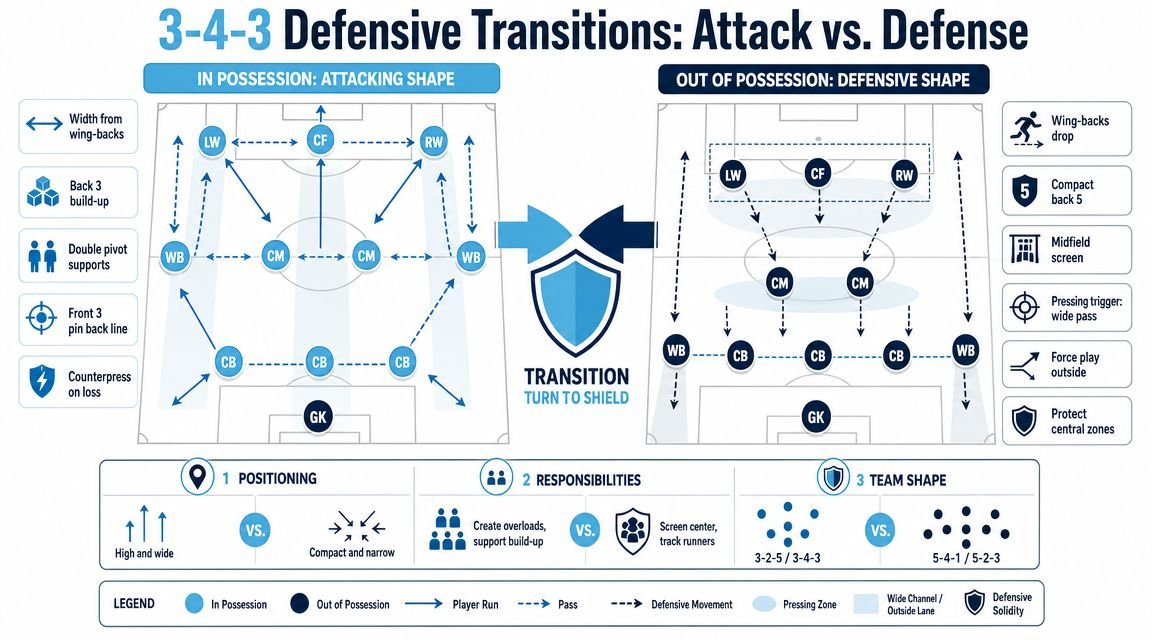
The 3-4-3 is often called attacking because of the front three and advanced wing-backs. That description misses the structure underneath. The shape's defensive strength comes from the fact that it can attack with numbers while still preserving a clear recovery map.
THE DEFENSIVE SHAPES BEHIND THE ATTACK
A key reason for the system's balance is that it commits five outfield players to attacking phases while leaving five underneath to provide cover, creating a near-even split that can be adapted to game state, as noted by SoccerEDU's discussion of the 3-4-3. That split explains why the shape can absorb transition better than its reputation suggests.
When the ball is lost high, the immediate aim is usually to stop the first forward pass. The nearest forward presses back toward the ball, the wing-back closes the outside lane, and one pivot protects the pass into the opposition striker. If that first pressure fails, the structure usually drops into either a 5-4-1 or a 5-2-3 depending on the height of the front players.
The 5-4-1 is safer when the opponent can circulate patiently and force long defending. The 5-2-3 is sharper for high pressing because the front three can still lock the first line while the double pivot protects central access. The choice depends on the opponent's build-up quality and on the fitness of the wing-backs.
PRESSING TRIGGERS AND WIDE COVER
The front three give the coach clear pressing references. The central forward can screen the pass into the holding midfielder while curving the press toward one side. The wide forwards then jump onto the outside center-backs or full-backs, depending on the opponent's shape. That can funnel play into pre-set traps around the touchline.
The biggest vulnerability remains the space around the wing-backs. If a wing-back presses high and the press is beaten, the outside center-back must decide quickly whether to step out or protect depth. That is the hardest defensive decision in the system because getting it wrong can expose either the channel or the box.
A coaching checklist for the defensive phase usually includes:
- Wing-back trigger: Press only when cover exists behind or inside.
- Near pivot position: Stay close enough to stop the inside pass.
- Outside center-back body shape: Face both ball and channel, not just the ball.
- Far-side wing-back: Tuck in early to protect the back post and diagonal switch.
Coaching cue: The outside center-back shouldn't defend the touchline too early. The first priority is to protect the path to goal.
Well-drilled teams make the shape look compact rather than adventurous. Poorly drilled teams leave the wing-back exposed, pull a center-back too wide, and open the half-space. The difference is usually timing, not effort.
COMMON 3-4-3 VARIATIONS AND TACTICAL FLEXIBILITY
The most useful way to analyze the 343 soccer formation is to stop treating it as one shape. At high level, the label often hides two very different attacking models. One uses clear width from the front line. The other narrows the attack and asks the wing-backs to own the flank.
FLAT 3-4-3 VERSUS 3-4-2-1
The flat 3-4-3 keeps three forwards higher and wider. It is direct in its spacing logic. The wide forwards threaten the outside shoulder of the full-backs, the striker pins centrally, and the wing-backs can either overlap or hold a supporting line underneath. This version is useful when a coach wants to stretch the opponent's back line across the full width of the pitch.
The 3-4-2-1 changes the problem. Rather than using two high wingers, it places two narrow attacking midfielders behind a lone striker. Recent tactical analysis shows that many modern interpretations morph into a 3-2 base in possession, with the front line narrowing into two number 10s behind the striker to overload central areas and improve pressing resistance, as shown in this video analysis of the 3-4-3 and 3-4-2-1 relationship. That is why many nominal 3-4-3 teams feel more like central occupation machines than wing-heavy systems.
A side-by-side comparison makes the trade-offs clearer:
| Variation | Best use | Main gain | Main risk |
|---|---|---|---|
| Flat 3-4-3 | Attack space around full-backs | Strong wing presence and direct depth | Midfield can feel lighter between lines |
| 3-4-2-1 | Dominate central pockets | Better access between the lines | Wing-backs become even more demanding |
| False nine version | Pull center-backs out of shape | More combination play near the box | Penalty-box presence can thin out |
Narrowing the front line doesn't make the system less wide. It transfers the width responsibility almost entirely to the wing-backs.
WHEN COACHES ADD FURTHER TWISTS
A false nine changes the system without changing the structure. When the central striker drops, the two inside forwards can run beyond him. The move is designed to disturb man-oriented center-backs and create momentary uncertainty in the back line. It works best when the two attacking midfielders or inside forwards attack depth aggressively.
Some coaches also create asymmetry. One wing-back stays very high while the other starts deeper. One outside center-back steps into midfield more often while the opposite side remains conservative. These are not cosmetic tweaks. They are ways of choosing where the free player should appear.
That idea matters when reading elite sides, including City's own tactical adaptations. Pep Guardiola's teams have often used back-three build-up shapes and asymmetrical occupation patterns without calling it a settled 3-4-3. The tension between innovation and structural clarity is explored well in this piece on Guardiola's tactical tinkering and whether innovation has turned into inconsistency.
For coaches, the key question isn't which label looks best on the team sheet. It's which variation produces the right overload against the opponent in front of them. A wide 3-4-3 asks the opponent to defend the whole pitch. A 3-4-2-1 asks them to survive the center first.
HOW TO EXPLOIT AND DEFEND AGAINST THE 3-4-3
Any good game model creates a signature weakness. In the 3-4-3, that weakness usually appears not in settled defending, but in the spaces that open while the structure is transforming.
WHERE OPPONENTS TARGET THE SHAPE
The first target is the space behind the wing-back. If the wing-back has advanced and possession turns over, the opponent can switch play quickly into the vacated channel before the outside center-back arrives. That is especially dangerous when the 3-4-3 side attacks with both wing-backs high at the same time.
The second target is the corridor between the outside center-back and the wing-back. Opponents look to create a two-against-one there. One attacker fixes the center-back. Another runs outside or inside him depending on the body shape. If the near pivot is late to support, the back line gets stretched.
A practical opposition playbook often includes:
- Fast diagonal switches: Move the ball away from the initial pressure before the far-side wing-back can recover.
- Wide overloads: Pin the wing-back with one player and attack the outside center-back with another.
- Pressure on the double pivot: Deny the easy linking pass and force build-up into longer, riskier deliveries.
- Third-man runs from midfield: Attack the spaces that open when the pivot follows the ball.
One useful comparison comes from looking at how coaches build central stability in other shapes. A side preparing to face this system can borrow ideas from a compact double-pivot structure, similar to the framework discussed in this analysis of the 4-2-3-1 soccer formation.
HOW A 3-4-3 TEAM CAN PROTECT ITSELF
The answer is not “drop deeper.” Teams that retreat too early often lose the attacking strengths that justified the system in the first place. The better solution is to control when and where the risk appears.
One method is staggering the wing-backs. If one is high, the far-side wing-back starts slightly lower and narrower, ready to protect transition. Another method is using the near-side narrow attacker or winger to recover into the wide lane quickly on loss, buying time for the wing-back to reset.
A coach preparing the shape usually wants the following responses:
On loss near the touchline
The nearest forward presses backward toward the ball. The wing-back blocks the line. The near pivot protects the inside pass. This traps the opponent before the switch is released.On loss in central midfield
The first priority is to stop vertical progression. One pivot applies immediate pressure while the second screens the next pass. The back three hold compact distances rather than stepping out rashly.Against deliberate flank overloads
The wide forward or narrow attacker must help. If the front players don't contribute defensively, the structure becomes a back five with no midfield shield.
The shape is hardest to beat when the front players accept defensive tasks early, not after the back line has already been dragged apart.
That is why the 3-4-3 is more demanding than it first appears. Its weak points are known. What decides success is whether the team can anticipate the opponent's route into them before the attack develops.
TRAINING THE 3-4-3 WITH A MANCHESTER CITY CASE STUDY
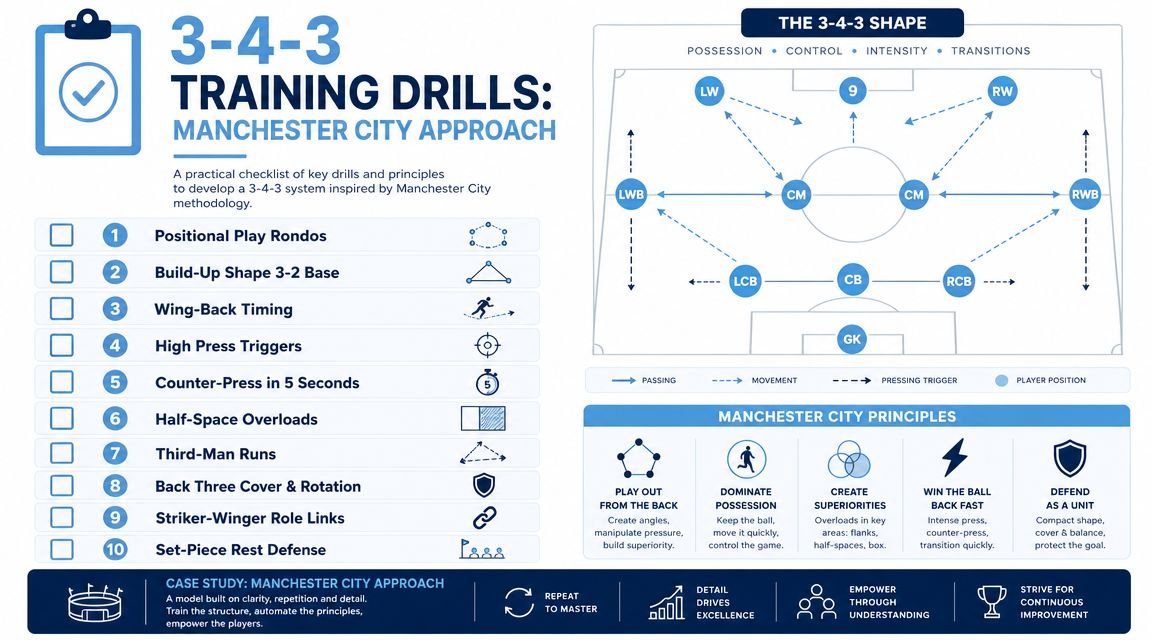
Training the system well means coaching relationships, not just rehearsing lanes. Players need repeated pictures of when to widen, when to narrow, when to press, and when to hold the rest-defense underneath the ball.
THREE TRAINING IDEAS FOR THE MODEL
Positional build-up game
Set the first exercise around the back three, goalkeeper, and double pivot against a pressing unit. The objective isn't only escaping pressure. It is teaching the outside center-backs when to carry, the pivots when to separate or stack, and the goalkeeper when to act as the extra pass. Coaches should freeze the practice when the pivot line becomes flat and disconnected.
Wide combination pattern
Use one side of the pitch with an outside center-back, wing-back, narrow attacker, and striker against a compact defensive unit. Rehearse three outcomes: bounce pass into the wing-back, inside pass into the narrow attacker, and underlap from the inside player after the wing-back receives. The detail to coach is timing. If the underlap starts too early, the lane closes before the pass arrives.
Transition to defensive block
Start with the team attacking in its higher structure. On a coached turnover, the task is to recover into the chosen out-of-possession shape without losing central compactness. This trains the hardest moment in the system, which is not settled possession but the few seconds after the ball is lost.
A coach can summarize the priorities like this:
| Drill | Core habit trained | Typical correction |
|---|---|---|
| Build-up game | Clean first progression | Don't let both pivots occupy the same line |
| Wide combination | Timing around the wing-back | Delay the third run until the receiver is set |
| Transition block | Recovery structure | Protect the center before chasing the ball |
THE MANCHESTER CITY LENS
Manchester City are a useful case study because opponents often try to unsettle them with back-three and wing-back structures, while Guardiola's own teams frequently borrow the same principles in possession. City tend to ask difficult questions of any 3-4-3 side. Can the wing-backs hold width under sustained pressure? Can the double pivot play through City's central press? Can the outside center-backs defend wide spaces once City circulate the ball quickly from side to side?
Against a 3-4-3, City often try to pin the wing-backs deep. Once that happens, the opponent loses one of the system's main attacking benefits and starts to resemble a back five with a disconnected front line. That is the hidden battle. It isn't only about who has the ball. It is about whose wide players are dictating the height of the flank.
City's own adaptations also show why formation labels can mislead. A nominal back four can become a back three in build-up if one full-back moves inside or one defender holds while another steps. The broader principles behind that flexibility are discussed in this analysis of Manchester City, Guardiola's winning philosophy, and the elite squad structure behind it.
The City lesson is clear. The coach doesn't need to declare a 3-4-3 to use 3-4-3 mechanisms.
For coaches, that is the practical takeaway from the case study. Training the 3-4-3 should not focus only on where players stand at kickoff. It should focus on how the team creates width, secures the center, and survives transition once the shape starts moving.
CONCLUSION KEY TACTICAL TAKEAWAYS FOR COACHES
The 343 soccer formation remains relevant because it is not one thing. It is a platform for changing the pitch geometry without changing the entire lineup. That's its real value.
At its best, the system gives a team three major advantages. It can build with stability from the back, it can attack with natural width through the wing-backs, and it can create different overloads depending on whether the front line stays wide or narrows into a 3-4-2-1. Those features explain why coaches keep returning to it across different leagues and game models.
Its weaknesses are just as clear. The spaces around advanced wing-backs are vulnerable. The outside center-backs can be dragged into difficult channel defending. The double pivot can be isolated if distances stretch. None of those flaws are fatal, but all of them require coaching detail and the right player profiles.
For that reason, the shape shouldn't be treated as a plug-and-play solution. It asks for wing-backs who can think like defenders and attackers, center-backs who can defend space as well as duels, and midfielders who understand cover shadows, angles, and tempo. If those pieces aren't present, the structure can look unstable very quickly.
The strongest conclusion is also the simplest. The 3-4-3 is not defined by the starting lineup graphic. It is defined by how well a team can turn one structure into another while keeping control of the important spaces. Coaches who understand that can use the system as a flexible tactical language. Coaches who don't usually end up with a formation instead of a game model.
Manchester City supporters, coaches, and analysts looking for more high-level tactical breakdowns can find them at Manchester City Analysis, where match structure, Guardiola's ideas, and elite-game details are examined with the depth they deserve.