Why do elite teams make the pitch look huge in possession and suffocatingly small without the ball, even when the formations on the teamsheet look ordinary? The answer usually isn't a secret shape. It's a shared command of zones in football, the invisible architecture that tells each player which spaces matter, which spaces can be left, and which spaces must be attacked or sealed in the next second.
Manchester City offer the clearest modern example. Guardiola's side rarely treats possession as a string of passes for its own sake. The ball moves to distort the opponent's spacing, but the true objective is territorial. Rodri stabilises the central lane, De Bruyne bends runs into the right half-space, Foden drifts between full-back and centre-back, and Haaland pins the last line so the space in front of it opens for someone else. The team doesn't just occupy positions. It sequences access to zones.
That distinction changes how football is watched. Instead of tracking only the ball, the eye starts following the battle for the square just ahead of the box, the channel beside the centre-back, the wide lane that invites a press, or the central corridor a holding midfielder refuses to vacate. Once that lens is in place, a match stops looking chaotic and starts looking designed.
Table of Contents
- INTRODUCTION BEYOND THE 90-MINUTE GAME
- MAPPING THE PITCH A GEOGRAPHY OF TACTICAL ZONES
- THE ART OF ATTACK EXPLOITING ZONES FOR GOAL-SCORING OPPORTUNITIES
- THE SCIENCE OF DEFENCE USING ZONES TO CONTROL SPACE AND PRESS
- CITYS BLUEPRINT HOW MANCHESTER CITY DOMINATE THROUGH ZONAL PLAY
- FROM THEORY TO TRAINING COACHING DRILLS TO MASTER ZONAL CONCEPTS
- CONCLUSION SEEING THE GAME IN ZONES
INTRODUCTION BEYOND THE 90-MINUTE GAME
Football has always been about space, but modern analysis has given that space sharper language. Coaches now talk less about where a player starts on the lineup card and more about which corridor must be occupied, which lane must be blocked, and which pocket must be reached at the correct moment. That is why the same nominal formation can produce entirely different football.
Manchester City make this obvious. A full-back can become an extra midfielder. A winger can hold the touchline like a chalk mark or dart inside to connect with the striker. A centre-back can step into midfield to alter the geometry of the next pass. None of those movements make sense unless the pitch is understood as a collection of linked zones with different tactical values.
Zones in football aren't abstract coaching jargon. They are the reference points that turn movement into coordinated advantage.
The payoff is practical. A coach can build training tasks around access to a half-space rather than around a vague instruction to “play forward.” An analyst can isolate whether a team reaches the area in front of the box but fails to penetrate beyond it. A supporter can see why a patient possession spell is an attempt to drag one defender five metres away from a zone that matters more than the ball's current location.
That is also why City's control often feels different from simple domination. The side doesn't just hold territory. It prioritises the right territory, then structures player movements so that one zone opens the next.
MAPPING THE PITCH A GEOGRAPHY OF TACTICAL ZONES
The basic map
The cleanest starting point is the widely used pitch grid that divides the field into 18 rectangular areas. In that model, zones 1 to 6 cover defence, 7 to 12 cover midfield, and 13 to 18 cover attack. Within that framework, zone 14 is the central attacking area directly in front of the opponent's penalty box, sitting roughly 10 to 20 metres from goal, a location treated as especially valuable for shots and final passes in tactical analysis, as outlined in this explanation of zone 14 and the 18-zone pitch model.
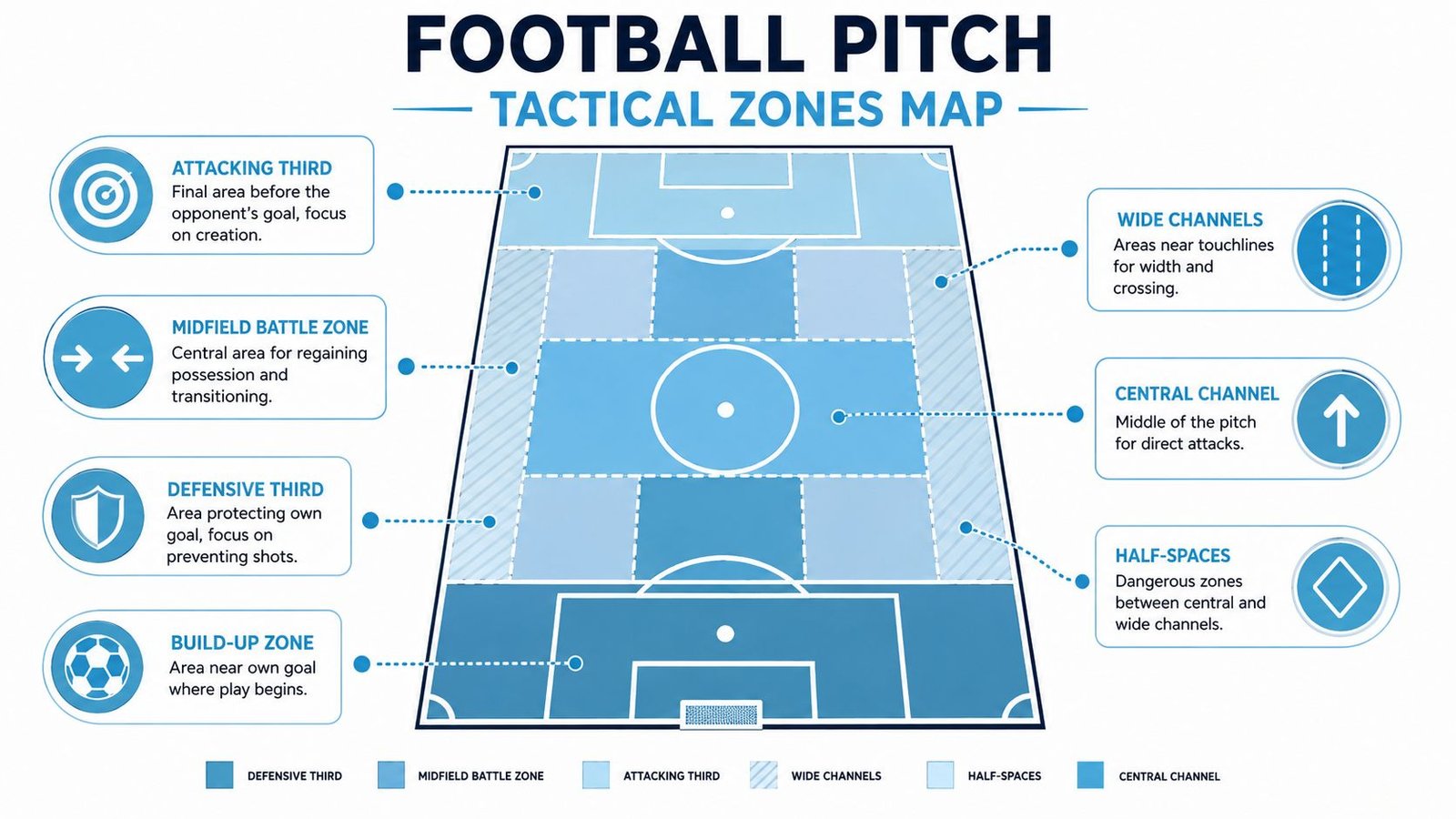
That grid matters because it gives analysts a common map, but coaches usually layer simpler language over it. They speak in thirds, wide channels, central corridor, and half-spaces. The thirds tell a team where build-up, consolidation, and final action occur. The horizontal channels tell players whether width is stretching the defence or whether central occupation is pinning it.
The half-spaces are where systems become more advanced. They sit between the wide lane and the central lane, and they matter because players receiving there can face multiple options at once. They can combine inside, slip a runner through, shoot, switch play, or drive diagonally toward goal. City have long used these lanes as connecting tissue between circulation and penetration.
A team shape like the structures discussed in this analysis of the 4-2-3-1 in modern football only becomes meaningful when those channels are assigned to specific roles and rotations.
Why some zones matter more than others
Not every square metre has the same tactical weight. Analysts using event data don't draw these areas arbitrarily. They isolate the spaces that repeatedly produce decisive actions.
Practical rule: A zone becomes tactically important when it creates either direct shots, high-value final passes, or reliable ball recoveries that launch attacks.
That logic is why the area in front of the box receives so much attention. It links circulation to incision. It is close enough for dangerous final actions but far enough from the defensive line to offer the receiver a fraction more time than the penalty area itself.
The table below gives a working map coaches can use on the training ground or in video review.
| Zone Name | Location | Primary Attacking Purpose | Primary Defensive Purpose |
|---|---|---|---|
| Defensive Third | Nearest own goal | Start build-up, attract pressure, create exit lane | Protect goal, deny direct progression |
| Central Midfield Corridor | Middle of the pitch | Connect phases, control tempo, play through pressure | Screen passes, block central access |
| Wide Channels | Near touchlines | Stretch shape, isolate full-back, cross or recycle | Force play outward, trap against line |
| Half-Spaces | Between central and wide lanes | Receive on the turn, combine, slip runners through | Prevent turns, track interior runs |
| Zone 14 | Central area in front of the penalty box | Final pass, shot setup, combination play | Deny clean reception, collapse quickly |
| Penalty Area | In and around goalmouth | Finish attacks, attack cutbacks and crosses | Clear danger, protect near-post and central lane |
The map works like a city plan. Some districts are transit routes. Some are commercial hubs. Some are heavily guarded government buildings. Teams that confuse those functions move a lot but create little. Teams that understand them, like City at their sharpest, make every movement serve territorial purpose.
THE ART OF ATTACK EXPLOITING ZONES FOR GOAL-SCORING OPPORTUNITIES
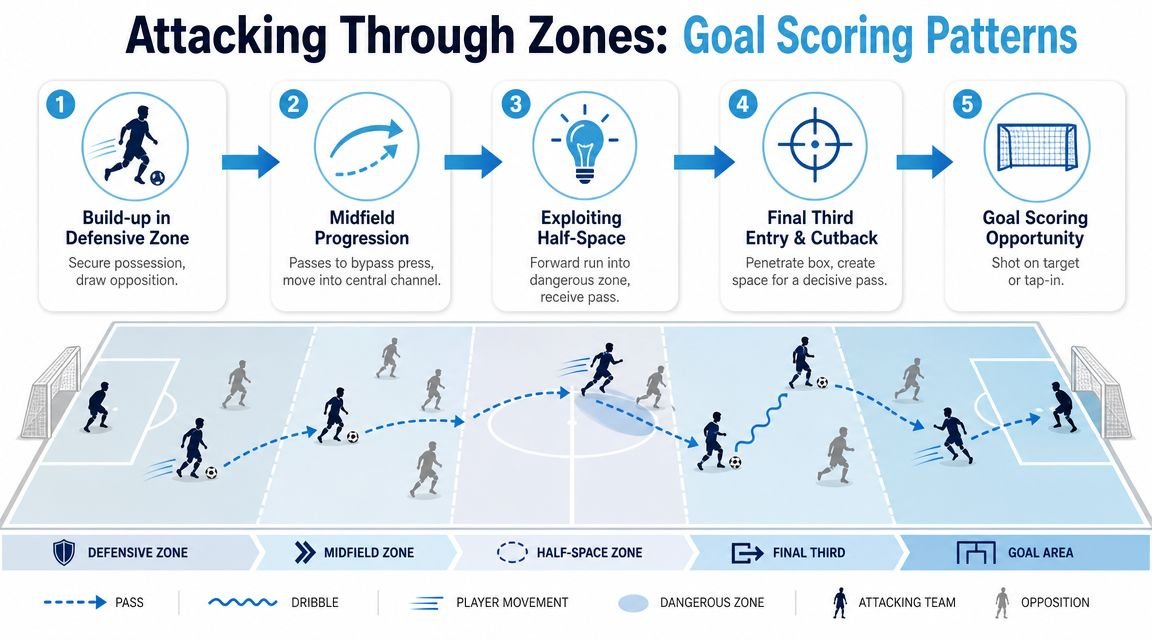
Why do the best attacks seem familiar before they seem spectacular?
Because high-level chance creation is usually a zonal sequence, not a moment of improvisation. The ball is moved to pull one line out of shape, then delivered into the next zone before the defence can repair the spacing. Elite attacks repeat those routes because repeatability is the point. A pattern that consistently creates a free receiver between defenders is more valuable than variety for its own sake.
One of the clearest progressions runs wide channel to half-space to zone 14 to box. The winger pins the full-back on the outside lane. An interior player appears just inside him, often on the blind side of the nearest midfielder. The pass into that pocket changes the whole picture, because the defending back line now has to decide whether to hold shape or step into the receiver.
Manchester City have used this pattern across different squads, but the logic has stayed constant. De Bruyne's work in the right half-space is a strong example. He rarely waits as a static No. 10. He starts narrower than a winger and wider than a central midfielder, then times his movement as the ball travels. That positioning creates a temporary dilemma between full-back and centre-back. If neither steps early, he can turn. If one jumps, the lane for the runner behind opens.
That is why the half-space produces so many clean final actions. The receiver can see the far side of the pitch, the striker's movement, and the edge of the box in one frame. Compare that to a touchline reception, where one side is closed by the line, or a central reception with pressure arriving from both shoulders. The half-space offers more continuation options and better passing angles.
City's best versions under Guardiola add one more layer. The wide player does not always become the creator. Often he is the reference point that holds width while the chance is built inside him. Bernardo Silva and Phil Foden have both done this repeatedly on the right, receiving between full-back and midfielder, then combining with De Bruyne or the striker for a cutback. On the left, Jack Grealish has often served a different function. He slows the move, fixes the full-back, and waits for the underlap from an interior runner or an inverted full-back. The pattern changes by side. The zonal objective does not.
A useful coaching shorthand is to organise the attack in layers:
- Stretch first: Keep the widest player high and outside so the back four cannot collapse centrally.
- Fix second: Occupy centre-backs with a striker, a far-post runner, or a midfielder threatening beyond the line.
- Release third: Find the free player in the half-space or zone 14 after the defence has already shifted toward the wing.
- Finish fourth: Attack the cutback lane, penalty spot, or far-post channel with late arrivals.
Why central advanced possession matters
Attacks become more dangerous when possession is secured in the central advanced lane, not merely circulated around it. A peer-reviewed football study found that teams with greater possession in the middle offensive zone were 1.72 times more likely to win in the one-variable model, with the two-variable model still showing a 1.67 increase. The same study reported a 44.25% probability of winning when teams maintained longer possessions in that zone, as shown in this peer-reviewed analysis of possession zones and match outcomes.
That helps explain why Guardiola's sides keep probing inside even during long spells of patient circulation. The switch to the wing is often a tool to move the block, not the intended endpoint. The primary target is a controlled reception near the width of the penalty area, where one pass can release an underlapping runner, set a third-man combination, or feed the cutback zone.
Watch City enter the final third and the pattern becomes clear. Rodri or the inverted full-back secures the rest defence behind the ball. The winger holds the outside shoulder of the full-back. De Bruyne, Foden, or Bernardo arrives in the inside lane just as the pass lane opens. The attack is dangerous before the shot because the defending line is already facing its own goal and protecting multiple lanes at once.
For coaches, that means training attacks by zone and timing, not only by passing pattern. Run exercises where the ball must enter the half-space before a finish is allowed. Add a rule that the final pass has to come from zone 14 or the lateral edge of the box. Those constraints teach players what City's structure teaches every week. Territory only matters if the team knows which zone should set the next action.
The video below helps visualise how those patterns evolve at match speed.
THE SCIENCE OF DEFENCE USING ZONES TO CONTROL SPACE AND PRESS
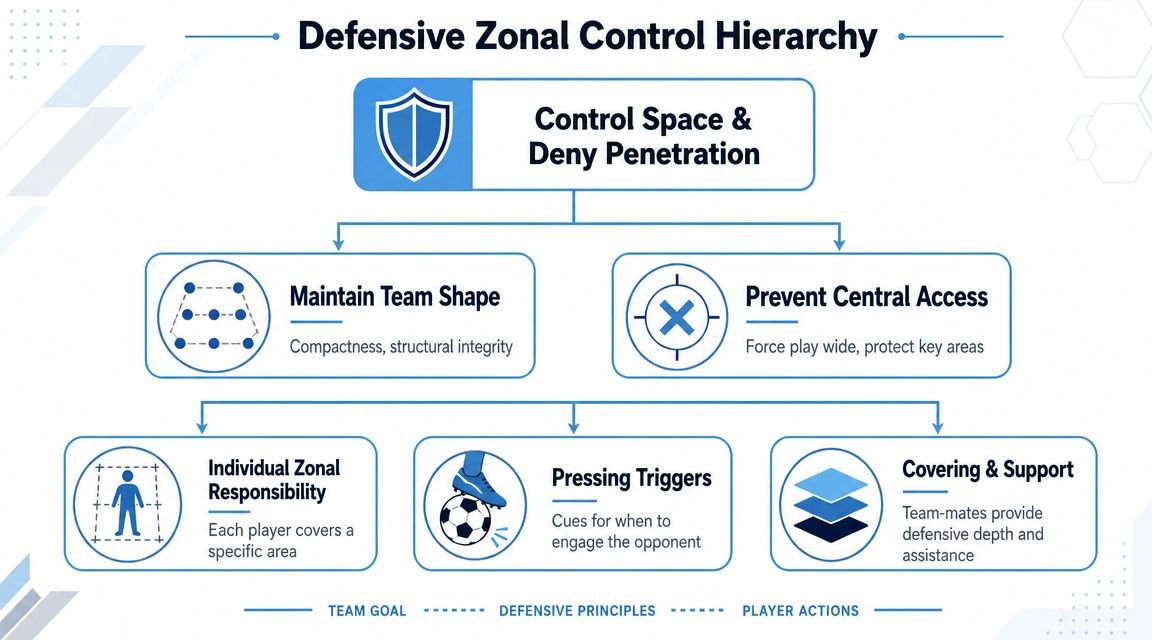
Defending zones in football isn't passive. It is a method of deciding which spaces can be tolerated and which cannot. Man-marking follows bodies. Zonal defending protects routes, angles, and corridors. The distinction matters because elite attacks are built to drag defenders away from where the main threat will appear next.
Zonal defending as space management
A strong zonal block protects the centre first. The back line stays connected enough to deny direct access into the box. The midfield line screens passes into pockets where a receiver can turn. The nearest defender engages the ball only when cover behind and beside him is stable.
That is why compactness is not just about being narrow. It is about preserving distances that allow two actions at once. One player presses. Another protects the lane behind him. A third closes the diagonal that would bypass both.
The best zonal teams don't chase every pass. They decide which pass they want the opponent to make, then close the trap on the next touch.
Inside reduced space, generic labels like Cover 2 or Cover 3 do not explain enough in other football codes, and the same principle applies here. Once the field compresses near goal, static landmarks change. Defenders have less recovery room, attackers can use tighter alignments, and every small movement threatens multiple zones at once. The core problem is no longer broad shell identification. It is adaptation to compressed space and shifting advantage.
Pressing corridors and triggers
Pressing becomes more coherent when tied to zones rather than to emotion. Teams usually want to force the opponent into an area where both the touchline and nearby defenders help close exits. That is the logic of the pressing corridor. Allow the ball wide, block the return inside, then attack the receiver's first touch.
Common triggers include:
- A pass into the wide channel: The touchline removes one exit and makes the next passing angle predictable.
- A receiver with back to goal: That body shape delays the forward action and invites pressure from behind and beside.
- A square pass under pressure: The ball travels slowly enough for the block to jump together.
- A poor orientation on the first touch: One bad touch turns space into a trap.
Manchester City often defend this way after losing the ball high. The nearest player attacks the receiver, but the rest action behind him is just as important. Rodri or the nearest central midfielder blocks the return pass inside, the full-back squeezes distance, and the centre-backs hold a line that can attack any loose second ball without exposing the central lane.
A coach analysing defensive film should ask three questions:
- Which zone was the team trying to protect first?
- Which pass was the press designed to invite?
- Did the covering players protect the next zone after the first jump?
When the answers align, zonal defending looks proactive rather than reactive. The opponent feels rushed without necessarily seeing many tackles. Space disappears before the duel even starts.
CITYS BLUEPRINT HOW MANCHESTER CITY DOMINATE THROUGH ZONAL PLAY
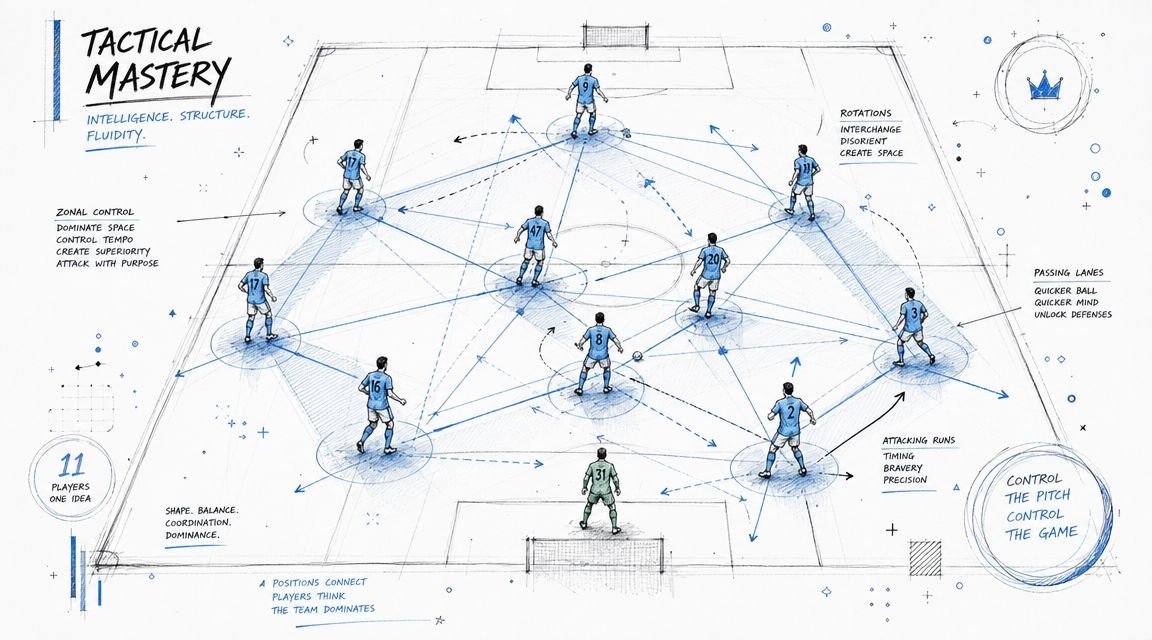
Manchester City's positional play looks fluid on television, but the fluidity is built on strict territorial logic. The side rarely sends two players into the same functional lane unless the overload is deliberate. More often, the shape creates one player to pin, one to connect, and one to arrive. That is why City can seem both patient and sudden in the same move.
Rodri and the central scaffold
Rodri is the clearest example of a player whose value is zonal before it is statistical. He protects the central corridor in rest defence, offers the first secure pass in build-up, and shifts just enough to keep the structure balanced when a full-back inverts or a centre-back steps forward.
When City circulate across the back line, Rodri often positions himself to offer a vertical pass that changes the line of pressure rather than merely continuing it. His body orientation matters. He receives half-open, with one shoulder checking the nearest presser and the other already scanning the lane ahead. That lets City turn safe possession into progressive possession without losing access to defensive coverage if the move breaks down.
This is also where City's principles connect to broader tactical study. The platform's coverage of Guardiola's winning philosophy and elite squad structure tracks how role allocation, spacing, and squad profiles support those repeating territorial patterns.
De Bruyne Foden and Haaland in connected zones
De Bruyne's classic action starts in the right half-space, not directly on the shoulder of the striker. From there he can do three things in the same movement. He can receive between the lines, run beyond the full-back into the channel, or angle his body to deliver early into the box. That uncertainty is the weapon.
Foden offers a different version of the same principle. His receiving style is tighter, often in crowded interiors where he can roll a marker or combine quickly around the corner. When he starts nominally wide and drifts inside, the wide lane stays occupied by an overlapping runner or remains vacant long enough to distort the full-back's reference point. Either way, the opponent must decide whether to protect width or the inside pocket. City exploit whichever choice arrives a fraction late.
Haaland completes the chain by pinning the last line. Even when he doesn't touch the ball, he bends the shape of the defence. A centre-back who fears the run toward goal is less willing to step into zone 14. That hesitation creates the passing window for De Bruyne or Foden to face forward.
Coaching takeaway: City's superiority often comes from synchronising three occupations at once. Width outside, creativity inside, and depth on the last line.
The result is not random chance creation. It is zonal layering. Rodri secures the centre beneath the move. The interiors receive where defenders hate indecision. Haaland fixes the last line so the pocket in front of it becomes playable. The system turns individual quality into collective geometry.
FROM THEORY TO TRAINING COACHING DRILLS TO MASTER ZONAL CONCEPTS
Good zonal coaching starts by deciding what the session is trying to reward. If players keep getting praised for circulating the ball without changing the opponent's shape, they will learn possession without penetration. Guardiola's training design works the other way. The constraint usually points toward a space, a body orientation, or a pressing cue.
That is the value of translating zone theory into drills. The coach is not teaching abstract pitch maps. The coach is teaching players to recognise the same pictures City create repeatedly: Rodri receiving behind the first press, De Bruyne arriving in the right half-space on the move, Bernardo Silva baiting pressure wide before the next pass attacks the inside lane, and the front line timing runs so the final action comes against a destabilised back line rather than a set defence.
Half-space overload game
Objective: Train players to access the interior lane between the touchline and the central corridor, then play forward before the defence can reset.
Setup: Mark a medium-sided pitch with clear wide lanes, half-spaces, and a central corridor. Use two teams, plus one or two neutrals if the attacking side needs a numerical edge. Award points for controlled receptions in the half-space that lead to the next forward action, not for standing in the zone alone.
Rules: A goal counts only if the attack includes a reception in the half-space before the shot. Limit touches for the deepest players to speed ball circulation. Give the half-space receiver freedom to turn, combine, or set the third man.
Coaching points:
- Arrive on the pass: The receiver should move into the lane as the passing line opens, which mirrors how De Bruyne attacks space rather than waiting flat between markers.
- Receive half-turned: Body shape must keep the far side, the forward pass, and the return option available.
- Build the triangle: One support player sits beneath the ball, another threatens beyond the line. That structure gives the receiver two immediate references and prevents dead-end touches.
Run the drill from both sides. City's right-sided patterns often differ from their left, because the profile of the interior player changes the next pass.
Zone 14 cutback circuit
Objective: Rehearse the sequence from central access in front of the box to a cutback into the highest-value finishing space.
Setup: Build the pattern in three zones. The first player starts in midfield, the second receives in zone 14, the third runs into the lateral channel of the box, and the final player arrives centrally to finish. Keep mannequins or passive defenders in place so the passing lane into zone 14 has to be played with precision.
Rules: The pass into zone 14 must stay on the ground and break a line. The zone 14 player has two touches at most. The wide runner cannot deliver early. He must reach the cutback line before releasing the ball. The finisher starts outside the box and arrives late.
Coaching points:
- Pass quality into the pocket: The first ball must travel with enough pace to let the receiver play forward in rhythm.
- Quick set or swivel: The zone 14 player either sets the runner first time or turns sharply if the lane is open. Foden does this well because his first touch often shifts the defender's angle rather than just securing possession.
- Delayed box entry: The finisher attacks the space after the defence drops toward goal. That is why City so often score from square passes and cutbacks rather than hopeful early crosses.
This drill teaches more than pattern repetition. It teaches why the timing of the final run matters. Arrive too early and the defender can mark the player. Arrive too late and the cutback hits an empty zone.
Wide trap pressing game
Objective: Train the collective press once the opponent is forced into a touchline corridor.
Setup: Use one flank as the trap zone. The attacking team tries to progress through that channel into a target area. The defending team scores by winning the ball and finding a central target within a limited number of passes.
Rules: The press cannot start before the trigger. Defenders wait for the pass into the wide lane, then react together. The nearest player presses the ball, the second blocks the inside return, and the third covers the space behind the first two.
Coaching points:
- Curve the first run: The presser must close the ball while screening the inside option. That is the difference between pressure and actual control.
- Keep short cover distances: The second and third defenders must be close enough to intercept the next pass or attack the second ball.
- Attack the middle after the regain: City often recover wide and play inside immediately because the opponent's rest defence is stretched across the pitch.
This is one of Guardiola's clearest coaching themes. The touchline acts as an extra defender, but only if the pressing angles are coordinated.
Coaches who want to study how those ideas change from one opponent to another can use Manchester City's tactical flexibility against West Ham as a practical case study in turning match-specific structures into training tasks.
CONCLUSION SEEING THE GAME IN ZONES
The richest way to understand football is not as a collection of positions but as a contest for controlled space. Zones reveal why one pass matters more than five sterile ones, why one defender's refusal to leave the centre can stop an attack before the final ball, and why Manchester City's structure so often looks inevitable rather than improvised.
Once that lens is in place, matches change shape. The eye notices the half-space run that opened the cutback, the central screen that killed the counter, and the striker's occupation of the last line that created a pocket for someone else. That is the core value of studying zones in football. It turns movement into meaning.
The next time City play, the key battle may not be where the ball is. It may be in the zone the ball is trying to reach.
Manchester City Analysis publishes tactical breakdowns, match analysis, and opinion pieces focused on how Manchester City structure attacks, defend space, and adapt across competitions. Readers who want more detail on Guardiola's patterns, squad roles, and game models can explore Manchester City Analysis.