A Champions League knockout tie often turns on one simple question. Can a team keep its structure while still placing enough bodies around the striker? That tension sits at the heart of the 4231 soccer formation, a system that has survived tactical fashion because it solves more problems than it creates when coached well.
Table of Contents
- INTRODUCTION
- DECODING THE 4-2-3-1 SHAPE AND STRUCTURE
- PLAYER ROLES AND PROFILES IN THE SYSTEM
- THE 4-2-3-1 IN ACTION ACROSS FOUR PHASES OF PLAY
- STRATEGIC STRENGTHS AND VULNERABILITIES
- MODERN ADAPTATIONS AND MANCHESTER CITY'S FLUIDITY
- COACHING THE 4-2-3-1 KEY TRAINING DRILLS
- CONCLUSION
INTRODUCTION
The 4231 soccer formation lasts because it gives coaches a reliable starting structure without forcing rigid football. On a team sheet, it looks simple. On the pitch, it can become a compact defensive block, a pressing shape, or a fluid possession structure that shifts pieces around the ball.
That's why the system keeps showing up at the top end of the game. It offers enough protection to survive transitions, enough central presence to control matches, and enough width to stretch opponents when the front line and full-backs coordinate their movements properly. It isn't a compromise formation in the negative sense. It's a balancing mechanism.
Elite teams use it less as a fixed map and more as a framework. The two pivots don't always behave like twin holding midfielders. The number 10 doesn't always stay high. One full-back may hold while the other advances, or an inverting full-back may step inside to preserve midfield cover. That's part of what makes the shape so instructive for coaches and analysts.
A close reading of modern positional play, including this look at Guardiola's winning philosophy and elite squad, shows why static diagrams can mislead. The formation matters. The relationships matter more.
The best 4-2-3-1 teams don't just occupy positions. They solve the next pass, the next counterpress, and the next defensive transition before the ball even gets there.
DECODING THE 4-2-3-1 SHAPE AND STRUCTURE
A coach writes 4-2-3-1 on the team sheet, but the game rarely leaves it in that clean arrangement for more than a few seconds. The value of the shape is not the diagram itself. The value is that it gives players clear reference points while the team keeps changing around the ball.
At its base, the structure is simple. Four defenders sit behind a double pivot, three attacking midfielders operate underneath one striker, and each line supports the next. That part is easy to label. The harder part, and the part that decides matches, is how those lines compress, stretch, and rotate without breaking the team's balance.
THE FOUR LINES
From a tactical camera view, the 4-2-3-1 begins as four connected bands with distinct jobs.
| Line | Function |
|---|---|
| Back four | Protect depth, start circulation, cover the width of the pitch |
| Double pivot | Close central lanes, offer passing angles, stabilize transitions |
| Attacking three | Occupy half-spaces and wide lanes, connect midfield to attack, support the striker |
| Striker | Pin centre-backs, set the depth of the attack, finish moves or bring others in |
That structure gives coaches a reliable map. It tells the centre-backs where protection should be. It tells the pivots where the next pass should form. It tells the front four how to stretch the opponent without leaving the middle empty.
WHY THE SHAPE HOLDS UP
The 4-2-3-1 survives at elite level because it can defend with control and attack with enough numbers. In settled moments, the back four plus the double pivot give the team a stable platform behind the ball. Once possession is secure, one full-back can advance, the number 10 can join the striker, and one winger can move inside. The same starting shape can quickly resemble a 2-3-5, a 3-2-5, or a lopsided front line depending on who steps forward and who stays to protect rest-defence.
That flexibility is where many basic guides stop too early.
The two midfielders are rarely a matched pair. One may act as the ball-winner who protects the zone in front of the centre-backs. The other may turn out of pressure and play through lines. One full-back may hold the touchline in the first phase. The other may invert into midfield, which is a pattern Guardiola has used to keep central control while still freeing creative players higher up the pitch.
WHAT THE NUMBERS HIDE
On paper, the formation looks symmetrical. On the pitch, it usually is not.
A right-back may step inside next to the pivots while the left-back pushes on. The left winger may stay wide to pin the opposing full-back while the right winger drifts into the half-space. The number 10 may play as a true link player in one attack, then arrive as a second striker in the next. Coaches who treat the 4-2-3-1 as a fixed grid miss its core purpose.
The shape works because it organizes movement, not because it freezes players into zones.
That also brings the trade-off that matters most. Every extra freedom granted to the front four must be paid for with protection somewhere else. If both pivots leave the centre at the same time, or if both full-backs advance without cover behind the ball, the 4-2-3-1 loses the spacing that makes it dependable in transition.
Practical rule: The shape stays healthy when the double pivot can still close the middle after the next turnover, not just support the current attack.
For coaches, that is the primary structural lesson. The 4-2-3-1 is a starting framework for controlling space, distributing risk, and deciding which players get freedom and which players secure the team behind them.
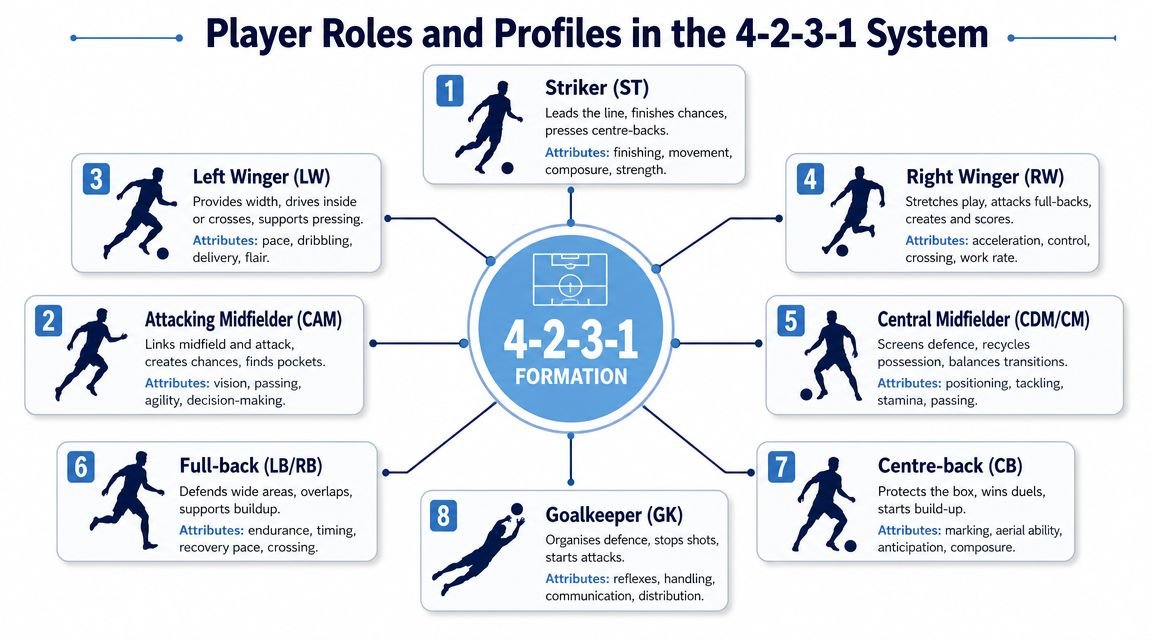
PLAYER ROLES AND PROFILES IN THE SYSTEM
A 4-2-3-1 only works when the profiles fit together. Good teams don't just select the best players. They build complementary relationships across the spine and along the flanks.
THE BACK LINE AND GOALKEEPER
The goalkeeper must do more than save shots. In this system, the keeper often starts circulation and helps the centre-backs find the free side. The centre-backs need enough composure to split, receive, and step forward when pressure allows it.
Full-backs carry a more delicate brief. They must judge when to advance, when to hold, and when to protect the outside lane. A full-back who only overlaps can destabilize the structure. A full-back who never moves can leave the winger unsupported and flatten the attack.
THE DOUBLE PIVOT
This is the tactical heart of the formation. On paper, both players sit in front of the back four. In practice, they rarely perform identical jobs.
One common split looks like this:
Destroyer-type pivot
Reads second balls, protects space in front of the centre-backs, and anchors rest-defence.Progressive pivot
Receives under pressure, switches play, and advances the team through passing or carries.Situational balance
The key isn't which player is more defensive. It's whether one always secures the middle while the other supports progression.
If both pivots chase the ball, the team opens the centre. If both stay flat and deep, the attack loses rhythm. The strongest versions of the 4231 soccer formation use staggered positioning rather than mirror-image roles.
THE ATTACKING MIDFIELD LINE
The central attacking midfielder, or number 10, decides whether the shape feels connected or broken. This player must find space between lines, receive on the half-turn, and arrive near the striker at the right moment. A 10 who only waits for final passes leaves the build-up disconnected.
The wide attackers need range in their game. They may hold width, drive inside, press full-backs, or attack the far post depending on the phase. The system improves when the two wingers don't make the same movements at the same time.
A balanced attacking line usually includes different functions:
| Role | Primary value |
|---|---|
| Number 10 | Connects midfield and attack |
| Ball-side winger | Supports combinations and overloads |
| Far-side winger | Attacks space, back post, or isolated defender |
Before moving further, this video offers a useful visual reference for how these roles combine in live play.
THE LONE STRIKER
The striker is the position most coaches misread in this shape. It isn't enough to finish attacks. The lone forward must pin centre-backs, link under pressure, and decide when to drop versus when to stay high.
If the striker drops, somebody else must threaten depth. If nobody runs beyond, the move dies in front of the block.
That's why profile matters so much. A back-to-goal striker can stabilize possession. A runner can stretch the line. A false 9 can create overloads. None of those profiles is automatically best. The right choice depends on whether the team needs more connection, more depth, or more manipulation of the back line.
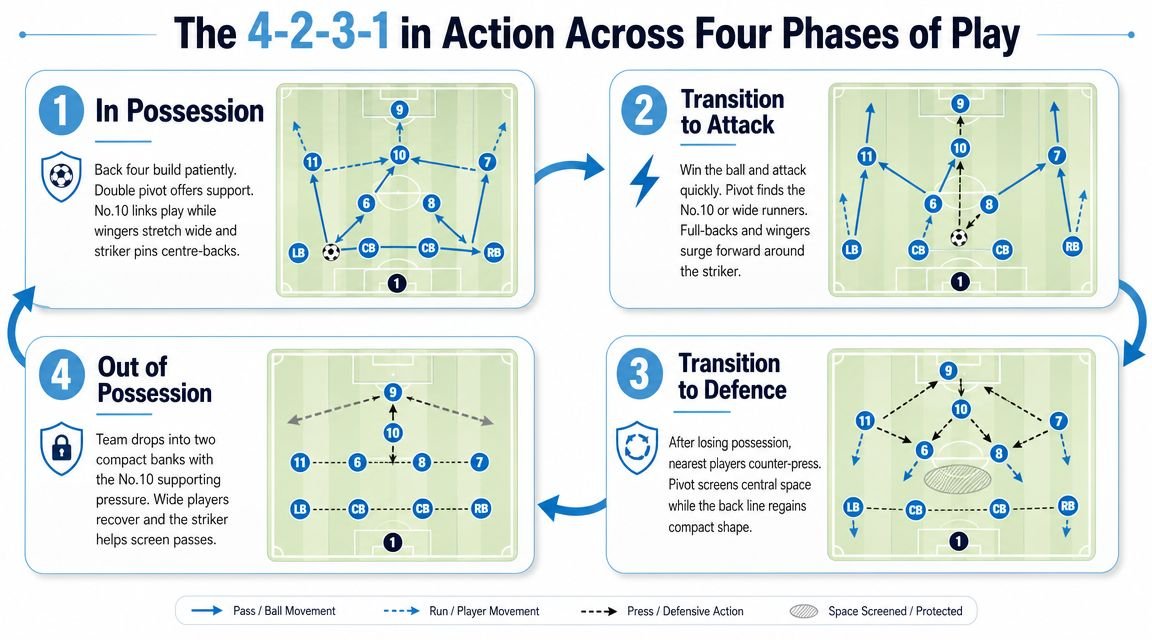
THE 4-2-3-1 IN ACTION ACROSS FOUR PHASES OF PLAY
A team can line up in a 4-2-3-1 and still look completely different across a single passage of play. That's normal. The system breathes with the ball, with pressure, and with the positions of the full-backs and attacking midfielders.
The central trade-off is clear. Tactical analysis of the shape shows that the system constantly balances central security against forward presence. The lone striker can become isolated if support doesn't arrive, and the shape becomes vulnerable if both full-backs advance together. Effective teams solve that through coordinated rotation, with the striker dropping, the 10 attacking the space behind, and one full-back providing width, as explained in this tactical video analysis of the formation's key mechanisms.
IN POSSESSION
The sequence often starts with the centre-backs spreading and the pivots offering angles underneath the first line of pressure. If the opponent presses narrowly, the full-backs can receive wider. If the opponent jumps to the full-backs, the pivots and number 10 become the route through the middle.
The key is occupation, not just possession. One winger usually needs to stretch the pitch. The number 10 needs to stay available between lines. The striker must either pin centre-backs or drop at the exact moment someone else attacks beyond.
TRANSITION TO ATTACK
When the ball is regained, the 4-2-3-1 can become dangerous very quickly because support lines already exist. The question is whether those support lines are close enough. If the front four are too spread, the first pass isolates the striker. If they're connected, the team can combine immediately.
Short combinations work best when the nearest pivot secures the second ball and the far-side players start moving early. That's how the shape turns recovery into progression rather than just temporary possession.
The first three seconds after regaining the ball often decide whether the 4-2-3-1 feels fluid or fragmented.
TRANSITION TO DEFENCE
Discipline matters most in this situation. If both full-backs have advanced, a switch of play can expose the weak side before the block resets. The double pivot then faces too much ground, and central security disappears.
A well-coached side reacts in layers:
- Nearest attackers counterpress
- One pivot protects the centre immediately
- The far-side full-back narrows early
- The weak-side winger recovers with urgency
OUT OF POSSESSION
Without the ball, the shape often compresses into a narrower block. The number 10 may support the striker in the first pressing line or drop closer to midfield to reduce central access.
Objective is to deny clean entries into the middle while keeping enough access to the outside. A passive block concedes too much territory. An overaggressive one opens lanes behind the first pressure. Good 4-2-3-1 defending lives between those extremes.
STRATEGIC STRENGTHS AND VULNERABILITIES
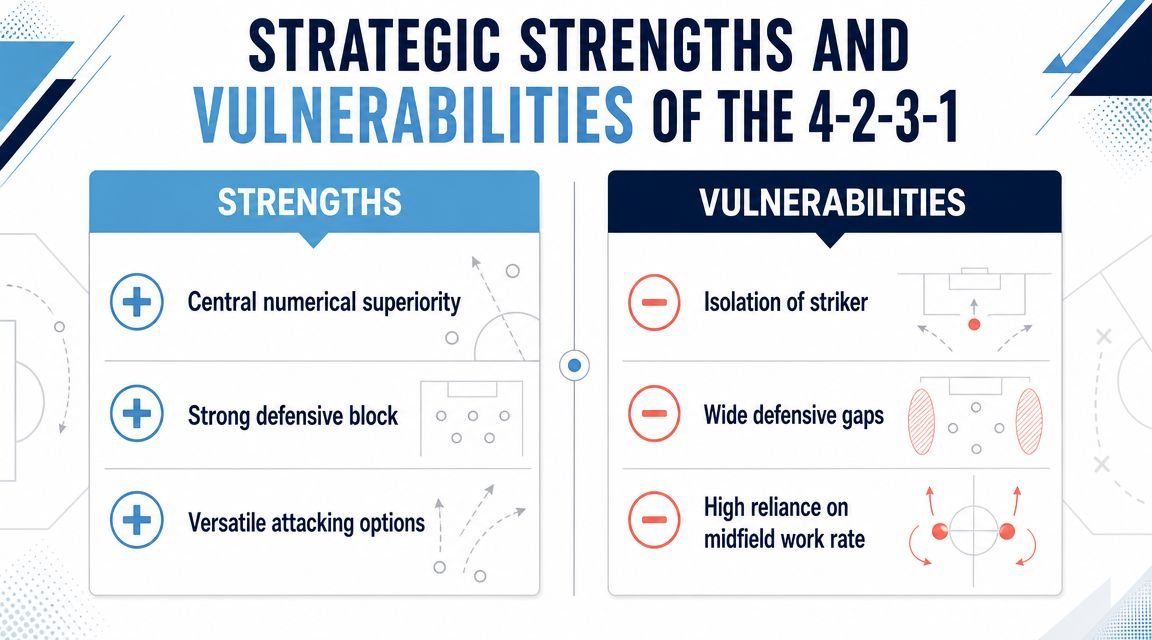
A 4-2-3-1 can make a team feel in control until one small spacing error turns control into exposure. The shape is popular because it gives coaches security behind the ball and enough attacking presence ahead of it, but its strengths only hold if the distances between the units stay right. As noted in BlazePod's breakdown of 4-2-3-1 strengths and weaknesses, the system offers balance. At elite level, balance is never static. It has to be rebuilt phase by phase.
WHERE THE SHAPE HELPS
The clearest strength is control of the centre. Two pivots protect the space in front of the centre-backs, close passing lanes into the opposition striker or 10, and give the team a platform to regain second balls. That matters against sides who want to attack through the inside channels, because the 4-2-3-1 can crowd those lanes without sacrificing width completely.
It also gives coaches two different kinds of midfield profile in the same line. One pivot can destroy play and hold position. The other can receive on the half-turn, break lines, or step forward to support the 10. That split is one reason the system still works across very different squads. The trade-off is obvious. If both pivots want the ball and neither wants to screen, the shape loses its backbone.
The second major strength is how easily it creates local overloads. On one side, the full-back, winger, 10, and near pivot can combine to outnumber an opponent near the touchline. On the next attack, the same shape can feed the 10 between the lines or find the far-side winger after a switch. Coaches like this because the formation does not force one attacking route.
Role definition helps too. Players usually understand the first defensive reference points, the main support angles, and who is expected to arrive around the striker. At youth and senior level, that clarity speeds up coaching.
WHERE IT BREAKS
The shape starts to fail when the 10 drifts too far from the striker or when the wingers stay pinned to the touchline without timing their inside runs. Then the centre-forward receives with no close support and every attack turns into a duel instead of a combination.
The wider weakness is structural. If both full-backs advance and one pivot joins the attack, the rest defence is often just two centre-backs plus a midfielder covering too much ground. Elite opponents wait for exactly that picture. Guardiola's teams have often solved this by moving a full-back into midfield or by holding one defender in a more conservative position, but the principle is broader than City. Somebody has to replace the protection that has moved.
That is why the double pivot should never be judged as two identical players standing side by side on a tactics board. One may hold. One may push. One may press the ball while the other blocks the next pass. If those roles blur at the wrong moment, the team becomes easy to counter through the middle or around the outside. City's drop in control without their main anchor is clear in this analysis of Rodri's absence and City's midfield struggles.
| Strategic upside | Associated risk |
|---|---|
| Double pivot protection | Forward support can arrive too late |
| Wide overload potential | Weak-side space opens after switches |
| Clear role structure | The striker can become isolated |
| Freedom for the 10 and one pivot | Central transitions become harder to control |
MODERN ADAPTATIONS AND MANCHESTER CITY'S FLUIDITY
The textbook version of the 4-2-3-1 assumes two true holding midfielders behind a fixed line of three. Elite football doesn't work like that anymore. Modern coaches treat the shape as a starting grid, then redistribute responsibilities according to phase, opponent, and the qualities of specific players.
That's why one of the most interesting questions in the 4231 soccer formation is what happens when there isn't a classic double shield in midfield. The answer is that the structure can still function, but only if another player replaces the missing protection at the right moment.
WHEN ONE PIVOT PUSHES
A useful example comes from Guardiola's 2020/21 Manchester City. As described in Coaches' Voice's study of the 4-2-3-1 under managers including Guardiola, Rodri could partner with the more advanced Gündogan, while an inverting full-back such as Cancelo stepped into midfield to maintain the double pivot. That detail changes the whole interpretation of the shape.
The lesson isn't just that City rotated well. The lesson is that the team protected function rather than position. If Gündogan moved, someone else had to preserve the midfield pair. If Cancelo stepped in, the rest of the structure adjusted around that movement.
WHY STATIC DIAGRAMS FAIL
A flat diagram can't show three important realities:
Role substitution
One player leaves a zone, another fills it.Phase-specific behavior
The same player may be a full-back in rest-defence and a midfielder in possession.Asymmetry by design
One side may hold width while the other side folds inside.
That's why calling something a 4-2-3-1 can be accurate and incomplete at the same time. The team may defend in one shape, build in another, and attack in a third without losing the core logic of the original system.
The modern version of the formation isn't less disciplined. It's more disciplined, because rotations only work when every compensating movement is understood in advance.
THE REAL TRADE-OFF
The trade-off is creative circulation versus transition protection. A more aggressive pivot can help break lines, support the 10, and keep attacks alive near the box. But every step forward raises the question of who protects the centre if possession is lost.
That balance sits at the center of Manchester City's tactical flexibility against different opponents. The shape remains recognisable. The functions inside it keep moving.
COACHING THE 4-2-3-1 KEY TRAINING DRILLS
Coaching this formation starts with relationships, not set plays. If the distances between the pivots, the 10, and the striker aren't right, no amount of pattern work will save the structure.
DOUBLE PIVOT POSITIONING GAME
Use a central-possession exercise with two pivots operating ahead of a back line and against an active pressing unit. The target is simple. One pivot supports the ball while the other secures the centre and the next pass.
Key coaching points:
Staggering matters
Don't allow both pivots to stand on the same horizontal line for long stretches.Body shape matters more
The receiving pivot should open to play forward when possible, not just recycle under pressure.Security comes first
If one steps toward the ball, the other must immediately think about rest-defence.
STRIKER AND NUMBER 10 CONNECTION DRILL
Set up a channel in front of the box with the striker, the 10, and one winger combining against defenders. The striker alternates between pinning and dropping. The 10 must read that cue and either receive underneath or run beyond.
This drill teaches timing rather than choreography. The common error is both players coming short. That kills depth and compresses the attack into one zone.
A connected 9 and 10 don't move together. They move in response to each other.
PRESSING TRAP ON THE FLANK
Organize the front four plus one pivot against a back line and midfield outlet. The trigger can be a wide pass into the full-back. Once that pass travels, the winger jumps, the striker curves the press, the 10 blocks the central return, and the near pivot squeezes up behind the play.
Role detail matters. The goal isn't reckless pressure. The goal is to force the next action into a predictable space.
SMALL-SIDED FINAL THIRD GAME
Use a reduced game with neutral support players and reward goals that come from a third-man combination or a wide-to-central attack. This encourages the exact actions the 4-2-3-1 needs near the box. One player fixes the line, one connects, one arrives.
For younger players or developing teams, technical repetition underneath these tactical ideas is essential. Resources that help players develop soccer skills in Humble are useful because this formation punishes poor first touches, weak scanning habits, and slow support angles.
CONCLUSION
The 4231 soccer formation remains one of football's most useful reference systems because it balances order and freedom better than most alternatives. It gives a team a stable base, clear midfield relationships, and enough flexibility to attack through central combinations or wide overloads.
Its real value, though, doesn't sit in the numbers themselves. It sits in the movement inside them. The strongest versions of the system understand how the pivots share responsibilities, how the 10 and striker protect each other from disconnection, and how full-back behavior shapes both attack and rest-defence.
That's also why the formation still belongs in elite football. It can absorb modern ideas without losing its identity. Inverted full-backs, rotating pivots, asymmetrical wings, and fluid occupation of the half-spaces don't replace the 4-2-3-1. They refine it.
For coaches, the lesson is direct. Don't coach the diagram alone. Coach the distances, the compensations, and the moments when one player's freedom requires another player's restraint. For informed fans, that's the true beauty of the system. It looks familiar, but the best teams keep finding new ways to bend it without breaking it.
For readers who want more elite-level tactical breakdowns, Manchester City Analysis offers detailed coverage of Guardiola's structures, player roles, match adaptations, and the strategic ideas shaping Manchester City across the Premier League and Champions League.