A familiar scene decides too many matches. The goalkeeper makes the first save, the back line reacts half a second late, and the rebound drops into the zone the keeper should already have been influencing. On the report sheet, it looks like a finishing problem. On video, it is usually a positioning problem.
That distinction matters even more in teams built on territorial control. In Manchester City's model, the goalkeeper does far more than protect the six-yard box. He supports the high line, shortens recovery distances behind the centre-backs, offers a stable passing outlet in build-up, and adjusts his starting point as the ball, line of pressure, and defensive block shift. Positioning becomes part of the team structure, not an isolated goalkeeping skill.
Coaches often train saves as separate events. Elite teams train starting positions, body orientation, set timing, and recovery routes as connected actions. That is why a goalkeeper can look sharp in isolated shot-stopping work but still concede from cut-backs, second phases, and transition attacks. The issue is rarely one dramatic technical error. It is a chain of small positional decisions made too early, too late, or from the wrong reference point.
Good positioning drills therefore need a tactical frame. They should teach the keeper to read distance to the ball, access to the near post, depth relative to the back line, and the likely next pass. Manchester City's keepers are a useful benchmark because their role is system-heavy. They are asked to defend space, support circulation, and solve pressing traps before the shot even arrives.
That is also why movement quality still matters. A goalkeeper who reads the picture correctly still needs the power to adjust his feet and reset his stance under pressure, which is one reason coaches pair positional work with explosive training tools such as those covered in MONFIT's plyometric equipment guide. Positioning is not static geometry. It is repeated movement in service of the game model.
Table of Contents
- 1. One-vs-One Distribution and Pressure Drills
- 2. Box Positioning and Zone Coverage Mapping
- 3. Back-Pass Control and Foot-Skill Sequences
- 4. Cross and Aerial Dominance Positioning
- 5. Reactive Positioning and Quick-Play Adjustments
- 6. Deep Positioning and Sweeper-Keeper Orchestration
- 7. Set-Play and Standardized Restart Positioning
- 8. Distribution Pattern Recognition and Game-Model Positioning
- 8-Drill Goalkeeper Positioning Comparison
- INTEGRATING DRILLS INTO YOUR GAME MODEL
1. One-vs-One Distribution and Pressure Drills
A goalkeeper receiving under pressure is really solving a positioning problem before solving a passing problem. If the starting angle is wrong, the first touch narrows the next action instead of opening it. That's why one-vs-one distribution drills should begin with the goalkeeper claiming or collecting service, then immediately facing an arriving presser.
Manchester City provides the benchmark. Their goalkeeper often becomes the spare player in the first phase, but only because the body shape and starting spot create passing lanes before pressure arrives. The drill should replicate that tension. A server plays from different angles, a forward presses on the touch, and the goalkeeper must decide whether to secure, release quickly, carry, or reset the shape.
Why It Mirrors Manchester City
The tactical lesson isn't just composure. It's relationship management between the goalkeeper, the central defenders, and the nearest full-back or pivot. When City bait pressure, the goalkeeper's position tells the press where it thinks the trap is. A keeper who stands too square invites panic. A keeper who opens the hips early can disguise the next line-breaking pass.
A useful progression starts with passive pressure, then moves to active closing runs and blocked passing lanes. The coach should vary the service so the goalkeeper doesn't memorize one picture.
- Start Central: Begin from the middle of goal to teach the keeper to receive and then create the next angle rather than drifting into one by habit.
- Press On The Trigger: Release the pressing forward only when the first touch is taken, so the goalkeeper learns to connect touch and body shape.
- Coach The Exit: Judge whether the goalkeeper chose the right side to escape pressure, not just whether the pass reached its target.
Practical rule: If the goalkeeper's first touch doesn't change the presser's run, the touch probably wasn't good enough.
This drill becomes even more valuable when aerial service is mixed in. A keeper who claims high and lands balanced can launch transition. A keeper who catches while falling backward usually kills the team's structure. That distinction matters in City-style football, where the goalkeeper isn't ending the attack against. The goalkeeper is often starting the attack for.
2. Box Positioning and Zone Coverage Mapping
A cut-back reaches the top of the six-yard box. The centre-backs are recovering toward goal, the weak-side full-back is tucked in late, and the goalkeeper has half a second to solve the picture. That moment is why many goalkeeper positioning drills teach spots instead of pictures, which is a failing. Match actions inside the box are shaped by ball line, cover shadows, defender recovery speed, and the shooter's available finish. A static marker on the grass cannot capture that.
Zone coverage mapping gives the drill tactical value. The coach divides the penalty area into reference zones, then links each zone to three live cues: ball location, the position of the back line, and the most likely shot type. The goalkeeper is no longer learning where to stand in isolation. The goalkeeper is learning how the team's defensive structure changes the available space.
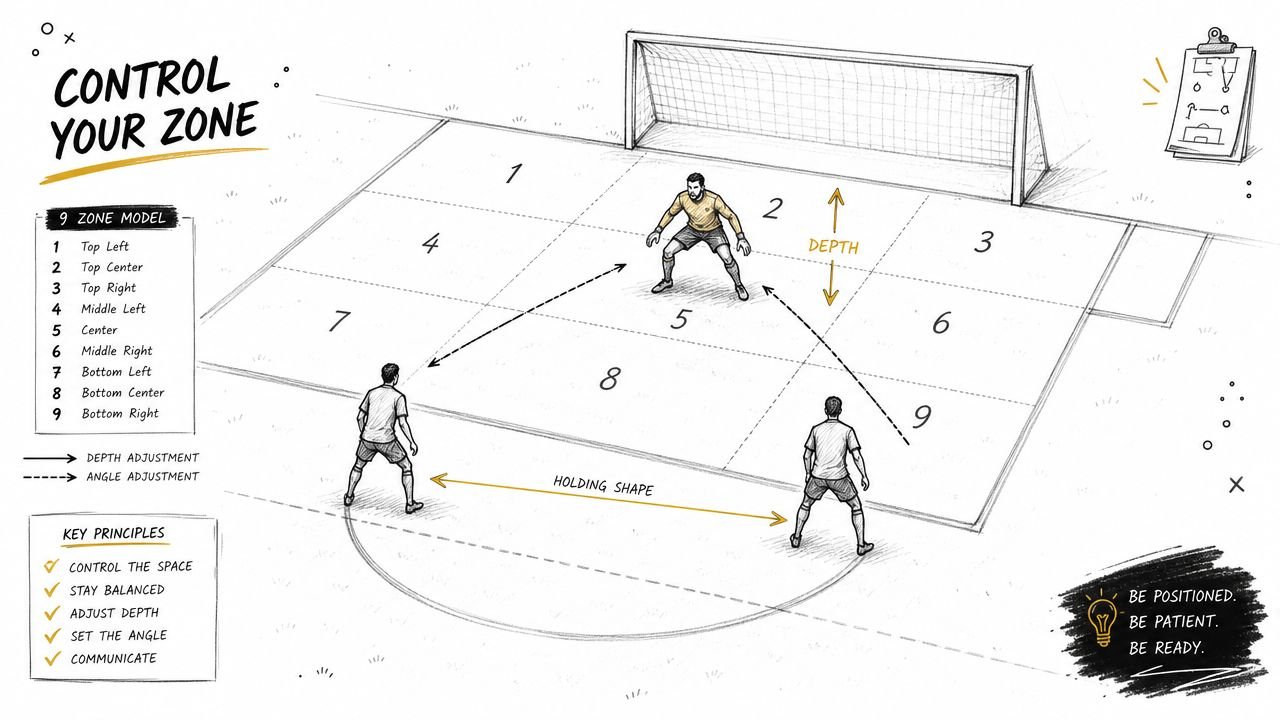
Mapping The Nine-Zone Picture
The nine-zone model works best when the service changes constantly. Feed balls from both half-spaces, the wings, and central pockets. Hold the defensive line in realistic positions rather than a neat flat line. Then ask the goalkeeper to adjust depth and width according to the shot that is on, not the one the drill designer expected.
That distinction matters in elite football. Penalty-area positioning is a joint task between goalkeeper and defenders. If the near-side centre-back has closed the direct lane, the goalkeeper can protect the cut-back and delay the far-post finish. If the line is broken and the shooter's body is open, the goalkeeper must claim more depth earlier. The drill should coach that exchange of responsibility.
Manchester City provide a strong benchmark here. Their rest defence often controls central access well, but transitional moments can still expose the channels just inside the box, especially when the full-backs have stepped into midfield roles. City's goalkeeper has to read whether the defenders have removed the near-post shot, narrowed the square pass, or left a clear lane through traffic. Zone mapping trains that reading. It turns positioning from a generic habit into a system-specific response.
Good positioning removes the finish the attacker wants first.
Coaches should grade the drill against three details:
- Depth discipline: Step off the line when the shooter has a clean strike, but hold a depth that still allows adjustment to a dinked finish or square ball.
- Width matching: Stay connected to the ball line as possession travels across the box, especially on passes that shift the angle by a few yards rather than a full switch.
- Set position timing: Arrive balanced before contact. Early enough to react. Late enough to keep moving information.
The last point is often the separator. A goalkeeper can move into the correct zone and still concede because the feet never settled or the chest stayed too high. That is why this drill should be evaluated by the quality of the final stance, not by cone accuracy. At the highest level, including in City's model, box positioning is less about occupying a location and more about arriving in a location ready to solve the next action.
3. Back-Pass Control and Foot-Skill Sequences
The modern back-pass isn't a relief touch. It's a tactical invitation. Opponents see it as a pressing trigger, while possession teams see it as a chance to reorganize the whole pitch. That tension makes first touch and positioning inseparable.
Manchester City's game model depends on a goalkeeper who can receive from either centre-back, hold the press for a moment, and then release to the free player. The detail that matters most is rarely the pass itself. It's where the goalkeeper moves before the ball arrives. One extra adjustment step can open the body to the far side. One lazy starting position can trap the team on the same side.
A simple sequence works well. Centre-backs and full-backs feed back-passes from different lanes and speeds. The goalkeeper must adjust the feet before contact, cushion the first touch into space, and then pick the next action based on the pressure picture.
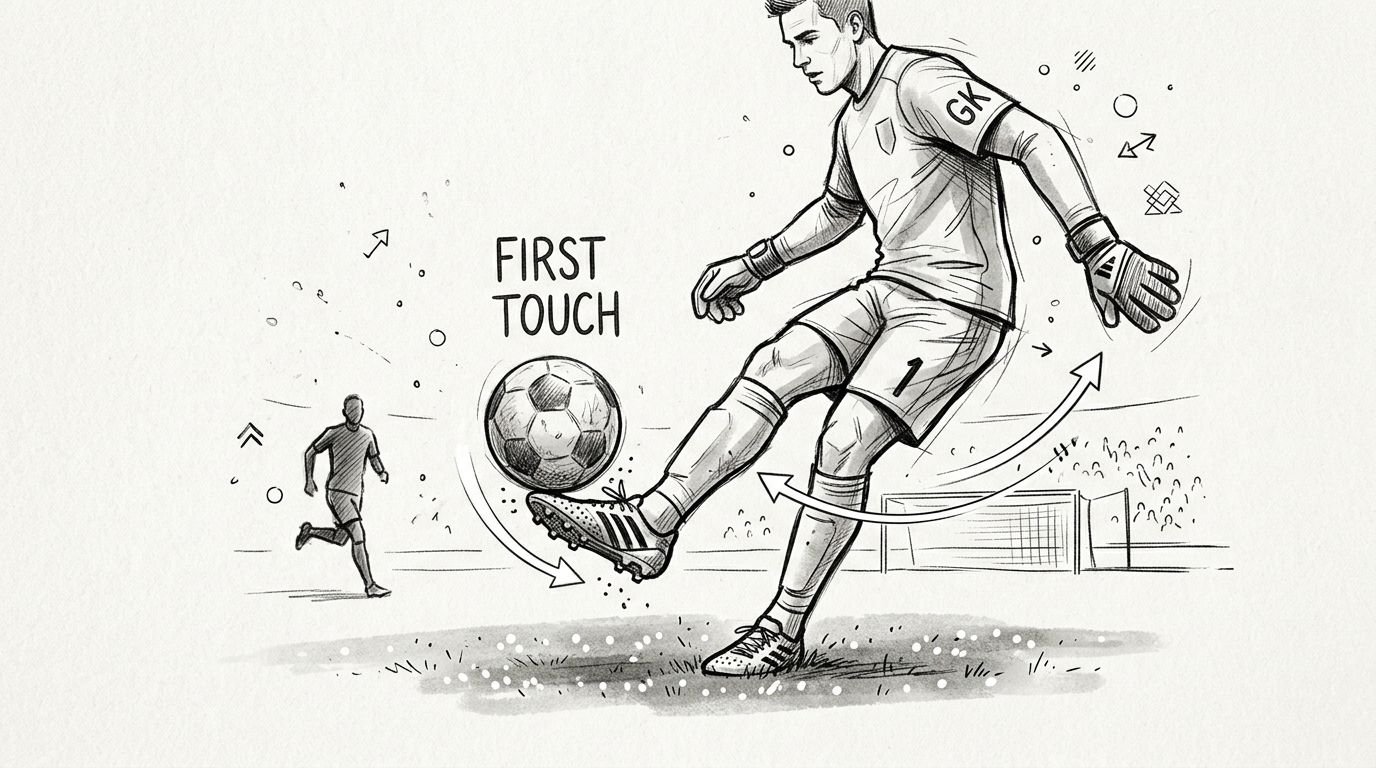
The First Touch Decides The Position
This drill should alternate between clean circulation and emergency recovery. Some repetitions should allow the goalkeeper to play short. Others should force a carry or driven longer pass after a poor angle or delayed support. That's closer to match reality, especially in City's build-up phases, where the goalkeeper often has to solve the consequences of an imperfect previous action.
The image below captures the technical demand. The body stays low, the first touch stays active, and the goalkeeper moves with intent rather than passive reception.
A few coaching interventions sharpen the exercise:
- Change The Passing Foot: Feed from left and right so the keeper can't become one-sided in body shape.
- Punish Static Starts: Restart the repetition if the goalkeeper waits flat-footed for the pass.
- Link To Team Structure: Add midfield and full-back targets so the pass choice reflects actual build-up options.
This is one of the clearest examples of why goalkeeper positioning drills must include possession logic. A technically clean touch that leaves no passing lane is still a bad action. At elite level, the goalkeeper's feet don't just control the ball. They control the geometry of the build-up.
4. Cross and Aerial Dominance Positioning
Cross defending starts long before the ball enters the six-yard area. The goalkeeper's first job is to read the source of service, the line of defenders, and the likely flight path. The second job is to place the body where two outcomes remain available. Claim if the delivery invites it. Hold if the delivery protects the attackers.
That distinction matters against teams that attack width well, and it matters in Premier League contexts where service quality varies from clipped far-post balls to driven near-post cut-ins. Manchester City has repeatedly faced this problem against opponents who refuse central access and instead attack the edge of the box, then deliver quickly before the block settles.
Reading Width Before The Delivery
A strong crossing drill shouldn't begin with the ball in the air. It should begin with the ball wide and the goalkeeper adjusting in relation to the centre-backs. Service then arrives from varying trajectories, with attackers contesting the space and defenders screening sightlines.
The underused coaching point is the recovery after the first intervention. Many public drills stop at the catch or punch, but modern positioning also has to prepare for the recycled ball. Adidas' goalkeeper drill discussion emphasizes movement that can switch between blocks, smothers, and quick adjustments to passes or bouncing balls, which is especially relevant for second-phase coverage and cut-backs in Adidas' goalkeeper training overview.
That's where this drill becomes tactically rich for City-style analysis. The goalkeeper cannot sell out entirely for the first cross if the weak-side attacker is waiting for the second action. A near-post stance must still allow recovery if the ball is nodded back across goal.
A cross isn't one event. For elite teams, it's often the first event in a chain.
Useful coaching cues include staying connected to the defensive line, timing the forward step to the crosser's touch, and demanding clear verbal ownership. If the goalkeeper arrives late, the jump becomes desperate. If the goalkeeper starts from the right depth, the jump becomes routine.
5. Reactive Positioning and Quick-Play Adjustments
The ball breaks at the top of the box, the first shot is blocked, and possession stays alive for two more touches. That is the moment that exposes a goalkeeper's positioning level. Initial alignment matters, but elite teams punish the reset between actions. Manchester City's model makes that demand even sharper because their high-possession structure often compresses the game into short, violent sequences around the penalty area.
Reactive positioning drills should therefore train reorientation, not just reflexes. The goalkeeper needs to recover foot placement, shoulder angle, and distance to the ball after each intervention. A save only solves the phase if the keeper can restore a balanced starting point before the next action arrives.
Training The Reset Between Actions
This drill works best when the coach builds a chain of related problems. Start with a central shot. Add a rebound into a crowded zone. Then play a short pass to either side for a second finish. The detail that matters is the goalkeeper's shape after the first contact. If the feet are square but heavy, the next push is late. If the shoulders stay open to the first shooter, the layoff to the far side becomes much harder to cover.
City offer a useful benchmark here. Their worst defensive moments rarely come from one clean action. They come from a partial solution that fails to settle the phase. The first block delays the attack, but it does not restore the team's structure. That pattern is clear in Manchester City's defensive lapses against transition threats, where one broken line creates a second decision and then a third.
For coaches, the implication is straightforward. Stop rewarding highlight saves that destroy the keeper's next position. Reward the rep where the goalkeeper deals with the first ball and is ready again inside the same sequence.
Use coaching cues that measure tactical control:
- Set before contact: If the goalkeeper is still drifting as the shot arrives, restart the rep.
- Reset on the shortest line: Recover with compact steps rather than exaggerated movement that opens new gaps.
- Change the visual problem: Add a screen, a deflection, or a disguised layoff so the keeper reads cues instead of memorizing a pattern.
- Limit the sequence length: Three or four actions are enough if every touch has purpose and match speed.
This is also where serious analysis separates reaction speed from positional discipline. An athletic goalkeeper may still reach the ball. A tactically stable goalkeeper arrives with the body shape to handle the next pass as well. In a Guardiola-style game model, that difference affects more than save percentage. It influences whether the block survives the phase or collapses after the first intervention.
6. Deep Positioning and Sweeper-Keeper Orchestration
A striker spins in behind from 45 metres, the centre-backs are holding near halfway, and the pass is released before the defensive line can turn. In that moment, goalkeeper positioning is no longer an isolated technical detail. It becomes the mechanism that protects the entire rest-defence structure.
That is why the sweeper-keeper drill should be coached as a team-spacing exercise with a goalkeeper intervention layered into it, not as a series of recovery sprints and clearances. In Manchester City's model, the goalkeeper's depth sets the upper limit of the back line. If the keeper starts too deep, the line must retreat earlier and the team loses territorial control. If the keeper starts too high without reading pressure on the ball, one clean release turns control into a footrace.
Reading Depth From Pressure and Access
The tactical question is simple, but the answer changes every few seconds. Can the opponent play forward with control, or are they receiving under pressure with limited passing access? The goalkeeper must read that before the pass, because a late read usually produces an emergency action rather than a controlled one.
A useful drill format places the back line high, gives the attacking unit repeated chances to play into the space behind, and forces the goalkeeper to adjust depth with every change in ball pressure, body shape, and passing lane. The coaching point is not raw aggression. It is calibrated starting position.
The best repetitions look quiet. The goalkeeper is already in the right corridor, already balanced, and arrives early enough to solve the problem with one touch.
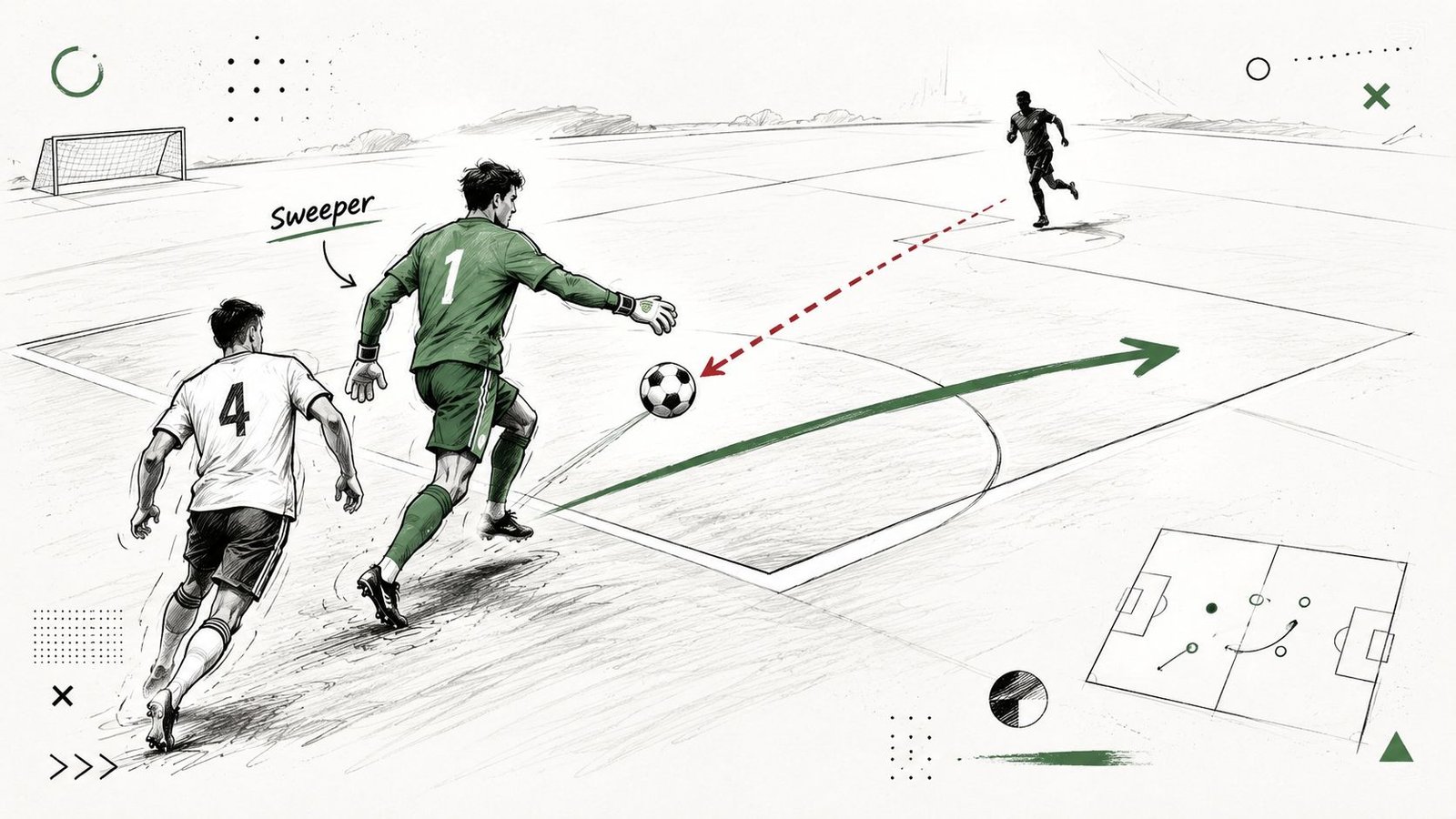
The sweeper-keeper moves when the pass becomes available, not when the danger is already obvious.
For coaches, the drill needs clear triggers tied to the opponent's capacity to hurt the line. If the ball carrier is pressed and facing his own goal or receiving on a poor angle, the goalkeeper can hold a higher starting point. If the ball carrier is stable, facing forward, and has time to clip or slide a pass, the goalkeeper must protect depth earlier. Manchester City's best defensive phases often depend on that shared reading between keeper and line, the same collective logic that also shapes City's set-piece and aerial control in defensive structure.
One more point matters here. Coaches often praise the final clearance, but the stronger rep starts earlier than that. The goalkeeper scans, adjusts two or three steps before the release, opens the body to play either forward or back toward goal, and makes the intervention from balance. That body orientation determines whether the keeper can clear first time, cushion the ball into a second action, or retreat if the through-ball is overhit.
Train the drill with variable pass types. Include straight balls, clipped passes, and angled releases from half-spaces. Add a rule that attackers can either play in behind or recycle once, because that prevents the goalkeeper from guessing off a fixed pattern. The objective is to build a keeper who protects depth while staying connected to circulation, which is the modern requirement in elite possession teams, not just a keeper who can sprint out of the box on command.
7. Set-Play and Standardized Restart Positioning
Set-plays punish inconsistency more brutally than open play does. The attacking side rehearses spacing, blocks, and delivery zones. If the goalkeeper changes the starting spot by a yard from one repetition to the next, the whole defensive picture shifts.
That's why standardized restart positioning should be trained with fixed landmarks and repeatable communication. The goalkeeper must know the reference point relative to the ball, the wall or first screen, and the strongest aerial threat. Defenders then need to hear the same commands every time so the team can recognize who owns which zone.
Building Repeatable Landmarks
This drill should move from clean, scripted deliveries to contested live balls. Early repetitions establish where the goalkeeper stands and when the first adjustment happens. Later repetitions test whether those rules survive movement, traffic, and noise.
Manchester City analysis has repeatedly shown how small errors in aerial organization can become decisive, especially when rest-defence habits from open play don't carry cleanly into dead-ball defending. That broader issue is reflected in Manchester City Analysis on the importance of set pieces and aerial dominance.
A strong set-play positioning drill should include:
- Consistent Starting Marks: Use field markings or cones so the goalkeeper can repeat the same reference.
- Opposed Traffic: Add blockers and runners to recreate sightline problems.
- Second-Ball Rules: Continue the rep after the first clearance so the goalkeeper must recover shape for the next delivery.
The hidden value here is leadership. A goalkeeper who owns the restart picture reduces indecision across the line. A goalkeeper who hesitates invites defenders to solve conflicting problems at once. In organized chaos, the keeper's position is the team's first instruction.
8. Distribution Pattern Recognition and Game-Model Positioning
The highest level of goalkeeper coaching doesn't isolate the goalkeeper from the team. It places the goalkeeper inside the team's tactical map. Positioning then changes according to where the side expects to recover the ball, how the press is set, and which passing lane the opponent is being invited to use.
That's the most useful way to understand Manchester City's benchmark. Their goalkeeper's role goes beyond occupying space near the goal and reacting to attacks. The goalkeeper often starts from a place that anticipates the team's next possession structure. In that sense, positioning becomes part of the game model itself.
Positioning Inside The Team Structure
A productive session can begin with shape work rather than shots. The team builds in one structure, loses the ball in a designated zone, then immediately shifts into rest-defence and pressing positions. The goalkeeper's job is to recognize where the likely regain or escape pass sits and to adjust depth and width accordingly.
One useful training example from modern goalkeeper work highlights this speed-of-decision principle. In a reaction drill, the goalkeeper starts facing away from goal, responds to a coach's command from 10 to 15 yards away, and repeats the action 20 times with different service locations, while another drill runs 8 to 12 repetitions around mannequins and cones to mimic visual traffic, as outlined in BlazePod's goalkeeper training examples. The tactical takeaway isn't just reaction speed. It's that modern goalkeeper positioning drills are built on repeated cue recognition under time pressure.
That principle connects well to team shape. A goalkeeper in a 4-2-3-1 structure and its positional implications will read support distances, central coverage, and rest-defence differently from a goalkeeper behind a more aggressive positional attack.
- Read Teammates First: The goalkeeper should scan the line and pivot cover, not just the ball.
- Tie Depth To Press Quality: If the press is stable, the keeper can hold advanced support. If the press breaks, recovery starts immediately.
- Make Distribution Part Of The Drill: Every recovery or regain should end with a pass choice that reflects the team model.
The position becomes modern. The goalkeeper isn't just defending the goalmouth. The goalkeeper is defending and accelerating the team's preferred way of playing.
8-Drill Goalkeeper Positioning Comparison
| Drill | Implementation complexity | Resource requirements | Expected outcomes | Ideal use cases | Key advantages |
|---|---|---|---|---|---|
| One-vs-One Distribution and Pressure Drills | High, realistic pressure progression and variable service | Skilled attackers/servers, varied service angles, protective measures, optional video | Faster decision-making under pressure; confident aerial claims and distribution | Preparing goalkeepers for high-press systems and sweeper-keeper roles | Realistic match simulation; improves distribution under pressure and spatial awareness |
| Box Positioning and Zone Coverage Mapping | Medium, systematic, repeatable sequences | Cones/zone markers, defenders to hold shape, video analysis | Consistent positional choices; reduced last-minute scrambling | Teaching relationship between GK and defensive shape; shot-prevention drills | Promotes proactive positioning and improved coordination with defense |
| Back-Pass Control and Foot-Skill Sequences | Medium, technical progression from simple to pressured situations | Multiple passing defenders, controlled pressure, video for technique review | Improved first touch, composure on the ball, smoother build-up distribution | Possession-dominant teams; build-up play sessions | Enhances foot skills and reduces errors in back-pass scenarios |
| Cross and Aerial Dominance Positioning | Medium–High, varied trajectories and contested aerial work | Quality crossers, attacking challengers, protective safety measures, film optional | Stronger aerial command; better claim vs punch decisions and communication | Preparing for wide attacks and high-cross frequency opponents | Builds aerial dominance, communication and reduces set-piece concessions |
| Reactive Positioning and Quick-Play Adjustments | High, unpredictable, high-tempo sequences | Multiple servers, shooters, varied service types, recovery protocols | Improved reflexes, explosive lateral movement and chaos management | Training for transitions, high-press/quick-release match periods | Develops agility and shot-stopping from unpredictable scenarios |
| Deep Positioning and Sweeper-Keeper Orchestration | High, tactical triggers and live defensive coordination | Live defenders, through-ball servers, tactical briefings, video analysis | Effective interception of through-balls; initiates play from deep | Teams operating a high defensive line and possession initiation | Prevents dangerous through-balls and enables proactive playmaking |
| Set-Play and Standardized Restart Positioning | Medium, structured repetition with variants | Full defensive unit, attacking patterns, markers, video review | Consistent set-piece positioning; clearer command and anticipation | Preparing for corners, free-kicks and organized attacking plans | Improves organization, leadership and repeatable set-piece responses |
| Distribution Pattern Recognition and Game-Model Positioning | High, integrated team-tactical sessions | Full team participation, coaches, tactical briefings, match video | GK aligned with team recoveries and press triggers; enhanced tactical intelligence | Embedding goalkeeper into the team game model and recovery phases | Promotes cohesion with team tactics and pattern recognition across phases |
INTEGRATING DRILLS INTO YOUR GAME MODEL
These drills matter most when they stop being isolated exercises and start becoming part of the team's tactical language. That's the critical lesson from elite environments and from any close reading of Manchester City's structure. The goalkeeper's position influences pressing height, rest defence, build-up security, cross protection, and second-phase stability. If those ideas are coached separately, the goalkeeper improves in fragments. If those ideas are coached together, the goalkeeper starts to shape the whole match.
A useful weekly plan doesn't need to overload volume. It needs to connect themes. One session might pair back-pass control with deep sweeping decisions because both depend on body shape before the ball arrives. Another might pair crossing work with reactive second-ball sequences because both punish poor recovery posture after the first intervention. The point isn't variety for its own sake. The point is tactical transfer.
Manchester City offers the clearest benchmark because the team asks so much of the position. The goalkeeper must support circulation like an extra defender, manage open space behind a high line, and still solve chaotic penalty-box moments against elite attackers. That combination changes how coaches should think about goalkeeper positioning drills. The best drill isn't the one that creates the most dramatic save. It's the one that teaches the goalkeeper to arrive early, set cleanly, and reduce the attacker's best option before the shot even happens.
Video review should sit alongside the on-pitch work. Coaches don't need inflated metrics to spot progress. They can track whether the goalkeeper is reaching a balanced set earlier, whether the first touch creates cleaner passing lanes, and whether recovery positions after crosses or rebounds are becoming more stable. Those are visible coaching outcomes, and they usually tell more than a highlight save does.
Load management matters as well. Reactive and transition-based drills create cognitive fatigue, not just physical fatigue. Once the goalkeeper's footwork becomes sloppy or the reset timing starts to disappear, the session has crossed from learning into noise. Better to stop early and preserve clean repetitions than to stack more reps that train the wrong picture.
For coaches building serious training plans, the strongest approach is simple. Pick one or two drills that match the team's current tactical problems. Coach the positioning details relentlessly. Then connect every repetition back to the match model. A team that wants to dominate territory needs a goalkeeper who understands territory. A team that wants to control transitions needs a goalkeeper who can position for the second and third action, not just the first. Physical preparation also plays a role in sustaining those movements across the week, especially when paired with sound guidance on how to prevent soccer injuries.
The result is a goalkeeper who does more than save shots. The result is a goalkeeper who makes the entire system more secure, more flexible, and more aggressive.
Manchester City Analysis publishes the kind of tactical work that helps coaches, analysts, and serious supporters connect training-ground detail to match-day structure. Readers who want more breakdowns on Guardiola's game model, defensive organization, and elite positional ideas can explore more at Manchester City Analysis.