A loose ball breaks at the edge of the area, the midfielder arrives one beat later than everyone else, and the finish looks inevitable before the pass is even played. That sequence became a familiar Manchester City pattern when İlkay Gündoğan operated as Guardiola's roaming interior, not because he ran everywhere, but because every run had tactical timing.
The modern box to box midfielder is often reduced to stamina and effort. That misses the point. At elite level, this role is a structural solution. It connects pressing, circulation, occupation of half-spaces, and late-arriving penalty-box threat. At Manchester City, that matters even more because Guardiola's best midfielders haven't merely crossed the pitch vertically. They've manipulated it diagonally, arriving where the system needs superiority rather than where tradition says a central midfielder should stand.
Table of Contents
- INTRODUCTION
- A TACTICAL HISTORY OF THE ENGINE ROOM
- THE ROLE IN GUARDIOLA'S MANCHESTER CITY
- MEASURING THE UNMEASURABLE DATA BEHIND THE ROLE
- PLAYER CASE STUDIES GÜNDOĞAN AND BEYOND
- COACHING AND SCOUTING THE MODERN BOX TO BOX MIDFIELDER
- CONCLUSION
INTRODUCTION
The phrase box to box midfielder still carries an old football image. It suggests mud, long strides, second balls, and endless running. That image isn't wrong, but it's incomplete. In modern elite football, especially in Guardiola's environment, the role has become far more precise.
A top-level box to box midfielder contributes in every phase. The player supports circulation in build-up, protects central spaces when possession is lost, presses forward at the right trigger, and then appears in the final third with enough composure to make the last action count. The role sits at the intersection of industry and interpretation. That's why it remains one of football's hardest profiles to teach and one of the easiest to misidentify.
THE ROLE IS BUILT ON FOUR DEMANDS
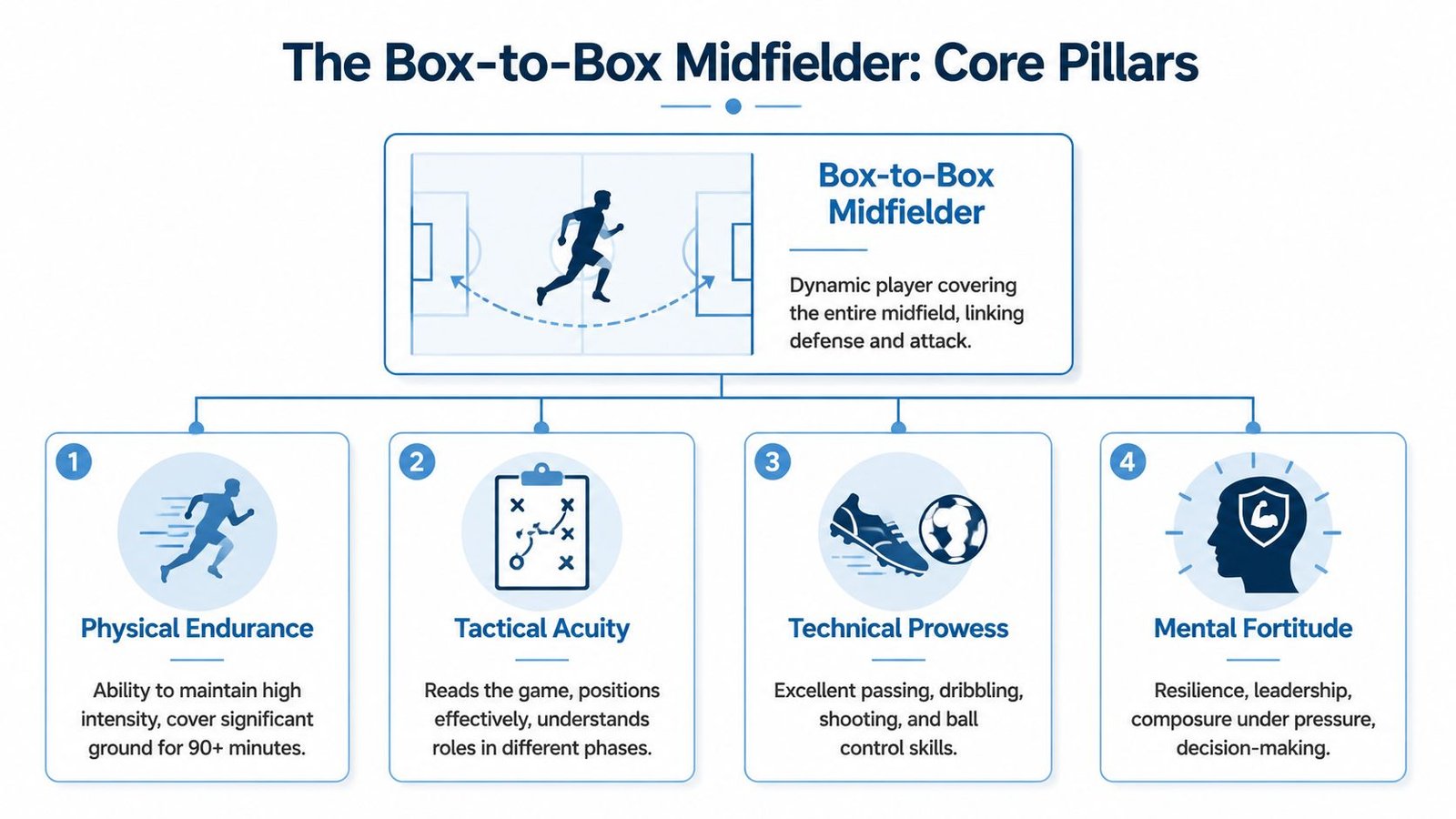
The role rests on four connected pillars.
- Physical endurance matters because the player has to repeat actions in both directions. The best examples don't just cover ground. They still arrive with quality late in matches.
- Technical prowess separates useful runners from elite midfielders. A box to box midfielder has to receive under pressure, release cleanly, carry through traffic, and finish with minimal backlift.
- Tactical acuity decides whether movement helps the team or wrecks its spacing. Timing is the role.
- Mental fortitude keeps the player active after errors, turnovers, and heavy physical loads.
A box to box midfielder is football's all-phase connector, influencing possession, transition, pressing, and penalty-box occupation within the same match.
That definition becomes clearer when the role is compared with more fixed midfield jobs. A holding midfielder protects structure first. A pure attacking midfielder hunts creation first. The box to box midfielder has to read which of those tasks is needed in the moment, then switch quickly enough that the team still looks coordinated.
For coaches working across different systems, the role also changes shape inside the formation. In a back-three build-up, the player may attack from the half-space. In a double pivot, the player may carry more defensive balancing work. In a shape like the 4-2-3-1 structure breakdown, the same player can become the runner beyond the 10 or the midfielder who stabilises rest defence after an attack breaks down.
WHY THE ROLE IS HARD TO COACH
Many midfielders can do two parts of the job. Very few can do all four. The player must know when to hold beside the pivot, when to underlap the winger, when to support circulation one line behind the ball, and when to sprint beyond the striker line.
That's why the role can't be assessed only through visible effort. Running is the entry point, not the end point. The best box to box midfielders don't move more than everyone else for the sake of it. They move where tactical pressure is about to appear.
A useful coaching lens is to treat the role as a chain of decisions rather than a list of attributes:
- Read the structure
- Judge the space
- Arrive at the right height
- Execute the action cleanly
Without that sequence, the midfielder becomes chaotic. With it, the player becomes the team's hidden organiser.
A TACTICAL HISTORY OF THE ENGINE ROOM
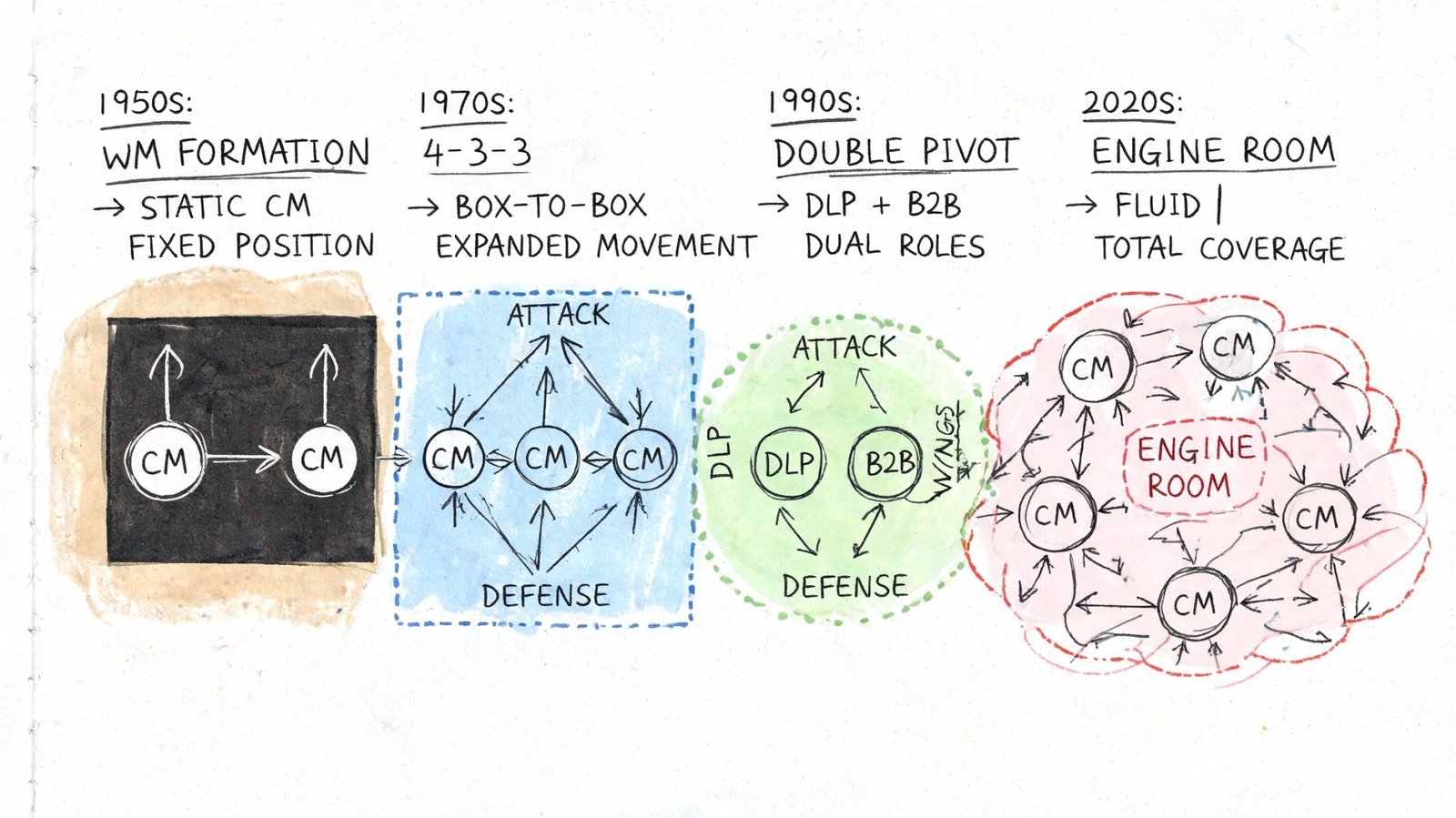
The role began as football's labour position and evolved into one of its most intelligent ones. Early versions of the box to box midfielder were celebrated for appetite, aggression, and territory coverage. The best of those players gave sides emotional force. They pushed matches uphill for opponents.
FROM RUNNER TO CONTROLLER
As tactical structures became denser, the role changed. Midfielders could no longer survive as pure ball-winners who occasionally burst forward. Teams started demanding press resistance, cleaner passing, and sharper positional reading. That's where the continental model added sophistication.
Lothar Matthäus stands as the historic benchmark in the verified material. His legacy from 1978-2000 is presented as the complete midfield profile, combining power, technique, and intelligence in a way that shaped the modern hybrid role. He was not just a runner between areas. He was a player who could govern transitions, defend aggressively, and still decide attacks with quality.
The box to box midfielder became elite when the role stopped being about distance alone and started being about influence across phases.
That shift matters because modern football compresses central space. A midfielder now receives under more pressure, defends larger spaces after turnovers, and operates inside structures designed to trap or isolate them. The old engine-room profile had to become cleaner and smarter.
THE BOX MIDFIELD CHALLENGE
The latest tactical wrinkle is the rise of structured central overloads, especially the box midfield. Guardiola and others have used square central occupations to create stable passing angles, secure possession, and dominate access to the middle. On paper, that can reduce the need for a free-roaming box to box midfielder. In practice, the issue is more complicated.
In modern Manchester City setups, the traditional role faces a specific tension. When a key holding midfielder such as Rodri is absent, progressive pass completion can drop by 15% in box-midfield structures due to limited passing angles, yet players with box to box traits create 20% more shot-creating actions against low blocks in 2025/26 data, according to FourFourTwo's discussion of the box midfield.
That creates an important conclusion. Structured midfield squares improve control, but they can flatten surprise. A true box to box midfielder restores vertical disorder inside an otherwise ordered possession game. Against deep defending opponents, that's often the missing ingredient.
THE ROLE IN GUARDIOLA'S MANCHESTER CITY
Manchester City's version of the role isn't built on box-to-box chaos. It's built on choreography. Guardiola's interiors, especially the advanced 8s, operate with freedom inside a highly managed positional framework. They don't abandon zones. They rotate through them with purpose.
THE FREE 8 IN POSITIONAL PLAY
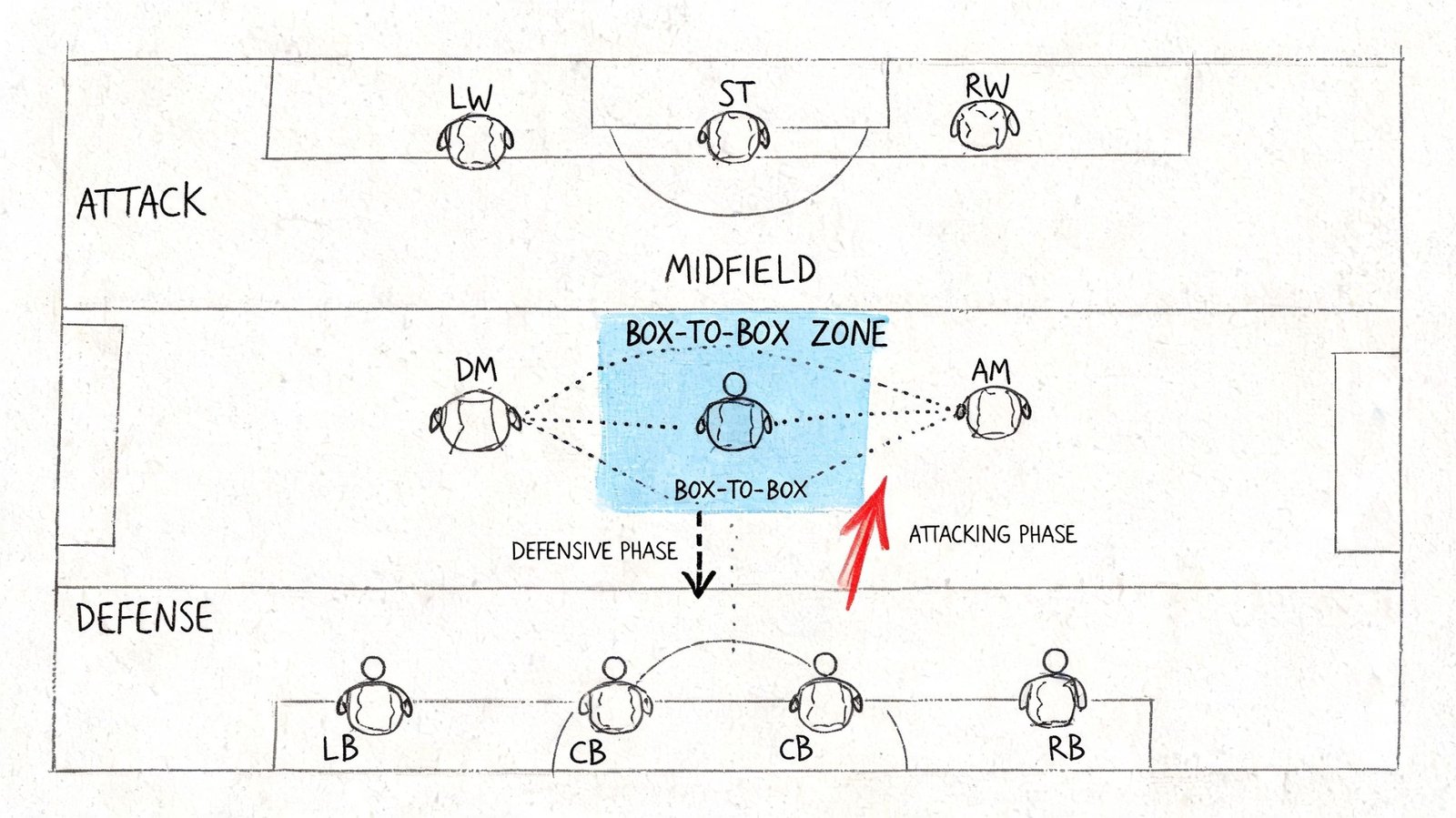
At City, the role is closest to what might be called a free 8. The player begins as an interior midfielder, but the actual job changes by phase.
In settled build-up, the box to box midfielder often supports circulation around the pivot. In the middle third, that same player may appear between lines to connect with the winger or full-back. In the final third, the responsibility shifts again. The midfielder attacks the half-space, underlaps the wide player, or arrives at the far post.
This is why Gündoğan fit the system so well. His best actions often looked simple because the timing was exact. He didn't attack the box at random. He waited for the defender's attention to be pulled elsewhere, then occupied the blind side. That's the Guardiola twist on the classic role. The running remains. The randomness disappears.
A broader tactical explanation of this environment appears in Guardiola's winning philosophy and elite squad structure, where City's midfielders are framed less as fixed positions and more as moving reference points inside possession.
WHY THE 4 3 3 MATTERS
The strongest verified evidence for this interpretation comes from Football Manager simulation work. In 20 trials of a 4-3-3, the box to box midfielder averaged 0.85 shots, 38 passes at 89% accuracy, 1.15 key passes, 8.2 successful dribbles, 13.255 kilometres covered, and 3 tackles. In another 20 trials within a 4-4-2, the outputs changed to 0.35 shots, 42 passes at 87% accuracy, 1.95 key passes, 1.15 dribbles, 13.52 km covered, and 2.7 tackles, according to Evidence Based Football Manager's simulation analysis.
The important takeaway isn't that one shape is universally better. It's that the role changes character with the structure around it. In the 4-3-3, the midfielder becomes more of a shooting and dribbling threat. In Guardiola terms, that aligns with the interior attacking narrower lanes and exploiting destabilised central spaces.
The visual explanation below helps frame how those rotations look in practice.
For City, that means the ideal box to box midfielder doesn't just support possession. The player gives possession a point. Without that, circulation can become sterile. With it, possession gains incision.
MEASURING THE UNMEASURABLE DATA BEHIND THE ROLE
The box to box midfielder often escapes clean statistical definition because the role sits between categories. It isn't purely creative, purely defensive, or purely transitional. That doesn't mean analysis should become vague. It means the correct metrics need to be combined rather than isolated.
WHICH METRICS ACTUALLY MATTER
The first useful category is attacking involvement. Goal involvements and shot-creating actions show whether the midfielder turns movement into threat. The second is defensive interruption, where blocks, tackles, and related actions indicate whether the player contributes when the team loses the ball. The third is ball progression, which includes carries and passing into advanced zones. The last is circulation security, usually reflected in strong pass completion and clean decision-making under pressure.
The verified material identifies these supporting indicators around elite performers: dribbles, carries, touches in the attacking third, key passes into the penalty area, passes and carries to the final third, shots on target, and fouls won. That collection matters because no single number captures the role.
Analyst's rule: evaluate the box to box midfielder through a portfolio of actions. A player who only scores isn't complete. A player who only covers ground isn't complete either.
BOX TO BOX MIDFIELDER METRIC COMPARISON PER 90 MINS
The table below uses only the verified numbers available.
| Player | Goal Involvements | Shot-Creating Actions (SCA) | Progressive Carries | Tackles + Interceptions |
|---|---|---|---|---|
| İlkay Gündoğan | 12 | 3.44 | Qualitatively strong carrying profile | Qualitatively active defensive output |
| Nicolò Barella | 14 | 4.05 | Qualitatively strong carrying profile | Qualitatively active defensive output |
| Jude Bellingham | 11 | 3.16 | Qualitatively strong carrying profile | Qualitatively active defensive output |
| Leon Goretzka | 6 | 3.87 | Qualitatively strong carrying profile | Qualitatively active defensive output |
| Bruno Guimarães | 9 | 3.09 | Qualitatively strong carrying profile | Qualitatively active defensive output |
According to The Mastermind Site's box to box midfielder analysis, Gündoğan posted 12 goal involvements and 3.44 SCA, Barella led this sample with 14 goal involvements and 4.05 SCA, while Bellingham recorded 11 goal involvements and 3.16 SCA. The same source also notes Bellingham's 2.06 blocks, Goretzka's 1.10 blocks, Gündoğan's 0.92 blocks, and Bruno Guimarães' 1.68 blocks, while describing pass accuracy as typically above 85% for this class of midfielder.
The hidden conclusion from that group is stylistic diversity. Barella reaches the role through volume and activity in creation. Gündoğan reaches it through timing and system fit. Bellingham adds stronger defensive interruption. The role has a common job description, but not a single aesthetic.
PLAYER CASE STUDIES GÜNDOĞAN AND BEYOND
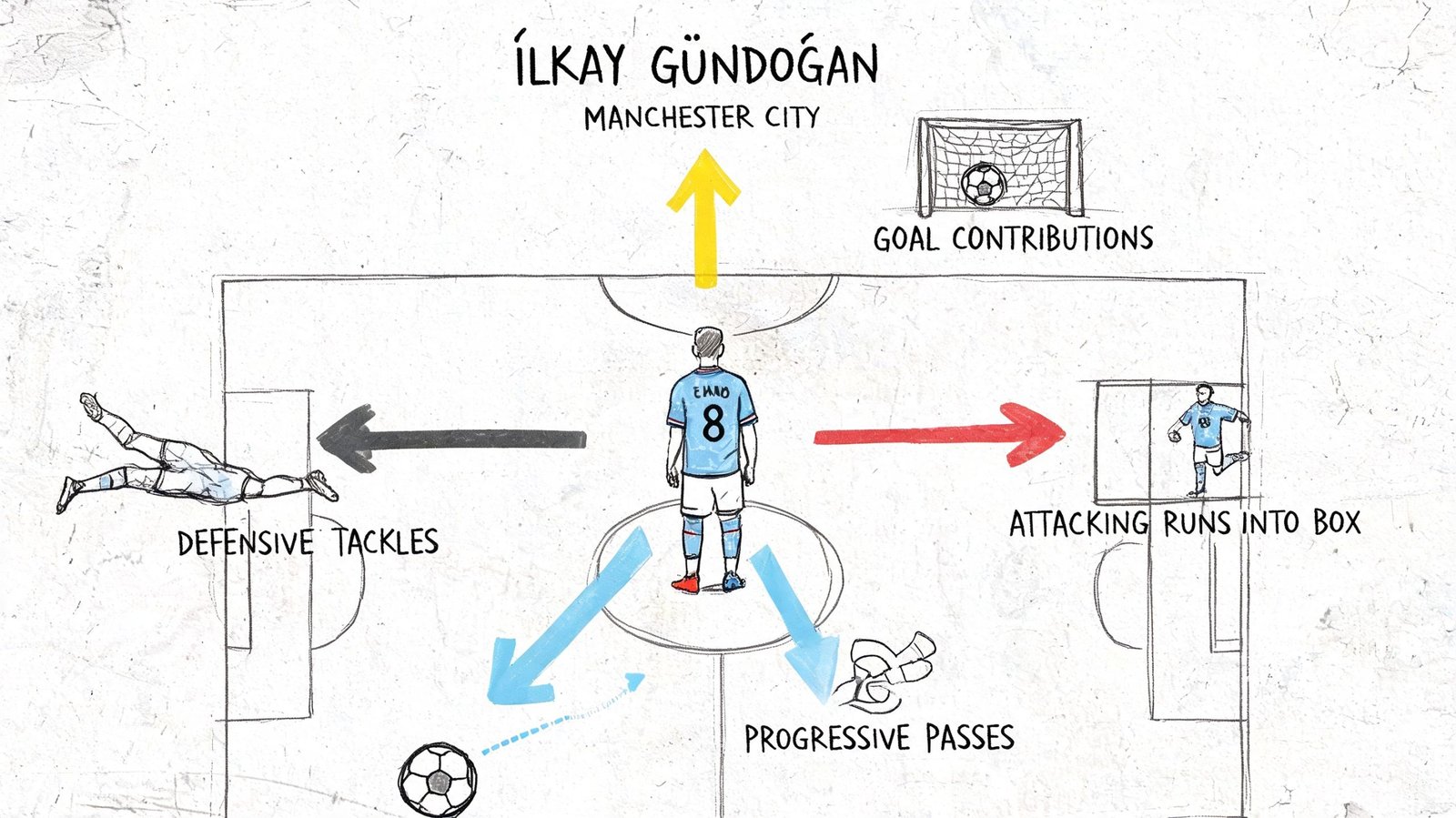
The best Manchester City case study remains Gündoğan because he embodied the role without advertising it. He rarely looked like a classic end-to-end midfielder in the old dramatic sense. Instead, he appeared exactly where the game was about to open.
GÜNDOĞAN AS CITY'S REFERENCE POINT
What made Gündoğan such a useful Guardiola midfielder was the blend of restraint and attack. During City's longer possession spells, he could act almost as a safety valve, recycling play and preserving rhythm. Then, once the opposition line narrowed toward the ball, he attacked the gap between full-back and centre-back or drifted onto a loose second ball at the edge of the area.
That kind of movement is difficult to defend because it arrives from midfield depth. Defenders naturally orient themselves to the striker and winger first. The late-arriving 8 enters the scene after those decisions have already been made.
The verified profile strengthens that reading. Gündoğan's peak output of 12 goal involvements and 3.44 shot-creating actions per game placed him among the standout all-phase midfielders in Europe in the source material already cited earlier. The significance for City isn't only production. It's where that production comes from. It comes from structure-aware movement.
For readers who want a City-specific breakdown of that season, Gündoğan's 2022-23 data and tactical analysis offers a focused companion piece.
DIFFERENT ELITE INTERPRETATIONS
Goretzka represents a more forceful version of the role. His game leans into physical pressure, direct surges, and presence in duels. Barella offers a more restless and creative interpretation, with constant involvement in combinations and final-third activity. Bellingham adds defensive disruption and broad attacking influence at a young age.
A coach should treat those differences carefully. The role doesn't need replication. It needs fit.
- Gündoğan type suits possession-dominant teams that want delayed attacking runs and calm under pressure.
- Barella type suits teams that need permanent tempo in circulation and repeated final-third involvement.
- Goretzka type helps sides that value power, duel-winning, and direct territorial gain.
- Bellingham type offers the broadest all-phase profile, combining attacking output with stronger defensive interruption.
The most valuable box to box midfielder isn't the one who does the most. It's the one who solves the most problems without damaging the team's spacing.
That distinction explains why some energetic midfielders never become elite interiors for positional-play sides. Energy is useful. Interpretation is decisive.
COACHING AND SCOUTING THE MODERN BOX TO BOX MIDFIELDER
Developing a box to box midfielder starts with resisting the obvious mistake. Coaches often train the role as an endurance project. That builds runners. It doesn't automatically build midfielders who understand when to run, where to arrive, or what to do on arrival.
WHAT COACHES SHOULD TRAIN
The most useful training work connects physical demand to football decisions.
- Transition rondos sharpen the switch from support play to counterpressing. The midfielder learns to receive, release, and react in the same sequence.
- Shuttle patterns into finishing actions help coach late arrivals. The run matters less than the body shape and timing of the final touch.
- Small-sided games with overload rules teach spacing. A midfielder who learns when not to join the attack often becomes more dangerous when finally doing so.
The role also demands active load management. A 2025 UEFA report highlighted that box to box midfielders covering 12+ km per game suffer 28% more hamstring injuries than players in more specialised roles, according to the verified source at BMWzzz's discussion of stamina and transition play.
That detail should change coaching behaviour. The solution isn't to reduce ambition. It's to organise exposure.
Practical rule: if a midfielder repeatedly carries extreme running loads, rotation becomes part of performance, not a concession to it.
The same verified source also points to a coaching takeaway around GPS thresholds, rotating players who consistently exceed defined limits so they can preserve late-game effectiveness. That's especially relevant in high-possession teams, where the same midfielder may perform long recovery runs after spending much of the game supporting attacks.
WHAT SCOUTS SHOULD PRIORITISE
Scouting the role requires a broader eye than many recruitment models allow. The player may not dominate one category enough to stand out in a narrow search. The profile often reveals itself in combinations.
A scout should look for three things above all:
- Phase recognition. Does the player understand whether the team needs support, pressure, or depth?
- Acceleration into action. Not just speed, but the capacity to burst at the exact moment space opens.
- Technical calm after effort. Many players can arrive in the box. Fewer can arrive and still finish or pass cleanly.
There's also a useful negative indicator. If the player's best clips are all in open-field transition, caution is needed. Elite possession sides ask the box to box midfielder to solve crowded problems in central zones. The role only becomes top-level when the player can combine control with intensity.
CONCLUSION
The box to box midfielder remains one of football's richest roles because it resists simplification. It isn't just about distance covered, even though endurance remains fundamental. It isn't just about goals or final-third actions, even though those matter. The role sits in the spaces between categories, linking build-up to attack, attack to rest defence, and rest defence to the next attack.
At Manchester City, Guardiola has refined rather than discarded the role. The old image of the charging central midfielder survives, but inside stricter positional logic. That's why players such as Gündoğan became so valuable. They translated effort into structure and structure into threat.
The future of the role may depend on that same adaptability. Football keeps becoming more specialised, more automated, and more data-driven. That only increases the value of midfielders who can solve multiple tactical problems inside one match.
Manchester City supporters who want sharper tactical breakdowns, coaches looking for practical ideas, and analysts tracking Guardiola's latest adaptations can find more detailed work at Manchester City Analysis.