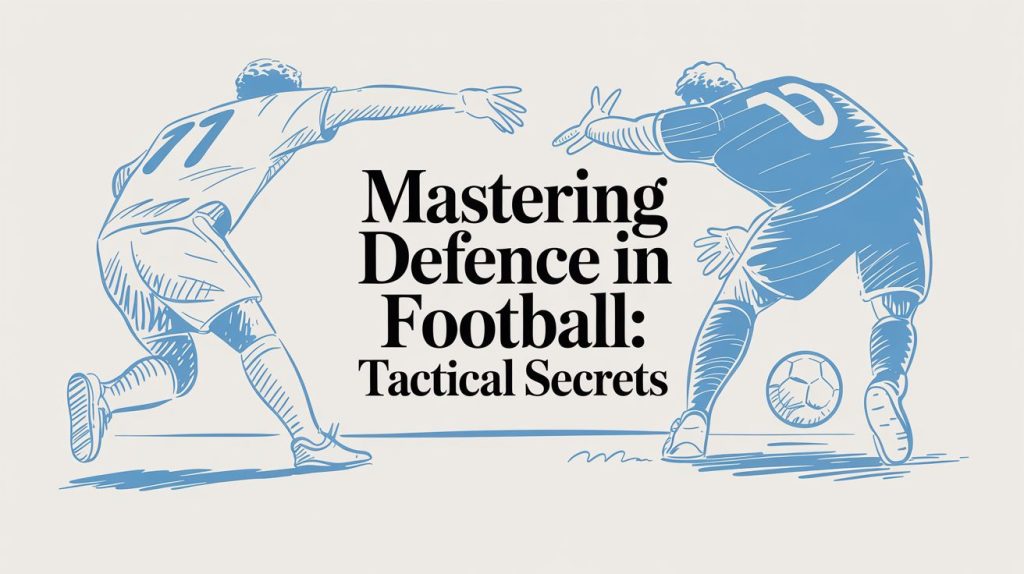
A loose clearance drops at the top of the box. Manchester City's first defender doesn't dive in, the second doesn't get dragged toward the ball, and the far-side midfielder narrows the lane that looked open a second earlier. The attack dies not because of one heroic tackle, but because every blue shirt arrives in the right place at the right moment.
That is modern defence in football. It isn't a chain of desperate interventions. It's a system for controlling space, forcing weaker decisions, and turning the opponent's next touch into a trap. The best defensive teams don't wait for danger to appear. They shape where danger is allowed to travel.
Manchester City offer the clearest working model for this idea because their defensive problems are unusually demanding. A high-possession team spends long stretches attacking, which means its defenders must protect large spaces when possession turns over. Their back line often has fewer obvious “defensive” actions than defenders on weaker sides, yet the quality of each action matters more. One missed press, one delayed recovery run, or one midfielder arriving late to cover the half-space can expose the entire structure.
That's why defensive analysis has moved beyond the old habit of counting tackles and calling it insight. City's matches show that defending begins with compactness, continues through pressing and recovery, and only ends once the side has restored control of the pitch. The shape changes. The roles shift. The principles don't.
Table of Contents
- INTRODUCTION
- THE CORE PRINCIPLES OF MODERN DEFENDING
- THE THREE PHASES OF DEFENSIVE ACTION
- DEFENSIVE STRUCTURES AND FORMATIONS IN PRACTICE
- INDIVIDUAL ROLES FROM THE DEFENDER TO THE FORWARD
- HOW TO MEASURE DEFENCE WITH ANALYTICS AND METRICS
- CONCLUSION
INTRODUCTION
A coach watching City defend has to resist the obvious. The obvious moment is the tackle, the block, the clearance off the six-yard line. The important moment often arrives earlier, when a midfielder cuts one passing lane, a full-back holds his line instead of chasing, and a centre-back stays connected rather than stepping into a duel he can't win cleanly.
That's why elite defending looks calmer than it feels. The players are making constant calculations about distance, body orientation, cover shadows, and whether the next action should be pressure or delay. Guardiola's teams are a strong reference point because they treat defending as part of possession football. When City have the ball, they're already arranging the players who'll defend the next transition. When City lose the ball, they don't merely react. They try to dictate the next pass.
For aspiring coaches, that distinction matters. A team that sees defending as emergency response will train last-ditch actions. A team that sees defending as spatial control will train distances between lines, pressing cues, midfield cover, and recovery routes. The second model produces fewer dramatic clips, but it produces more stable matches.
Practical rule: The best defensive action is often the one that prevents the duel from happening at all.
The game film usually confirms that point. One sequence might begin with a winger closing from the outside to lock the ball inside. Another might depend on the holding midfielder arriving just early enough to block the split pass. A third might be won by the goalkeeper starting high and shrinking the space behind the line. Each action belongs to a single chain.
Modern defending, then, has to be read on three levels at once:
- Principles: Compactness, pressure, cover, balance, and delay.
- Phases: Press, block, and recovery.
- Roles: Every player contributes, from striker to goalkeeper.
City's system makes those layers visible because the margins are so fine. Their defenders often operate with large spaces behind them and technical opponents in front of them. That environment exposes every structural mistake. It also reveals how good defending isn't passive resistance. It's coordinated problem-solving under pressure.
THE CORE PRINCIPLES OF MODERN DEFENDING
The most useful way to coach defending is to stop treating it as a formation and start treating it as a set of relationships. The distances between players matter more than the chalkboard label. A nominal 4-3-3 can defend compactly or badly. The structure only works if the principles inside it are sound.

COMPACTNESS CREATES THE CAGE
Compactness is the foundation. It is the act of shrinking the playable space around the opponent so that every forward option feels crowded. The team becomes a moving cage, not by sprinting wildly toward the ball, but by reducing the size of the area the attack can exploit.
In a City context, compactness is rarely flat or purely horizontal. It is layered. The nearest player pressures. The next line screens central access. The far side narrows in case the ball is switched. What matters isn't just being close together. It's being close together around the spaces that matter most.
When the shape loses compactness, the opponent's decisions become easy. The pass into midfield arrives cleanly. The bounce pass around the corner becomes available. The runner beyond the line doesn't need disguise because the covering distances are too long.
PRESSURE COVER BALANCE AND DELAY
Pressure is the visible part of defending. It's also the principle most often misunderstood. Good pressure doesn't mean charging. It means approaching with a purpose. The presser should shape the ball-carrier toward the least dangerous option, ideally toward the touchline, the weaker foot, or a teammate already waiting to engage.
Cover is what keeps pressure from becoming reckless. If the first defender is beaten, the second defender must already be positioned to absorb the next action. FIFA's Johnson Defending Principles framework describes this sequencing clearly. When the ball moves to a full-back, the nearest midfielder must press while the far-side midfielder tucks in centrally to cover the space left open. Teams that miss that coordinated 2-3 second reaction window typically concede 15-20% more progressive passes in the final third, according to the FIFA Training Centre's Johnson Defending Principles framework.
Balance is the protection against the switch and the second phase. City's far-side players often look uninvolved to casual viewers. They aren't. They are preventing the next problem. Balance is why one side can press aggressively without exposing the other side of the pitch.
Delay becomes essential once the first line is broken. Not every situation can be won immediately. Sometimes the defender's job is to slow the attack long enough for the block to recover. Delay turns a broken structure into a recoverable one.
A useful coaching checklist looks like this:
- Compactness first: Close central lanes before chasing the ball.
- Pressure with an angle: Force the touch where support exists.
- Cover underneath: Assume the first duel might be lost.
- Balance the far side: Protect against the switch before it happens.
- Delay when beaten: Buy time for the unit to reset.
Good defending isn't a collection of solo wins. It's a chain in which each player makes the next player's job easier.
THE THREE PHASES OF DEFENSIVE ACTION
Defending changes character depending on where the ball is, how secure the team's shape is, and whether possession has just changed hands. The same principles still apply, but the team expresses them differently in each phase.

THE HIGH PRESS AS AN ATTACKING DEFENSIVE TOOL
The high press is the most aggressive defensive phase because it tries to win the ball near the opponent's goal. For City, this phase often begins the instant possession is lost. The nearest players collapse on the ball, but the more important movements happen around them. Passing lanes are closed before the tackle is attempted.
The key point for coaches is that the high press isn't random intensity. It depends on triggers. A poor first touch, a backward pass, a receiver facing his own goal, or a pass into a wide player near the touchline can all trigger the jump. The striker's run matters because it curves the ball one way. The winger's starting position matters because it determines whether the full-back can receive facing forward.
When a team presses well, the opponent doesn't merely lose the ball. The opponent loses access to the parts of the pitch where clean progression begins.
MID BLOCK AND LOW BLOCK AS CONTROL MECHANISMS
When the first press is bypassed, elite teams don't keep chasing. They reorganize. That shift from press to block is one of the most important moments in modern defence in football. The side has to decide whether to engage immediately or compress the space in front of its own back line.
A mid-block is usually the preferred compromise for a side like City when the counter-press doesn't land. It preserves access to forward pressure while denying easy central progression. The front players screen. The midfield line stays connected. The back line protects depth without retreating too soon.
A low block appears when territory has already been lost or the opponent has forced the defence backward. At that point the priorities change:
- Protect the penalty area: Defend the zone of highest consequence.
- Track cut-back lanes: Many attacks survive the first cross and score on the second pass.
- Maintain line integrity: A single defender jumping out can open the seam.
- Clear with direction when possible: Blind clearances often restart the attack.
A useful related study of structural stress appears in this analysis of how Liverpool exploited City's defensive vulnerabilities, where the issue involved more than losing duels. It was losing the spacing that made the next duel manageable.
RECOVERY RUNS REST DEFENCE AND TRAP ESCAPE
Recovery is the phase that punishes teams with poor preparation. If the attacking structure leaves players ahead of the ball with no protection underneath, defenders end up running toward their own goal in unstable numbers. City's best defensive transitions come when the “rest defence” is already in place before possession is lost.
This is also where modern pressing has become more advanced. Some sides now bait pressure instead of merely resisting it. Post-2025 World Cup analysis by InStat found that 12 of the top 20 leagues adopted feint alignment, where midfielders feign runs to bait pressing traps, and that this reduced opponent PPDA by 9 points, as discussed in this video analysis of hybrid pressing traps and feint alignment. The coaching implication is sharp. Recovery defending is no longer just about sprinting back. It's about recognizing when the opponent is trying to manipulate the press itself.
The team that loses shape in transition rarely regains control with effort alone. It needs pre-built spacing.
That is why City's defensive quality often depends on players who aren't making the final tackle. The midfielder holding a central lane, the full-back staying slightly narrower before the turnover, and the centre-back resisting the urge to follow a decoy run all shape whether recovery becomes control or chaos.
DEFENSIVE STRUCTURES AND FORMATIONS IN PRACTICE
Formations are useful shorthand, but they serve as poor explanations. A 4-3-3 is only a reference point for where players begin, not where they defend every action. Coaches who analyse shape as static lines miss how elite teams move.

THE SHAPE ON PAPER IS NOT THE SHAPE IN PLAY
Manchester City often start from a 4-3-3 reference, yet the defensive picture changes immediately once the ball moves. In a mid-block, the wide forward may drop to flatten the midfield line. In the press, one attacking midfielder may step next to the striker and create a temporary front two. In deeper defending, the full-backs may narrow to protect the half-spaces first and only then jump wide.
That fluidity is the structure. The shape bends around the ball, the opponent's spacing, and the available cover. Coaches should ask three questions instead of one formation question:
| Situation | Better coaching question | On-pitch consequence |
|---|---|---|
| Ball wide | Who presses and who tucks in? | Determines whether the half-space stays closed |
| Ball central | Who screens the forward pass? | Decides whether the opponent can play through lines |
| Ball switched | Which far-side player protects the weak side? | Prevents overloads after circulation |
The labels still matter, but only as a starting language. For readers interested in contrasting stable and fluid structures, this breakdown of the 4-2-3-1 shape is useful because it highlights how roles shift once the ball starts moving.
HOW OPPONENTS READ THE SHAPE
Elite attacking teams don't just react to a formation board. They read cues in real time. One of the clearest cues is whether defenders track motion across the pitch or hold their zone. A defender following a mover across the field is a strong indicator of man-oriented coverage. Correctly identifying the defensive scheme allows elite teams to create 25-35% more open-man opportunities, according to this film-room explanation of pre-action coverage identification.
That matters for City in two ways. First, they must disguise their own intentions. Second, they must avoid becoming predictable when they press. If the opposition can identify where the pressure will come from before the pass is played, the press is already late.
A short film example helps:
The practical takeaway is that defensive structures should be coached as moving reference points. The front line's angle determines what the midfield can protect. The midfield's spacing determines how brave the back line can be. The shape is never one thing for long.
INDIVIDUAL ROLES FROM THE DEFENDER TO THE FORWARD
A team doesn't defend with “the defence.” It defends with all eleven players arranged into different tasks. That truth becomes obvious in a City match because each position carries a distinct responsibility inside the same collective plan.

THE KEEPER AND BACK LINE
The goalkeeper is the depth manager. In a high defensive system, that means starting position matters as much as shot-stopping. The keeper must read when to hold, when to sweep, and when to slow the opponent's transition by claiming the space behind the line before the pass becomes a race.
The centre-backs defend both opponents and geography. At City, they often have to protect large channels while still supporting possession. That demands body orientation that keeps both ball and runner in view. A centre-back who squares up too early can't recover depth. One who retreats too quickly invites access into midfield.
Full-backs face a dual burden. They are often asked to help the press high, but also to recover into the line if the press is broken. Their starting positions have to balance aggression with caution. Too high, and the wing opens behind them. Too passive, and the opponent exits pressure too comfortably.
A defender's first job isn't always to win the ball. Often it's to decide which space cannot be given away.
MIDFIELD ANCHOR WIDE PLAYERS AND THE FIRST PRESSER
The holding midfielder is usually the structural hinge. This player closes central routes, protects the space in front of the centre-backs, and gives the rest of the side permission to be aggressive. When that anchor is missing, the back line is exposed to more direct stress. A 2025 UEFA study found that teams with structured mental protocols conceded 22% fewer late goals under fatigue, and Opta data showed that without a key midfield anchor a back line's error rate can spike by 35% in the final 15 minutes, as cited in this discussion of tackling angles and defensive pressure management. The insight for coaches is broader than mentality alone. The mind and the structure interact. Players defend worse late in matches when the platform around them disappears.
Wide midfielders and wingers are rarely judged fairly in defensive analysis. Their role is not just to run back. They must decide whether to lock the pass wide, jump the full-back, or recover inside to protect the half-space. A winger who presses at the wrong angle can expose the full-back behind him.
The striker is the first defender. In City's model, the striker often determines the opponent's build-up route with one curved run. If that run cuts the centre and forces the ball wide, the rest of the press becomes coordinated. If it arrives straight and late, the press turns into chasing.
A compact summary for coaching sessions:
- Goalkeeper: Manages depth and cleans the space behind the line.
- Centre-backs: Protect depth, hold connection, and defend channels.
- Full-backs: Balance pressing width with recovery security.
- Holding midfielder: Screens central access and stabilizes second balls.
- Wide players: Protect inside lanes before chasing outside touches.
- Striker: Directs build-up into the trap.
HOW TO MEASURE DEFENCE WITH ANALYTICS AND METRICS
The worst habit in defensive analysis is treating action volume as proof of quality. A defender with many tackles may be excellent. He may also be constantly fixing situations his team failed to control earlier. Numbers without context can reward the symptoms of bad defending.
WHY RAW DEFENSIVE COUNTS MISLEAD
Modern analytics place clearances, blocks, and interceptions at the center of defender evaluation, with tackles as a secondary indicator, but those numbers need context because possession patterns shape how many opportunities a defender even gets. Analysts now use possession-adjusted metrics, and for high-possession teams that matters enormously. City's defenders naturally record fewer tackles than league averages because they spend less time defending. The same overview notes that Premier League defenders typically make 3-5 tackles, 1-2 interceptions, and 5-7 clearances per match, while Bundesliga defenders average 4-6 tackles per match, with a tackle success rate above 70% considered strong and below 50% a warning sign, according to this defender metrics study on Bleacher Report.
That is only the start. Event counts still miss the essence of defending, which is preventing threatening actions before they happen. Traditional metrics can't cleanly assign goals conceded or shots conceded to one defender because responsibility is distributed across the unit. More useful signals often come from role-based context, aerial duel win rate, tackle win rate, pass maps against the defensive block, and spatial analysis of where actions occur, as argued in this analysis of why defensive metrics are inherently flawed without context.
A BETTER WAY TO READ THE NUMBERS
A practical evaluation model should ask better questions, not just collect more totals. To achieve this, film and data should be combined. Coaches and analysts who publish breakdowns often face the same problem as video creators. The raw material is abundant, but the useful framing matters more than the volume. A helpful reference for packaging evidence clearly is this guide for creators ranking video, because the same discipline applies to tactical communication. The analyst has to show the key pattern, not drown the audience in clips.
The comparison below is a stronger starting point than a tackle leaderboard alone:
| Metric | Traditional Interpretation | Modern Question It Answers |
|---|---|---|
| Tackles | Defender is aggressive | Did he need to tackle because earlier positioning failed? |
| Interceptions | Defender reads play well | Were they created by role, team compactness, or individual anticipation? |
| Clearances | Defender relieved danger | Was the team under pressure because the block collapsed too deep? |
| Tackle success rate | Defender wins duels | Is his timing and body shape efficient when he engages? |
| pAdj defensive actions | Defender is active relative to possession | How much work does he do once team possession context is controlled for? |
| Defensive heatmap | Defender is involved in many zones | Is he protecting the right spaces or getting dragged out? |
A good City example is any match where the side dominates possession but still concedes transitions. The raw defensive totals may look modest. An important question is whether the rest defence protected the central lane and whether the midfield shield arrived on time. That sort of match state is explored well in this data-led City preview focused on xGA, counter-attacks, and defensive duels.
The strongest defensive metric is often the attack that never gets to start.
CONCLUSION
Modern defence in football is proactive. That is the central lesson. The best teams don't defend by waiting for the opponent to arrive. They defend by shaping where the next pass can go, how quickly support can arrive, and which spaces remain protected even when the first plan fails.
Manchester City are a powerful case study because every defensive detail is exposed by the way they play. A high line, heavy possession, aggressive pressing, and constant territorial control all place unusual demands on the unit. That pressure reveals the true structure of defending. Compactness matters because it closes the easiest route through the team. Pressure matters because it bends the ball toward help. Cover and balance matter because the first action is rarely the final action. Delay matters because time is often the most valuable defensive resource on the pitch.
The same logic carries through the phases of play. The high press hunts the ball. The block protects central access and the penalty area. Recovery defending tests whether the team prepared for loss of possession before it happened. Formations then become dynamic reference points rather than rigid shapes, and individual roles become interdependent tasks rather than isolated job titles.
Analytics sharpen the picture only when they respect that complexity. Tackle totals, clearances, and interceptions still matter, but they need possession context, spatial context, and film study. Otherwise, the analyst counts events without understanding causes.
For coaches, analysts, and serious supporters, that changes how matches should be watched. The key defensive moment may be the striker's angle, the holding midfielder's screen, the far-side winger's narrow position, or the goalkeeper's starting depth. Once that lens is applied, defending becomes as rich tactically as any attacking pattern.
Manchester City supporters who want more of that level of tactical detail can find it at Manchester City Analysis, where match breakdowns, structural reads, and role-specific insights turn City's performances into practical lessons for fans, coaches, and analysts.