For families searching for an elite soccer academy florida option, the pressure usually arrives before the first ID session. One player needs a direct pro environment. Another needs strong academics, daily training, and a realistic college pathway. The mistake isn't choosing a weak club. It's choosing the wrong model.
Florida offers several different academy types. Some are embedded in MLS organizations. Some are large independent clubs with broad regional reach. One is a full residential school model. That matters because structure shapes development. A player chasing a Homegrown route should evaluate academies differently from a player who needs a stable school schedule, or one who develops later and needs a longer runway.
A technical director wouldn't start with branding. The actual filters are simpler. How clear is the pathway? Who controls the coaching environment? What level does the player train and compete in each week? What does the family receive in return for the commitment in time, travel, and cost? Even hydration and tournament logistics become part of that equation, which is why practical families often think beyond boots and kits to basics like sustainable branded sports bottles by HYDAWAY.
Table of Contents
- 1. IMG Academy (Bradenton)
- 2. INTER MIAMI CF ACADEMY (FORT LAUDERDALE/MIAMI)
- 3. ORLANDO CITY SC ACADEMY (ORLANDO/KISSIMMEE)
- 4. TAMPA BAY UNITED
- 5. WESTON FC (BROWARD COUNTY)
- 6. SOUTH FLORIDA FOOTBALL ACADEMY (SFFA) BOCA RATON AREA
- 7. SPORTING JAX SOCCER ACADEMY (FORMERLY FLORIDA ELITE SOCCER ACADEMY)
- Top 7 Florida Elite Soccer Academies Comparison
- MAKING THE FINAL DECISION YOUR NEXT MOVE
1. IMG Academy (Bradenton)
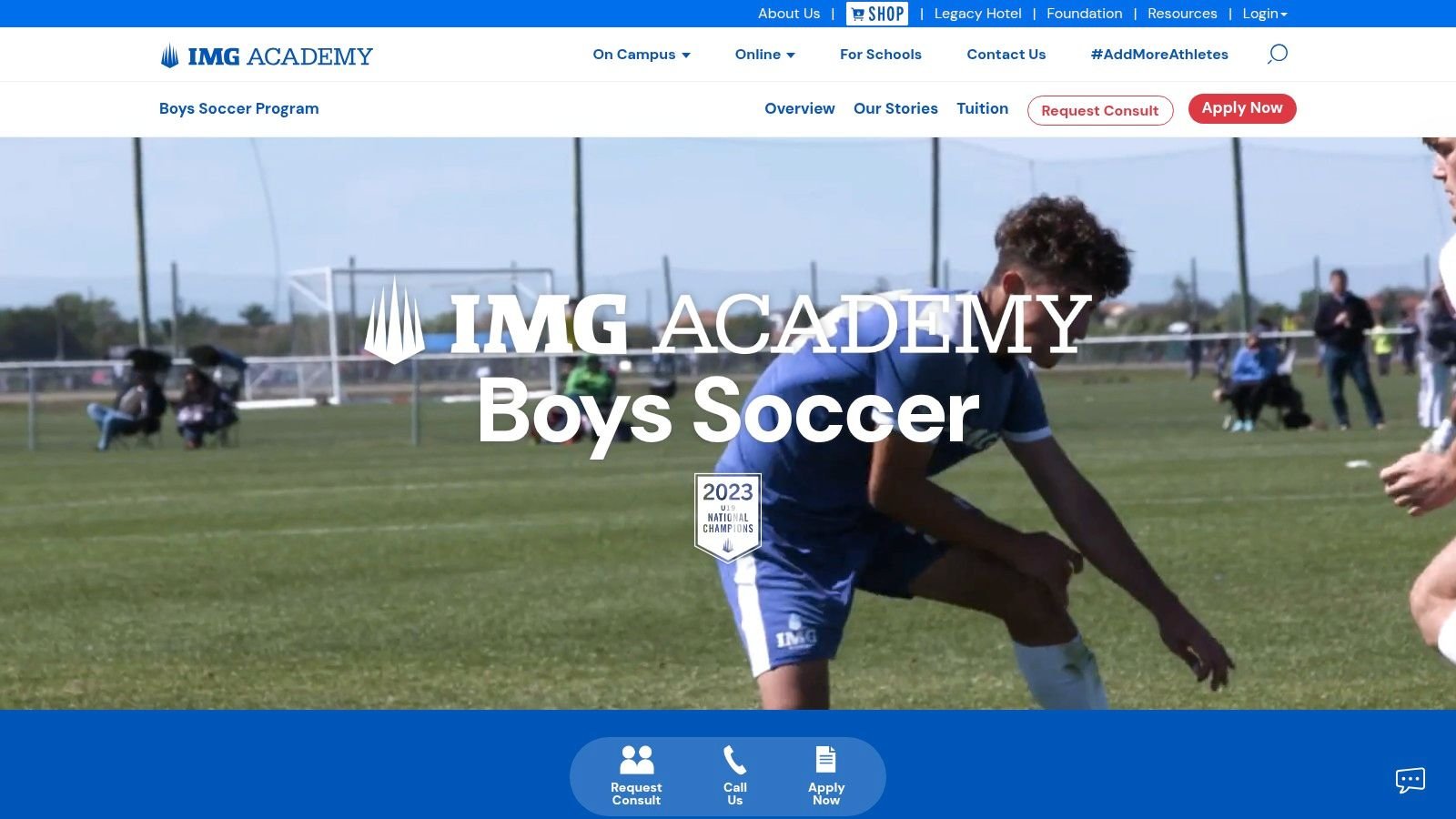
A family usually reaches IMG after the local club route starts to feel too limited. The player wants more touches, more staff oversight, and a week built around development instead of training squeezed around school and commuting. That is the primary starting point for evaluating IMG, not the brand alone.
IMG Academy operates as a full-time residential performance program linked to academics, training, recovery, and college recruitment through the IMG Academy soccer program. From a technical director's view, that structure changes the development equation. Staff can control far more of the player's week than a traditional elite club can.
The Residential Model
The value is concentration. Sessions, strength work, recovery, classroom schedule, and support services sit inside one system, so the player spends less time switching contexts and more time in repeatable routines. For some prospects, that consistency improves habits as much as it improves technical work.
The trade-off is straightforward. IMG is expensive, residential, and less connected to the normal local club experience. Families are not just choosing a training environment. They are choosing a lifestyle change, a school model, and a different social setup.
That matters because IMG is not the same pathway as an MLS academy. The program can sharpen a player and increase exposure, but it does not offer the built-in first-team alignment that defines club-owned professional academies. Families comparing options should separate development environment from direct pro pathway. Those are related, but they are not identical.
From a football perspective, residential settings can speed up tactical learning because coaches get more contact hours and more control over video, recovery, and position-specific detail. A wide player learning pressing triggers or an attacking midfielder working between lines can revisit the same ideas across the week instead of waiting for the next team session. That matters in systems such as the 4-2-3-1, where spacing, scanning, and role discipline decide whether a player looks tidy or affects matches.
The broader recruitment point is also practical. Environments that bring ambitious players into one place can raise the daily standard, which is often how young players develop fastest. The same logic shows up when clubs assess how to build future squads and develop young signings into first-team options.
Practical rule: Choose IMG if the family wants an all-in development model and accepts the cost, boarding structure, and reduced connection to local football. Pass if the player still benefits from home life, local school, and a club setup with less disruption.
Best for:
- Full immersion: Players who want football, school, strength work, and recovery in one daily structure.
- Recruiting exposure: Families prioritizing college-facing visibility and a national peer group.
- High-accountability learners: Players who respond well when staff can monitor habits across the full week.
2. INTER MIAMI CF ACADEMY (FORT LAUDERDALE/MIAMI)
A South Florida family can spend months comparing club fees, training nights, and tournament schedules, then run into a different reality with Inter Miami. This is not a broad-market academy choice. It is a club-controlled pathway where access depends on identification, fit, and retention inside a professional structure. The club's scouting and tryouts process for Inter Miami CF Academy makes that clear.
That distinction matters because families often evaluate MLS academies with the wrong framework. The right lens is not convenience or brand appeal. It is pathway design.
Inter Miami's value sits in vertical alignment. A strong prospect is training in an environment connected to MLS NEXT standards, second-team progression, and a first-team model that can shape role expectations early. In academy analysis, that matters more than glossy facilities or social media visibility. Players develop faster when the club can define what a fullback, winger, or holding midfielder must look like at each stage, then coach toward that profile with consistency. The same recruitment logic shows up in analysis of how top clubs evaluate future signings and development profiles.
There is also a real trade-off. MLS academies offer one of the clearest pro-facing routes in youth soccer, but they give families less control over timing and entry. You cannot assume an open trial cycle, a predictable admissions process, or an easy side-by-side comparison with independent academies. The player usually has to be seen first, then prove he can stay in the pool once the level rises.
What Families Need to Judge Honestly
Start with player level. Inter Miami is a fit for players already affecting games in strong environments, not just standing out physically or dominating weaker local competition.
Then assess role fit. Professional academies are not only selecting talent. They are selecting players who can execute jobs inside a game model. A flashy attacker who ignores pressing distances or rest-defense positioning may look less attractive than a slightly less explosive player who understands tempo, spacing, and repeatability. That is how elite clubs build identity from academy to senior side, the same principle behind a club-wide playing model and elite squad construction.
The financial equation is different too. In many independent academies, families are buying training volume, competition level, and exposure. Here, the bigger question is whether the player can gain entry to a system where the club has a direct incentive to develop first-team or second-team assets. That can be a far better long-term value, but only for players who are realistic candidates.
Selection rule: Judge Inter Miami like a technical staff would. Ask whether the player can solve problems at speed, handle coaching detail, and project into a club game model over several years.
Best for:
- Pro-pathway candidates: Players with a realistic chance to earn selection in a scouting-led MLS environment.
- Role-disciplined prospects: Athletes who can absorb tactical coaching and perform inside a defined structure.
- Families prioritizing pathway over convenience: Parents who understand that access is selective, timelines are less predictable, and the upside comes from club alignment rather than open enrollment.
3. ORLANDO CITY SC ACADEMY (ORLANDO/KISSIMMEE)
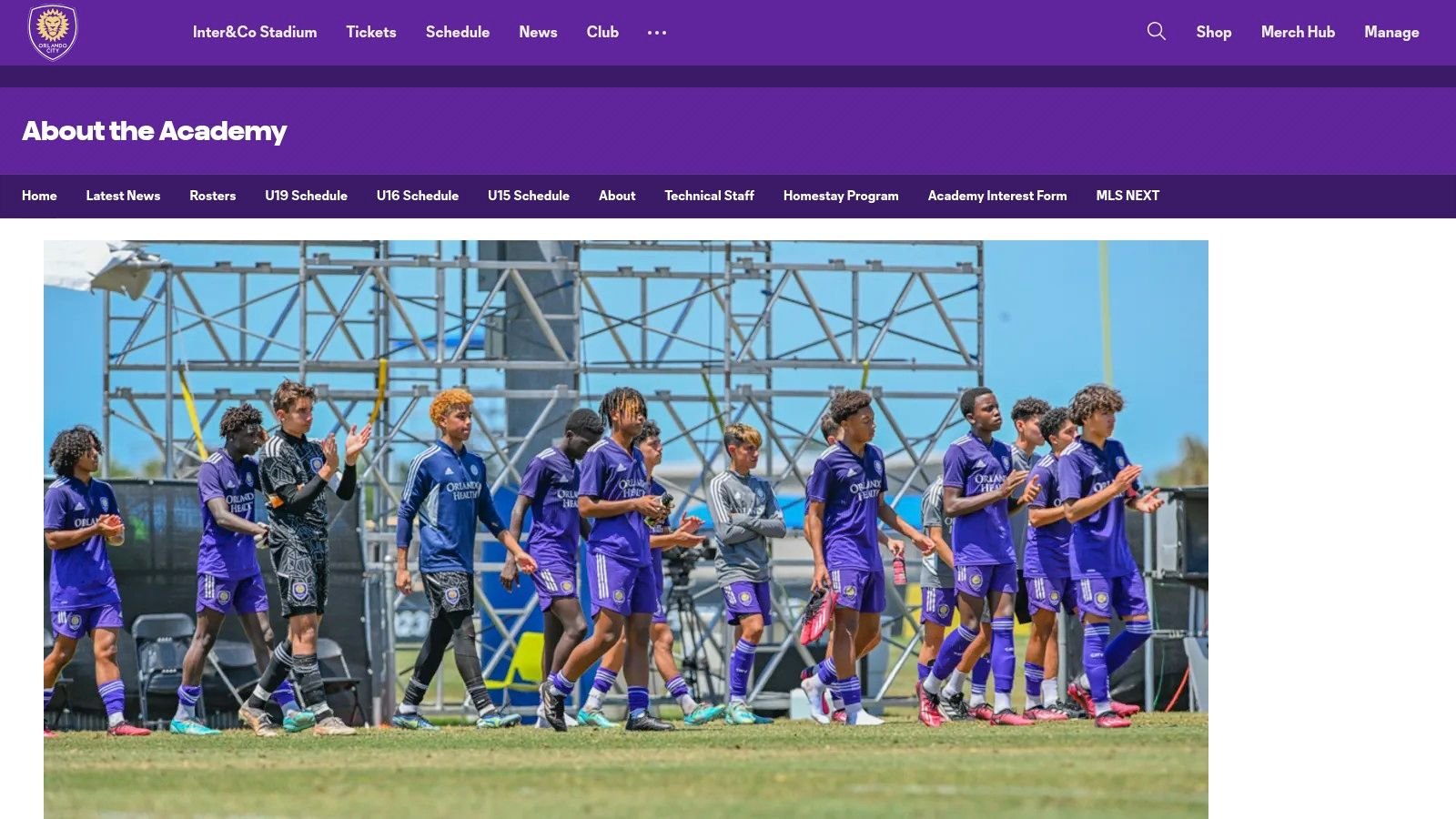
A central Florida family often faces a sharper question than "Which club is best?" Instead, the question is whether the player fits a professional development environment where selection is tight, expectations are high, and the club has a direct reason to build first-team assets. Orlando City SC Academy belongs in that category.
The academy, outlined through the club's Orlando City SC Academy overview, sits inside an MLS structure rather than an independent youth business. That distinction matters. Families are evaluating more than training quality or travel schedules. They are judging whether the player can enter a pathway connected to a professional club's game model, internal standards, and long-term roster planning.
How to Assess Orlando City Properly
The headline advantage is clear. For selected players, the academy removes the standard club-fee equation and shifts the decision toward football factors: level, fit, role, and access to minutes.
That benefit comes with a hard trade-off. Free is attractive, but free and selective usually means stronger internal competition and less margin for slow adaptation. A player who needs time, frequent mistakes, and guaranteed starts may develop better in a high-level independent environment where minutes are easier to secure.
Orlando's appeal is strongest when the player already shows traits that professional academies value. Coaches in this type of system are not just rewarding athletic flashes. They tend to prioritize repeatable decision-making, coachability, positional discipline, and the ability to function inside a club identity. The same logic shows up in Guardiola's winning philosophy and elite squad construction, where player value is tied to role execution and tactical fit, not only individual talent.
The Real Value Proposition
For the right prospect, Orlando City SC Academy offers one of the cleaner pathway bets in Florida. The club structure creates a clearer connection between youth development and the professional environment than families usually get at strong independent academies.
Still, families should examine the risk side with the same discipline a technical director would use. How likely is entry? How stable is the player's role once inside? Does the player's profile suit a possession-based, tactically coached setting, or is he still at a stage where volume, freedom, and weekly match repetition matter more than club branding?
Selection insight: Judge Orlando City SC Academy by projection, not prestige. The best fit is the player who can handle tactical detail, compete for limited places, and grow inside a club-controlled pathway.
Best for:
- High-upside boys with real MLS academy potential: Players who project into a selective, club-led development track.
- Families focused on pathway efficiency: Those willing to accept a narrow entry route in exchange for stronger professional alignment.
- Tactically reliable prospects: Athletes who can absorb structure, play within team rules, and earn trust over time.
4. TAMPA BAY UNITED
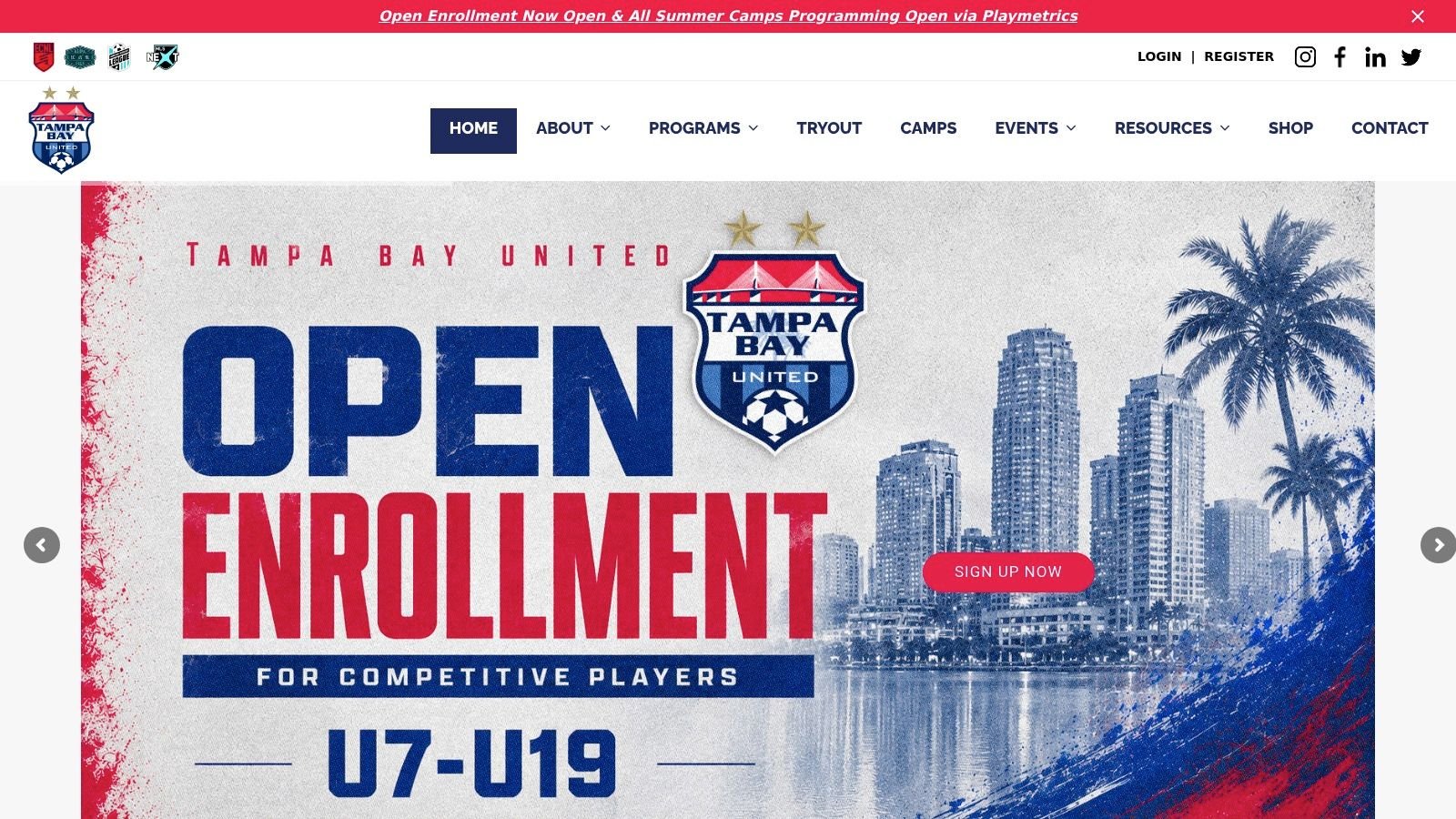
Tampa Bay United is the opposite of the closed MLS model. The club's public-facing structure through Tampa Bay United gives families something many elite setups don't. Clear access points through tryouts, ID events, multiple locations, and multiple competitive tiers.
That matters in a large state where geography shapes development almost as much as coaching does. A broad regional club can be more practical for a strong player who needs a serious pathway but can't relocate or wait for a scouting-only process.
The Club Scale Question
Large clubs create opportunity and inconsistency at the same time. On the positive side, they can offer depth across age groups, league platforms, and staff. On the negative side, family experience can vary depending on site, coach, team level, and where the player sits within the internal hierarchy.
For boys, the MLS NEXT angle raises the ceiling. For girls, ECNL and ECNL-R matter because they create strong competitive lanes inside the same wider club framework. That makes Tampa Bay United one of the more versatile entries in any elite soccer academy florida shortlist.
What works well:
- Open process: Public tryouts and ID events make entry more legible than in invite-only systems.
- Regional coverage: Multiple training locations reduce friction for many families.
- Tiered pathways: Players can often find an appropriate level without leaving the broader club.
What needs scrutiny:
- Team-specific reality: One age group may be excellent while another is still stabilizing.
- Cost visibility: Families still need direct conversations because fee detail isn't broadly posted.
- Large-club fit: Some players thrive in scale. Others get lost in it.
The right evaluation is local and specific. Not "Is Tampa Bay United big enough?" but "Which coach, which squad, which league, and what happens if the player needs to move between tiers?"
5. WESTON FC (BROWARD COUNTY)
Weston FC has long carried weight in South Florida because it combines strong youth competition with a pre-professional bridge. The club's Weston FC program structure matters less for branding than for what it signals. This isn't only about youth teams. It is about continuity into older age groups and meaningful senior-game exposure.
That bridge is where many academy evaluations get sloppy. Plenty of clubs can market elite development at younger ages. Fewer can show what the transition looks like once a player ages out of the pure academy phase but isn't yet a full professional.
Pathway Value
Weston FC's USL League Two connection strengthens the older-player conversation. For advanced prospects, pre-professional minutes can be more useful than remaining inside a youth label for too long. That bridge often helps late maturers, college-bound players, and those who need one more proving stage.
The club also carries a college advisory profile, which matters because most families need both tracks in view. In real academy planning, the professional route and the education route shouldn't compete. They should coexist.
A strong academy doesn't just ask whether a player can win youth matches. It asks whether the environment prepares that player for the next adult layer of the game.
The trade-off is familiar. Selection is competitive, and families don't get broad public fee clarity up front. Still, Weston remains one of the stronger South Florida options for players who value serious competition and want a clearer bridge beyond youth football.
Best for:
- Older elite prospects: Players who need a route toward pre-professional minutes.
- South Florida visibility: Families who want a club with a strong regional reputation.
- Dual-path planning: Athletes balancing college ambitions with higher-level football goals.
6. SOUTH FLORIDA FOOTBALL ACADEMY (SFFA) BOCA RATON AREA
South Florida Football Academy occupies an important middle ground. It offers an MLS NEXT environment for boys without being an MLS-owned academy, and it supports additional pathways on the girls side and in regional competition through South Florida Football Academy. For many families in Palm Beach and Broward, that's the practical sweet spot.
The attraction isn't only the badge of the league. It's the visibility of the process. SFFA regularly publishes tryout information, club documents, and operational details that families often struggle to find elsewhere.
Why Families Shortlist It
Independent MLS NEXT clubs can be excellent fits for players who are strong enough for top competition but not currently inside an MLS club pipeline. They give access to high-level games while preserving more traditional club-style entry points and communication.
That doesn't remove the normal pressure. Travel, roster competition, and fee variability still come with the territory. But the transparency around forms, programming, and updates makes SFFA easier to assess than many peers.
Strong points:
- MLS NEXT access outside MLS ownership: A valuable lane for ambitious boys in the region.
- Visible administration: Public documentation makes family planning easier.
- Multi-platform club model: Girls and boys both have meaningful competitive structures.
The caution is simple. Families shouldn't confuse independent MLS NEXT status with the same internal pro pathway available at an MLS-owned academy. The competitive level may be strong, but the progression mechanism is different. In practice, that often means more emphasis on exposure, development, and next-step placement rather than direct club-controlled promotion.
7. SPORTING JAX SOCCER ACADEMY (FORMERLY FLORIDA ELITE SOCCER ACADEMY)
Sporting JAX is one of the most useful academies to study because it offers two things many families need. Scale and transparency. Through Sporting JAX Soccer Academy, families can evaluate a broad rec-to-competitive ecosystem with visible pricing structure and multiple competition platforms.
That transparency matters because many elite clubs ask families to commit before the full picture is clear. Sporting JAX tends to make the comparison easier, especially for parents trying to understand where an academy level, an ECNL-R squad, or a higher competitive team fits in the bigger pathway.
What The Numbers Actually Say
The legacy Florida Elite operation also brings verifiable performance markers. On the club side, Florida Elite Soccer Academy has estimated annual revenue ranging from Growjo's Florida Elite Soccer Academy profile, which lists figures from $6.3 million to $19.2 million. On the nonprofit side, the organization tied to EIN 59-3090428 shows ProPublica nonprofit records for Florida Elite Soccer Academy, including $103K revenue in 2020 and $94K in expenses in the same filing.
Those figures don't tell a parent whether a left back will develop. They do tell a family that the organization has operated at meaningful scale and survived difficult periods. Sporting output also gives context. The Florida Elite side connected to the pathway posted 7 wins, 17 points, and a +26 goal differential in 10 matches in 2022, as summarized in the verified data tied to Growjo's profile.
This is a club model, not an MLS club academy model. The pathway tends to run through competition level, college placement, and pre-pro visibility rather than direct first-team integration.
For player development, the stronger legacy record comes from FUTSOC Enigma. The program reports FUTSOC Enigma by the numbers including a No. 1 national ranking for U18/19 in 2015, Top 10 national rankings for U16-U18 teams from 2006 to the present, an undefeated 9-0-1 record against USSF Development Academies, more than 170 college scholarship players, and 13 players contributed to U.S. Youth National Teams. That kind of documented track record is hard to ignore when comparing independent development environments in Florida.
Top 7 Florida Elite Soccer Academies Comparison
| Program | Implementation complexity | Resource requirements | Expected outcomes | Ideal use cases | Key advantages |
|---|---|---|---|---|---|
| IMG Academy (Bradenton) | High, formal boarding admissions and year‑round commitment | Very high, tuition, relocation, full‑time boarding, extensive support services | Elite development, strong college recruiting exposure, pro opportunity potential | Families seeking an all‑in‑one residential training + education environment | Integrated campus: training, academics, sport science and recruiting |
| Inter Miami CF Academy (Fort Lauderdale/Miami) | High, invite/scout selection; limited open tryouts | Moderate–high but variable, club scholarships possible; travel and time commitment | Direct pathway to Inter Miami CF II and first team via MLS NEXT | Top regional talent aiming for a professional club pathway | Clear club pathway and high MLS NEXT competition/exposure |
| Orlando City SC Academy (Orlando/Kissimmee) | High, selective, identification/invite based | Low for selected players, no‑cost academy slots; travel/time still required | Homegrown pipeline to Orlando City B / first team and pro exposure | Talented players seeking a no‑cost, MLS‑aligned development route | Development‑first, cost‑free access for selected players with stable club structure |
| Tampa Bay United | Medium, public tryouts and multi‑tier placement | Variable, team fees vary, regional travel across multiple sites | Regional elite development with MLS NEXT/ECNL exposure and ID opportunities | Families seeking broad regional access and regular tryout opportunities | Large regional footprint and clear public tryout/ID calendar |
| Weston FC (Broward County) | Medium–high, competitive selection for MLS NEXT rosters | Variable, fees not publicly posted; travel and competitive commitments | Strong college placements and pathway to USL League Two for older players | Players targeting college placement or pre‑pro minutes in South Florida | Proven track record and USL2 bridge for advanced players |
| South Florida Football Academy (SFFA) – Boca Raton | Medium, published tryouts and regular ID events | Variable, published forms and financial aid info; MLS NEXT travel demands | MLS NEXT development with regional exposure and documented club resources | Palm Beach/Broward athletes seeking an independent MLS NEXT option | Transparent tryout info and public documentation including financial aid |
| Sporting JAX Soccer Academy | Low–medium, broad entry levels, public pricing and events | Transparent, published competitive pricing, team fee estimates, travel for events | Club‑to‑college pathways, tournament exposure; less direct MLS alignment | Families wanting clear costs, frequent tournaments and event exposure | Transparent fees and extensive tournament/camp/ID infrastructure |
MAKING THE FINAL DECISION YOUR NEXT MOVE
The strongest way to choose an elite soccer academy florida option is to stop asking which badge looks biggest and start asking which environment solves the player's actual problem. Some players need a direct professional pathway and can handle a ruthless selection process. Some need a transparent, high-level independent club with real minutes and a realistic college route. Others need the structure of a residential school that controls the entire week.
Families should also separate pathway talk from pathway reality. MLS club academies usually offer the clearest professional alignment, but access is narrow and retention is hard. Large independent clubs often provide a more practical development runway, especially for players who are still climbing, changing positions, or growing into the demands of top-level competition. Residential environments offer concentration and support, but they aren't the right social or financial fit for every household.
The next move is concrete. Visit training if possible. Ask who coaches the team now, not who coached it two years ago. Ask how players move between tiers. Ask what happens when a player is no longer the clear standout. Ask how the club handles school load, travel load, and role development over time. Families that travel heavily also learn quickly that logistics shape the season almost as much as the matchday plan, from carpooling and recovery routines to sideline organization with practical gear like a soccer sideline wagon.
The best academy isn't always the most famous one. It's the one that matches ambition with environment. A high-potential player can stall in the wrong setting just as easily as a late developer can flourish in a club that offers the right coaching, competition, and patience.
Florida has enough depth that most serious players can find a legitimate pathway. The harder task is choosing the pathway that fits now and still makes sense two years from now. That is how technical directors think. Families should do the same.
Manchester City supporters, coaches, and analysts who enjoy this kind of pathway-based football evaluation can find more tactical work at Manchester City Analysis, including clear breakdowns of systems, squad construction, and the strategic details that shape elite player development.