On June 10, 2023, Manchester City completed the treble and turned a tactical diagram into a proof of concept. The shape often looked like a 3 2 2 3 soccer formation, but the underlying story was how that structure gave City control before it gave them chances.
The modern game rarely rewards rigid systems. It rewards structures that can shift without losing balance, and few shapes have done that more convincingly than Guardiola's revival of the old WM.
Table of Contents
- INTRODUCTION THE FORMATION BEHIND THE TREBLE
- THE ANATOMY OF THE 3-2-2-3 FORMATION
- A PHASE-BY-PHASE TACTICAL BREAKDOWN
- PLAYER PROFILES FOR EACH ROLE IN THE SYSTEM
- MANCHESTER CITY'S 3-2-2-3 MASTERCLASS
- HOW TO COACH THE 3-2-2-3 WITH TRAINING DRILLS
- CONCLUSION THE ENDURING LEGACY OF THE 3-2-2-3
INTRODUCTION THE FORMATION BEHIND THE TREBLE
The 3 2 2 3 soccer formation is often described as a modern attacking structure, but that misses the deeper point. At elite level, it isn't an attacking shape. It's a control mechanism.
Historically, the system traces back to the WM, named for the way its lines resemble the letters W and M across the pitch. That old reference matters because the modern version still solves the same core problem: how to secure the center while keeping enough players high to threaten the back line. Guardiola's Manchester City gave that idea a contemporary expression through positional rotations, inverted movements, and relentless occupation of the half-spaces.
Its strongest modern validation came during City's 2022 to 2023 campaign. Variations of the structure in build-up contributed to a 91.47% possession average in key Champions League matches and a Premier League record of 33 goals conceded in 38 matches, as noted in this analysis of City's WM evolution. Those numbers matter because they capture the formation's central paradox. It looks aggressive, yet it often defends by monopolising the ball and sealing central access before the opponent can run.
That's why the shape shouldn't be treated as a frozen lineup card. The back three create a secure first platform. The double pivot protects circulation and screens the center. The advanced pair occupy the half-spaces where pressing lines are hardest to coordinate. The front three stretch the last line horizontally and vertically. Each line supports the next.
Practical rule: The 3 2 2 3 works best when a team treats space occupation as a defensive act, not just an attacking one.
For intelligent viewers, the breakthrough insight is this. The formation's value isn't that it places three defenders, two midfielders, two creators, and three attackers in neat rows. Its value is that it creates repeatable superiority in the zones that decide games: the first phase against pressure, the half-spaces against compact blocks, and the central lane against counters.
Three features explain why the system has become so influential:
- Central stability: Two deeper midfielders or a pivot-supported box make it harder for opponents to play directly through the middle.
- Half-space pressure: The advanced midfield pair can receive between full-back and center-back, where defensive handovers are most fragile.
- Elastic width: The front line can pin defenders wide while the midfield box keeps short connections underneath.
That combination is why the old WM feels new again. The structure survived because its geometry still solves modern problems.
THE ANATOMY OF THE 3-2-2-3 FORMATION
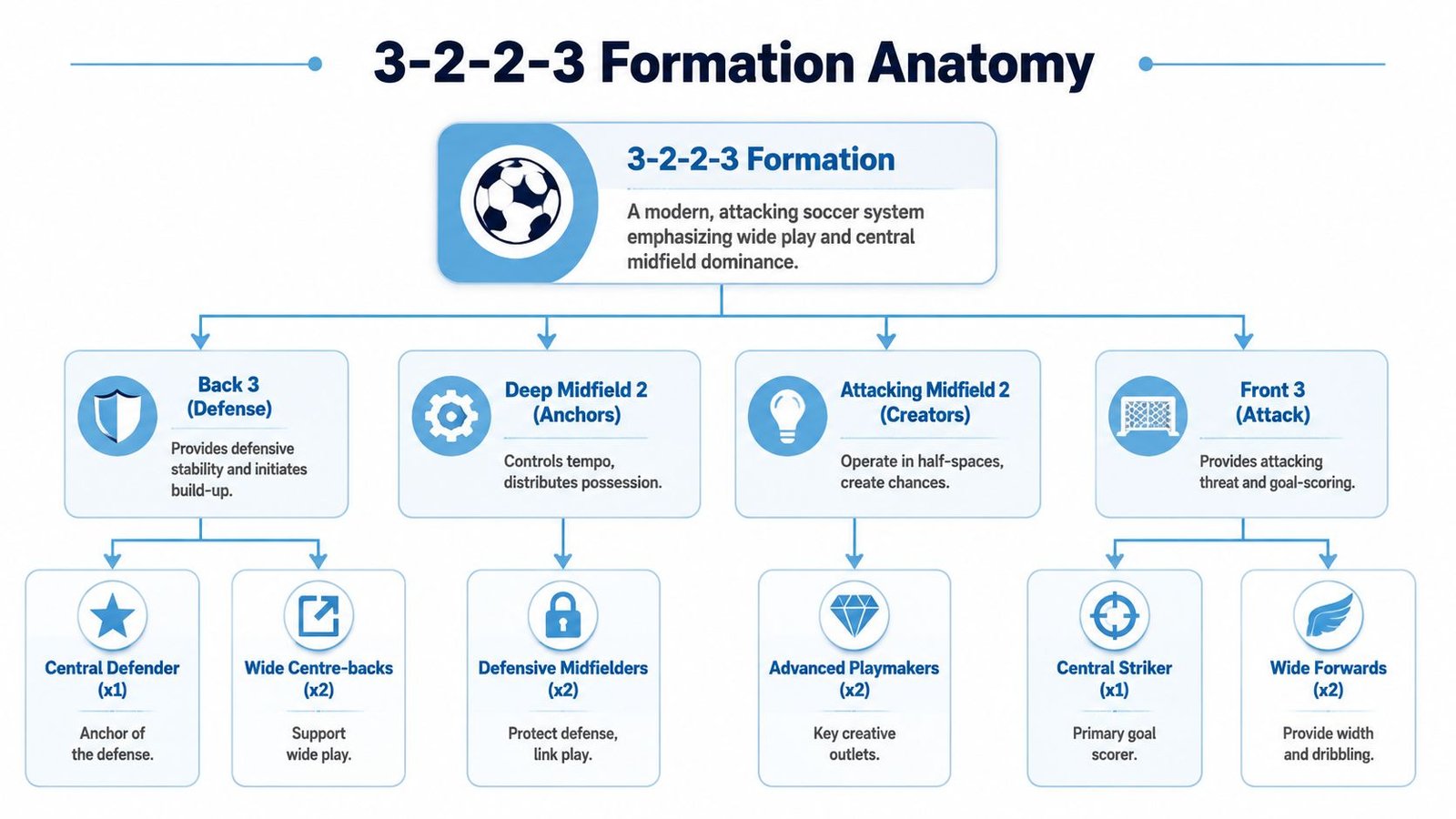
On a tactics board, the 3 2 2 3 soccer formation looks clean. On the pitch, its clarity comes from role separation. Every line has a different job, and the system collapses if those jobs blur too early.
BACK THREE AS THE FIRST PLATFORM
The back three do more than defend. They set the angle of the whole attack.
The central defender anchors the shape, protects depth, and keeps the distances between the wide center-backs compact. The two outside center-backs carry a more technical brief. They must step forward with the ball, invite pressure, and find passes into midfield or wide channels without exposing the team to immediate transition.
A useful contrast appears when comparing this shape with a more familiar 4 2 3 1 structure in modern football. In a 4 2 3 1, the full-backs often provide natural width in the first progression. In the 3 2 2 3, that width higher up usually comes from the front line, which means the wide center-backs need to progress possession with more composure and more responsibility.
THE MIDFIELD BOX AS THE ENGINE ROOM
The central feature of the formation is the box midfield. Two deeper players sit underneath two advanced midfielders. This creates four connected points through the middle, which is why the structure can sustain possession without becoming static.
The deeper pair control tempo, secure second balls, and protect against central counters. Their positioning is essential. If they flatten onto the same line too early, the passing network loses depth. If they separate too much, opponents can split them with one vertical pass.
The advanced pair operate in the half-spaces. That matters because the half-space is the zone where a team can threaten both the center and the wing at once. These players don't just create chances. They become the hinge between circulation and penetration.
The formation starts to breathe when the box midfield creates one safe pass, one progressive pass, and one third-man option from the same picture.
FRONT THREE AS THE STRETCH MECHANISM
The front three complete the geometry. The central striker fixes center-backs and provides depth. The two wide forwards stretch the defensive line and keep full-backs from narrowing too aggressively.
This front line often determines whether the formation becomes dominant or merely tidy. If the wingers stay too narrow, the pitch shrinks and the box midfield gets crowded. If they stay too wide without timing their inward runs, the attack becomes disconnected.
A static snapshot of the shape looks like this:
| Unit | Main Function | Typical Tactical Effect |
|---|---|---|
| Back 3 | Secure first phase and cover depth | Stable circulation and rest defence |
| Deep Midfield 2 | Protect center and link play | Tempo control and counter protection |
| Attacking Midfield 2 | Receive in half-spaces and connect attacks | Progression through central lanes |
| Front 3 | Stretch last line and attack spaces | Width, depth, and finishing presence |
The shape is simple on paper. Its sophistication comes from how long each player can hold the correct zone before rotating.
A PHASE-BY-PHASE TACTICAL BREAKDOWN
The 3 2 2 3 only makes full sense when it's seen in motion. Its real strength lies in phase changes. The team can look like one shape in build-up, another in attack, and a third the moment possession is lost.
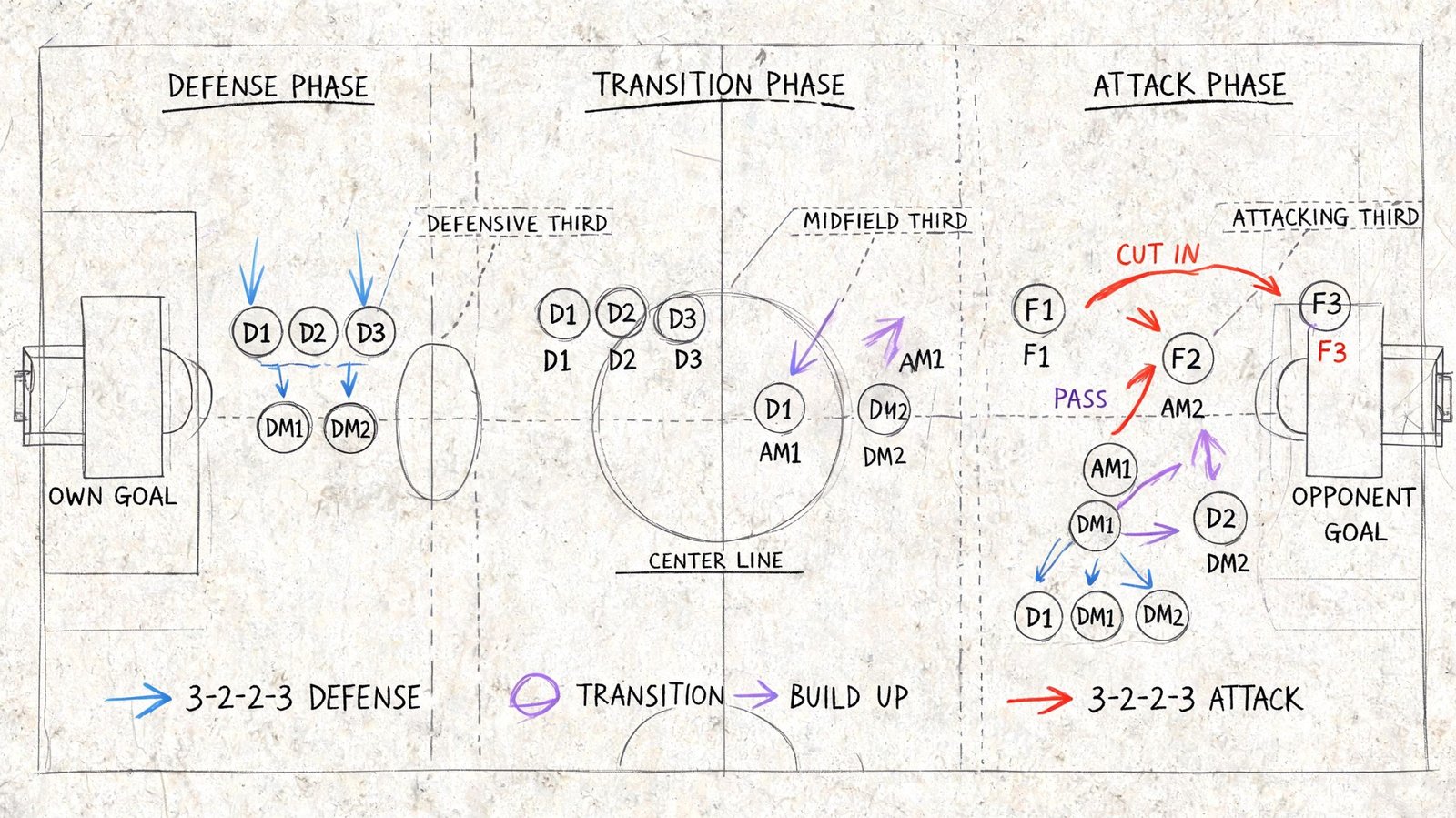
IN POSSESSION
Guardiola's version often morphed into a 3 1 6 during build-up, creating a 6 vs 5 numerical superiority against teams using a five-player backline. That fluidity was central to Manchester City averaging 68% possession and 2.61 xG per match in the 2022 to 2023 Premier League season, according to this tactical analysis of City's build-up structure.
The detail that matters isn't just the shape itself. It's the way the shape changes the opponent's decisions. If the rival front line presses high, the spare player appears in the first phase. If the rival midfield narrows, the half-space receiver opens. If the back line jumps wide, the striker can pin the remaining center-backs.
Three recurring in-possession mechanisms define the system:
- First-phase superiority: The back line plus goalkeeper can outnumber the first press and draw opponents forward.
- Half-space reception: The advanced pair become clean receivers behind midfield pressure.
- Front-line pinning: The front three stop the defense from collapsing inward too early.
OUT OF POSSESSION
Defensively, the shape often settles into a compact central block. The most important feature is not the front press but the denial of direct access into central zones.
The advanced midfielders can jump toward the ball when pressing triggers appear, while the deeper midfielders protect the space in front of the back line. That creates layered coverage rather than one aggressive wave. The formation is strongest when the press doesn't chase the ball blindly but guides it toward an area where the nearest line can trap.
Coaching cue: Press to close the next pass, not just the current ball carrier.
That idea separates effective 3 2 2 3 defending from chaotic pressing. The system wins territory when each line understands what it is protecting behind the pressure.
TRANSITIONS
Transitions determine if the shape appears refined or reckless.
When possession is won, the system can break quickly because the front three are already high and the half-space midfielders are close enough to join. When possession is lost, the same aggressive occupation can expose the wings if the nearest players react late or if the pivots have moved too far ahead of the ball.
The key is rest defence. A team using this formation needs enough players behind or around the ball to stop the first outlet pass. If that first pass escapes, the opponent can attack the channels outside the outer center-backs.
That's the tactical trade-off at the heart of the 3 2 2 3. It gives a team superior central control, but only if the distances after loss are disciplined.
PLAYER PROFILES FOR EACH ROLE IN THE SYSTEM
Good structures don't erase player profiles. They sharpen them. The 3 2 2 3 soccer formation demands specific technical and cognitive traits because each role carries both positional and relational responsibility.
THE ROLES THAT HOLD THE STRUCTURE TOGETHER
The deepest line needs defenders who can defend large spaces without becoming passive. The wide center-backs must be comfortable stepping into midfield lanes and defending the channel behind them. The central center-back needs authority in depth coverage and calm distribution into pressure.
The double pivot is the formation's stabiliser. The reason is structural, not stylistic. Manchester City's version used the two defensive midfielders as part of a block of five with the center-backs, and that structure helped the side record 12.4 possessions won in the middle third per EPL match in 2023, 25% above league average, as outlined in this study of the 3-2-2-3's defensive interactions. Those midfielders don't just pass. They close the center, read second balls, and decide whether the team can sustain pressure after losing possession.
That makes the pivot role especially demanding. A player in that position must scan early, receive under pressure, and keep the team balanced. A specialist example of those demands appears in this Rodri tactical profile and data analysis, where control, tempo, and recovery positioning all define the function.
A weak winger can be protected in this shape. A weak pivot can't.
The advanced midfield pair need a different toolkit. They must receive on the half-turn, combine in tight zones, and know when to stay between lines rather than running ahead of the ball too early. Their best quality is often timing rather than flair.
PLAYER ROLES AND REQUIRED ATTRIBUTES IN THE 3-2-2-3
| Position | Key Responsibilities | Essential Attributes | Example Player |
|---|---|---|---|
| Central Defender | Anchor the back line, cover depth, circulate safely | Positioning, calmness, aerial judgement | Ruben Dias |
| Wide Centre-back | Step forward, defend channels, break lines | Carrying, passing range, 1v1 defending | Manuel Akanji |
| Defensive Midfielder | Screen center, recover second balls, connect phases | Scanning, press resistance, tactical discipline | Rodri |
| Second Deep Midfielder | Support circulation, protect transitions, adjust spacing | Mobility, awareness, simple distribution | Ilkay Gundogan |
| Advanced Playmaker | Receive in half-spaces, combine, create final action | Body orientation, vision, timing | Kevin De Bruyne |
| Second Advanced Midfielder | Link play, rotate, support pressure | Agility, close control, tactical intelligence | Bernardo Silva |
| Wide Forward | Hold width, attack full-back, arrive inside | 1v1 skill, movement, ball security | Jack Grealish |
| Central Striker | Pin defenders, finish moves, occupy box | Timing, physical presence, finishing | Erling Haaland |
The shape doesn't demand eleven stars. It demands eleven players who understand how their movement changes someone else's space.
MANCHESTER CITY'S 3-2-2-3 MASTERCLASS
Manchester City's great achievement with the 3 2 2 3 wasn't inventing a new pattern. It was making a complex pattern feel inevitable. The shape appeared repeatedly, but the personnel and entry points changed according to the opponent.
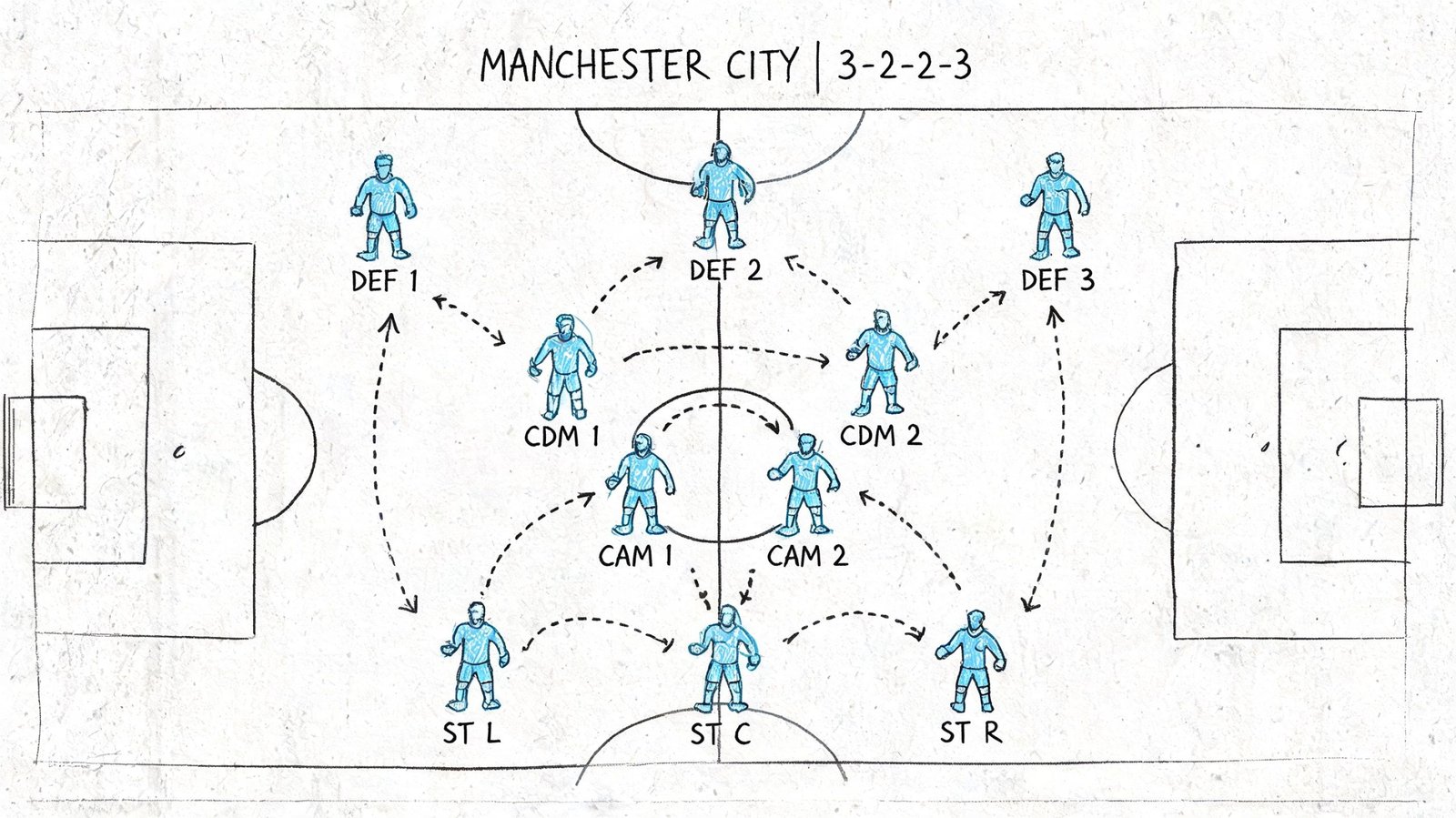
HOW CITY BUILD CONTROL
A defining feature of City's structure was the way a nominal defender could step into midfield and change the arithmetic. John Stones often performed this function, giving the team a back three behind the ball and an extra presence around Rodri. That movement did two jobs at once. It gave City another secure option in circulation, and it prevented the midfield from being outnumbered during the first progression.
The advanced pair then occupied the half-spaces rather than the touchline. That sounds minor, but it changes the whole attack. When Kevin De Bruyne and Bernardo Silva receive inside, full-backs hesitate. If they stay narrow, the wide forward has room. If they jump wide, the half-space opens for a slip pass or underlap.
City separated themselves from teams that imitate the formation without understanding its timing. They didn't force the next pass. They kept adjusting the opponent's reference points until one defender had to choose between two threats.
A broader study of Guardiola's squad design and winning philosophy helps explain why the system worked so well. The formation matched the squad's intelligence. City had defenders who could build, midfielders who could receive under pressure, and forwards who could hold width without disappearing from the attack.
One recurring pattern against low blocks looked like this:
- The back three circulate and draw the first line.
- The pivot secures the center and fixes the nearest midfielder.
- The advanced midfielder receives in the half-space.
- The winger pins the full-back.
- The striker attacks the gap between center-backs.
That sequence turns sterile possession into positional pressure. The ball moves, but the primary objective is to move defenders out of their preferred distances.
City's best attacks often started with patience, not speed.
A video breakdown helps visualise how these rotations combine into one coherent attacking structure.
WHERE OPPONENTS ATTACK THE SHAPE
No system is self-protecting. The weakness of the 3 2 2 3 appears when the central overload comes at the cost of wide security.
Opponents such as Liverpool have tried to exploit the spaces outside the outer center-backs, especially after turnovers. That threat emerges when one winger has pressed high, one advanced midfielder is caught ahead of the ball, and the nearest pivot is late shifting across. The danger doesn't come from the shape alone. It comes from the distance between the last secure pass and the first defensive sprint.
That's why City's best version of the system wasn't just elegant in possession. It was ruthless in counterpressure. The first few seconds after loss decided whether the formation looked dominant or vulnerable.
Two tactical lessons come from City's case study:
- The shape needs disciplined spacing after loss: Control in possession only matters if enough players can lock the center immediately.
- Wide protection must be collective: The outer center-back can't defend the whole flank alone. The winger, advanced midfielder, and pivot all have recovery responsibilities.
City turned the old WM into a modern elite structure because they solved both sides of the problem. They attacked with five lanes and defended with central density.
HOW TO COACH THE 3-2-2-3 WITH TRAINING DRILLS
A coach doesn't teach the 3 2 2 3 soccer formation by handing out a lineup sheet. The shape only works when players recognise distances, passing angles, and pressing cues before the ball arrives.
Youth football offers a useful proof of concept. Manchester City's Elite Development Squad mirrored the senior structure in 2022 and posted an 85% pass completion rate with 14 clean sheets in 26 matches, according to this report on youth application of the 3-2-2-3. The primary lesson isn't the output alone. It's that early repetition of positional principles can smooth the jump to senior football.
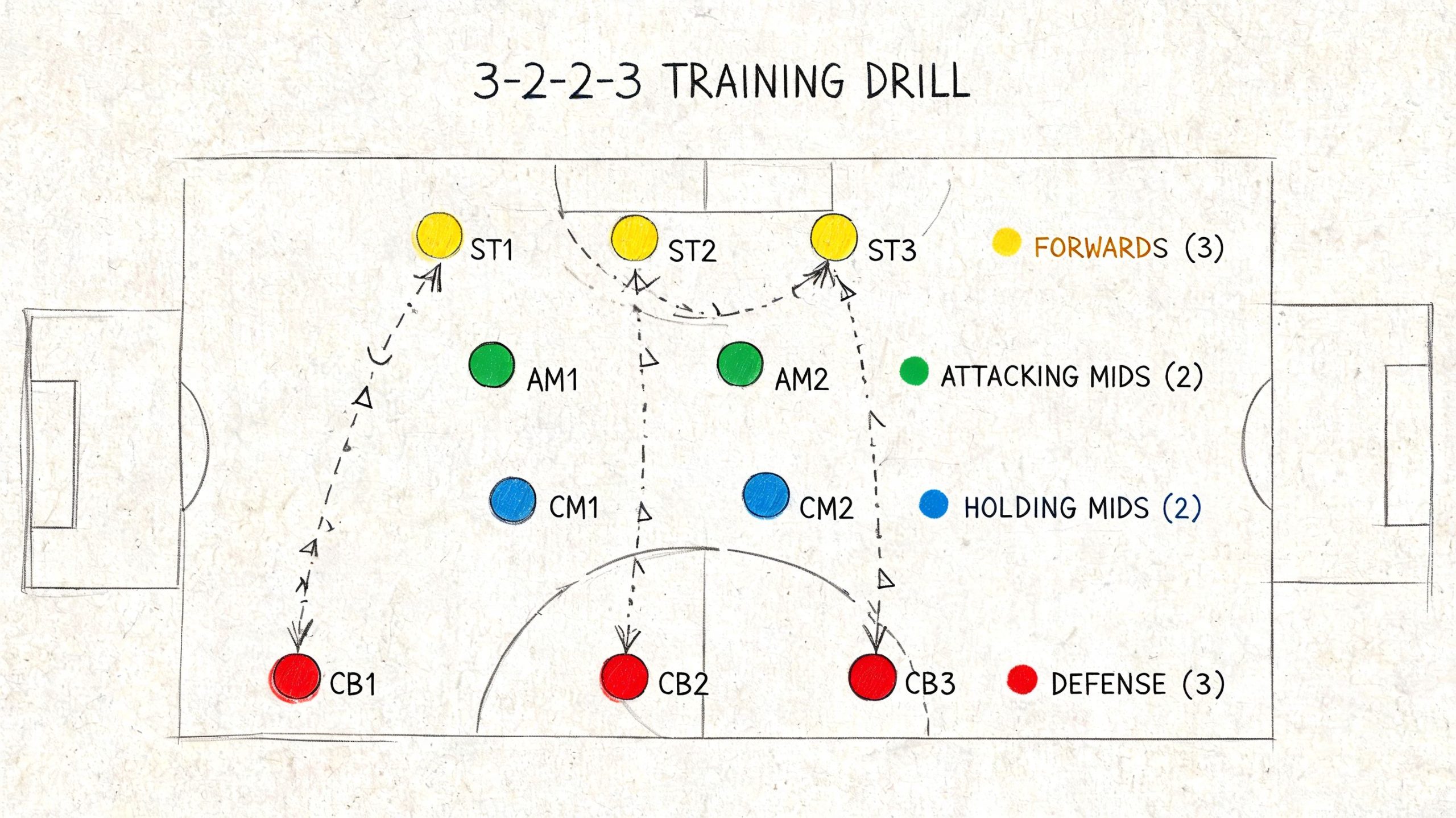
DRILL ONE BOX MIDFIELD RONDO
Use a central square with four midfielders arranged as a box and defenders pressing from different angles. Add outside support players if the group needs easier connections.
Objective: Teach the two deeper midfielders and two advanced midfielders to hold staggered heights, create third-man options, and play through pressure without flattening the box.
Coaching points:
- Body shape first: Players should receive half-open whenever possible.
- Different vertical lines: The front pair shouldn't stand level with the pivots.
- Third-man habits: The best pass often isn't the direct one.
DRILL TWO SHADOW PLAY FOR REST DEFENCE
Run unopposed phase play from goalkeeper build-up into the attacking shape, then whistle a simulated turnover and require instant recovery positions.
Objective: Connect attacking occupation with defensive security. Many teams fail in this area. They rehearse the pretty part of the system and ignore the emergency shape after loss.
A useful progression is to freeze the action at turnover and ask three questions: who protects the center, who covers the channel, and who can press the first pass?
Training emphasis: If players can't recover the structure in seconds, the attacking shape is too ambitious for the squad.
DRILL THREE WIDE TRANSITION RECOVERY GAME
Set up a narrowed pitch with bonus channels on each side. The attacking team begins in a 3 2 2 3. If the defending team wins the ball, they must find a runner in one of the wide channels quickly.
Objective: Stress-test the formation's main vulnerability. This teaches the winger, near-side advanced midfielder, and pivot to react together rather than as isolated sprinters.
Key details matter more than volume in this drill:
- Nearest player presses the ball immediately
- Second defender blocks the inside lane
- Third defender protects the run beyond
This is the practical truth of coaching the system. Positional play and transition defence must be taught as one subject, not two.
CONCLUSION THE ENDURING LEGACY OF THE 3-2-2-3
The 3 2 2 3 soccer formation has endured because it solves modern football's hardest tactical puzzle. It lets a team build with security, attack with central access, and defend by controlling the spaces where transitions begin.
Its strengths are clear. The shape gives coaches a stable first phase, a powerful box midfield, and layered access to the half-spaces. Its weaknesses are just as clear. If the team loses spacing, the wide areas can open quickly and the outer center-backs can be dragged into impossible defending.
That tension is exactly why the formation remains so interesting. It isn't a cheat code. It's a demanding structure that rewards tactical intelligence, coordinated movement, and disciplined rest defence. Manchester City's treble-winning season showed the ceiling of the system when every line understands the same positional language.
The deeper legacy may be felt beyond elite football. The old WM has returned not as nostalgia, but as a framework for teaching players how geometry shapes matches. Teams that understand that won't just copy the formation. They'll understand why it works.
Manchester City supporters, coaches, and analysts looking for deeper tactical breakdowns can find more detailed match analysis, player studies, and strategic coverage at Manchester City Analysis.