A centre-back steps forward, the holding midfielder angles half a yard to offer the safe pass, and the far winger stays high instead of chasing the ball. That short sequence is soccer 4 3 3 in its clearest form. The shape works when players recognize cues early and move before the pass forces them to.
Table of Contents
- INTRODUCTION
- THE ANATOMY OF THE 4-3-3 FORMATION
- COMMON TACTICAL VARIATIONS OF THE 4-3-3
- ATTACKING PRINCIPLES AND BUILD-UP PATTERNS
- DEFENSIVE PRINCIPLES AND PRESSING TRIGGERS
- EXPLOITING WEAKNESSES AND COUNTERING THE 4-3-3
- CONCLUSION
INTRODUCTION
Maracanã in 1950 still hangs over any serious discussion of soccer 4 3 3. Brazil lost 2-1 to Uruguay in the World Cup final, and the lesson was tactical as much as emotional. The old attacking structures left too much space around transitions, too much strain on the defenders, and too many decisions to solve late.
Brazil's answer did not appear overnight, but the direction was clear. The team moved away from older, top-heavy shapes, won the 1958 World Cup with a more balanced structure, and then sharpened that idea in 1962 when Mário Zagallo's deeper role gave the side an extra midfielder without losing width in the front line. That shift matters because it established the central question of the 4-3-3: which player leaves his line, at what moment, and what space opens or closes because of that choice, as noted in this historical account of the 4-3-3 formation.
That is why the 4-3-3 has lasted.
At elite level, the shape works as a decision-making system more than a static formation card. The front three set pressing direction. The midfield triangle decides whether the team can control the center or has to protect it. The back four and goalkeeper judge when to circulate, when to draw pressure, and when to play through it. Small timing errors break the structure. Good timing makes the whole team look one step ahead.
Manchester City offers the clearest modern example. Under Guardiola, the 4-3-3 changes function from phase to phase while keeping the same basic references. Rodri may hold as a single pivot, John Stones may step into midfield, and the wingers may either pin the back line or move inside depending on the opponent's full-back and the pressing cue. Readers who want the wider context behind those ideas can use this analysis of Guardiola's winning philosophy and elite squad.
The best 4-3-3 sides are not defined by symmetry. They are defined by how quickly players read the next trigger and adjust before the picture changes.
THE ANATOMY OF THE 4-3-3 FORMATION
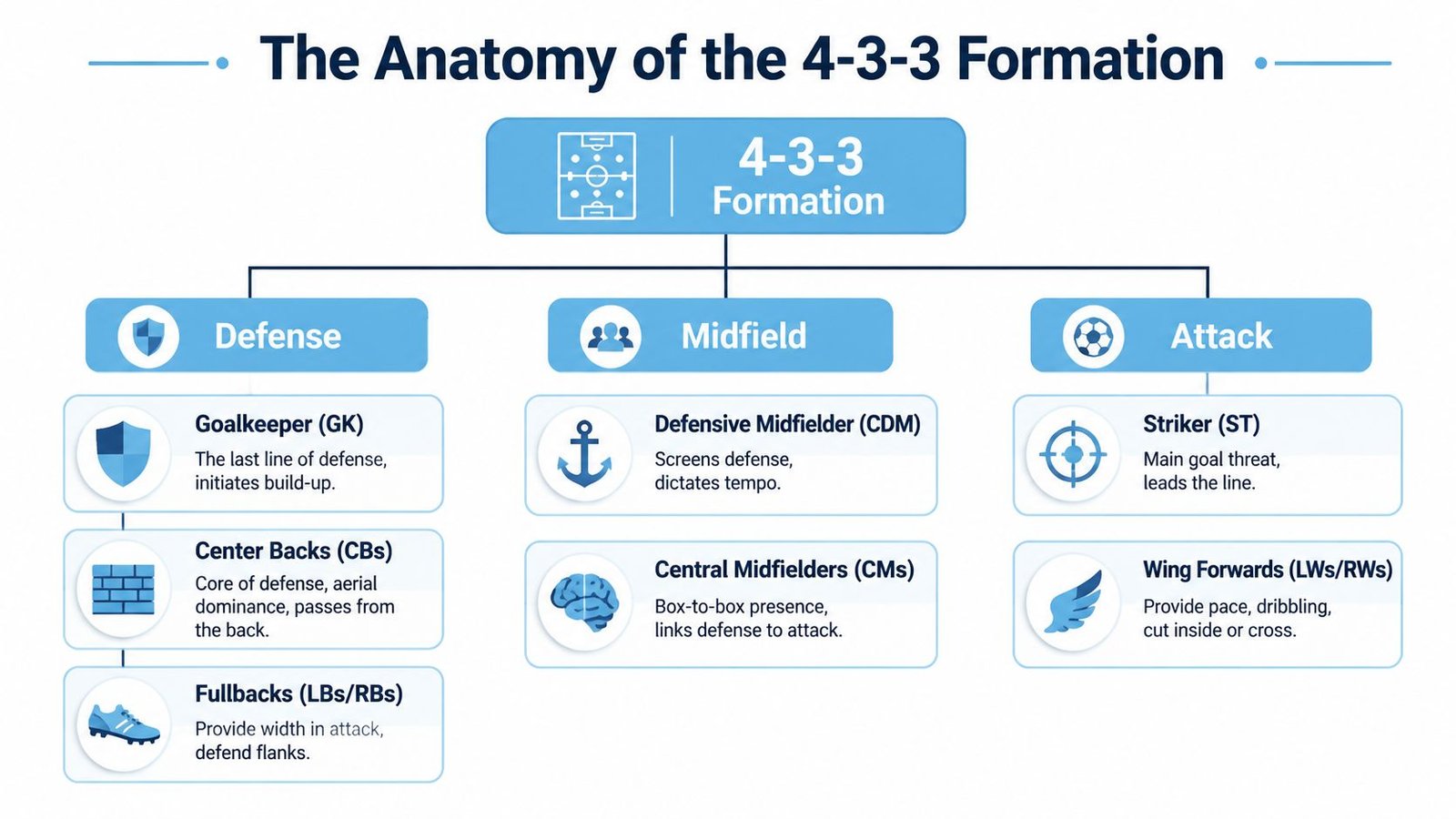
A 4-3-3 only looks simple from the stands. On the pitch, it asks each line to solve a different problem while staying connected to the others. The reason coaches still come back to soccer 4 3 3 is that it gives a team natural occupation across the width and depth of the field without sacrificing access to the center.
THE BACK FOUR
The back four isn't a flat defensive line in practice. The centre-backs provide the base for circulation, protect the box, and decide whether the team can build cleanly through pressure. One centre-back often carries the ball to provoke a press, while the other holds a covering position and protects against the direct counter.
Full-backs define the system's personality. In a more traditional version, they provide width and crossing support. In a more positional version, they can step into midfield, hold deeper to stabilize rest defense, or alternate their height depending on where the winger starts.
A useful coaching rule is to separate the jobs clearly:
- Centre-backs: Defend depth first, then progress play when the press invites it.
- Near full-back: Support circulation and create the next passing angle.
- Far full-back: Balance the structure and prepare for the switch.
- Goalkeeper: Start attacks with calm distribution and hold the team's line high enough to compress the pitch.
THE MIDFIELD TRIANGLE
This is the true engine room. The holding midfielder, commonly called the 6, screens the defense, protects the center, and sets the rhythm of possession. In elite 4-3-3 systems, the 6 doesn't just pass safely. The 6 decides when the game should be calm and when it should be accelerated.
The two 8s give the shape its range. One can push higher to connect with the winger and striker, while the other can drop to help progression. Their movements shouldn't mirror each other every time. If both leave the pivot exposed, the structure breaks. If both stay too close to the pivot, the attack becomes flat and easy to defend.
Coaching cue: The midfield triangle works when one player secures, one supports, and one threatens. If all three try to do the same job, possession becomes sterile or vulnerable.
A short positional table makes the balance clearer:
| Role | Main Task In Possession | Main Task Out Of Possession |
|---|---|---|
| 6 | Offer central outlet and dictate tempo | Screen central access and hold compactness |
| Right 8 | Support combination play and attack half-space | Press forward passing lanes |
| Left 8 | Link build-up and arrive into advanced zones | Track midfield runners and close inside channels |
THE FRONT THREE
The striker's job changes more than many fans realize. Some matches call for a fixed reference point who pins centre-backs. Others call for a forward who drops short, drags the line, and opens interior lanes for runners from wide or midfield.
The wingers stretch the pitch, but width alone isn't enough. They have to read the full-back's behavior. If the full-back overlaps, the winger can move inside. If the full-back holds, the winger may need to stay wider to isolate the opposing defender.
Three practical relationships define the front line:
- Striker and near winger: one pins, one moves.
- Far winger and far full-back: one stays high to preserve the switch.
- Winger and 8 on the same side: one comes short, the other attacks beyond.
That is why the 4-3-3 remains so useful. It gives coaches a base shape, but the essential value sits in the relationships between adjacent players.
COMMON TACTICAL VARIATIONS OF THE 4-3-3
A 4-3-3 can look stable on the team sheet and behave very differently once the first press arrives. That is the point coaches need to keep in view. The numbers stay fixed. The decisions do not. A full-back steps inside, an 8 holds his run for two seconds, the winger waits on the touchline instead of coming short, and the whole structure changes.
Manchester City have shown this better than anyone under Guardiola. The shape often starts as a familiar back four, midfield three, and front three. Within a few passes, it can turn into a 3-2-5, a box midfield, or a lopsided front line built to isolate one defender. The variation is not cosmetic. It is a response to triggers. How the opponent presses. Where the spare man appears. Which defender can be dragged out.
SINGLE PIVOT CONTROL
The purest version uses one clear 6 behind two advanced 8s. In City's case, that role has usually been the reference point for the entire possession phase. Rodri holds the center, offers the safe reset pass, and decides whether the next action should calm the game or accelerate it.
This version gives the 4-3-3 its cleanest passing map. The center-backs can split, the full-backs can choose their height, and the 8s can work between lines without constantly checking behind them. It also asks a lot from the pivot. If the ball-side 8 goes too high and the far-side full-back is already advanced, one bad touch or one forced pass can leave the 6 defending too much space alone.
That trade-off shows up in real matches. Against opponents who defend with one striker and protect the middle poorly, the single pivot gives City steady central access and long spells of control. Against teams that counter through two fast forwards or attack the inside channels quickly after regains, the same setup can leave the first defensive transition exposed.
A quick comparison helps:
| Variation | Main Strength | Main Risk | Best Use Case |
|---|---|---|---|
| Single pivot | Clear central circulation and strong occupation ahead of the ball | Large defensive space around the 6 after turnovers | Teams expecting to dominate possession |
| Double pivot | Better rest defense and safer build-up under pressure | One fewer player between the lines | Teams facing direct counters or aggressive pressing |
| Inverted winger version | Extra combinations in central lanes | Loss of width if full-back timing is poor | Teams with wide forwards who can receive inside and create |
DOUBLE PIVOT SECURITY
Some sides keep the 4-3-3 label but create a double pivot during build-up. The adjustment can come from an 8 dropping next to the 6, or from a full-back stepping into midfield. City have done both. John Stones moving inside beside Rodri is the clearest recent example.
That one movement changes the decisions around the ball. The center-backs can split wider because two players now protect central loss. One 8 can stay higher. The full-back on the far side can advance earlier. The team becomes harder to counter through the middle, but it also needs better timing from the players ahead of the ball, because one midfielder has been used to secure the structure instead of joining the attack.
This is why coaches often choose the double pivot against teams that press man to man or break fast after recoveries. The extra security is real. So is the cost. If the front five do not stretch the pitch properly, possession becomes safe but blunt.
For a useful contrast, this breakdown of the 4-2-3-1 formation and its double-pivot logic shows why some managers prefer two natural screens from the start rather than building one situationally inside a 4-3-3.
INVERTED WINGERS AND INTERIOR TRAFFIC
The third common variation changes the front line more than the midfield line. The wingers start wide, then move inside to receive between the opposition full-back and center-back. City have used this pattern with Phil Foden, Jack Grealish, Bernardo Silva, and Riyad Mahrez in different ways. The role is the same in principle. The timing is not.
Foden tends to attack the inside lane early if he sees a defender fixed wide. Grealish often waits longer, holds the full-back in place, and comes inside only after the ball is secure. Mahrez used to receive wide first, slow the duel down, then come onto his left foot once support had arrived. Same starting slot. Different reads.
That is the coaching point. Inverted wingers are not merely told to drift inside. They move on triggers. The near full-back overlaps or underlaps. The 8 vacates the half-space. The striker pins the near center-back. The far side remains wide enough to keep the back line stretched. If those details do not line up, central overload becomes central traffic.
One rule keeps the structure honest.
If the winger leaves the touchline, another player must occupy it, or the defense can collapse inward without paying a price.
City's best sequences with inverted wingers usually come from patience before the movement, not from early roaming. The ball is secured first. The opponent is shifted. Then the winger attacks the gap that has opened. That is why elite 4-3-3 teams look coordinated even while they are rotating constantly. The rotations follow clear cues, and each cue changes who secures, who supports, and who threatens.
ATTACKING PRINCIPLES AND BUILD-UP PATTERNS
At the Etihad, some of City's best attacks start with a pass that looks harmless. Rúben Dias rolls it into Rodri. The opponent steps late. Bernardo Silva shifts five yards inside. Suddenly the next pass breaks a line, and the whole move changes speed.
That is the core attacking idea in a 4-3-3. Each player's position should shape the defender's next decision before the ball arrives. Good possession is not sterile. It is a sequence of cues, reactions, and calculated risks.
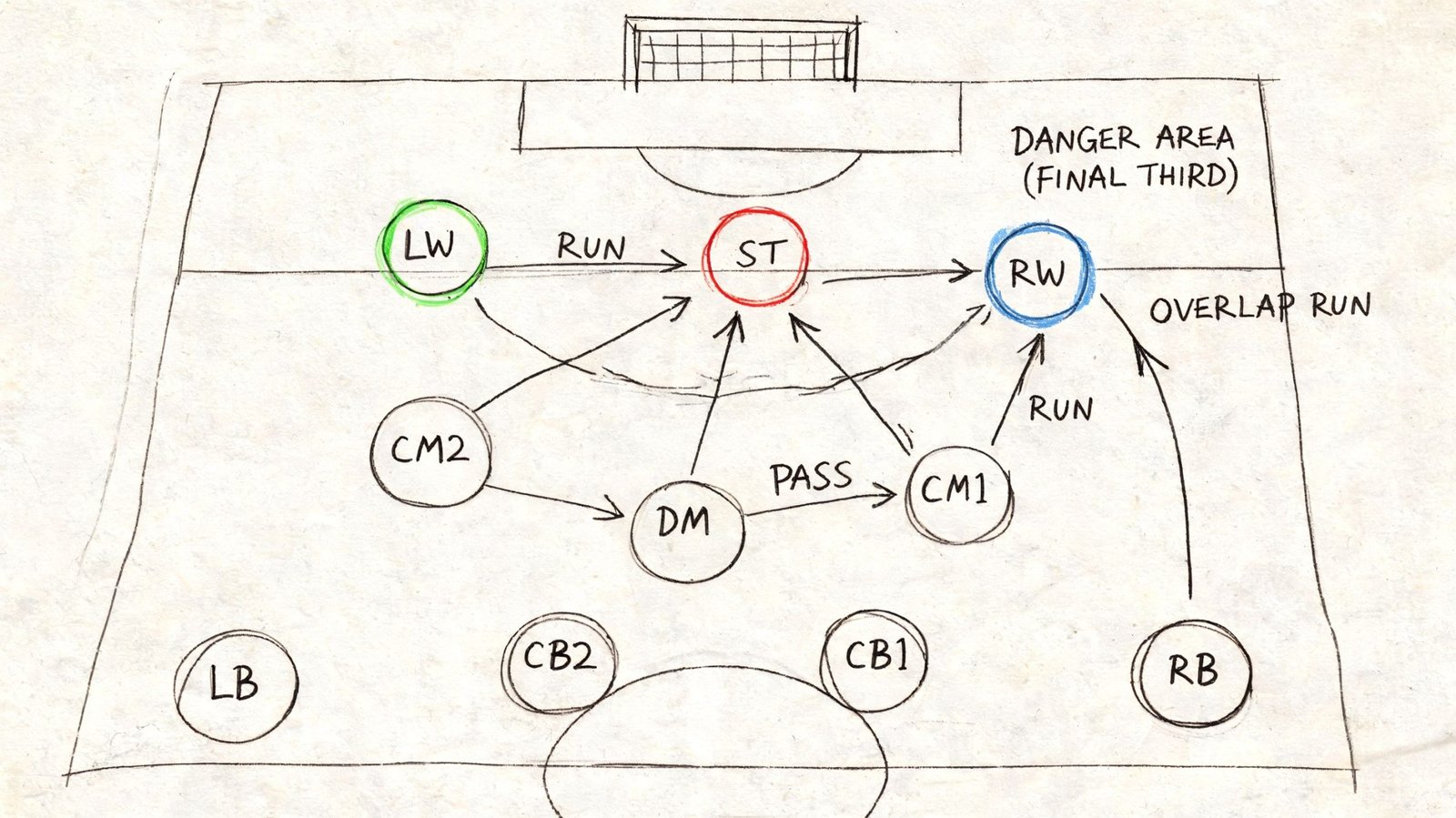
The first job in build-up is to establish distances that give the ball carrier more than one clean option. Centre-backs split to stretch the first line. The pivot stays available with the right body angle to play forward or bounce the ball away from pressure. One 8 positions between midfielders, not just in front of them, because the value is in receiving on the turn. Out wide, the wingers and full-backs read each other constantly. If both occupy the same lane too early, the shape loses depth and the press becomes easier to trap.
HOW THE FIVE-LANE ATTACK FORMS
A functioning 4-3-3 usually attacks with five lanes across the pitch. Left wing, left half-space, central lane, right half-space, right wing. The reason coaches teach those lanes is simple. They force the back line to make choices it cannot solve with one defender.
City have used those lanes in different ways under Guardiola. Some matches ask the full-backs to provide width. Others ask them to step inside and form a box midfield, leaving the wingers high and wide. The principle stays the same. Keep the last line stretched, keep central support close enough for combinations, and make sure somebody can attack the far side when the block shifts.
The right-back role shows the trade-off well. Kyle Walker has often held a slightly deeper or narrower position, not because City wanted less ambition, but because his starting point protected rest defence and improved the angle for the next circulation pass. That one adjustment can hold the opponent on one side long enough for De Bruyne or Bernardo to find the switch.
A coach should watch the trigger, not just the shape on the teamsheet.
- If the winger stays wide: the full-back can underlap or support inside the ball.
- If the winger moves into the half-space: the full-back must decide whether to overlap or hold for security.
- If the opponent collapses centrally: the far-side wide player becomes the immediate target.
- If the pivot is covered: a centre-back has to carry forward to force a midfielder out.
CITYS POSITIONAL ROTATIONS IN POSSESSION
City's rotations work because the players recognize the cue at the same moment. De Bruyne drifting toward the right half-space is not random movement. It usually responds to a specific picture. The opposing full-back is uncertain whether to hold Foden, jump to Walker, or pass De Bruyne on to a midfielder. That half-second of doubt is often enough.
The detail that separates elite 4-3-3 play from casual possession is occupation after movement. When De Bruyne leaves the interior lane, someone has to fill the space behind the striker or secure the pivot line. Bernardo Silva is one of the best in Europe at reading that exchange. He will support under the ball if the move needs control, then arrive higher once the lane is stable.
This is also why Rodri matters so much to City's attacking structure. The first pass into midfield sets the tempo for the next two actions, and his positioning often determines whether City can attack through the center or must recycle around the block. Their analysis of Rodri's absence and City's midfield struggles shows how much of the build-up rests on that single reference point.
A common build-up sequence looks like this:
- The centre-back carries forward to draw pressure from the first line.
- The pivot adjusts his angle to receive, screen, or act as a decoy.
- The near 8 checks into the pocket only when the passing lane is open enough to play forward.
- The winger reads the full-back's feet and either pins wide or moves inside.
- The full-back reacts last because that final movement should complete the overload, not crowd it.
That final point matters. In many 4-3-3 teams, the full-back moves too early and gives the defense an easy picture. City are better when the last runner arrives after the opponent has already shifted once.
A practical video example helps show those timings on the pitch.
THE STRIKERS ROLE IN A SUPPOSEDLY WIDE SYSTEM
The striker decides whether the attack has depth or just possession. In a 4-3-3, that role changes by phase. One moment the forward pins both centre-backs to leave room for the 8s. The next moment he drops short to connect a wall pass and release a winger beyond him.
Haaland changed City's attack because defenders had to respect the run behind on every touch. That did not just create chances for him. It also changed the decisions around him. When the back line dropped a step to protect the space behind, De Bruyne had more room to receive facing goal. When a centre-back followed Haaland tight, the weak-side winger could attack the gap left behind.
The trade-off is clear. A striker who drops too often can help circulation but flatten the attack. A striker who only pins the line can leave the midfield outnumbered in build-up. The best 4-3-3 sides solve that tension through timing. The forward's movement has to match the trigger around him.
Match principle: If the striker pins the centre-backs, the 8s and wingers can attack the space in front of and around the back line. If the striker drops, one wide forward or an 8 has to run beyond immediately.
That is why the 4-3-3 remains so demanding. The shape gives teams width, depth, central access, and clean rest-defence positions, but only when the players read the same cue and react in the right order.
DEFENSIVE PRINCIPLES AND PRESSING TRIGGERS
At the Etihad, the key defensive moment in a 4-3-3 often comes before any tackle. The ball goes into a full-back, the winger curves the run to block the line pass, the striker shades the return into the centre-back, and Rodri has already taken two steps to seal the inside lane. The trap is not the sprint. The trap is the sequence of decisions.
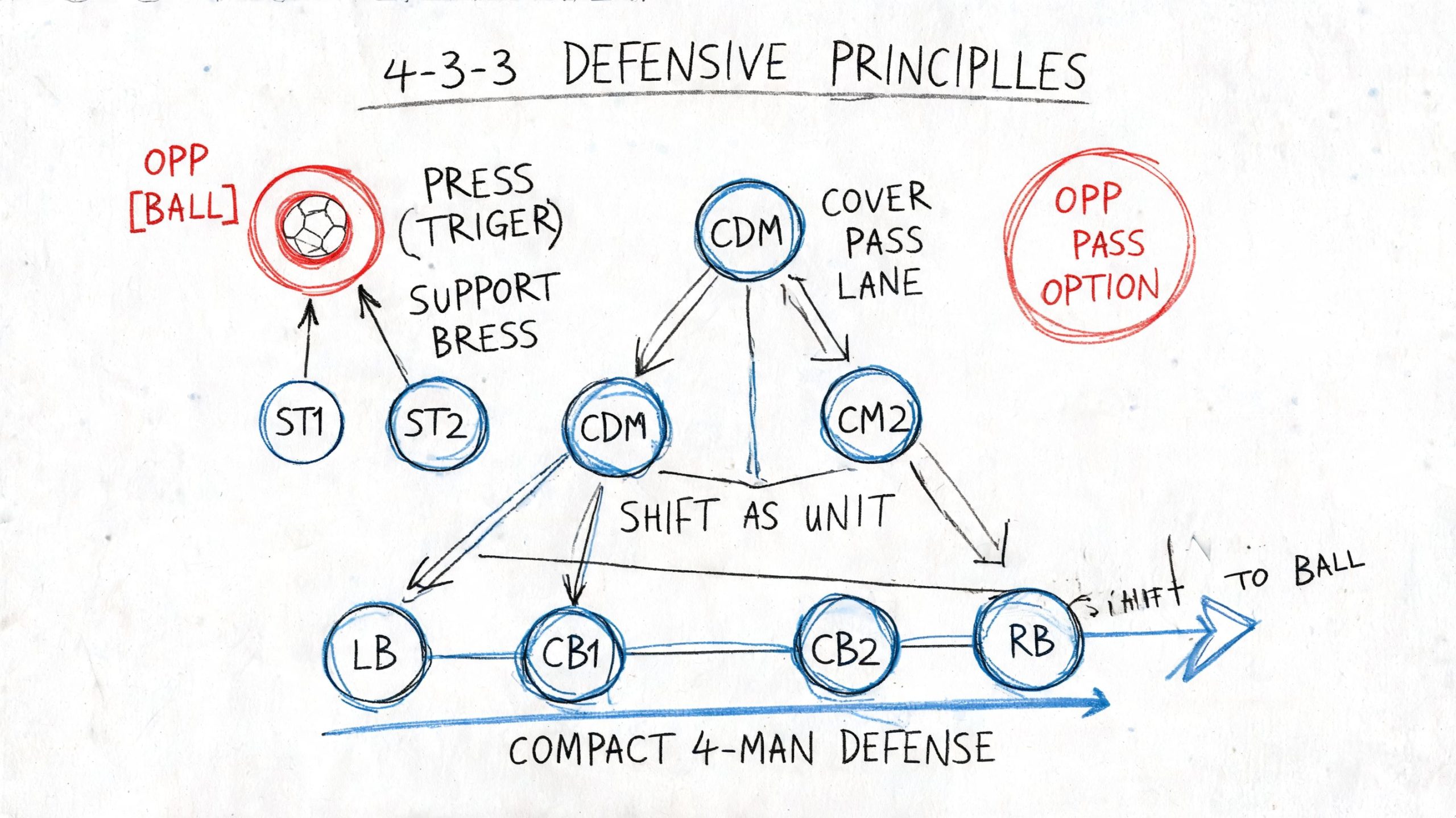
That is what separates an organized 4-3-3 from an eager one. The shape defends by removing the best pass first, then attacking the next touch. If the front three jump without midfield cover, one clean pass breaks the press and exposes the centre.
HOW THE FRONT THREE START THE PRESS
The front line sets the direction of play. In a good 4-3-3, the striker rarely presses straight at the ball for show. He screens one side of the pitch and invites the pass his team wants. The wingers then arrive as the outside locks, showing play toward the touchline and closing the route back inside with their body shape.
The triggers are usually simple and repeatable. A backward pass. A heavy first touch. A receiver facing his own goal. A centre-back shifting onto the weaker foot. Coaches should train the reaction after the trigger, not just the trigger itself. If the winger jumps and the near 8 is late, the press fails even if the read was right.
Manchester City have been a strong example of this under Guardiola, especially in matches where the wide player and the near 8 work as a pair. Bernardo Silva has done this role as well as anyone. He does not just run at the full-back. He blocks the inside option, waits for the receiver to settle the ball, then presses on the second touch so support can arrive under him. That timing matters more than raw speed.
THE MIDFIELD SCREEN BEHIND THE PRESS
The midfield line decides whether the press has protection. The 6 holds the central seam. The near 8 supports the jump under the ball. The far 8 narrows early to close the switch and protect the opposite half-space. If one of those three misreads the cue, the whole shape stretches.
Elite 4-3-3 teams make better decisions than average ones in these moments. They do not ask the pivot to chase every pass. They ask him to guard the lane that would release the press. City's best defensive spells often come when Rodri resists the temptation to jump, stays connected to the centre-backs, and lets the press develop in front of him. Coaches looking at Rodri's absence and City's midfield struggles can see the cost of losing that restraint. The team can still press high, but it becomes harder to control the space behind the first challenge.
A practical coaching detail matters here. The back line should not squeeze just because the front line has gone. It should squeeze when the midfield has closed the inside lane and the ball carrier is playing under pressure. Without that cue, defenders step into space they cannot protect.
- Striker: Screens the easy return pass and sets the pressing angle.
- Near winger: Forces play outside, then attacks the receiver's second touch.
- Near 8: Supports under the press and blocks the inside bounce pass.
- Far 8: Tucks in early to stop the switch and protect the weak side.
- 6: Stays central, reads the loose ball, and protects the space in front of the centre-backs.
WHAT CITY SHOW ABOUT REAL-TIME ADAPTATION
City rarely defend the 4-3-3 in one fixed way for 90 minutes. The principle stays the same, but the roles shift with the opponent's build-up. If the opposing full-back drops deep, the winger may hold wider and wait. If the centre-back drives forward, the near 8 can jump first and the striker will cover behind him. If the opponent creates a box midfield, the weak-side winger often tucks in earlier to protect the centre before the ball even travels there.
That is the primary lesson for coaches and serious fans. The 4-3-3 is not a pressing shape by itself. It is a decision-making framework. The best teams know which pass to bait, which runner starts the trap, and which player must hold position so the next ball does not break the structure.
EXPLOITING WEAKNESSES AND COUNTERING THE 4-3-3
Rodri receives with his back half-turned, both full-backs have stepped on, and one loose pass changes the whole picture. That is the moment opponents hunt against a 4-3-3. The shape still has numbers behind the ball, but its protection is no longer connected.
WHERE OPPONENTS FIND SPACE
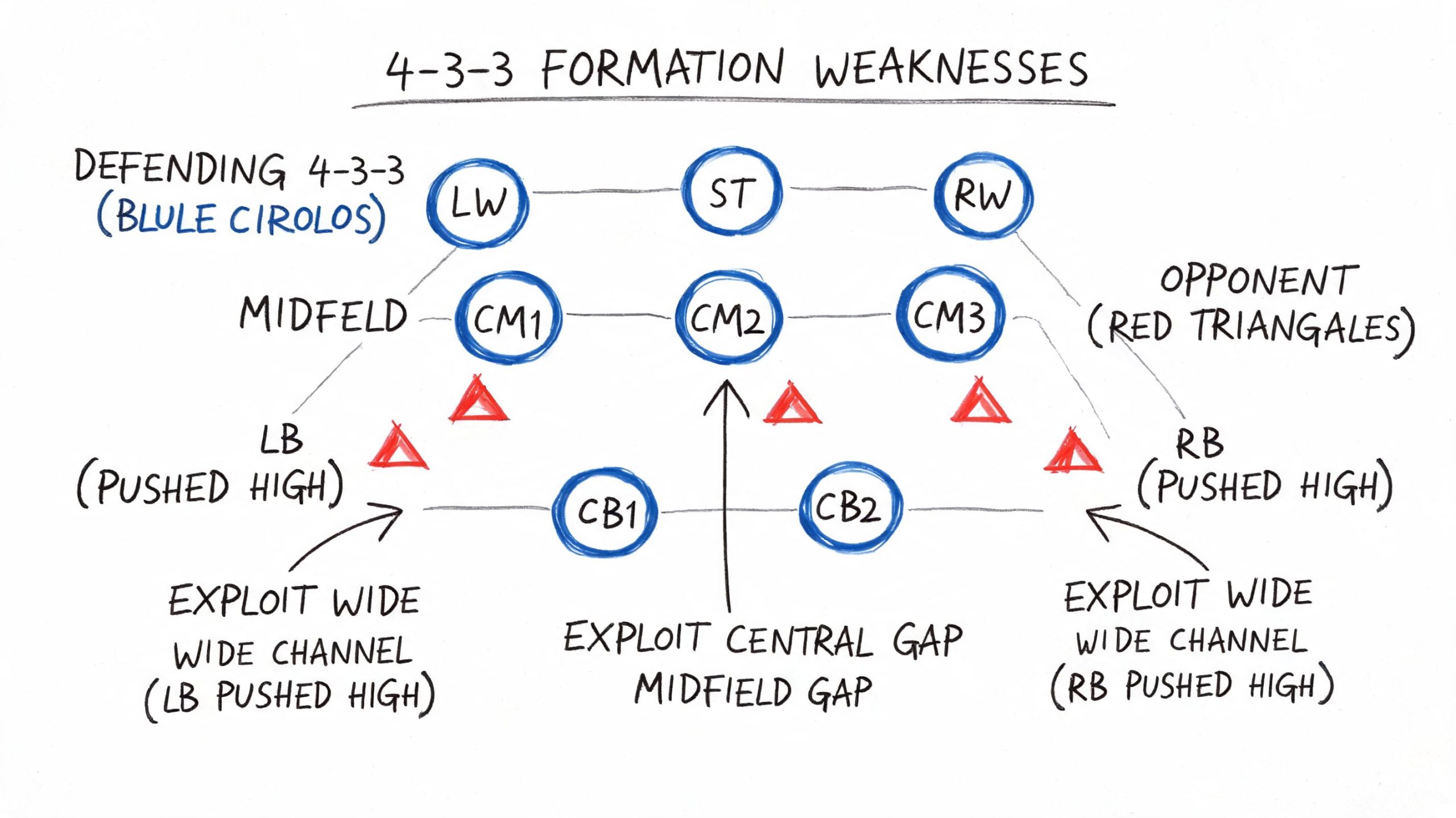
The first pressure point sits around the single pivot. In a standard 4-3-3, the 6 has to screen central access, support circulation, and protect transition space if both 8s have moved ahead of the ball. Against a compact 4-4-2, that can become a 3v4 problem in midfield, especially if the striker does not drop in time or the full-back stays wide instead of stepping inside. Once the pivot is pinned, opponents can play into the feet of a striker, a 10 drifting off the front line, or a runner arriving from the blind side.
City have solved this in different ways depending on the opponent. Sometimes the answer is positional. John Stones stepping into midfield gave Rodri a second central reference point. Sometimes it is a forward movement. Julián Álvarez dropping short can turn the midfield picture from equal numbers into an extra passing lane. The principle stays the same. The 4-3-3 is strongest when the pivot is supported early, not when he is left to cover the width of the centre alone.
The next weakness appears in the channels beside the centre-backs.
If the full-backs are high and the ball is lost on the wing, the recovery run gets long and awkward. Opponents do not need a long possession spell to punish that. One direct pass into the outside lane, then a second run beyond the nearest centre-back, is often enough to force emergency defending. Teams that play quick diagonals into the winger-full-back gap have caused City trouble there, particularly when the counter-press misses its first contact.
A third issue shows up on the far side. The ball-side overload that helps the 4-3-3 combine in tight spaces can leave the weak side exposed if the switch arrives one pass earlier than expected. The far winger has to recover inside. The far 8 has to judge whether to protect the half-space or jump to the receiver. Elite opponents read that hesitation.
A compact description of the danger zones looks like this:
| Vulnerability | What Causes It | What Opponents Try |
|---|---|---|
| Space around the 6 | Both 8s advance and the pivot loses close support | Vertical pass into a striker or 10 zone |
| Wide transition lanes | Full-backs high on loss | Quick switches and channel runs |
| Far-side exposure | Ball-side overload leaves weak side open | Diagonal switch after one extra pass |
THE BEST COUNTER PLANS AGAINST IT
The best counter to a 4-3-3 usually starts with changing its decisions, not mirroring its shape. A 4-4-2 can do that by screening the pivot, showing the ball outside, then attacking the moment the full-back commits forward. A 4-2-3-1 can crowd the same central space with a 10 while keeping a double pivot behind the press to collect second balls and stop counters.
Against Manchester City, the clearest route has often been to bait one pass, then attack the reaction. Force the ball into the pivot under pressure. Or tempt the full-back high, regain possession, and hit the channel before City can fold back into their rest defense. Those are two different plans, but both target the same issue. They attack the seconds when role changes are still happening.
I would coach it with three cues in mind:
- Press the pivot on his first closed-body touch
- Run into the channel as the full-back moves, not after
- Switch play before the far winger can recover narrow
The trap against a 4-3-3 comes from winning the ball when the structure is changing, not simply from winning it.
There is a trade-off for the defending side too. Sit too deep and the 4-3-3 settles into controlled possession. Press too aggressively and the interior lanes open for the exact combinations the shape is built to create. The better plan is selective pressure with clear triggers. Block central access, invite the pass you want, then break into the space the shape has just uncovered.
CONCLUSION
Late in matches, the 4-3-3 often stops looking like a formation board and starts looking like a chain of decisions. A full-back steps inside instead of outside. The winger stays wide for one more pass. The No. 8 runs beyond the striker because the pivot has already secured the space behind the ball. That is why the shape has lasted. It gives teams a clear reference point, then lets them solve the next problem in real time.
At its best, the 4-3-3 balances structure with choice. The back four holds the platform. The midfield triangle sets passing angles, pressing distances, and cover. The front three stretch the pitch, but they also determine where the next overload or isolation will appear. Coaches value the system because each line supports the next without locking players into one pattern.
Manchester City under Guardiola remain one of the clearest examples. The same base shape can produce very different pictures within a single half. Rodri can hold as the single pivot while John Stones or Rico Lewis steps into midfield. Kevin De Bruyne can attack the half-space early, or Bernardo Silva can stay deeper to help circulate and pin the opponent's midfield line. Phil Foden may hold width to open the lane inside, while Jérémy Doku or Jack Grealish can attack the full-back in isolation when City want a different kind of threat.
The point is not the starting positions alone. The point is what each movement asks the next player to read.
That is the essential value of the 4-3-3 for coaches and serious fans. It teaches timing. It teaches which pass triggers the press, which body shape invites the next action, and which rotations protect the team when possession is lost. City's strongest performances show that clearly. The shape changes from build-up to attack to counterpress, but the players still recognize the same references around the ball and around space.
Used well, the 4-3-3 gives a team control without making it predictable. Used badly, it becomes flat, easy to press, and too reliant on individual quality in wide areas. That trade-off is why the formation still matters. Success with it comes from coaching the decisions inside the shape, not from writing 4-3-3 on the team sheet.
Manchester City supporters, coaches, and analysts who want sharper match breakdowns can explore more at Manchester City Analysis, where tactical reporting turns complex team structure, player roles, and game-state adjustments into clear football insight.