A decade ago, the 4-3-3 often looked like a static shape on a tactics board. Under Pep Guardiola, it became something else: a moving framework where the same starting positions could produce a back three, a box midfield, or a front five within a single possession.
That's why 4 3 3 soccer still matters. It isn't just common. It remains the clearest expression of how elite teams control space, tempo, and risk.
Table of Contents
- INTRODUCTION THE ENDURING DOMINANCE OF THE 4-3-3
- THE FUNDAMENTAL STRUCTURE AND PLAYER ROLES
- ATTACKING PRINCIPLES AND PATTERNS
- DEFENSIVE ORGANIZATION AND PRESSING TRIGGERS
- COMMON VARIANTS AND TACTICAL ADAPTATIONS
- COACHING THE 4-3-3 PRACTICAL DRILLS AND ANALYTICS
- CONCLUSION THE 4-3-3 AS A FOOTBALLING PHILOSOPHY
INTRODUCTION THE ENDURING DOMINANCE OF THE 4-3-3
The modern game still keeps returning to the same reference point. Ajax and the Netherlands popularized the 4-3-3 through Total Football in the 1970s, a period linked to 11 major trophies for Ajax, and the same formation has carried Manchester City to four Premier League titles in five years from 2018 to 2024, as outlined in this history of the 4-3-3's development.
That lineage matters because the shape has survived multiple tactical eras without losing its core logic. It gives teams width without isolation, central numbers without crowding, and pressing access without sacrificing a spare defender in build-up. Few systems offer all three at once.
At Ajax, the idea was fluidity. At Barcelona, the same logic fed positional play. At Manchester City, Guardiola has pushed it toward maximum territorial control, often turning the nominal 4-3-3 into a possession structure that looks more complex than the team sheet suggests. The listed formation is only the starting point.
WHY THE SYSTEM KEEPS RETURNING
The strongest reason for the 4-3-3's durability is that it balances proactive football with defensive order. A back four anchors the shape. A midfield three gives a natural platform for circulation and central occupation. A front three stretches the opponent horizontally while still keeping enough bodies between the posts to threaten immediately.
The 4-3-3 works best when the team treats positions as reference points, not fixed parking spots.
For coaches and analysts, that distinction is vital. The shape's strength doesn't come from symmetry. It comes from controlled asymmetry. One full-back can step high while the opposite side secures. One midfielder can advance while the pivot holds. One winger can stay wide while the far-side winger attacks inside.
That's also why Guardiola's version attracts so much scrutiny. City don't just line up in a 4-3-3. They use it as a platform for repeatable superiority in the middle third, then alter details according to the opponent. Readers looking for a broader tactical frame around that idea can find it in this look at Guardiola's winning philosophy and elite squad.
WHAT MAKES 4 3 3 SOCCER DIFFERENT
Other formations can dominate isolated phases. The 4-3-3 tends to connect them. It links build-up to chance creation, and pressing to rest defense, more cleanly than most alternatives.
Three features explain that staying power:
- Natural triangles: every line can support the next with short passing options.
- Flexible height: the midfield can flatten, stagger, or rotate depending on pressure.
- Wide threat with central security: wingers stretch the pitch, while the midfield trio protects the core.
That combination is why 4 3 3 soccer remains the tactical language of elite possession sides. The shape has changed. Its principles haven't.
THE FUNDAMENTAL STRUCTURE AND PLAYER ROLES
A classic 4-3-3 starts with simple geometry. Four defenders provide the base, three midfielders connect every phase, and the front three create width, depth, and finishing presence. The reason the structure has lasted isn't aesthetic. Each line solves a different spatial problem.

In practice, the shape only works if roles are understood in relation to one another. The left center-back's passing lane depends on the pivot's body position. The winger's starting width affects the full-back's timing. The center forward's movement changes which midfielder becomes the third-man runner.
THE BACK FOUR AND THE GOALKEEPER
The goalkeeper in a modern 4-3-3 is part of circulation, not just protection. Against a front two, that player often helps create a first-line overload by making the build-up effectively three against two.
The center-backs handle different tasks depending on the opponent's press. One may carry forward while the other secures. The full-backs are even more variable. In a traditional version they overlap. In a more controlled version, one may invert or hold deeper to stabilize possession.
A useful way to read the back line is by function rather than title:
- Goalkeeper: starts possession, supports the first line, and fixes pressure.
- Center-backs: protect depth, switch play, and break lines when space opens.
- Full-backs: either supply width or help create numerical stability inside.
That last point has become especially important at City. Full-back behavior often decides whether the shape remains a clean 4-3-3 or tilts into a different build-up picture. The structural consequences of that shift become clearer in this analysis of Rodri's absence and City's midfield struggles.
THE MIDFIELD THREE AND THE FRONT LINE
The midfield is the system's control center. The deepest midfielder protects central access, offers the safe pass, and dictates the rhythm of circulation. The two advanced midfielders must do more than create. They need to arrive in useful zones without blocking the winger or striker.
Practical rule: If the advanced midfielders stand on the same horizontal line too early, the 4-3-3 loses its best feature, staggered support.
The front three also need complementary profiles. The center forward pins center-backs or drops to connect. One winger may hold the touchline. The opposite winger may attack the inside channel. Balance matters more than labels.
A clean positional reference looks like this:
| Unit | Main role | Tactical purpose |
|---|---|---|
| No. 6 | Screen, recycle, switch play | Protects the center and organizes tempo |
| No. 8s | Support, arrive, combine | Connect possession to penetration |
| Wingers | Stretch or invert | Force the back line to make choices |
| Center forward | Pin or link | Creates depth and space for runners |
The strongest 4-3-3 teams don't ask every player to do everything. They ask each player to solve one problem at the right time.
ATTACKING PRINCIPLES AND PATTERNS
The attack in 4 3 3 soccer begins before the final third. Its first objective is to create a passing picture with at least two safe exits and one progressive option. That's why elite versions of the system look calm in circulation but dangerous once the opponent shifts a half-step too far.
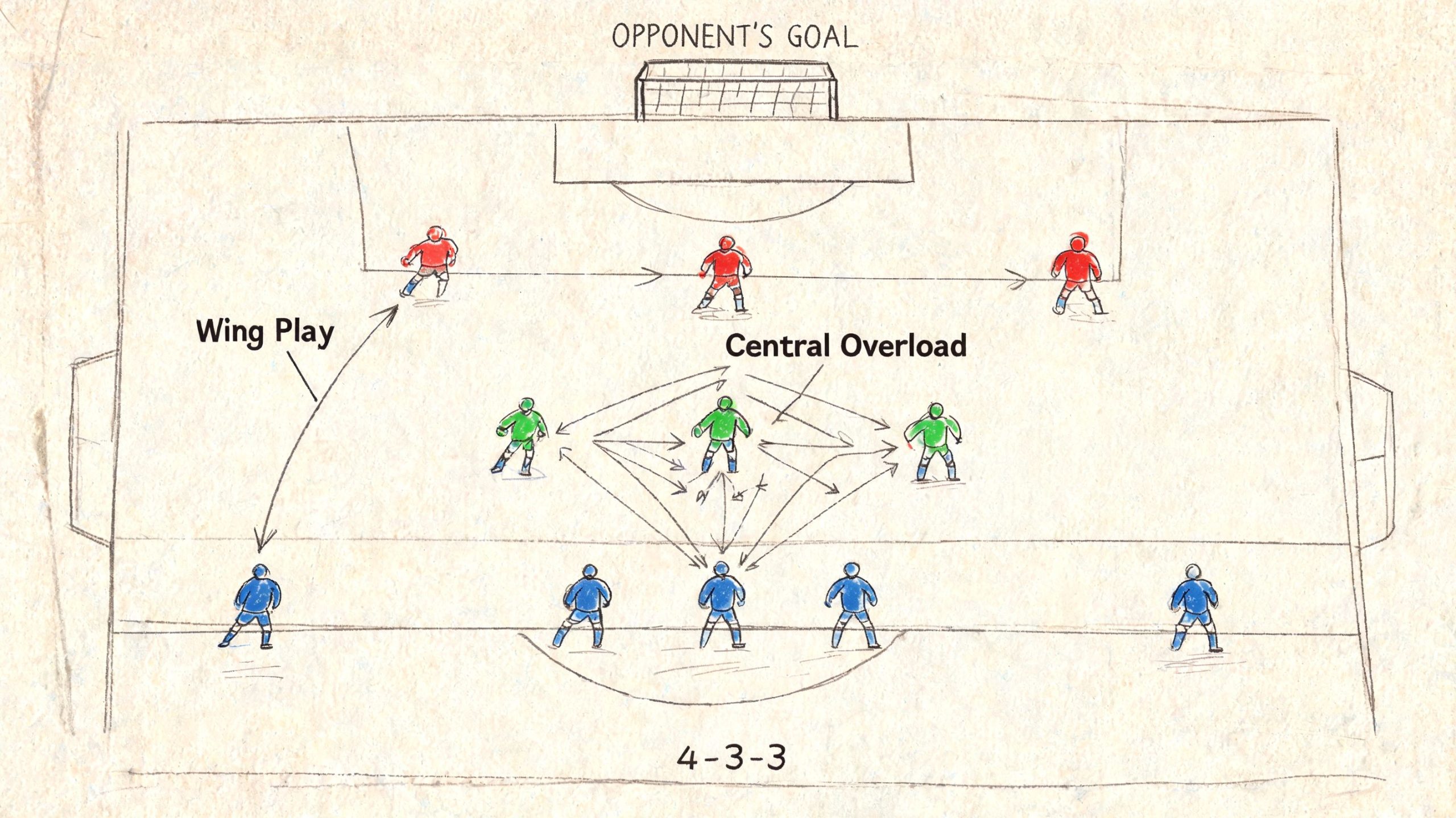
For Guardiola's Manchester City, the attacking phase often depends on positional interchanges and full-back asymmetry, with one full-back dropping to help form a back three while the other advances. That movement opens spaces between the opposition full-back and center-back for No.10-like runs from wingers or midfielders. In City's 4-3-3 variants, the side has produced 2.4 xG per match in the 2024-25 Premier League, with 25% of that coming from half-space overloads, according to this analysis of 4-3-3 attacking mechanisms.
TRIANGLES, WIDTH, AND HALF-SPACES
The phrase “passing triangles” can sound generic, but in a 4-3-3 it has a precise meaning. The triangle isn't just there to keep the ball. It's there to pull one defender out of the chain and expose the next zone.
City repeatedly create those shapes in three lanes:
- Wide triangle: full-back, winger, advanced midfielder.
- Inside triangle: pivot, advanced midfielder, dropping forward.
- Switch triangle: center-back, pivot, far-side full-back or winger.
When one triangle attracts pressure, the next one becomes the release valve. That's where the half-space becomes decisive. The half-space is difficult to defend because it sits between center and flank responsibilities. If the full-back jumps, the winger stays free. If the center-back shifts, the striker can pin or spin.
This short visual is useful before moving to the next layer of movement.
WHY CITY'S 4-3-3 CREATES BETTER SHOTS
The true value of these patterns isn't possession for its own sake. It's shot quality. Haaland's role illustrates that clearly. By pinning center-backs, he narrows their spacing and prevents easy support jumps into midfield. That gives rotating wingers such as Foden or Doku a better platform to receive facing the box.
A useful attacking sequence often looks like this:
- Secure the first line: one full-back drops and the pivot offers the central outlet.
- Move the opponent laterally: circulate until the opposition winger or full-back has to choose.
- Attack the gap: an advanced midfielder or inverted winger runs into the channel between full-back and center-back.
The best 4-3-3 attacks don't rush the final pass. They manufacture it.
That's the hidden strength of Guardiola's model. The shape generates patience without passivity. The team can hold width, crowd the half-space, and keep a central finisher occupied in the box. Most formations can do two of those at once. The 4-3-3 can do all three when the rotations are timed well.
DEFENSIVE ORGANIZATION AND PRESSING TRIGGERS
The strongest 4-3-3 sides defend with the same logic they attack. They want the opponent to play into predictable areas, then collapse the space around the ball. Defensive quality in this system isn't only about duels. It's about how quickly the team restores compactness after losing the ball.

Evidence for that defensive value appears in broader tactical analysis. Teams using the 4-3-3 average 58-62% possession in Premier League matches, and their high-press success rates are 15% above 4-2-3-1 variants because the lines stay compact at under 40 yards wide. The shape can also drop into a 4-5-1, which has been linked to a 22% reduction in counter-attack concessions, according to this breakdown of 4-3-3 midfield and pressing dynamics.
HOW THE SHAPE CHANGES WITHOUT THE BALL
The nominal front three don't always remain a front three defensively. In a high press, they often mark the first build-up line and try to direct play toward the touchline. In a mid-block, one winger may recover into midfield, producing a 4-1-4-1 or 4-5-1.
That flexibility matters because the 4-3-3 can defend two different threats with the same players:
| Defensive phase | Common shape | Main objective |
|---|---|---|
| High press | 4-3-3 | Lock central exits and force rushed passes |
| Mid-block | 4-1-4-1 | Protect central lanes and delay progression |
| Deeper block | 4-5-1 | Defend width without opening the middle |
The No. 6 is the hinge in all three versions. If that player screens well, the center-backs can hold their line and full-backs can step out with more conviction. If the No. 6 is bypassed too easily, the entire shape starts retreating.
PRESSING TRIGGERS THAT MAKE THE SYSTEM WORK
A press shouldn't begin because the team feels aggressive. It should begin because the ball location and body orientation favor the defender. In a good 4-3-3, the triggers are visible and repeatable.
Common examples include:
- A backward pass to the goalkeeper: the front line can jump and narrow angles.
- A poor first touch near the sideline: the nearest winger presses while the full-back squeezes behind.
- A square pass into a full-back: the winger curves the run, and the near-side No. 8 blocks the inside lane.
A pressing trigger is only useful if the next two players react at the same moment.
That point separates organized pressure from energetic chaos. Guardiola's teams rarely press as individuals. They compress as units. The winger's run shapes the pass. The midfielder shadows the inside option. The full-back decides whether the trap closes or whether the team resets.
For coaches, that means the defensive side of 4 3 3 soccer is less about slogans such as “press high” and more about distances, angles, and synchronized movement.
COMMON VARIANTS AND TACTICAL ADAPTATIONS
The 4-3-3 isn't one structure. It's a family of structures that share the same broad outline while changing the control points inside it. The most useful way to study it is by asking a practical question: where does the extra layer of security come from?
Sometimes it comes from a lone pivot who controls the center alone. Sometimes it comes from a second holding midfielder. Sometimes it comes from a false 9 dropping into midfield. Each choice changes progression, pressing, and defensive recovery.
SINGLE PIVOT VERSUS DOUBLE PIVOT
A single pivot gives the team one more advanced player between the lines. A double pivot gives the build-up more protection and easier circulation under pressure. The trade-off is simple. The first model is more expansive. The second is more conservative.
| Aspect | Single Pivot (e.g., 4-1-2-3) | Double Pivot (e.g., 4-2-3-1) |
|---|---|---|
| Central control | Strong higher up the pitch | Stronger in first and second build-up lines |
| Chance creation | More runners ahead of the ball | More security behind the ball |
| Defensive cover | Relies heavily on the No. 6 | Shares screening duties |
| Press resistance | Excellent if the pivot is elite | Safer if the opponent presses centrally |
| Best use case | Dominant possession side | Transitional or risk-managed approach |
For readers comparing these systems directly, this tactical guide to the 4-2-3-1 formation provides a useful contrast.
THE FALSE 9 AND THE 3-2-5 SOLUTION
Manchester City's adjustments around Rodri's absence show how elastic the shape can be. In the 2025/26 Premier League season up to May 2026, City dropped 15 points in matches without Rodri compared with 5 with him, according to Opta data cited in this analysis of the 4-3-3's tactical trade-offs. The response has included a false 9 or a 3-2-5 build-up, which has pushed possession to 68% while reducing progressive passes by 22%.
That trade-off reveals something important. When the specialist single pivot is missing, the team can still dominate the ball, but the route to the final third changes. Possession remains. penetration becomes harder.
A false 9 helps by dropping onto the midfield line and creating one more short option. A 3-2-5 helps by stabilizing the first phase and giving the front line five occupied lanes. Both adaptations protect structure. Neither fully replaces what an elite pivot gives in tempo, screening, and vertical distribution.
The variant doesn't exist to preserve the chalkboard shape. It exists to preserve the team's priorities.
That is the fundamental lesson for coaches. The numbers on the team sheet matter less than the question being solved.
COACHING THE 4-3-3 PRACTICAL DRILLS AND ANALYTICS
The hardest part of coaching a 4-3-3 isn't drawing it. It's teaching players how each movement changes the next pass, the next cover angle, and the next recovery run. The shape becomes coherent only when training connects positioning to physical demand.

That physical component is easy to underestimate. In elite youth football using the 4-3-3, central midfielders cover significantly greater distance per minute than central defenders and side defenders, while side defenders and forwards lead in high-speed running and sprint distance, according to this study of positional demands in a 4-3-3. Coaches who ignore those role differences usually end up training the shape without training the engine.
THREE DRILLS THAT TEACH THE SHAPE
The most effective sessions isolate one principle, then add the next layer.
Positional rondo with outside lanes
Use a central grid with two flank channels. The objective isn't just possession. The objective is to move the ball from one side to the other through the pivot or the near-side No. 8, then find the winger in the outside lane. This teaches body orientation, support angles, and the patience needed to create the right release.Half-space pattern play to finish
Start with center-back to No. 6, then into an advanced midfielder, then wide, then a cutback or slipped pass into the half-space runner. Keep the sequence constrained at first. Then add passive pressure, followed by live defenders. The striker's role should vary between pinning, dropping, and clearing the lane.Pressing trap game in one half
Set the defending side in a 4-3-3 and the attacking side building from the back. Award extra value for regains won after a trigger near the touchline. This teaches the near winger's curved press, the No. 8's cover shadow, and the full-back's decision to jump or hold.
Coaching cue: Stop the drill when distances break, not only when the pass goes wrong.
That correction matters because a failed press often begins two movements earlier. The same is true in possession. A bad receiving angle can ruin the next three options.
THE METRICS THAT ACTUALLY MATTER
Coaches and analysts need measures that reflect the system's ideas, not just the scoreline. A useful monitoring set includes:
- PPDA: tracks pressing intensity and whether the front three are forcing rushed circulation.
- Half-space entries: shows whether the team is progressing into valuable interior channels.
- Wide-to-central conversions: records whether wing access leads to box occupation rather than sterile crossing.
- Rest-defense recoveries: examines how quickly the team regains structure after losing the ball.
- Position-specific load markers: especially for central midfielders, side defenders, and forwards, whose running demands differ sharply in this shape.
Staff building that monitoring framework can benefit from a broader primer on understanding player performance metrics, especially when linking tactical roles to tracking data and training design.
The key point is simple. Analytics should confirm whether the 4-3-3 is producing its intended advantages. If the team has the ball but doesn't enter the half-spaces, the shape is only cosmetic. If the team presses but the distances are poor, the numbers should expose that quickly.
CONCLUSION THE 4-3-3 AS A FOOTBALLING PHILOSOPHY
The 4-3-3 has lasted because it offers more than balance on paper. It gives coaches a way to organize territory, create superiorities, and control transitions without surrendering attacking presence. That's why its history runs from Ajax and Total Football to Guardiola's Manchester City without losing relevance.
Its deeper value lies in how it connects ideas that often pull against each other. Width and compactness. Patience and penetration. Aggressive pressing and structural caution. Other systems can emphasize one of those poles. The 4-3-3 remains the best-known framework for holding them together.
For informed fans, that makes the shape a lens rather than a label. A listed 4-3-3 might become a 3-2-5 in possession, a 4-1-4-1 in the mid-block, or a front-foot pressing structure with narrow wingers and a screening pivot. The formation is the entry point. The actual subject is coordinated space management.
That's also why the future of 4 3 3 soccer won't be about whether elite teams abandon it. The more likely story is continued mutation inside the same basic shell. Full-backs will keep changing roles. Midfielders will keep splitting tasks differently. Forwards will keep rotating between pinning and linking. The philosophy will stay familiar even as the details keep moving.
Manchester City supporters, coaches, and analysts looking for sharper tactical breakdowns can explore more at Manchester City Analysis, where match structures, player roles, and Guardiola's adaptations are examined in detail.