At the Etihad, the shape on the teamsheet rarely tells the whole story. You might see a back four, two holding midfielders, three attackers underneath a striker, and think it’s simple. On the pitch, the 4-2-3-1 is anything but simple.
Table of Contents
- Introduction The Formation That Defined Modern Football
- Anatomy of the 4-2-3-1 Player Roles and Responsibilities
- The 4-2-3-1 in Every Phase of Play
- Tactical Variations and Modern Adaptations
- Strengths and Weaknesses Dissected
- Coaching the 4-2-3-1 Practical Drills for the Training Ground
- Conclusion The Enduring Blueprint for Modern Football
Introduction The Formation That Defined Modern Football
The soccer formations 4 2 3 1 discussion matters because this system changed how elite teams controlled space. It wasn’t just a new arrangement of players. It was a practical answer to a real tactical problem.
The formation emerged from the old 4-4-2 structure in the late 1990s and early 2000s, first gaining traction in Spain before becoming the most used shape in modern elite football, with its rise especially visible at the 2010 FIFA World Cup and beyond. That shift happened because the classic two-man central midfield in a 4-4-2 often left gaps when forwards dropped off the front line, pulling markers out of position.
The key adjustment was the double pivot. Instead of asking one midfielder to cover too much ground in front of the defence, coaches placed two deeper midfielders there. That gave teams stronger central protection, cleaner first-phase build-up, and better support for pressing after the ball was lost.
Manchester City under Pep Guardiola offer a useful lens because they show why the shape has lasted. Even when City’s players rotate so aggressively that the system looks fluid, the logic remains familiar. Two players protect the middle. A line of three attacks different channels. The striker occupies the last line or pins centre-backs long enough for others to arrive.
Why it still dominates
The 4-2-3-1 survives because it gives coaches choices without sacrificing balance.
- Central security: Two pivots reduce the risk of direct attacks through midfield.
- Attacking flexibility: The three behind the striker can rotate, stay wide, come inside, or attack the box.
- Pressing structure: The shape can step high or settle into a compact block without major reorganisation.
The best 4-2-3-1 teams don’t treat it as a static formation. They use it as a reference point for controlling the centre and releasing the right players at the right time.
That’s why the formation has remained so relevant in the Premier League and Champions League. It gives coaches a stable base. It also gives smart teams room to improvise.
Anatomy of the 4-2-3-1 Player Roles and Responsibilities
A coach board can make the 4-2-3-1 look tidy. Real matches aren’t tidy. Roles overlap, players rotate, and responsibilities change by phase. Still, every strong version of the system starts with clear job descriptions.
The back four and the double pivot
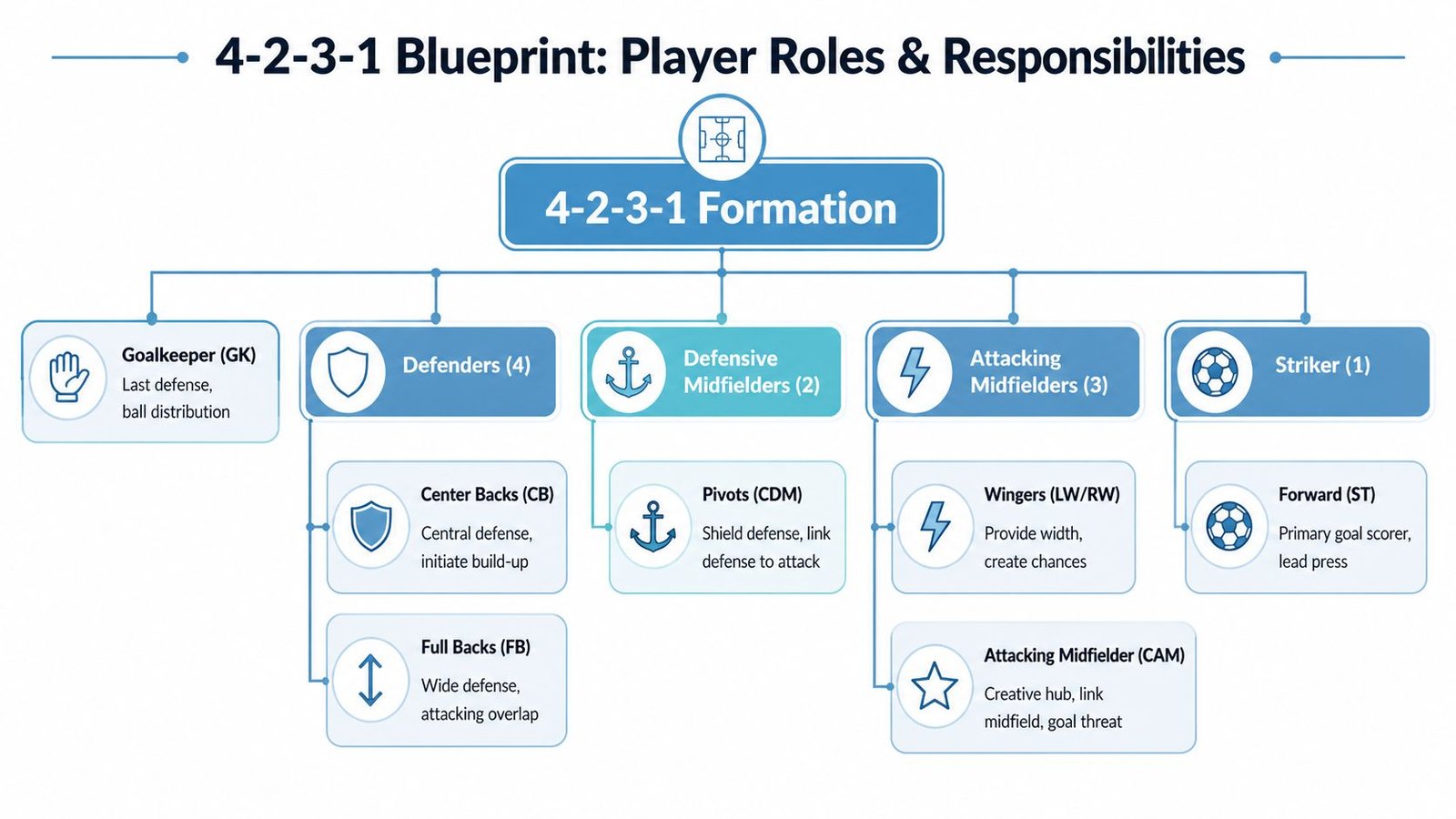
The goalkeeper is more than the last defender. In a good 4-2-3-1, the keeper starts attacks, chooses which side to overload, and knows when to go long if the first line is blocked.
The centre-backs defend the penalty area but also form the first line of circulation. If both centre-backs are passive in possession, the pivots receive under too much pressure. The full-backs have a dual task. They defend wide channels, then either overlap or support inside depending on the winger’s position.
The engine room is the double pivot.
| Unit | Primary job | What goes wrong if they fail |
|---|---|---|
| Goalkeeper | Secure distribution and depth behind the line | Build-up becomes rushed |
| Centre-backs | Protect the box and start progression | Team gets pinned back |
| Full-backs | Balance width and recovery runs | Wide spaces open fast |
| Double pivot | Screen the centre and link phases | Team gets split in two |
One pivot usually holds while the other adjusts. That doesn’t mean one is always defensive and one is always progressive. At the elite level, both need to read danger, receive under pressure, and cover for advanced full-backs. Manchester City’s problems without a stable reference in that zone show how fragile possession can become when the middle no longer feels secure. That theme is examined well in this Rodri absence and midfield structure analysis.
Practical rule: If your two pivots stand on the same line and ask for the same pass, your build-up is already easier to press.
The line of three and the striker
The three advanced midfielders determine whether the formation feels blunt or dangerous.
The two wide players can stretch the pitch or move inside. If they only hug the touchline, the team may gain width but lose interior combinations. If they always come inside, the full-backs must provide width and cover larger recovery distances. The central attacking midfielder, often the number 10, connects everything. He receives between lines, attracts pressure, and decides whether the next action should accelerate or settle the game.
Then there’s the striker. In a 4-2-3-1, the striker can’t just wait for service. He has to pin centre-backs, create depth, set pressing cues, and often combine with the 10. A lone forward who can’t protect the ball or threaten the line leaves the whole structure stretched.
A simple way to coach the front four is to define their shared tasks:
- Create different heights: One player comes short, one threatens in behind, two support around the ball.
- Protect the centre after loss: The nearest attacking midfielder reacts first, not last.
- Attack the box in waves: The striker shouldn’t arrive alone on every cross.
That’s the blueprint. What matters next is how it moves.
The 4-2-3-1 in Every Phase of Play
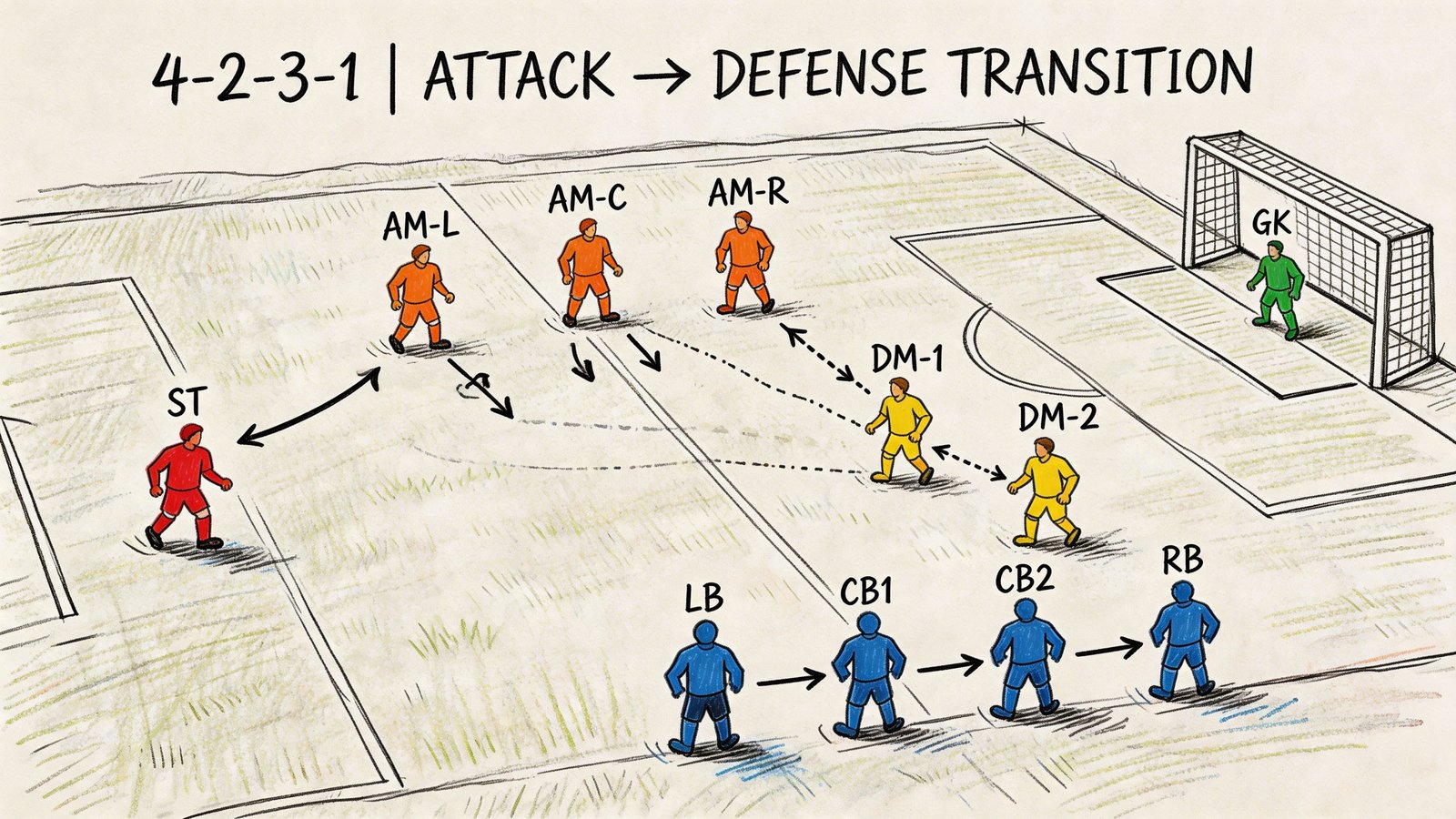
The value of the 4-2-3-1 shows up when the ball moves and the shape bends without breaking. Strong teams don’t stay frozen in the starting diagram. They transform from a build-up shape to an attacking structure, then recover their compactness fast when possession turns over.
Build-up and controlled possession
The double pivot is the first reference point. In this system, those two midfielders provide critical central protection and help teams keep possession while still being ready for transition. In elite use, including Manchester City’s, that structure also forces opponents to do more physical work and disrupts direct play, with empirical data showing significant differences in exertion levels against the shape in controlled study settings, as outlined in this analysis of the 4-2-3-1 defensive and possession profile.
City often use the pivots to create simple but powerful passing triangles. One centre-back has the ball. The near pivot offers underneath. The full-back or interior attacker gives the next angle. That sequence matters because it keeps multiple exits available if the opponent jumps.
When the shape is functioning well in possession, a few patterns appear repeatedly:
- One pivot stabilises: He stays available behind the ball and closes the counter lane.
- The other supports progression: He moves to receive on a different line or side.
- The 10 finds blind spots: He doesn’t stand next to a pivot. He waits between midfield and defence.
- Wide players pin and release: One might stay wide to stretch. The other may attack inside.
In this instance, fans often misread the system. They see full-backs pushing on and assume the formation has become something else. Often it hasn’t. The 4-2-3-1 still exists as a set of relationships, especially around the pivots and the line behind the striker.
Defending and transition moments
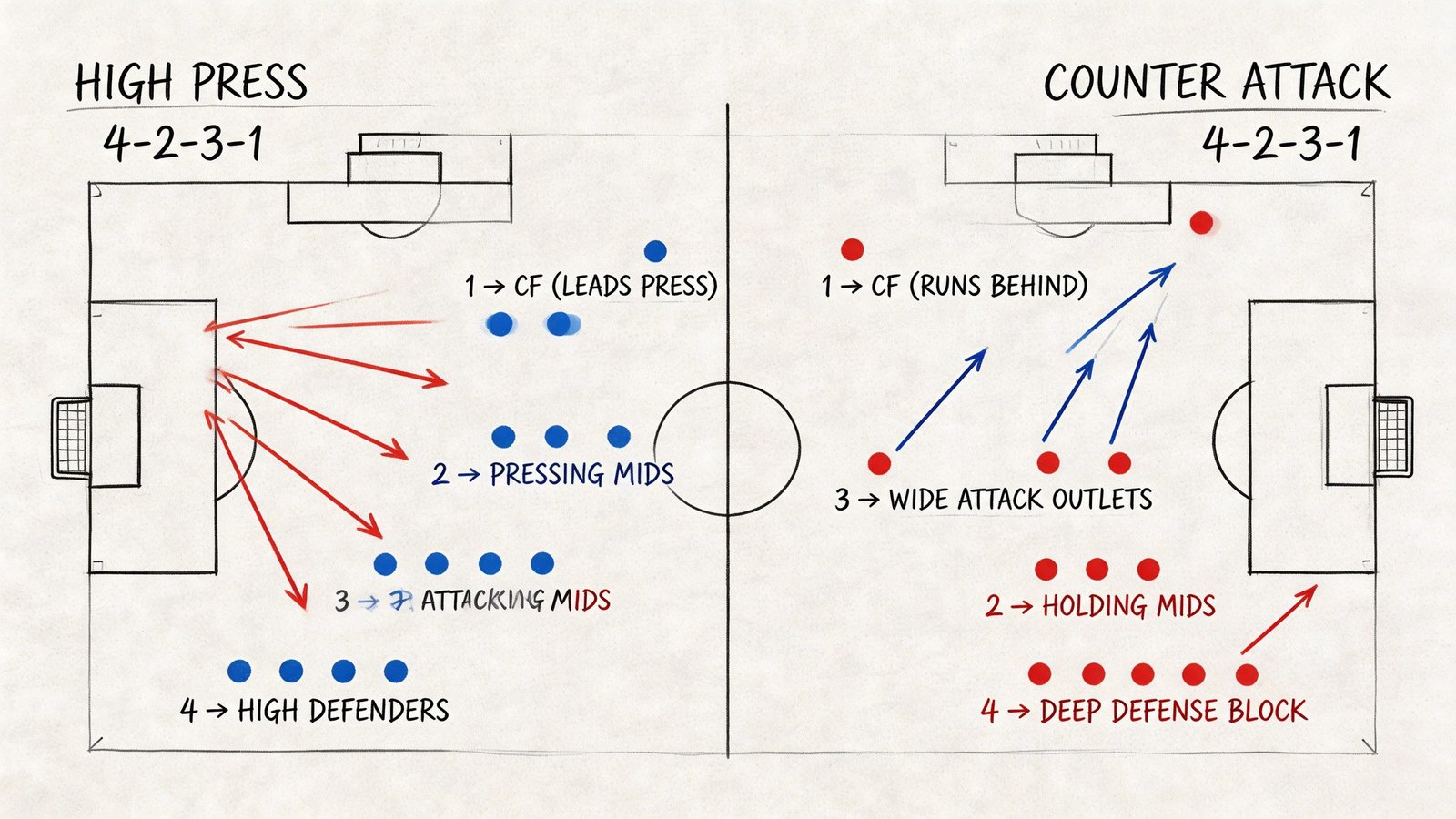
Out of possession, the shape can fold into a 4-4-2 or a 4-5-1. Which one appears depends on the striker’s role and the defensive height. If the 10 steps up alongside the striker, the team can press the opposition centre-backs more directly. If the 10 drops into midfield, the block becomes denser and harder to play through.
City’s best defensive moments in this shape usually come immediately after they lose the ball. The nearest players attack the loss, while the pivots close central lanes. That’s the difference between counterpressing with structure and just chasing.
If the pivots react late after a turnover, the back four gets exposed before the team can reset.
The main defensive trade-off is width. If both full-backs have gone high and the ball is lost with poor rest defence behind it, the wide spaces are vulnerable. That’s why the distances between centre-back, full-back, and near pivot matter so much. Compactness isn’t about standing close for the sake of it. It’s about making the next defensive action realistic.
A clean way to think about the phases is this:
| Phase | Typical 4-2-3-1 behaviour |
|---|---|
| First build-up | Pivots offer angles, centre-backs split, full-backs adjust |
| Sustained attack | Front four rotate, one full-back may advance aggressively |
| Immediate loss | Nearest attackers press, pivots close inside lanes |
| Settled defence | Team forms 4-4-2 or 4-5-1 depending on the 10 |
That fluidity is why the system has lasted. It gives a team order, but it doesn’t trap them in one picture.
Tactical Variations and Modern Adaptations
Guardiola’s 4-2-3-1 rarely looks identical for 90 minutes. A game can start with a clean double pivot on the teamsheet, then shift into a box midfield in possession and a flatter shape when the ball is lost. That flexibility is why coaches still trust the structure. It gives clear reference points, then allows controlled distortion around them.
Different double pivot models
The first variation sits in midfield.
A destroyer and a creator can still work, especially in matches built around duels, second balls, and faster attacks into space. One player screens, tackles, and protects the centre. The other receives on the half-turn and plays forward early. The trade-off is control. If the creator jumps too high or the destroyer gets dragged wide, the space in front of the centre-backs opens quickly.
City have often preferred two midfielders who can both organize possession and defend transitions. Rodri beside John Stones in his stepping midfield role gave a good example of that logic, even if the starting shape changed around them. Both could receive under pressure. Both could hold central positions after a turnover. That made City harder to counter because the team kept a platform behind the ball instead of relying on recovery runs.
Three common pivot profiles show up in modern 4-2-3-1 use:
- Destroyer and creator: stronger for direct games and loose-ball battles
- Double controller: stronger for territory, circulation, and stable rest defence
- Hybrid pair: useful when one full-back or centre-back steps inside and changes the midfield numbers
The key coaching point is spacing, not labels. If both pivots stand on the same line, passing angles die. If both break forward together, the structure underneath the attack disappears.
Front four adaptations under Guardiola
The front four decide whether the system feels rigid or dangerous.
At City, the wide players and the 10 are rarely given identical jobs. One winger may pin the full-back on the touchline. The far-side winger may come inside earlier to attack the half-space. The 10 can stay between the lines, drop to help overload midfield, or run beyond the striker if the centre-backs are too focused on the nine.
Kevin De Bruyne has often been the player who turns the shape from controlled to aggressive. In a 4-2-3-1, he can start as the central connector and then arrive in the right half-space at the exact moment the winger holds width and Haaland occupies both centre-backs. That is the primary value of the structure. It creates a base for timed movements, not random freedom.
Guardiola also adjusts the same shape according to the opponent’s press. Against a passive block, City can hold both wingers high and stretch the back line. Against a team that presses the pivots hard, one full-back may step inside earlier, creating a temporary midfield three and giving the 10 more freedom to stay high. That constant reworking of width, depth, and support runs is central to his method, and this analysis of Guardiola’s tactical tinkering and its trade-offs tracks that pattern well.
The best front-four rotations change the opponent’s reference points. They do not just swap positions for the sake of movement.
Modern adaptations also include asymmetry by design. One side may be built for control, with shorter distances and cleaner support under the ball. The other may be built for penetration, with a winger staying high and the full-back underlapping or overlapping, depending on the defender’s body shape. City have used this often. The result is a 4-2-3-1 that attacks one channel with patience and the other with speed.
For coaches, the practical lesson is simple. Train the shape as a living structure. The 4-2-3-1 works best when the pivots understand cover shadows, the 10 reads the striker’s movements, and the wide players know when to hold width and when to attack inside. The formation still matters. The modern version wins through relationships, timing, and role clarity within that framework.
Strengths and Weaknesses Dissected
The 4-2-3-1 is popular because it solves many problems at once. It also creates new ones. Good coaching starts by accepting both sides.
Why coaches trust it
Its biggest strength is central control. The double pivot protects the space in front of the centre-backs, and the number 10 gives the team a player between opposition lines. That means the side can defend with numbers in the middle and still attack through the middle when possession is regained.
The formation also creates a natural platform for pressure and support. The striker has three players close enough to combine with. The pivots have short options behind and ahead. Full-backs know they’re not isolated because the nearest pivot and winger can help protect the channel.
A coach usually values four practical benefits:
| Strength | Coaching value |
|---|---|
| Central superiority | Easier to deny direct passes through midfield |
| Defensive cover | Two pivots protect transitions better than a lone holder |
| Flexible attacking support | The 10 and wingers can adapt to the striker’s profile |
| Clear rest-defence base | Back four plus pivots gives structure behind attacks |
That’s why it remains so useful against teams that either sit deep or try to play directly through central zones.
Where it breaks down
The weaknesses start appearing when the distances get stretched.
If full-backs push high without good counterpressure, the channels outside the centre-backs become inviting. If the pivots don’t stagger properly, one pass can remove both. If the wingers stop working back, the block stops being compact and starts becoming porous.
The other classic problem is the lone striker. Against a deep defence, he can get surrounded unless the 10 and weak-side winger arrive quickly enough. A striker who is asked to occupy both centre-backs, secure long passes, and still attack every cross is carrying too much of the attack alone.
Coaching warning: The 4-2-3-1 doesn’t fail because it lacks balance. It fails when players assume the balance is automatic.
Manchester City have shown both sides of this. At their best, they suffocate games through central stability and layered support around the ball. At their worst, especially when the structure behind possession is loose, opponents can break into the spaces City thought were protected. That broader pattern is visible in this analysis of City’s defensive frailties against Real Madrid.
So when does the system work best? When the squad has disciplined midfielders, an active 10, and wide players who understand both attacking width and defensive recovery. When does it disappoint? When coaches treat it as balanced on paper and ignore how much coordination it needs.
Coaching the 4-2-3-1 Practical Drills for the Training Ground
On a training pitch, the 4-2-3-1 usually breaks down for a simple reason. The shape looks clear on the board, then the distances collapse once pressure starts. One pivot hides behind the press, the 10 waits on the wrong line, and the striker gets isolated before the attack has even formed.
That is why I coach the system through repeatable game pictures. Manchester City under Guardiola are a strong reference point here. Even when City start from a nominal 4-2-3-1, the core work sits in the connections. The near pivot must offer an angle under pressure, the second pivot must hold a different height, and the 10 must arrive where the next pass can continue the move. As noted earlier, the shape is being used and adapted more often, while opponents are pressing central lanes with much better coordination. Training has to reflect that.
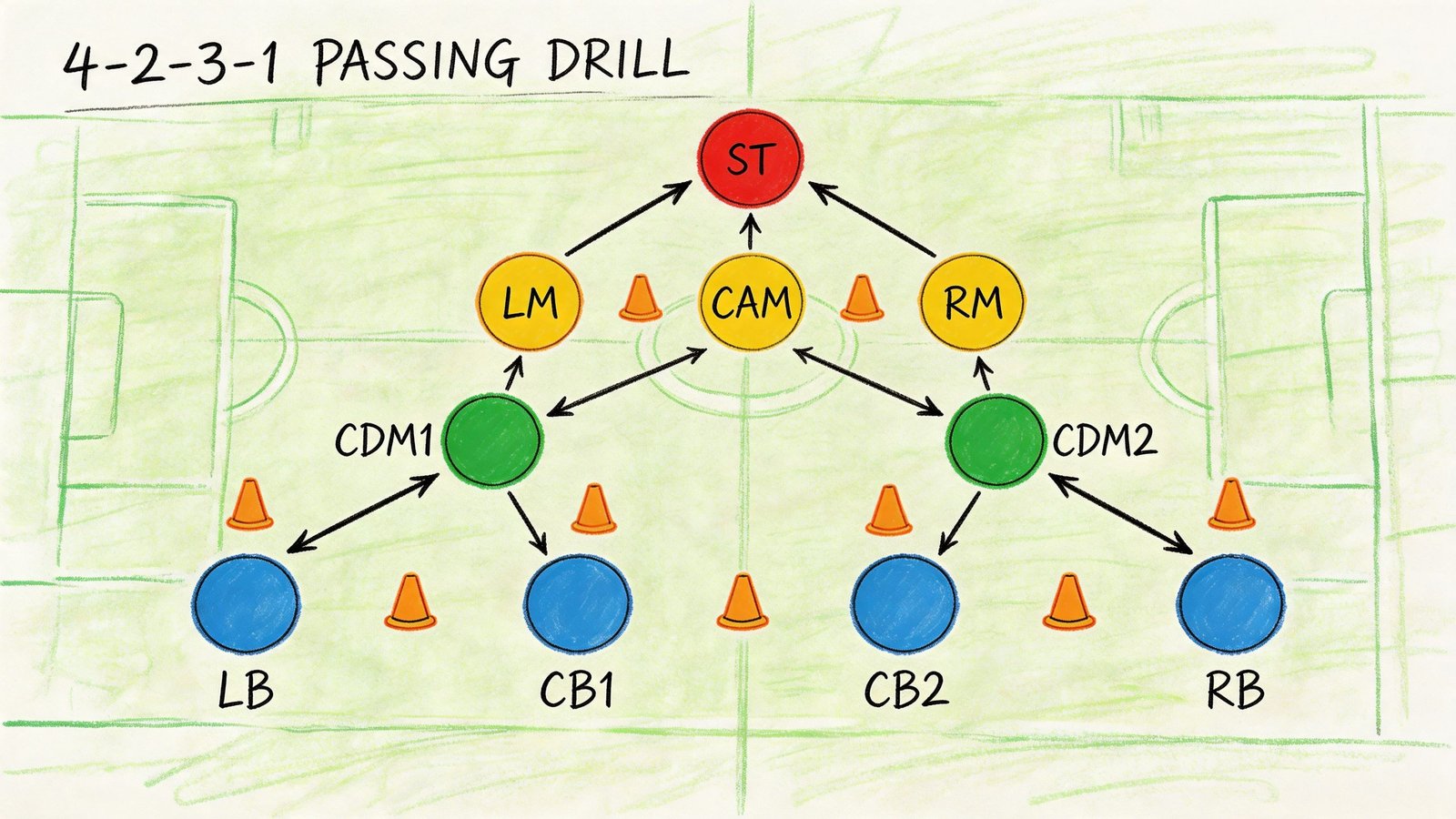
Drill one pivot support under pressure
Set up a rectangular build-up zone with a back four, two pivots, and three pressing opponents. Start from the goalkeeper or one centre-back. The objective is to find a pivot, bounce the pass, then play into a target player representing the 10 between the lines.
Use these rules:
- Two-touch limit for defenders and pivots
- If both pivots stay on the same horizontal line, restart the action
- If the press wins the ball, they counter into mini goals
This drill teaches the detail coaches often miss. The pivot pair are not just two safety valves. They have to create different pictures for the ball carrier. One supports beneath the ball. The other shifts higher or wider to stretch the first line of pressure. City have done this for years, sometimes with Stones stepping in, sometimes with Rodri holding and a second midfielder rotating around him. The principle stays the same. If the pivots mirror each other, the press becomes easy.
For coaches seeking more session variations for first-phase circulation, these possession-play training methods are useful because they focus on support angles and progression rather than empty-passing volume.
Drill two pressing triggers for the front four
Use half a pitch. One team sets up in a 4-2-3-1 pressing shape against a back four and a midfield unit that builds from the back. Start the front four in medium positions so they have to read the trigger, not just sprint on command.
Coach these triggers:
- Back pass to the goalkeeper
- Square pass between centre-backs
- Poor body shape from the full-back
- Pass into a marked midfielder
The striker presses on a curve to send play one way. The 10 jumps to the nearest pivot. The near winger locks onto the full-back. The far winger narrows to protect the switch and be ready for the second ball.
Reward the forced pass, not the loud sprint.
That detail matters if you want the press to resemble City at their best. Guardiola’s front players rarely chase randomly. They set traps. If the 10 arrives a second late, the pivot turns. If the far winger stays too wide, the switch is on. If the striker presses straight instead of curved, the centre-back can play through the middle. Add a neutral midfielder after a few repetitions so the pressing side has to pass runners on and communicate through the action.
A good visual reference for movement timing helps players understand the pattern before they execute it live.
Drill three freeing the 10 from half-space traps
This is the drill I would keep if time only allowed one attacking pattern.
Set up three vertical lanes in the attacking half. Place one pivot in the central lane, the 10 between lines in a half-space, a winger outside him, and a full-back underneath. Begin with passive defenders. Then move to active pressure once the spacing is right.
Run the sequence like this:
- Ball goes from the pivot to the wide player
- The 10 moves out of the cover shadow before the next pass
- The full-back overlaps only after the 10 has shifted the defender
- Finish with a cut-back, wall pass, or switch across the box
Coach three details hard:
- Timing before touch: the 10 moves before the pass travels
- Third-man logic: the 10 does not always receive. Sometimes he opens the lane for the winger or full-back
- Overlap discipline: the full-back goes on the cue, not from habit
City’s example is useful. Watch how often their central attacker leaves the obvious space to create a better one for someone else. Kevin De Bruyne has done it from the right half-space for years. Phil Foden does it differently, with shorter movements and quicker combinations. The coaching point is not to copy one player’s style. It is to teach the relationship. The 10 is free when the players around him stop standing still.
Good 4-2-3-1 coaching comes from training distances, cues, and consequences. If the pivot pair are flat, reset it. If the press is late, replay it. If the 10 receives with no exit, freeze the picture and correct the spacing around him. That is how the shape becomes usable on match day.
Conclusion: The Enduring Blueprint for Modern Football
The 4-2-3-1 has lasted because it gives coaches a rare combination of order and freedom. It protects the centre, supports possession, and creates clear attacking relationships without locking players into rigid lanes for the full match.
That’s why it remains one of the key reference points in any serious discussion about soccer formations 4 2 3 1. The system offers a strong defensive base through the double pivot, but it also gives the front four enough freedom to attack in different ways. For Manchester City, that balance has been especially revealing. Guardiola’s teams use the shape to control tempo, create overloads, and build pressure through repeated positional advantages.
Still, the formation only looks balanced when the details are right. If the pivots lose their stagger, the centre opens. If the full-backs go at the wrong time, wide transition spaces appear. If the 10 doesn’t connect the lines, the striker becomes detached from the game. Those aren’t small errors. They decide whether the structure feels dominant or fragile.
For coaches, the lesson is straightforward. Don’t teach the 4-2-3-1 as a static board diagram. Teach distances, timings, and support relationships. Train the pivot pair to solve pressure. Train the front four to recognise when to rotate and when to hold. Train the team to defend the instant after losing the ball, because that moment often defines whether the shape is modern or merely familiar.
The formation will keep evolving. Opponents now press smarter, trap central routes more deliberately, and punish loose rest defence faster. That doesn’t make the 4-2-3-1 outdated. It makes coaching it well even more valuable.
If you want more Manchester City-focused tactical breakdowns like this, Manchester City Analysis is worth following. It’s a strong resource for supporters, coaches, and analysts who want clear explanations of Guardiola’s structures, match-specific adjustments, and the strategic details behind City’s performances.