A Manchester City full-back receives on the touchline, but the next action doesn't go down the line. Rico Lewis steps inside, joins midfield, and suddenly the opponent's first pressing line is facing the wrong way. One movement has changed the shape of the match.
That's the clearest way to understand the full back position in soccer today. It isn't just a defensive slot on the outside of the back four. In elite systems, especially Manchester City's, the full-back often decides whether a team can progress the ball cleanly, pin the opposition wide player, create the extra man in midfield, and still survive the moment possession is lost. The role has become less about where a player starts and more about what structure that player enables.
Older descriptions of the position still matter. A full-back must defend the flank, control 1v1s, cover the back post, and support circulation in buildup. But those duties now sit inside a larger tactical framework. The modern game asks the full-back to connect defensive spacing with attacking geometry. That's why two players listed as right-backs can perform completely different functions depending on the manager's design.
The sharpest way to read the position is through systems, not through shirt numbers. Manchester City offer the most useful lens because Pep Guardiola has repeatedly used full-backs as width providers, underlapping runners, auxiliary midfielders, and stabilisers in rest defence. That tactical flexibility explains why the position now shapes entire team structures rather than supporting them.
Table of Contents
- INTRODUCTION
- THE CORE RESPONSIBILITIES OF A FULL-BACK
- DEFENSIVE PRINCIPLES AND POSITIONING
- THE ATTACKING EVOLUTION OF THE FULL-BACK
- THE INVERTED FULL-BACK AND MIDFIELD PLAYMAKER
- THE FULL-BACK IN DIFFERENT PHASES OF PLAY
- KEY METRICS AND COACHING DRILLS
- CONCLUSION
INTRODUCTION
The modern full-back often starts as the widest defender and ends the sequence as something else entirely. In one possession he may hold the touchline to stretch the block. In the next, he may move inside to form a midfield triangle, or arrive outside the winger to create a crossing lane. The position has become fluid because elite teams now build attacks through occupation of space, not fixed labels.
That shift has changed how coaches evaluate the role. A full-back can no longer be judged only by clean tackles or recovery pace. He has to read pressing triggers, offer the right passing angle in first phase buildup, know when to overlap and when to stay, and recover into the correct rest-defence line if the attack breaks down.
Manchester City make that complexity easier to see because their structure constantly asks questions of the full-back. If the winger stays high and wide, the full-back may invert. If midfield is already overloaded, he may hold a supportive outside lane. If the opponent leaves the far side open, he may arrive late as the free player. The same position keeps changing function because the system needs different solutions in different moments.
The full-back now sits at the intersection of width, progression, pressing resistance, and transition defence.
That's why the role matters so much to informed fans and coaches. To understand a top team's shape, it often helps to start with the full-back and work outward.
THE CORE RESPONSIBILITIES OF A FULL-BACK
Before discussing inversion and complex rotations, the baseline still matters. A full-back's original job description remains the foundation of the role. If those fundamentals fail, the tactical sophistication on top of them won't hold.
DEFENSIVE BASELINE
The first responsibility is still control of the wide channel. A full-back must deal with the opposing winger, protect the route into the box, and prevent easy service from the flank. That means defending both the ball and the space behind the line.
Several tasks sit inside that broad duty:
- Contain the winger: The full-back must stop direct progression down the outside and avoid being isolated too early.
- Protect the inside lane: If the winger cuts in too easily, the centre-back gets dragged across and the whole line starts to distort.
- Cover for the centre-back: When the near-side centre-back steps out, the full-back often has to narrow and protect the gap.
- Defend the far post: On switches and crosses from the opposite flank, the back-post zone becomes the full-back's problem.
This is why the position has always required concentration more than spectacle. A full-back can perform unobtrusively for long stretches, then concede one far-post run and undo the rest of the match.
ATTACKING BASELINE
Even in more traditional systems, the role has never been purely defensive. The full-back helps create width, supports the winger, and offers the simple outside passing lane that prevents attacks from collapsing into central traffic.
The classic attacking actions are familiar:
| Role Type | Primary Position (In Possession) | Key Attacking Action | Primary Defensive Focus |
|---|---|---|---|
| Traditional full-back | Wide and slightly deeper | Overlap and cross | Stop winger and protect channel |
| Attacking full-back | High on the flank | Advance beyond winger | Recover wide after loss |
| Inverted full-back | Inside lane or midfield | Support buildup and circulate centrally | Secure central transition spaces |
Those categories overlap in real matches, but the table clarifies the baseline. The full-back stretches the pitch when needed, supports combinations near the touchline, and gives the winger either an outside runner or a safe recycle option.
Coaching rule: If the full-back's positioning doesn't improve either width or security, it's probably wrong.
That principle explains why the position remains so demanding. The player must keep answering the same question. Is the team better served by width, support, or protection in this exact moment?
DEFENSIVE PRINCIPLES AND POSITIONING
Elite full-back defending is built on details that often look small from the stands. The key moments are usually about stance, angle, and timing rather than dramatic tackles. A defender who starts from the correct body shape often doesn't need a desperate action later.
BODY SHAPE AND DIRECTION OF PLAY
Technical coaching guidance stresses two connected points. When the ball is on the full-back's side, showing the attacker toward the touchline reduces the attacker's room to manoeuvre, and the defender's body shape should often stay open toward goal so he can react faster to inside runs and protect the inside channel, as outlined in this technical coaching analysis on full-back body orientation.
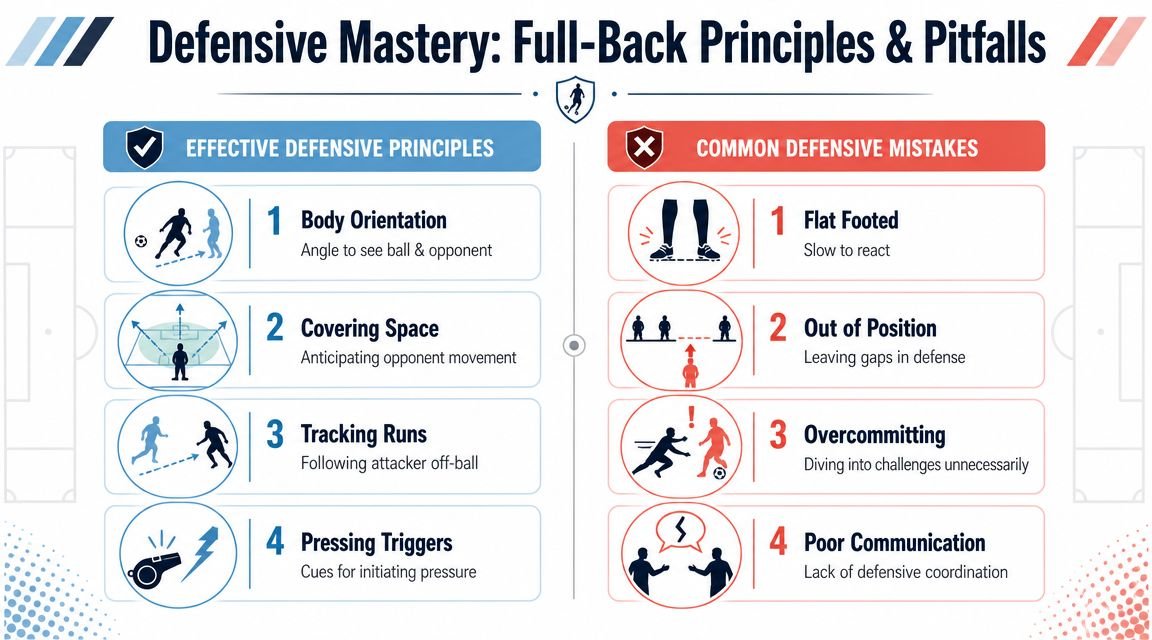
That coaching point matters because the biggest danger often isn't the touchline. It's the attacker receiving, rolling inside, and forcing the full-back into a turning race toward his own penalty area. Once the defender's hips are square or closed the wrong way, the next action becomes reactive.
A sound starting posture does three things at once:
- It protects the inside first: The shortest route to goal usually runs through the half-space, not the sideline.
- It preserves acceleration: An open body lets the defender adjust to either a dribble or an off-ball run.
- It improves the next pass in possession: Good orientation doesn't just help defending. It can also speed the first forward action after recovery.
DISTANCE COVER AND TRANSITIONS
Defending wide spaces also depends on starting distance. Too tight, and the attacker can spin in behind. Too loose, and the attacker can receive, turn, and attack the defender with momentum. The full-back's spacing must match pressure on the ball. If the passer is unpressed, depth becomes urgent. If the passer is under pressure, the full-back can engage earlier.
Manchester City's structures are instructive. Their full-backs rarely defend as isolated duelists by choice. The line shifts across, the near-side midfielder helps close the inside passing lane, and the opposite full-back often narrows to protect the far post. A strong full-back performance, then, isn't only individual. It's relational.
A full-back who wins every 1v1 is useful. A full-back who prevents the 1v1 from becoming dangerous is elite.
Defensive transition sharpens the point. When possession is lost, the full-back is often the first player exposed to a direct ball down the line or a quick switch into the vacated channel. His recovery angle matters as much as his speed. If he sprints straight toward the ball, he may open the lane behind him. If he recovers inside-out, he can block the route to goal and still force play away from danger.
THE ATTACKING EVOLUTION OF THE FULL-BACK
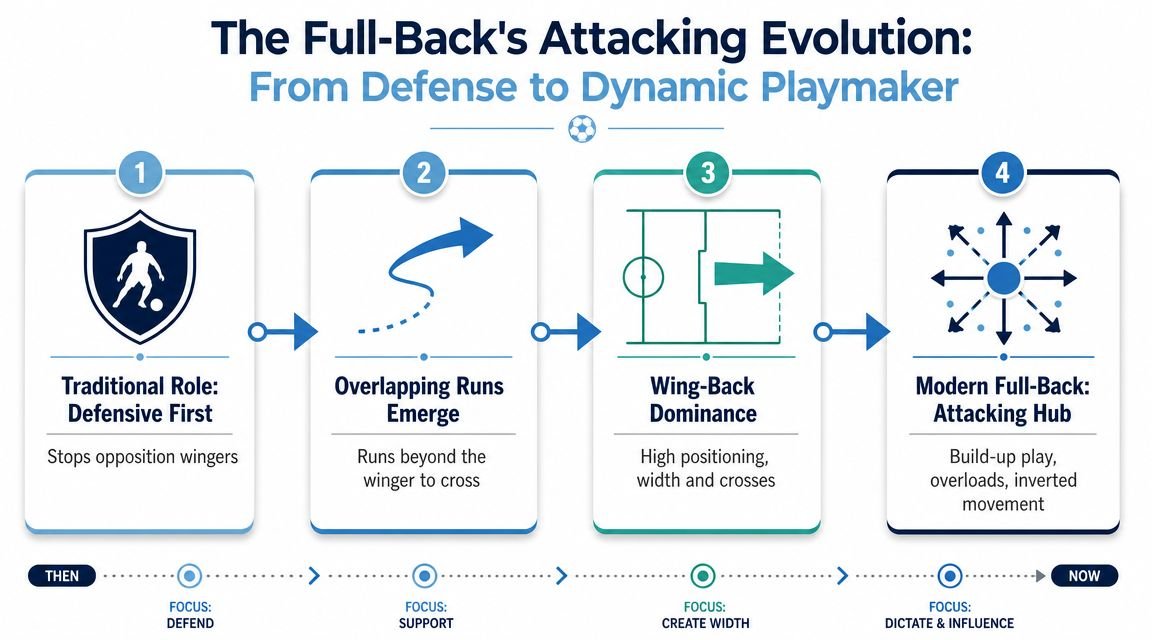
The attacking side of the role has changed the public understanding of the position. Full-backs used to be judged mainly on containment and support. Now they can be major creators, progression players, and chance shapers.
ESPN describes how players such as Trent Alexander-Arnold and Achraf Hakimi have “revolutionized” the position, turning it from a “stolid behind-the-ball role” into one where the full-back becomes a primary playmaker, as discussed in this ESPN analysis of the modern full-back role.
WHY THE ROLE CHANGED
The logic behind that shift is tactical, not cosmetic. As wingers became narrower and more comfortable attacking inside lanes, the outside corridor opened up. That empty space had to be occupied by someone. In many elite systems, the full-back became the answer.
This changed the geometry of attack in several ways:
- Wider starting positions stretched the back line.
- Advanced runs created 2v1s against the opposing full-back.
- Arrivals from deep were harder to track than static wide positioning.
Manchester City's own attacking variations show the same principle. When a winger holds width, the full-back can support underneath or inside. When the winger attacks the half-space, the full-back can become the outside release. The role is no longer one pattern repeated. It's a set of spatial solutions.
A useful complementary lens appears in this analysis of Manchester City's attack without a traditional winger. It highlights how width can be redistributed across the structure, which is exactly where modern full-backs become so influential.
OVERLAPS UNDERLAPS AND DECISION QUALITY
The two key attacking movements are the overlap and the underlap. The overlap sends the full-back outside the wide teammate. The underlap sends him inside, usually into the half-space or channel between full-back and centre-back.
According to Coaches' Voice, modern full-backs support attacks and defend “in almost equal measure”, and their high positioning can also force the opposition winger deeper, reducing the opponent's own attacking threat, as explained in this Coaches' Voice breakdown of the modern full-back.
The movement itself isn't the point. The effect is.
- An overlap tends to stretch the block horizontally and create crossing or cut-back angles from the outside.
- An underlap attacks the blindside of midfield coverage and often opens central passing lanes or third-man combinations.
- A delayed support run can be the best choice if the defence has already committed to the first two threats.
The best attacking full-backs don't just run often. They run at the moment the defence has to make a bad choice.
That's why final-action quality matters so much. Once advanced, the full-back must decide whether the situation calls for a cross, a cut-back, a through ball, or simple circulation to sustain pressure. The modern role is less about raw volume and more about reading the defensive picture at speed.
THE INVERTED FULL-BACK AND MIDFIELD PLAYMAKER
No tactical adaptation has altered the perception of the full-back more than inversion. Through inversion, the position stops looking like a lane occupation role and starts looking like a structural tool.
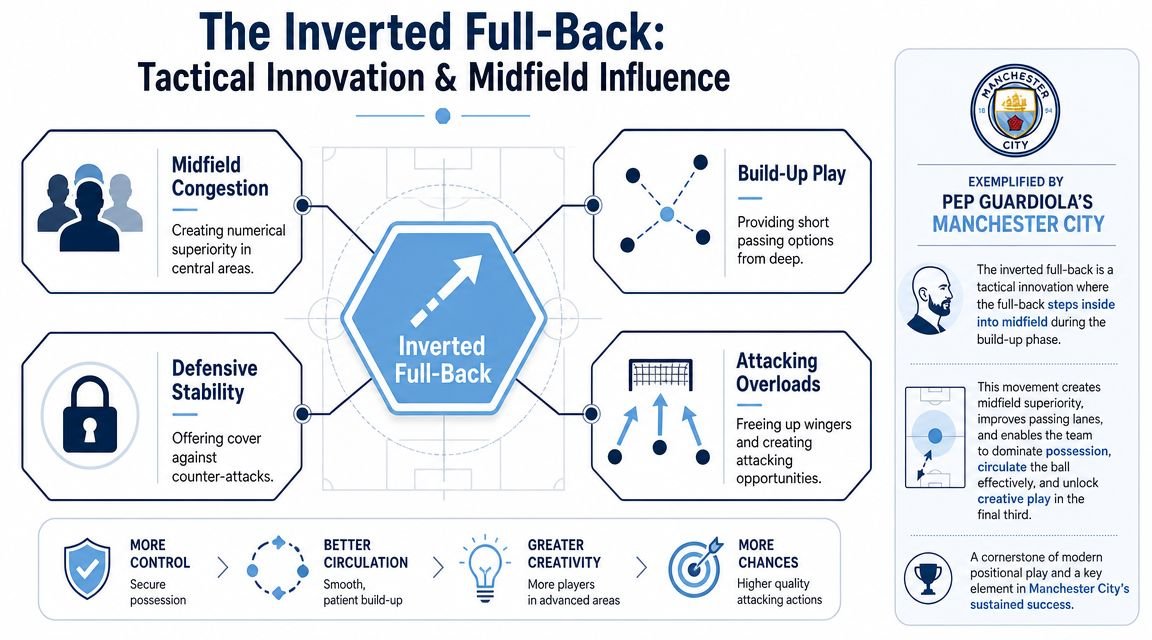
At Manchester City, the move is familiar. The nominal full-back begins wide in the defensive line, then steps into midfield in possession. He may stand next to the holding midfielder, create a box shape with two advanced interiors, or act as the free connecting player behind the first press. The shirt number stays the same, but the role changes phase by phase.
WHAT INVERSION REALLY DOES
The obvious benefit is numerical presence in central areas. Possession teams want short passing distances, stable angles, and enough players around the ball to escape pressure. An inverted full-back gives them that without sacrificing a defender from the starting line.
The deeper tactical gain is structural balance. By moving inside, the full-back can support buildup while also positioning himself closer to the centre of any turnover. That improves the team's ability to counter-press and block direct central transitions.
This embedded video illustrates the concept in motion.
A modern full-back isn't just a wide defender. In elite systems, he must defend wide channels and initiate attacking sequences, often through overlapping or underlapping support. The role's dual nature is exactly why some players can invert effectively and others can't. A player asked to move inside must scan like a midfielder, receive under pressure, and understand when to hold his place rather than chase the next pass.
WHY CITY KEEP RETURNING TO IT
City use inversion because it solves multiple problems with one movement. It gives Guardiola another central passer. It releases the winger to stay higher or wider. It also helps guard against the counter by placing an extra player near the most dangerous transition routes.
João Cancelo made this role look expansive because he could receive inside and hit difficult passes immediately. Rico Lewis has often made it look connective because he links play quickly, occupies the correct central pocket, and keeps the structure stable. Different profiles, same tactical principle.
This João Cancelo tactical and data analysis offers a strong example of how one player can reshape City's buildup and chance creation from the full-back line.
The important conclusion is that the inverted full-back isn't a novelty. It's a way of reallocating midfield tasks without changing the nominal formation. For Manchester City, that has repeatedly been the key to controlling the centre of the pitch without losing access to the wings.
THE FULL-BACK IN DIFFERENT PHASES OF PLAY
The role only makes full sense when viewed through game phases. A full-back isn't performing one fixed job for ninety minutes. He is constantly switching between support, width, compactness, pressure, and recovery.
BUILD-UP AND TERRITORIAL CONTROL
In buildup, the full-back's first task is often angle creation. He can stand slightly advanced relative to the centre-back to provide a safer passing lane and stretch the opposition winger's line. That small adjustment matters because it changes the press. The opponent's wide player must decide whether to jump, hold, or screen inside.
For Manchester City, this phase is often less about the full-back receiving for his own sake and more about what his position forces. If he holds width, the opposing winger must travel farther. If he inverts, the opponent's central midfielder has a new problem. If he stays deeper, the centre-back may gain an extra second to step in with the ball.
Three recurring full-back functions in this phase stand out:
- Outlet on the flank: Keeps circulation alive and prevents the press from locking centrally.
- Interior connector: Offers the bounce pass that helps the team escape the first line.
- Decoy for pressure: Draws an opponent out and opens the lane behind him.
ATTACKING PHASE AND DEFENSIVE TRANSITION
Once the team settles in the final third, the full-back becomes a spacing piece and a timing piece. He may overlap to attack the outside shoulder, underlap into the inside lane, or remain behind the ball to secure circulation. The right choice depends on teammate occupation. A full-back shouldn't attack the same zone as the winger or interior unless the move is deliberately coordinated.
The risk appears the moment possession is lost. Aggressive full-back use can improve chance creation but also increases vulnerability to counterattacks and switches of play. The key issue isn't whether a full-back should advance, but whether the team's rest-defence structure is strong enough to protect the spaces left behind, as argued in this tactical discussion of full-back risk and rest defence.
That idea is central to Guardiola's teams. When one full-back goes, another player often compensates. The opposite full-back may tuck in. A centre-back may widen. The holding midfielder may drop into the vacated lane. The role can't be judged in isolation because every forward movement creates a defensive debt that the structure must repay if the attack breaks down.
Good full-back play is often invisible in transition because the danger never fully develops.
That's the tactical maturity of the position. The modern full-back isn't merely adventurous or conservative. He is calibrated to the phase, the scoreline, the spacing of teammates, and the likely route of the opponent's counter.
KEY METRICS AND COACHING DRILLS
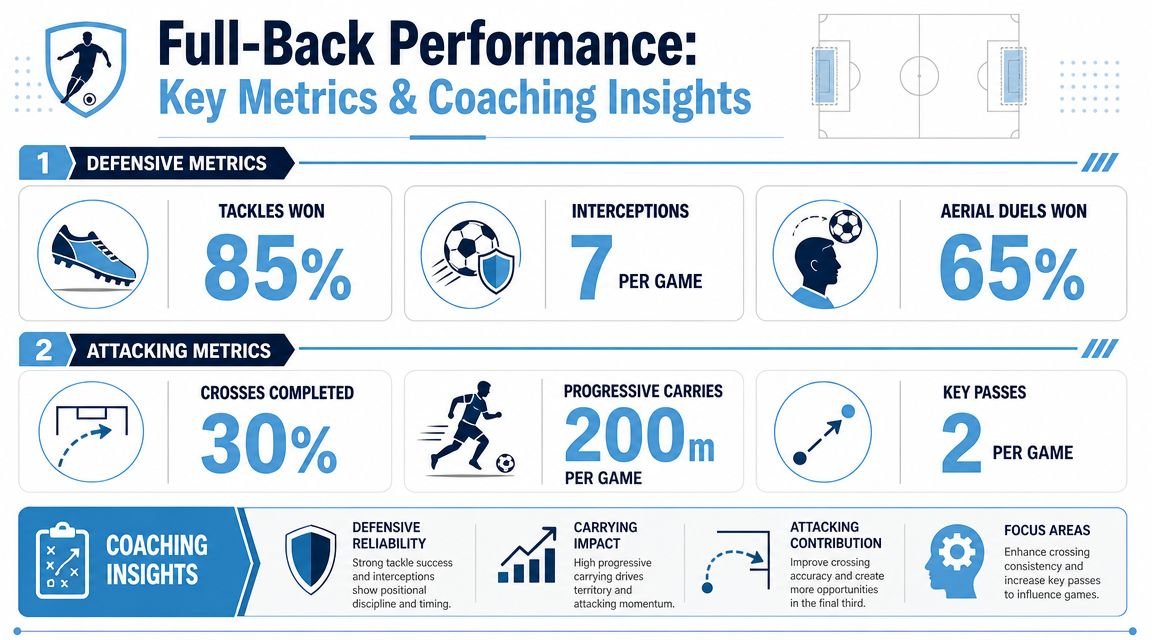
The position is hard to judge with one-dimensional numbers. A modern full-back can influence the match through progression, occupation, recovery, and circulation without always producing a clean highlight clip. Evaluation has to combine physical load, technical output, and tactical reliability.
WHAT TO MEASURE
A peer-reviewed study in PMC reports that full-backs recorded the third-most high-intensity running among positions in that sample, commonly cover roughly 9 to 10 km per match, and showed second-half declines of 9.8% in total distance, 10.6% in power plays, and 7.8% in distance per minute, as detailed in this PMC study on positional match demands in soccer. That profile explains why the role demands both endurance and repeated sprint capacity.
Physical demand is only the starting point. Analysts and coaches should also track actions that match the team's tactical use of the player:
- Progressive carries and forward receptions: Useful for full-backs asked to break pressure with the ball.
- Passes into advanced areas: Important for inverted full-backs and buildup-oriented profiles.
- Crosses and cut-backs by situation: More meaningful than raw crossing volume.
- Recovery positioning after turnover: Often better judged through video than event data.
- Pressure support in the middle and wide lanes: Especially relevant for teams that counter-press.
A player such as Rico Lewis is a good example of why role-specific interpretation matters. This Rico Lewis scouting and tactical report shows how a full-back can be assessed through structure and function, not only traditional defensive counting stats.
HOW TO TRAIN THE ROLE
Three drills sharpen the core demands of the position.
1v1 channel defending
Use a narrow outside lane with a recovering centre-back behind the action. The full-back's task is to show the attacker outside, delay, and block access to the inside lane rather than dive into an early tackle.Possession to transition wave
Start with a wide combination on one side. On a coach's cue or a turnover, the defending team counters immediately into the vacated channel. This trains the full-back's recovery angle and the team's rest-defence coordination.Underlap and cut-back pattern play
Position the winger high and feet-on-the-line. The full-back begins deeper, then times an underlap once the winger receives inside. The repetition should focus on the final decision, not just the run.
Training priority: The drill should test the player's timing and scan before the action, not only the action itself.
CONCLUSION
The full-back has moved from the edge of the system to its centre of gravity. What once looked like a straightforward wide defensive role now carries responsibilities from three different lines. The player must defend the channel like a defender, connect play like a midfielder, and arrive in dangerous spaces like an attacker.
Manchester City have helped make that evolution unmistakable. Their use of full-backs shows that the position is really a structural mechanism. It creates central overloads, supports buildup, frees wide attackers, and determines whether the team can stay protected when the ball is lost. That's why the full back position in soccer now tells so much about a side's tactical identity.
The future of the role will probably bring even more hybrid profiles. But the central truth won't change. Teams that understand the full-back as a system key, not just a position on the team sheet, will keep controlling the most important spaces on the pitch.
Manchester City supporters, coaches, and analysts looking for sharper tactical breakdowns can find more at Manchester City Analysis, where match structure, player roles, and Guardiola's evolving ideas are examined with the level of detail the modern game demands.