You’re probably in a familiar spot. A match has just finished, and one team looked sharper without obviously running harder or fielding better dribblers in every line. The ball kept arriving to the right player a second early. The press looked coordinated rather than frantic. The same lane opened again and again, even when the opponent knew it was coming.
That feeling usually points to patterns of play.
When Manchester City are at their best, you’re not watching isolated actions. You’re watching a chain of rehearsed relationships. A centre-back steps in, a full-back inverts, the holding midfielder pins the first press, the winger narrows, and suddenly the next pass looks obvious. It wasn’t obvious a second earlier. The pattern created it.
For coaches, analysts, and serious supporters, that’s the useful lens. Football isn’t only about formation boards or broad labels like possession football. It’s about repeatable sequences that turn a game model into actions under pressure. Once you learn to spot those sequences, matches slow down. You stop describing only outcomes and start reading causes.
Table of Contents
- Introduction Decoding Football's Invisible Architecture
- What Exactly Are Patterns of Play
- The Three Core Types of Tactical Patterns
- Manchester Citys Blueprint for Dominance
- How Analysts Detect and Quantify Patterns
- Coaching and Countering Tactical Patterns
- Conclusion The Art and Science of Teamwork
Introduction Decoding Football's Invisible Architecture
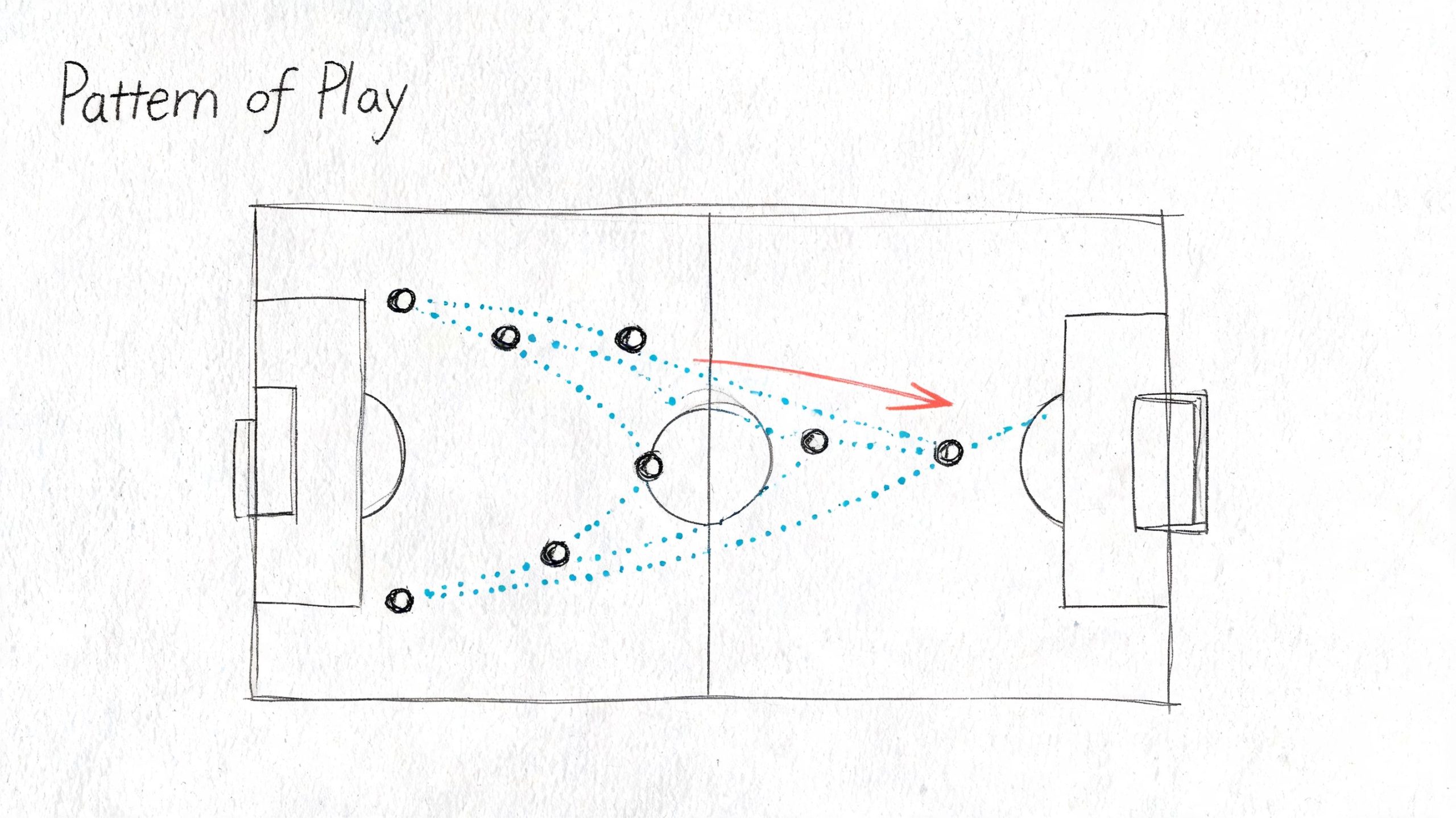
The ball goes from goalkeeper to centre-back, into the pivot, out to the full-back, then back inside to the free eight. By the time the fifth pass is played, the opponent has already been moved into the trap. What looks quick on match day usually began as a coaching problem solved on the training ground.
Elite teams share more than technical quality. They share timing, reference points, and a common reading of space. One player opens his body before the pass arrives because he expects the third man to appear. Another leaves a zone at the exact moment a teammate attacks it. Those actions look natural at full speed, but they are usually rehearsed solutions to recurring game states.
That is football's hidden architecture. Patterns of play are the repeatable relationships between movement, spacing, and ball circulation that coaches build to answer specific tactical questions. How do you draw out the first press. How do you create a free man between lines. How do you arrive in the box with the defence turned and unbalanced.
Pep Guardiola's influence matters here because his teams treat patterns as a full-cycle process, not a set of memorised passes. First comes design. Coaches build the spacing, triggers, and player references in training. Then comes execution under pressure, where Manchester City have provided some of the clearest recent examples of central progression, third-man combinations, and occupation of the half-spaces. After that comes detection. Analysts now use video, event data, and tracking data to separate a deliberate structure from ordinary possession. The final step is practical. If you coach, you need to know how to teach the pattern without making players rigid. If you face it, you need to know which reference point to break.
One test helps when you watch film.
Practical rule: If the same players arrive in the same spaces through the same cues across multiple possessions, you are probably looking at a coached pattern, not spontaneous circulation.
That shift in perspective changes analysis. The key question is rarely the final pass or finish. It is the earlier sequence that fixed one defender, opened one lane, or forced one midfield line to shift two metres too far. Coaches build those sequences on purpose. Good analysts can trace them, and good opponents try to break them before the decisive action appears.
What Exactly Are Patterns of Play
A pattern of play is a pre-rehearsed sequence of movements and passes involving multiple players, built to solve a specific problem. That problem might be escaping the first line of pressure, entering the final third, creating a cutback, or locking the ball in after a loss of possession.
Think of formation as the cast list, style as the genre, and pattern as the scene being performed. A 4-3-3 tells you where players begin. A possession style tells you the team prefers control. The pattern tells you what the left-back, pivot, and winger do when the opponent presses on one side.
Pattern, style, and formation are not the same thing
This distinction clears up a lot of bad tactical analysis.
A team can share a formation with another side and look nothing alike because the patterns differ. Two teams might both line up in 4-3-3. One uses the full-backs to overlap early and hit the winger’s outside shoulder. The other inverts a full-back into midfield and builds through the half-space. Same shape on paper. Different game.
Data science supports that distinction. A 2023 scoping review of over 25 studies found that factor analysis and Principal Component Analysis can cluster teams by variables such as pass length and progression, which means patterns and styles can be identified scientifically rather than treated as vague coaching language, as summarized in this scoping review on soccer styles of play.
A useful coaching definition is this:
- Formation gives players reference points.
- Style expresses the team’s broader preference.
- Patterns of play create repeatable solutions inside that style.
Why repetition matters
Repetition matters because football gives players very little time. The best teams reduce decision time by rehearsing likely answers before the match begins.
That doesn’t make players robotic. It does the opposite. A well-learned pattern handles the first problem, so the player can spend his attention on the next one. If the centre-back knows the inverted full-back will appear inside, he can draw the press longer. If the winger knows the striker will pin the near centre-back, he can time the underlap instead of checking his shoulder twice.
Patterns don’t remove creativity. They give creativity a platform.
When you watch elite football this way, the smartest question isn’t “What formation are they in?” It’s “What repeatable move are they trying to trigger?”
The Three Core Types of Tactical Patterns
Most useful patterns fall into three buckets. They don’t cover every tactical detail, but they give you a clean framework when you’re watching film or building a session plan.

Positional patterns
These happen during settled possession. The team is organized, the opponent is mostly set, and the aim is to move defenders, create overloads, and access a free player between or beyond lines.
Manchester City provide the obvious example. A defender carries forward, the full-back moves inside, the interior midfielder occupies the next line, and the winger holds width until the moment a central lane opens. The pattern isn’t just pass-pass-pass. It’s a coordinated manipulation of spacing.
The cause and effect is straightforward. If you crowd central midfield with smart positioning, the opponent has to choose between protecting the middle or jumping to the ball. The instant they jump, a lane opens elsewhere. Coaches working from a 4-2-3-1 reference structure often use the same logic, even if the exact rotations differ.
Transitional patterns
These appear the moment possession changes. The clock speeds up here. Teams either attack exposed space after winning the ball or swarm the ball immediately after losing it.
A good transitional pattern has clear cues. If the ball is regained on the flank, one player secures, one runs beyond, and one attacks the inside lane. If possession is lost near the box, the nearest players lock onto immediate forward options while the rest compress the next pass.
Many teams confuse intensity with structure in these moments. Running hard after a turnover isn’t a pattern by itself. A pattern requires pre-assigned responses. Who presses the ball, who screens the pivot, who protects the far side, and who drops to stop the release.
Set-piece patterns
These are the most scripted patterns in football. The ball is dead, time is available, and coaches can choreograph movement with far more precision than in open play.
A corner routine is still a pattern of play. So is a throw-in trap where one short option draws pressure, a third man spins free, and the far-side receiver attacks the blind side. The reason set-piece patterns matter is that they train players to recognize timing and spacing under a tighter script. Those habits often carry back into open play.
Here’s a quick comparison:
| Pattern type | Main moment | Core objective |
|---|---|---|
| Positional | Settled possession | Create overloads and progression lanes |
| Transitional | Immediately after regains or losses | Exploit disorder or prevent exposure |
| Set-piece | Restarts | Use scripted movement to create an advantage |
The key coaching point is that each type asks for a different rhythm. Positional patterns require patience. Transitional patterns demand instant recognition. Set-piece patterns need exact timing.
Manchester Citys Blueprint for Dominance
The camera angle from high behind the goal shows the pattern before the pass does. Ederson splits the centre-backs. Rodri holds just beyond the first pressing line. The full-back steps inside, not outside. An opponent jumps to press, and the next passing lane appears where the movement was designed to create it.
That is why Manchester City are such a useful teaching model. Their attacks can look improvised at full speed, yet repeated video shows the same reference points, spacing rules, and timing cues. Guardiola’s teams rehearse structures until players can solve live pressure without losing the underlying pattern. A broader explanation of that training logic sits in this analysis of Guardiola's winning philosophy and squad structure.
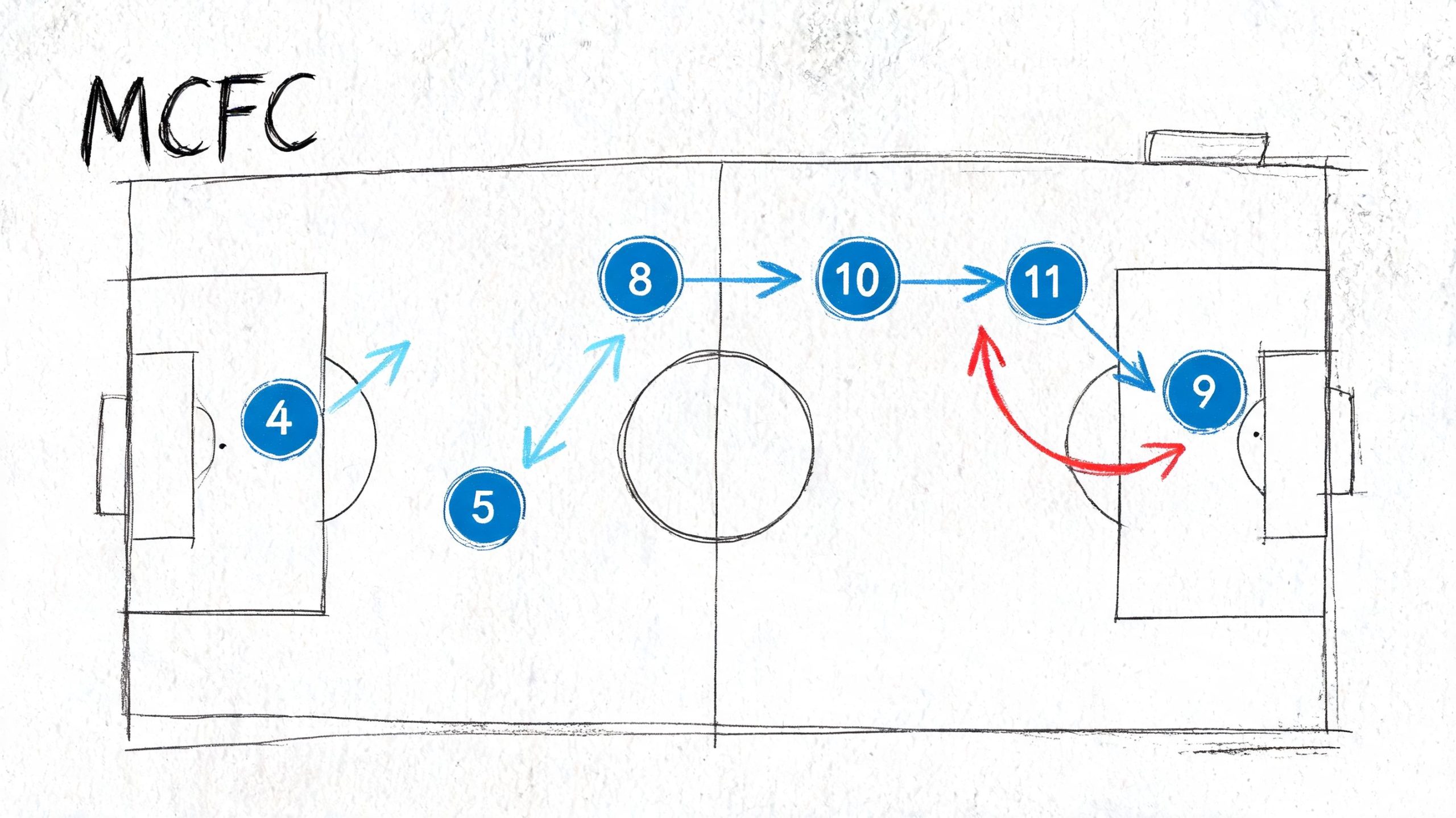
City’s dominance starts on the training ground with a simple idea that Guardiola has repeated for years. Occupy the pitch so the ball carrier always has a short option, a secure option, and a forward option. The pattern matters because each pass is chosen for the effect it has on the opponent’s shape. City are not collecting passes for control alone. They are using circulation to move defenders, expose cover shadows, and create a receiver who can turn.
The build-up pattern that starts everything
City often begin by inviting pressure into a controlled area. The goalkeeper or near-side centre-back receives with time. The opponent sees a pressing trigger. City see a manipulation point.
Earlier analysis in this article noted external work on recurring build-up patterns. City consistently fit the profile of a side that starts short from the back and prefers central progression when the route is available. That preference is tactical, not aesthetic. A pass through the middle does two jobs at once. It gains territory and forces the defending block to contract.
Once the block contracts, the far side changes. The winger can stay wide against a full-back with less support. The far-side interior can arrive into the half-space against a midfielder who has already shifted inward. Coaches often teach these as separate options. City connect them inside one possession, because the central pass causes the wide advantage that follows.
A typical sequence looks like this:
- Ederson or a centre-back receives and waits half a second: the press commits.
- The inverted full-back moves inside the opponent’s first line: a new central angle appears.
- Rodri, or the single pivot in that role, fixes the next presser: City keep access to the middle.
- The interior receives on the half-turn: the attack moves from circulation into penetration.
The key point for coaches is the order. The free man rarely appears by accident. He appears because the first two passes have already assigned defenders to the wrong spaces.
How City create the free man
The inverted full-back is the clearest example of design becoming pattern. When John Stones stepped into midfield in 2022 and 2023, City did not merely add another passer. They changed the arithmetic of the first phase. Against a front two, the extra central player gave City a 3v2 or 4v2 base. Against a front three, it gave them a way to keep the pivot protected while still holding width ahead of the ball.
Watch the opponent’s midfield line in these moments. If a midfielder jumps to Stones, Bernardo Silva or Kevin De Bruyne can receive behind him. If no one jumps, Stones advances the ball himself and the press loses depth. Either response gives City a receiver facing forward.
That is the hidden value of the pattern. It reduces the number of difficult passes City need to play. The structure does part of the creative work before the final-third action begins.
A pattern is doing its job when the next free player is predictable to the attacking team and ambiguous to the defending team.
The far-side midfielder is often the piece younger coaches miss on first viewing. He may not touch the ball for several seconds, but his position prevents a full defensive collapse toward the ball side. In film sessions, pause the clip before the line-breaking pass and check the weak side. City’s spacing there is usually what keeps the central lane open.
For a visual breakdown, this match video is a useful companion:
Final-third patterns and the value of the half-space
City’s final-third play follows the same logic as their build-up. The aim is not merely to reach advanced zones. The aim is to arrive there with the right distances between players.
The half-space is where that work pays off. If the winger pins wide, the interior can occupy the channel inside the full-back. If the striker holds the centre-back, a lane opens for a slipped pass or cutback. If the defence closes the lane early, City recycle and repeat because their rest structure is already in place behind the ball.
Haaland changed the reference point at the top of these attacks, but not the pattern underneath. His presence gave City a stronger threat on the last line, especially against teams that defended the box with four or five players. The supply still depended on coordinated occupation of the half-space, the underlap, and the cutback zone. In other words, the striker finished the pattern. He did not replace it.
Modern analysis tools now make these repetitions easier to confirm. Sequence mapping, possession clustering, and tracking data can group together City attacks that begin from similar starting shapes and reach similar receiving zones. Coaches no longer have to rely on memory alone to identify the pattern. They can test whether the same movements are producing entries into the same spaces against different opponents.
That matters for coaching, and it matters for opponents. To train a pattern like this, coaches need fixed positional references, clear pressing triggers in practice, and repeated rehearsal of the second and third pass, not just the first. To defend it, the problem is usually not the initial pass into the centre-back. The test is whether the defending side can stop the next inside receiver without opening the far-side switch or the half-space runner. City keep forcing that dilemma, which is why their patterns hold up against very different defensive schemes.
How Analysts Detect and Quantify Patterns
An analyst clips City’s first 20 build-up possessions from a match and notices the same picture appearing again. The right-sided interior drops into the half-space, the full-back holds width to pin the winger, and the next pass arrives into the far-side pocket after the first press is drawn. The job is no longer to say, “I’ve seen this before.” The job is to prove how often it happens, under what pressure, and whether it still works once the opponent adjusts.

Video still sets the pattern
Footage is where pattern work starts because tactics are built from cues, not from raw totals. An analyst studies repeated possessions and tags the trigger, the supporting runs, and the destination zone. Did the pattern begin when the opposition winger jumped to the full-back? Did the six move on the blind side of the first presser? Did the action end in a cutback, a switch, or a reset?
That process matters because the same pass can belong to different ideas. A diagonal into the winger might be an escape from pressure in one sequence and the planned final action in another. Video separates accident from design.
With City, that distinction is clear. Under Guardiola, many of their best attacking patterns look flexible on the surface but are highly controlled underneath. The spacing is coached first. The movement is read from the opponent’s pressure. Analysts who only log pass maps often miss the tactical cause.
Event data checks whether the film reading holds up
Once the pattern is defined on video, event data helps test it across a larger sample. Pass origins, receiving zones, sequence length, and pressure context can show whether the action is reliably repeatable or whether one memorable clip distorted the analysis.
A useful example is preview work. If you suspect an opponent concedes after failed wide presses, event data lets you isolate the possessions that begin near the touchline, survive the first duel, and then reach the box within a small number of passes. That turns a coaching hunch into a scouting point you can train against. A data-led match preview such as this Manchester City vs Leeds tactical stats analysis works because the numbers are tied to a football question, not presented as decoration.
The best analysts also cluster similar possessions rather than counting isolated actions. Ten progressive passes from the goalkeeper do not mean ten examples of the same build-up pattern. What matters is whether the same starting shape, the same pressing trigger, and the same receiving lane keep appearing together.
Tracking data shows the structure around the ball
Event data records the visible action. Tracking data records the team shape that made it possible.
Systems such as Second Spectrum track player positions at 25 frames per second, while projected Hawk-Eye AI deployments provide 120 fps 3D trajectories, as described in this overview of AI systems in sports tracking. That level of detail lets analysts measure the distances and timings coaches care about. How far was the weak-side winger from the back line when the switch was played? How quickly did the rest-defense box reform after possession was lost? Did the receiving midfielder have separation before the pass, or did he create it with body orientation at the last moment?
Those questions matter because patterns are collective mechanisms. Guardiola’s training-ground design is not just about where the next pass goes. It is about fixing one defender, freeing another lane, and keeping enough balance behind the ball to repeat the attack if the first entry fails.
AI helps detect the full lifecycle of a pattern
AI is most useful when it searches for recurring shapes and sequence families at a scale the human eye cannot handle alone. Analysts can train models to flag possessions with the same starting occupation, the same press response, and the same end zone. From there, coaches can compare success rates by opponent, game state, or personnel.
That changes the conversation inside a performance meeting. Instead of saying City “often” access the half-space after baiting the press, an analyst can pull every possession that matches that pattern, show where it breaks down, and separate design failure from execution error.
For coaches, the gain is practical. You can see whether a pattern trained on Tuesday survived match pressure on Saturday. For opponents, the same process reveals where to intervene. Many patterns are not beaten at the first pass. They are beaten by destroying the spacing that makes the second and third actions available.
Coaching and Countering Tactical Patterns
Saturday morning. The opponent has spent all week rehearsing your left-sided build-up. Their winger knows when to jump to the full-back. Their striker curves his press to hide the pass into the six. Their weak-side midfielder is waiting for the third man. If your pattern has been taught as a memorized route, it dies on first contact. If it has been taught as a set of cues, distances, and priorities, the same structure can still survive in a different form.
That distinction sits at the center of good coaching. Guardiola’s patterns are designed on the training ground with clear spatial rules, but they are not scripted down to a single pass order. Players learn the reference points first. Which player fixes the first presser. Which angle keeps the next lane open. Which positions protect rest defense if the move breaks down. The pattern is stable. The exact sequence is not.
A useful way to coach that is to isolate the tactical problem before expanding the picture. For a third-man build-up pattern, start with the centre-back, six, and interior against two pressers and one cover player. The objective is specific. Can the centre-back attract pressure without releasing too early? Can the six receive on the correct foot and set the ball into the far-side lane? Can the interior arrive with separation rather than standing in it? Those details decide whether the pattern works under pressure or only on the whiteboard.
Then build the exercise in stages:
- Shadow work: Fix starting positions, passing lines, and body orientation.
- Directional positional game: Add live pressure while preserving the intended exit.
- Phase-of-play practice: Place the pattern in the zone where it appears on match day.
- Conditioned game: Reward the team for recognizing the cue, not for forcing the same pass.
The coaching intervention should also change as the drill expands. Early on, stop the exercise for spacing and scanning errors. Later, coach outcomes. If the opponent screens the six and jumps the full-back, the interior may become the free player earlier than planned. That is still the pattern functioning correctly. The structure has created the next solution.
Manchester City offer the clearest model here. Their build-up often starts with one idea and ends with another because the first function of the pattern is to move defenders, not to complete a predetermined passing chain. A centre-back carries forward, the nearest presser commits, the inverted full-back pins the next line, and the free midfielder receives facing play. Against a compact opponent, the same opening positions can produce a switch instead of a central punch. Coaches should train that elasticity on purpose.
Countering patterns requires the same level of detail. Pressing harder is rarely enough against an elite side because the problem usually sits in the spacing behind the first press. Good opposition plans alter the picture that the attacking team expects to see.
Three interventions show up again and again:
- Deny the clean first reception inside: Screen the pivot and invite the centre-back toward the touchline.
- Close the next pass, not only the current one: The trap works when the receiver has no third-man option.
- Protect the continuation lane: Allow safe circulation if it prevents access into the half-space or the run beyond.
This is why opposition analysis has to move from naming patterns to ranking them. As noted earlier, analysts often log a set of recurring opponent sequences from film and tracking, then sort them by how often they lead to central access, box entry, or unstable defensive transitions. The point is not to stop everything. The point is to identify which link in the chain gives the pattern its real value.
If you are preparing for City, that usually means rehearsing the moment after the first inside pass. Many teams focus on blocking Rodri or the inverted full-back. The sharper question is what happens next. Does the winger tuck in quickly enough to narrow the lane into the half-space? Does the striker’s cover shadow force the centre-back to pass on the defender’s weaker angle? Does the far-side midfielder stay connected so the switch does not become the release valve? Counterplans fail when one player presses the ball and the next line defends the original shape instead of the new one.
One practical rule helps both coaches and analysts. Attack the pattern at its point of acceleration. Every sequence has a moment when the opponent goes from balanced to stretched. Sometimes that is the first bounce pass into midfield. Sometimes it is the underlap that fixes the full-back and opens the cutback zone. Sometimes it is the rest-defense shape that allows the attack to be repeated after a clearance. Find that moment, and the pattern becomes coachable. Remove that moment, and the pattern becomes far less dangerous.
Elite teams rarely lose their favorite patterns because the opponent guessed the route. They lose them because the opponent understood the mechanism.
Conclusion The Art and Science of Teamwork
Patterns of play sit in the space between theory and action. They’re where a coach’s game model becomes visible, where a formation starts to move, and where a team’s style turns from an idea into a repeated behavior under pressure.
That’s why they matter so much. They explain why one possession feels sterile and another feels loaded with threat, even before the shot arrives. They explain why Manchester City can make familiar movements look fresh, and why opponents who know the script still struggle to stop it. The pattern doesn’t work because it is hidden. It works because it manipulates the next decision faster than the opponent can solve it.
For coaches, the lesson is practical. Train relationships, not isolated actions. For analysts, the lesson is methodological. Use film first, then test it with data, then deepen it with tracking when available. For anyone trying to counter an elite side, the lesson is tactical. Break the sequence before the most dangerous player ever receives.
Football keeps getting more measurable, but the core insight stays the same. The best teams don’t just have talented players. They give those players a shared map.
If you want more breakdowns in this style, Manchester City Analysis is worth adding to your reading list. It’s one of the few outlets focused on clear tactical storytelling, with detailed work on City’s structures, adaptations, and match-specific patterns that serious supporters, coaches, and analysts can use.