A striker checks short. One centre-back follows. The second holds the line a step too deep. The gap opens for half a second, the through ball arrives, and everyone in the stadium blames the finish.
The error happened earlier. It happened in the spacing between defenders, in the angle of the hips, in the decision to step or delay. That’s why center back positioning has become one of the most important tactical subjects in elite football. The position isn’t defined by clearances anymore. It’s defined by timing, reference points, and how a defender shapes both the game without the ball and the game with it.
Manchester City offer the clearest modern example. Under Pep Guardiola, the centre-back is asked to protect depth, manage pressure, circulate possession, and sometimes function like an auxiliary midfielder. Remove a stabilising pivot and those demands intensify. The role becomes less about occupying a fixed spot and more about solving a sequence of problems.
Table of Contents
- Introduction The Modern Defensive Linchpin
- Core Principles of Defensive Positioning
- The Centre Back's Role in Possession
- Mastering Defensive and Offensive Transitions
- The Guardiola System Centre Back Variations
- Common Positioning Mistakes and Data-Driven Fixes
- Essential Drills and Coaching Cues
- Conclusion The Future-Proof Defender
Introduction The Modern Defensive Linchpin
City are 1-0 up, the opponent jumps the first pass, and Rodri is not there to settle the structure. In that moment, centre-back positioning stops being a defensive detail and becomes the mechanism that keeps the whole team stable. A centre-back has to offer the goalkeeper a clean angle, protect the space behind the ball if possession is lost, and shape the next line of attack with one starting position.
That is the modern job description.
The role still includes the visible actions. Winning duels, defending the box, and clearing crosses remain part of it. At elite level, though, the bigger gains often come earlier. The best centre-backs read the pressing trigger, adjust their body shape before the pass arrives, and close the option the opponent wanted to use.
Analysts at Stats Perform have noted how much more involved centre-backs are in first-phase circulation than they were a decade ago. The broad trend is clear even without repeating the source here. Top teams now use central defenders as repeat distributors, not just as emergency recyclers. That change matters because positioning is no longer judged only by what happens in the penalty area. It is judged by whether the defender improves the next pass, the rest defence behind it, and the team’s access into midfield.
Manchester City provide the clearest case study. Under Guardiola, the centre-back does not merely wait for play to arrive. He sets the map for the possession. A wider starting position can open the goalkeeper’s passing lane and stretch the first press. A more aggressive step forward can pin an opposing forward and change the angle into the No. 8. A delayed movement can protect the space that Rodri would usually control. Remove the pivot, and the centre-back’s positioning carries even more tactical weight because the back line has to absorb some of the spacing, timing, and security that midfield normally provides.
The recent City versions of John Stones, Rúben Dias, Manuel Akanji, Nathan Aké, and Josko Gvardiol show that the position has split into several jobs at once. One defender may hold width for circulation. Another may step into midfield. Another may stay connected to the striker to prevent the counter from starting cleanly. Coaches still call them centre-backs, but the role now sits at the junction of build-up structure, rest defence, and pressure resistance.
Good centre-back positioning is early positioning.
That is why this subject deserves more than generic advice about staying compact or holding the line. The useful questions are more specific. How does a defender’s starting spot change the opponent’s press. How does the pair adjust when the midfield platform changes. How does City preserve control when the usual pivot reference is missing. Those questions explain why modern centre-back play has become one of the clearest indicators of a team’s tactical level.
Core Principles of Defensive Positioning
The best centre-backs often look quiet. They don’t dive into scenes. They don’t pile up visible interventions. They shrink the opponent’s options before the pass arrives. That matters because off-ball positioning and anticipatory intelligence account for 60 to 70% of defensive value, according to this centre-back evaluation study from The xG Football Club.
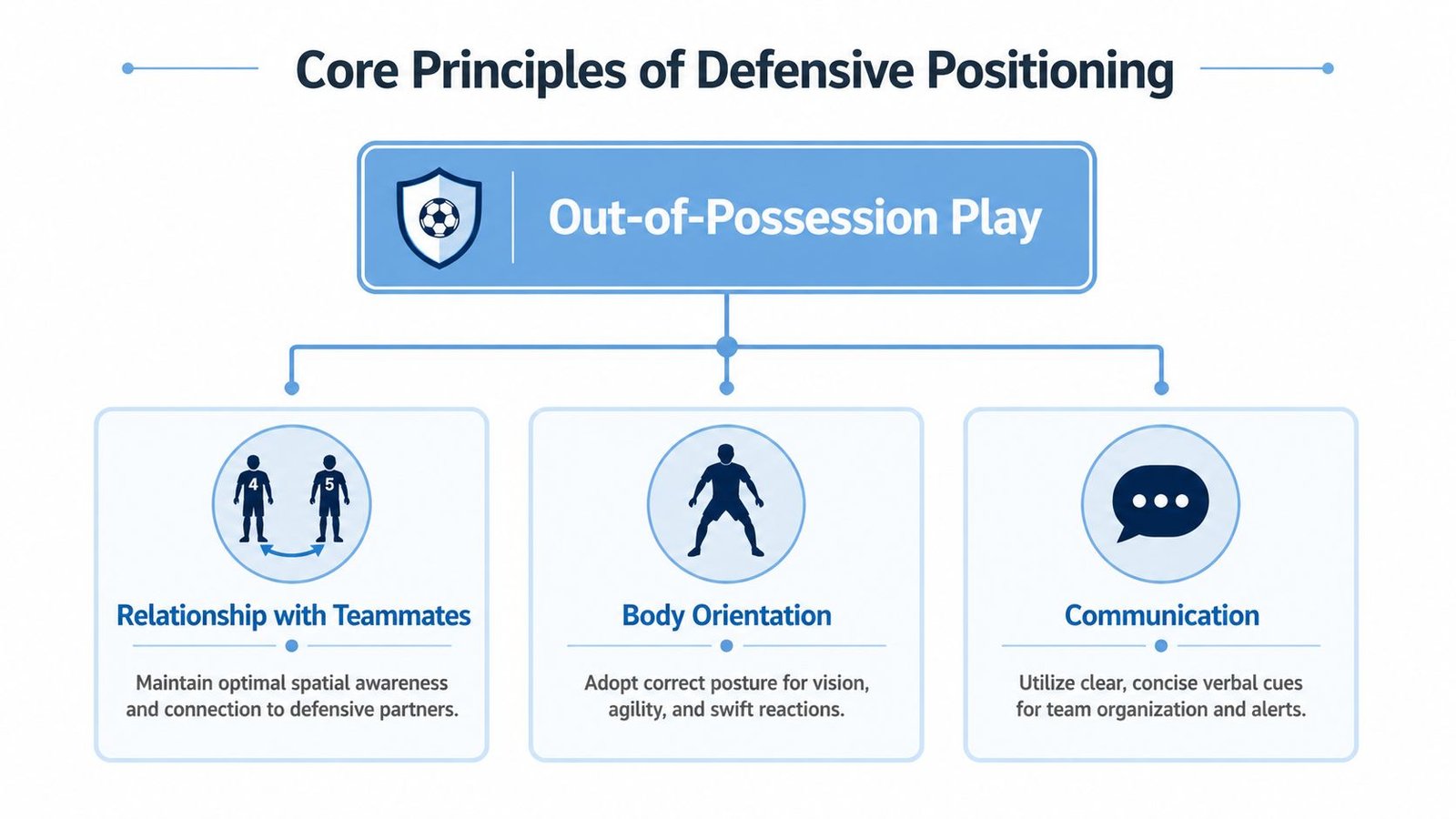
The partner distance that prevents split passes
The first principle is the relationship with the other centre-back. Think of the pair as connected by an elastic band. If one steps, the other adjusts. If one drops, the other can’t stay flat and detached. The aim isn’t perfect symmetry. The aim is coordinated cover.
Coaches often tell centre-backs to “stay compact,” but that phrase is incomplete. Compactness only helps if it preserves two things:
- Cover depth: one defender can engage, the other can sweep.
- Access to the striker: neither player gets screened too easily.
- Control of the lane: the pair don’t open a clean vertical pass between them.
When strikers split a pair, the mistake is usually relational. One centre-back has reacted to the ball, while the other has reacted to the last line. Those are different references. Good defending starts when both players read the same cue.
The line moves on one signal
A back line should move like a pendulum, not like four separate decisions. The strongest trigger is pressure on the ball. If the passer is under stress, the line can step and compress space. If the ball carrier has time and body control, the line must protect depth first.
That’s why center back positioning can’t be isolated from the teammates in front. The centre-back isn’t just judging the striker. He’s judging the quality of the ball source. A high line without ball pressure is optimism. A deep line when the passer is locked is wasted territory.
A useful coaching sequence is simple:
- Check the ball carrier
- Check the runner
- Check your partner
- Move the line with your next step
The centre-back who watches only the striker arrives late to the real problem.
Communication belongs here too. The command doesn’t need to be long. “Step,” “drop,” “hold,” and “inside” are enough if the line already shares common reference points.
Body shape decides your next action
The third principle is body orientation. Many defensive errors come from being square to the ball. A square stance narrows the defender’s next movement. It slows the turn, hides the blind side, and invites the runner to attack the shoulder.
A half-open stance solves that. The defender can see the ball, feel the striker, and move forward or backward without a full reset of the feet. That matters most in the channels, where one bad hip angle can turn a manageable situation into a footrace.
Use these cues with players:
- See ball and man: don’t sacrifice one reference for the other.
- Show your far shoulder less: don’t invite the direct run across your body.
- Open to retreat: if you can’t run backward quickly, your starting stance is wrong.
The headline point is blunt. Most defending is preventive. A centre-back with fewer tackles may still be the better defender because his positioning stopped the pass from being played at all.
The Centre Back's Role in Possession
Possession starts with geometry. Before the pass reaches midfield, the centre-backs have already shaped the next layer of the attack by deciding their distance from each other, their angle to the goalkeeper, and whether they tempt the press or avoid it.
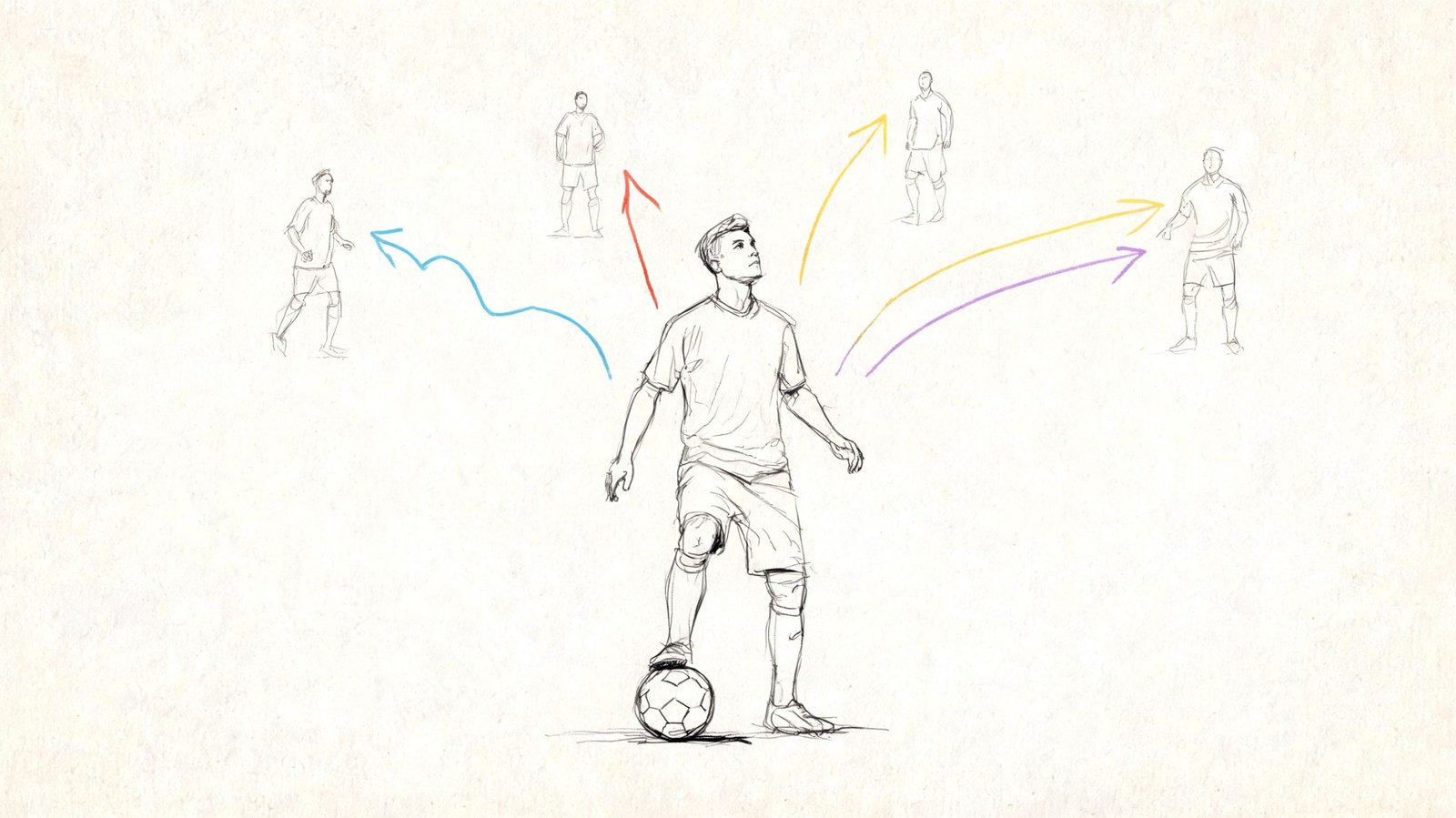
Start positions create the build-up map
At elite clubs, centre-backs now sit at the centre of circulation. The increase to 60 passes per 90 minutes, up from 40, shows how far the role has shifted toward orchestration in possession, as detailed in Stats Perform’s build-up analysis. That number matters less as a badge of volume than as proof of responsibility. The centre-back is repeatedly trusted to choose the next phase.
In practical terms, the first decision is width. Split too wide and you lengthen the next pass into midfield. Stay too narrow and the press can lock both central defenders in the same cover shadow. Guardiola sides often manipulate this by changing the spacing according to the opponent’s front line rather than using a fixed template.
For City, one of the most interesting examples has been Joško Gvardiol, whose receiving positions and carrying angles affect whether the left side becomes stable or progressive. A detailed Gvardiol tactical scout report shows how those positions support both circulation and line-breaking access.
Carrying forward changes the press
A centre-back should not drive into midfield just because the lane looks open. The carry must provoke a reaction. If nobody jumps, the defender can continue and commit a line. If a presser leaves his line to engage, space opens behind him.
That’s why the carry is a positional act, not just a dribble. It changes the opponent’s defensive map.
Three good triggers for a centre-back carry are:
- The first presser screens the pass but doesn’t engage the ball
- The nearest midfielder is pinned by a teammate and can’t jump cleanly
- The far-side centre-back remains connected enough to protect rest defence
A bad carry is easy to spot. The centre-back advances without support angles behind the ball, gets pressed from the blind side, and turns a stable possession into a transition against his own defence.
Passing that changes the picture
Safe passes are necessary, but they don’t define top-level center back positioning in possession. The more important question is whether the defender can pass in a way that changes the opponent’s shape. That might be a firm ball into a pivot under pressure, a diagonal into the far full-back, or a vertical pass through the first line into an interior.
A line-breaking pass is valuable because of what it forces next. The opponent has to turn, reset, and defend facing their own goal.
The centre-back’s passing choices also shape the distances around the receiver. A pass into a teammate’s back foot under pressure can kill the next action even if it’s completed. A pass into the front foot, with the body opened to the far side, can start an attack from the same zone. Good defenders don’t just complete passes. They deliver playable passes.
Mastering Defensive and Offensive Transitions
Transitions expose the honesty of a structure. A team may look stable in settled possession or in a formed block, but the moment the ball changes hands, quality of center back positioning becomes visible.
When the ball is lost
The first defensive transition question is not “Can I win it back?” It’s “What space am I responsible for if we don’t?” That distinction separates disciplined aggression from reckless aggression.
If the turnover happens with support around the ball and the opponent’s receiver is facing his own goal, the centre-back can help compress the field by stepping early. If the receiver can turn, or if the turnover leaves the last line exposed, the priority changes immediately. Protect depth. Narrow the central lane. Delay until support recovers.
The strongest centre-backs are excellent judges of danger hierarchy:
- Central depth beats wide pressure
- Delay beats diving in
- Recovery angle beats straight-line sprinting
When the ball is won
Offensive transition requires a different kind of courage. Many centre-backs win the ball and then retreat too fast, disconnecting from the counter and forcing the team into a low-value reset. Elite defenders support the next action without forgetting the threat behind them.
That usually means stepping up to sustain possession, offering a secure outlet, and adjusting slightly toward the ball side while staying connected to the far-side centre-back. The point isn’t to join the attack as a spectator. The point is to keep the attack alive if the first forward pass is blocked.
One coaching cue works well here: arrive behind the counter, not inside it. The centre-back should be close enough to recycle the move and far enough to defend the next loss.
Win it, support it, secure it. Those are the three beats of a modern centre-back in transition.
The Guardiola System Centre Back Variations
Manchester City make the position harder to label because Guardiola treats the centre-back as a moving function, not a fixed location. The role changes with the opponent, with the phase of possession, and with the structure around the pivot.
Formation changes the job description
Research on Premier League formations shows that tactical context directly changes centre-back output. In 4-3-3 and 4-2-3-1 systems, centre-backs produce higher values in ball-possession phases and in short and middle passing. In back-three systems, centre-backs record the highest sprinting distances, with effect sizes ranging from 0.13 to 1.27, according to the formation-based EPL study on PubMed Central. That aligns closely with what we see in Guardiola teams.
In a back four, the centre-back often acts as the first distributor and the rest-defence anchor. In a back three, especially when one player steps out or wide, the role becomes more mobile. Side centre-backs can defend broader spaces and press into zones that a full-back might normally own.
That context matters when analyzing City. One match may ask Dias to act as the central stabiliser in a four. Another may ask Stones to step into midfield from a three-plus-one shape. Judging both performances with the same checklist misses the tactical demand.
Citys hybrid centre-backs
John Stones represents Guardiola’s most radical interpretation. He can start as a centre-back, step alongside or ahead of the pivot, and alter the midfield numbers without a substitution. The move doesn’t just add an extra body. It changes opponents’ pressing references and often opens a cleaner lane into advanced midfielders.
Akanji and Gvardiol reflect a different variation. They can defend centrally, then provide width or underlapping support depending on the side of the attack. That hybrid role matters because it lets City preserve central security while still stretching the opposition’s shape.
A closer look at how those adjustments can sharpen control or create inconsistency appears in this analysis of Guardiola’s tactical tinkering and its trade-offs. The key lesson is that “centre-back” at City often describes a starting point, not a final zone.
Centre-Back Role Comparison Traditional vs. Guardiola System
| Attribute | Traditional Centre-Back | Guardiola System Centre-Back |
|---|---|---|
| Primary defensive task | Protect box and duel with striker | Protect box while also managing large spaces in rest defence |
| Position in build-up | Outlet or safety pass | First-line playmaker and press manipulator |
| Relationship to midfield | Mostly behind it | Sometimes inside it or adjacent to it |
| Wide-zone responsibility | Limited in a back four | Can expand wide or cover hybrid full-back zones |
| Decision under pressure | Clear, hold, reset | Invite press, break line, or carry forward |
| Value indicator | Duels, headers, clearances | Positioning, progression, timing, and structure control |
City’s system reveals a broader truth. Modern center back positioning is no longer about defending a strip of grass. It’s about controlling a changing zone of influence that stretches from the penalty area to the first phase of midfield occupation.
Common Positioning Mistakes and Data-Driven Fixes
A common failure pattern looks like this. City lose the ball with one centre-back already shifted toward the touchline, the partner stepping to protect the next pass, and the pivot absent or late to recover the central lane. The mistake is then blamed on the final duel, even though the problem started two actions earlier with poor spacing behind the ball.
That is why City without Rodri provide such a useful case study. Remove the player who usually secures the zone in front of the defence, and every small positional error by the centre-backs becomes easier to see. Distances stretch. Cover shadows disappear. Decisions that are harmless in a settled structure become expensive in transition.
What changes without the pivot
The useful point is not a speculative forecast for 2025/26. It is a tactical model built from recent City performances and then projected onto matches where the lone pivot is missing. In that framing, the warning is clear: build-up quality from the defensive third declines, and central protection becomes less stable because the centre-backs have to solve both circulation and cover at the same time.
That trade-off showed up in different forms across recent high-level matches. City could still dominate the ball, but their rest-defence shape was less reliable once central access behind the first line opened too easily. A strong match-specific example appears in this analysis of Manchester City’s defensive collapse against Real Madrid, where the issue was not only individual defending but the spacing between the back line and the zone Rodri usually protects.
The lesson is immediate. “Stay narrow” is too crude to guide elite centre-backs. Narrow positions help secure circulation and protect the box, but if the full-back is high, the eight is advanced, and the pivot cannot lock the inside lane, that same narrowness can leave the half-space open on the next pass.
Three recurring errors and the correction
The first mistake is overcommitting to the ball side. This often happens when the pivot is unavailable and the near centre-back tries to close the overload alone. City’s better versions solve that with stagger, not with both defenders sliding on the same horizontal line. One engages the immediate receiver. The partner stays half a step deeper and more central to protect the lane that matters most.
The second is reacting to the obvious pass instead of the pass before it. At top level, the dangerous reception is usually telegraphed one action earlier by the opponent’s body shape, support angle, or full-back position. If the centre-back adjusts only when the ball enters the half-space, he is already late. Dias is strong here at his best because his hips are often set before the release, which lets him defend forward without losing access to depth.
The third is stepping out without pressure on the ball. Guardiola sides ask centre-backs to compress space aggressively, but that only works when the passer is rushed, screened, or forced onto a weaker option. If the ball carrier can look up and play cleanly, the step from the line creates the gap the attack wants. This was one of the bigger differences in City’s less stable spells. The action looked proactive, but the structure behind it was not aligned.
Use these corrections on the pitch:
- Protect the inside lane first: the first reference is the route into goal, not the nearest wide receiver.
- Adjust on the previous pass: body shape has to be set before the dangerous reception.
- Step with collective pressure: the line moves when the passer is controlled, not when one defender feels the need to jump.
- Keep asymmetric spacing: the far centre-back should rarely mirror the near one exactly.
The repeated error is not aggression. It is aggression applied by one player without matching support around him.
That distinction matters for coaching. Rising danger through central channels does not always mean the centre-backs defended poorly as individuals. It often means the team removed the conditions that make good positioning possible. City’s recent adaptations without their main pivot make that point unusually clear, and they offer a sharper coaching takeaway than generic advice ever will.
Essential Drills and Coaching Cues
Training center back positioning has to connect perception, movement, and communication. If a drill isolates only one of those, the transfer to matches is weak.
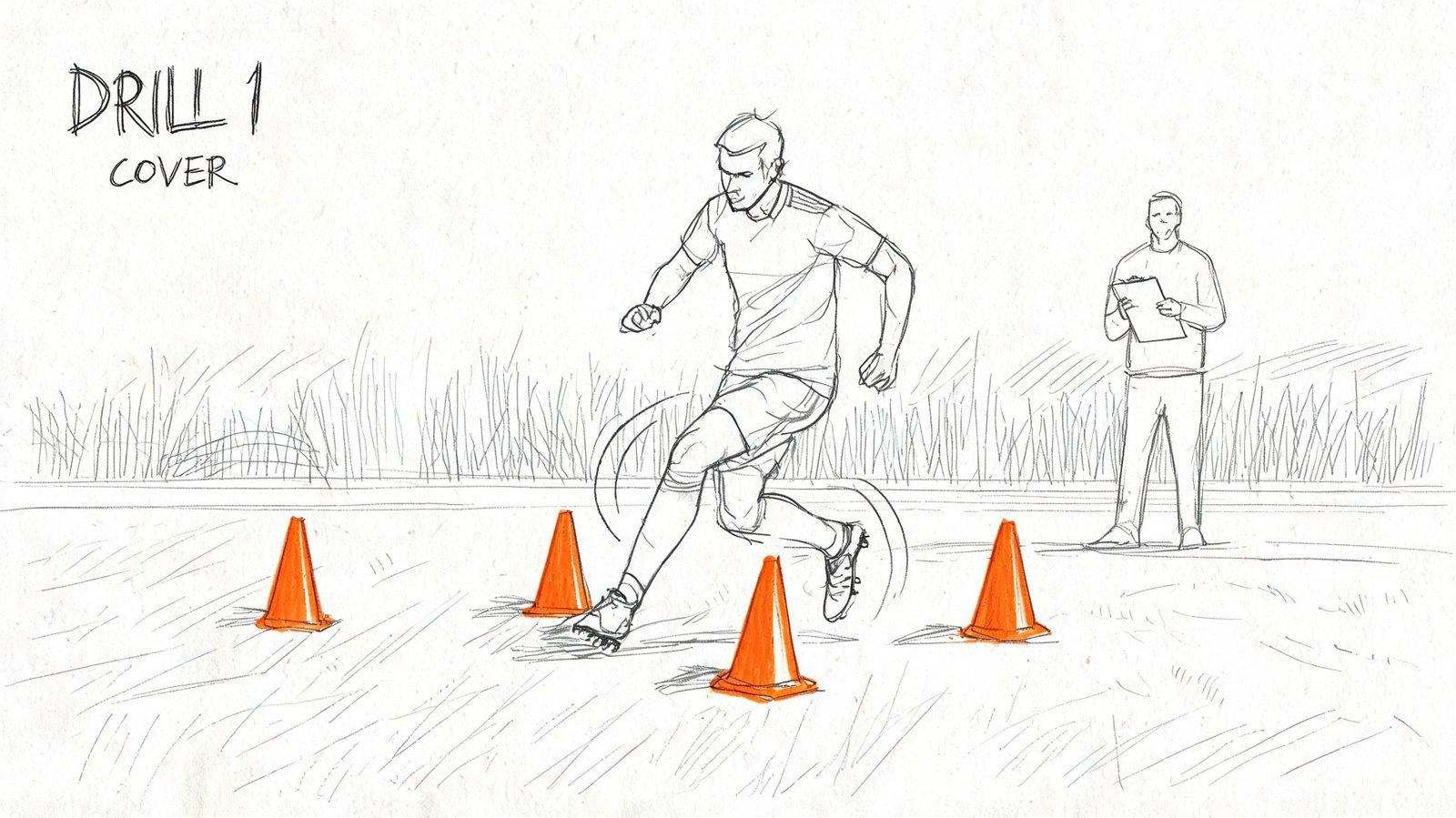
Pendulum pair drill
Set up two centre-backs, one striker, one server, and two mini-goals or gates behind the line. The server can play into feet, into channels, or threaten the direct ball. The pair shift together and defend the gates, not just the striker.
Coaching cues:
- “Stay connected”
- “One presses, one covers”
- “See ball and partner”
Keep the reps short and reset often. The point is coordination, not exhaustion.
Build-up under pressure game
Mark a central build-up zone with a goalkeeper, two centre-backs, and a pivot against a pressing front. Award points only if the centre-backs find a pass that breaks the first line or carry into the next zone under control.
This is a good setting for filming repetitions. Coaches who want sharper feedback loops can study Creating engaging training videos to package those clips into short learning sequences players will revisit between sessions.
Add these cues:
- “Body open before the pass”
- “Invite pressure, don’t absorb it”
- “Carry to commit, pass to free”
A simple visual example helps players connect the language to the movement:
Transition lock drill
Play a directional game where one team builds and, on loss, has five seconds either to counter-press or recover into a compact line. The centre-backs score points for correct decisions, not just for regains.
Judge each action on three questions:
- Did they protect central depth first?
- Did the nearest defender delay or dive in?
- Did the far defender narrow soon enough to cover the second action?
The best sideline cue is still the simplest: “Can you see three corners?” If the centre-back can see the ball zone, the striker zone, and the recovery space behind, his body shape is probably right.
Conclusion The Future-Proof Defender
The modern centre-back is a hybrid. He has to defend space before he defends duels, shape build-up before midfield receives the ball, and survive transitions without losing his role in possession. That’s why center back positioning sits at the heart of elite football now.
Manchester City offer a useful blueprint because their defenders don’t just react to play. They construct it. Their centre-backs change height, width, and function according to formation, pressure, and midfield support. When the pivot is available, those relationships look smoother. When that support disappears, the importance of positioning becomes even more obvious.
For coaches, the takeaway is practical. Don’t teach centre-backs as static stoppers. Train partner distances, body orientation, pressure triggers, and build-up choices together. For players, the challenge is mental as much as physical. You’re not memorising spots on the pitch. You’re learning to read a moving picture early enough to control it.
If you want more match-specific tactical breakdowns in this style, Manchester City Analysis is one of the best places to follow City’s structural trends, player roles, and the tactical details that decide games.
Composed with Outrank app