You’re probably doing some version of the job already.
You watch a match and notice the full-back isn’t just “good on the ball.” He inverts at the right moment, protects the pivot in rest defence, and scans before receiving under pressure. You spot a winger who looks electric in highlights but fades when the game slows down and decisions matter. You pause clips, make notes, compare profiles, and wonder whether football talent scout jobs are really open to people who can think at that level.
They are. But the industry isn’t looking for a fan with opinions. It’s looking for someone who can turn observation into recruitment value.
That’s the difference most newcomers miss. Old ideas about scouting still linger. People imagine a scout in the stand, notebook in hand, relying on instinct and contacts. That world hasn’t disappeared, but it’s no longer enough at serious clubs. Modern recruitment departments expect live observation, video work, written reporting, tactical context, and enough data literacy to challenge first impressions instead of decorating them.
The opportunity is real. In the United States, the sports scouting job market employs approximately 275,200 professionals and is projected to grow by 9.2% between 2022 and 2032, creating demand for 32,300 new scouts over the decade, according to CareerExplorer’s sports scout job market data. That doesn’t make the field easy to enter. It does mean there’s a stable market for people who can evaluate talent properly.
At Premier League and Champions League standard, the bar is higher than most career guides admit. Clubs want evidence, not enthusiasm. They want scouts who can explain why a player fits a game model, not just why he looks promising. They want reports that survive internal challenge from analysts, coaches, and recruitment leads.
That’s where most generic advice falls short. It tells you to “network,” “gain experience,” and “follow your passion.” None of that is wrong. None of it is enough either.
Table of Contents
- Introduction From the Stand to the Scouting Gantry
- Defining the Modern Football Scout A Day in the Life
- The Scout's Toolkit Core Skills and Competencies
- Forging Your Path Qualifications and Experience
- Building Your Scouting CV and Portfolio
- Finding Football Scout Jobs and Building Your Network
- Progression From Academy Scout to Elite Strategist
Introduction From the Stand to the Scouting Gantry
The gap between a smart supporter and a professional scout is smaller than outsiders think, but sharper than insiders admit. Both watch football closely. Both judge players. Both compare profiles and discuss fit. The split happens when one person stops at impression and the other builds a decision process.
That process matters because talent identification is messy work. Players change role, level, coach, team structure, and league context. A winger who dominates in transition may struggle in a positional side. A centre-back who looks calm in a deep block may not survive on the halfway line. Recruitment mistakes usually start with a vague conclusion that sounded persuasive in the moment.
The game has changed faster than the mythology
The romance of scouting still sells. People talk about “an eye for a player” as if that alone gets you into a recruitment room. At lower levels, instinct still carries weight. At elite level, instinct needs support. Clubs want to know whether your read holds up across multiple viewings, different match states, and the tactical demands of their model.
Manchester City serve as an effective case study because their approach to football demands absolute precision. A scout evaluating a potential City signing cannot rely on surface-level output alone. You must analyze spacing, receiving angles, pressing triggers, body orientation, and whether the athlete can perform within a system that controls territory rather than merely attacks space.
Practical rule: If your report could fit any club in the league, it isn’t a real recruitment report yet.
Why this career attracts the wrong people and the right ones
Football talent scout jobs attract dreamers, obsessives, former players, analysts, coaches, and people who refuse to watch the game casually. The wrong entrants chase the image of the role. They want access, travel, and club branding. The right entrants enjoy the hard part. Rewatching sequences. Writing evidence. Revising a conclusion after seeing more film.
A lot of good candidates also underestimate themselves. They assume they need a famous playing career or a ready-made club connection. Those things can help. They aren’t the only route in. Good scouting departments need different minds. Some recruiters are strongest live. Some are strongest on video. Some ask better tactical questions than anyone else in the room. Some reduce noise and organise information cleanly.
The common denominator is disciplined judgement. That’s what moves you from talking football to working in it.
Defining the Modern Football Scout A Day in the Life
The modern scout’s diary is less glamorous than people expect and more demanding than most job descriptions reveal.
A typical week can involve tagging clips on Wyscout, reviewing a shortlist from Hudl, checking event data against live impressions, attending a youth game with a narrow brief, then condensing everything into a report that a Head of Recruitment can read quickly. The output has to be clear enough for a coach, sharp enough for an analyst, and specific enough for a decision-maker who doesn’t want theatre.

The week is built around questions, not fixtures
Good scouts don’t just “go watch a player.” They go to answer a defined question.
If the brief is a midfielder for a possession side, the task might be to test press resistance, scanning habits, receiving profile, and defensive coverage after loss. If the brief is an academy striker, the scout may focus on movement before service, timing of separation, and how the player reacts when the game becomes scrappy rather than structured.
A useful way to think about the work is to split it by environment:
| Environment | What you’re really assessing |
|---|---|
| Video scouting | Repeatable patterns, role usage, technical habits, weak-foot comfort, decision speed |
| Live scouting | Off-ball work, communication, physical presence, reaction to setbacks, coach interaction |
| Post-match reporting | Fit, risk, development needs, comparison set, recommendation strength |
The mistake new scouts make is treating every viewing like open-ended discovery. Serious departments don’t have time for that. They need scouts who can narrow attention without becoming blind to context.
What old-school scouts still get right
The old-school scout isn’t obsolete. He’s incomplete.
Live football still tells you things the dataset won’t. You see how a player reacts after a misplaced pass. You notice whether a centre-back organises teammates or points once the danger has already formed. You catch the tempo of movement between actions, not just the actions themselves.
That said, relying on gut alone is a weak method. A review of football scouting practices cited by LatentView’s analysis of predictive analytics in football scouting describes how top European clubs now employ over a dozen specialized analysts per team, and notes that combining human observation with data analytics can produce 20 to 30% more accurate talent selections in high-stakes recruitment environments. That represents the central shift. Better departments don’t choose between eyes and numbers. They force both to challenge each other.
A scout who can’t explain his opinion won’t last. A scout who can’t revise his opinion won’t help.
Later in the week, the work becomes communication. The best scouts write lean reports. They don’t bury the lead. They state role, level, strengths, risks, fit, and recommendation. If needed, they attach clips that support the judgement rather than overwhelm the reader.
The video below gives a feel for how the modern scouting role blends observation and analysis in practice.
What doesn’t work is easy to spot. Long reports with no clear conclusion. Highlight-reel assessments. Generic praise like “good engine” or “great mentality” without evidence. A scout’s job isn’t to sound knowledgeable. It’s to reduce uncertainty for the people making the final call.
The Scout's Toolkit Core Skills and Competencies
The best way to understand the role is as a stack of competencies. Each layer supports the next. If the base is weak, the polished language on top won’t save you.

Football knowledge still sits at the base
If you don’t understand the game thoroughly, every later skill becomes cosmetic.
That means more than knowing formations. You need to read player roles inside different structures. A left-back in a back four isn’t the same assignment as a left-back who inverts into midfield. A striker in a pressing side isn’t judged the same way as one in a low-possession team. Guardiola’s teams are a useful education because role definition is so exact. One player’s value can change entirely depending on spacing, timing, and the team’s occupation of central zones.
A practical development routine works better than generic “watch more football” advice:
- Watch with one lens per match: Spend one game on rest defence, another on midfield rotations, another on wide overloads. Broad watching builds familiarity. Narrow watching builds expertise.
- Track role changes, not just performances: Note when a player moves from build-up helper to final-third runner, or from touchline holder to inside receiver.
- Compare across levels: Academy football, senior domestic football, and European competition expose different speeds of thought and contact tolerance.
Data literacy separates opinion from recruitment value
Modern football talent scout jobs increasingly reward scouts who can speak both football and data. That doesn’t mean every scout needs to become a data engineer. It does mean you need to interpret performance information intelligently and know where numbers can sharpen or challenge your live view.
The main gain is not “finding hidden gems” through dashboards alone. It’s building a more stable judgement process. If your eye says a midfielder controls tempo, can you support that with pass selection, progression profile, receiving volume, and actions under pressure? If your eye says a forward’s output flatters him, can clips and event context show why?
Top clubs now build larger, more specialised departments. That trend is one reason analysts have become embedded in recruitment operations rather than parked on the edge of them. For readers trying to improve that side of their work, Manchester City Analysis resources offer a useful model of how tactical and analytical thinking can be communicated clearly.
Field note: Data doesn’t remove disagreement. It improves the quality of disagreement.
A scout with basic data literacy should be comfortable with tasks like these:
- Reading role-adjusted output instead of judging raw totals.
- Spotting sample traps in small runs of form.
- Using clips to verify metrics rather than assuming a number tells the whole story.
- Presenting evidence cleanly in tables, short summaries, and tagged video.
Reporting is where good work survives scrutiny
Plenty of people can spot players. Fewer can explain them. Even fewer can do it in language that helps a club decide.
Strong reports usually share four features:
- Clarity on role: What is this player now, not what could he be in a perfect world?
- Clarity on fit: Which game model suits him, and which one exposes him?
- Clarity on risk: What could stop the transition to a higher level?
- Clarity on recommendation: Monitor, advance, deprioritise, or move immediately.
What doesn’t work is trying to sound authoritative through jargon. If a Head of Recruitment needs three reads to understand your view, the report has failed. A scout’s toolkit is complete only when observation, data handling, and communication all hold up under internal challenge.
Forging Your Path Qualifications and Experience
There isn’t one accepted route into football talent scout jobs. That’s good news if your background is unusual. It’s bad news if you’re waiting for a single credential to open the door.
Clubs and agencies tend to assess combinations. Education can signal discipline. Coaching experience can signal game understanding. Published analysis can signal judgement and communication. Volunteer work can show that you’ve operated inside the messiness of real football rather than discussing it from distance.

Three routes into the profession
Some candidates arrive through formal study. A degree in sports science, performance analysis, or data analytics can help if it teaches applied thinking rather than just theory. The advantage is structure. You learn research habits, presentation, and often some technical tools. The weakness is obvious. A qualification without football judgement doesn’t impress anyone for long.
Others come through coaching. That route sharpens your understanding of role demands, training transfer, and what players can absorb. Coaches usually ask better questions about teachability and tactical fit. The downside is that some coaching backgrounds produce reports that are heavy on pedagogy and light on recruitment precision.
The third path is self-built. Blog work, independent scouting, tagging clips, and volunteering with local clubs can all matter. This route proves initiative. It also reveals whether you can keep standards high without external pressure. The risk is uneven quality. Plenty of self-built portfolios show enthusiasm, but not enough selectivity.
A simple comparison helps:
| Route | Main strength | Common weakness |
|---|---|---|
| Academic | Method, analysis, structure | Can be detached from match reality |
| Coaching | Tactical understanding, player development lens | Can over-focus on what could be coached |
| Self-built practical work | Initiative, evidence of output, real samples | Quality control varies widely |
What clubs actually respect
Clubs respect work that looks useful. That sounds obvious, but many applicants still optimise for looking impressive instead.
Useful experience often includes things like producing role-specific reports, helping a local academy organise opposition information, maintaining a tagged video library, or publishing tactical analysis that shows you understand player function. Former players can have an advantage in feel for the game, but they still need to prove they can report systematically. Analysts with technical skills can stand out quickly, but only if they can translate data into football language.
If you have to choose, choose evidence of judgement over another line on the certificate list.
A strong profile usually combines at least two of the three routes above. A coach who can analyse data is valuable. A graduate who has spent weekends watching academy football is more credible than one who hasn’t. A self-taught scout who writes cleanly and can defend decisions on video calls becomes employable much faster than someone waiting for permission to start.
Building Your Scouting CV and Portfolio
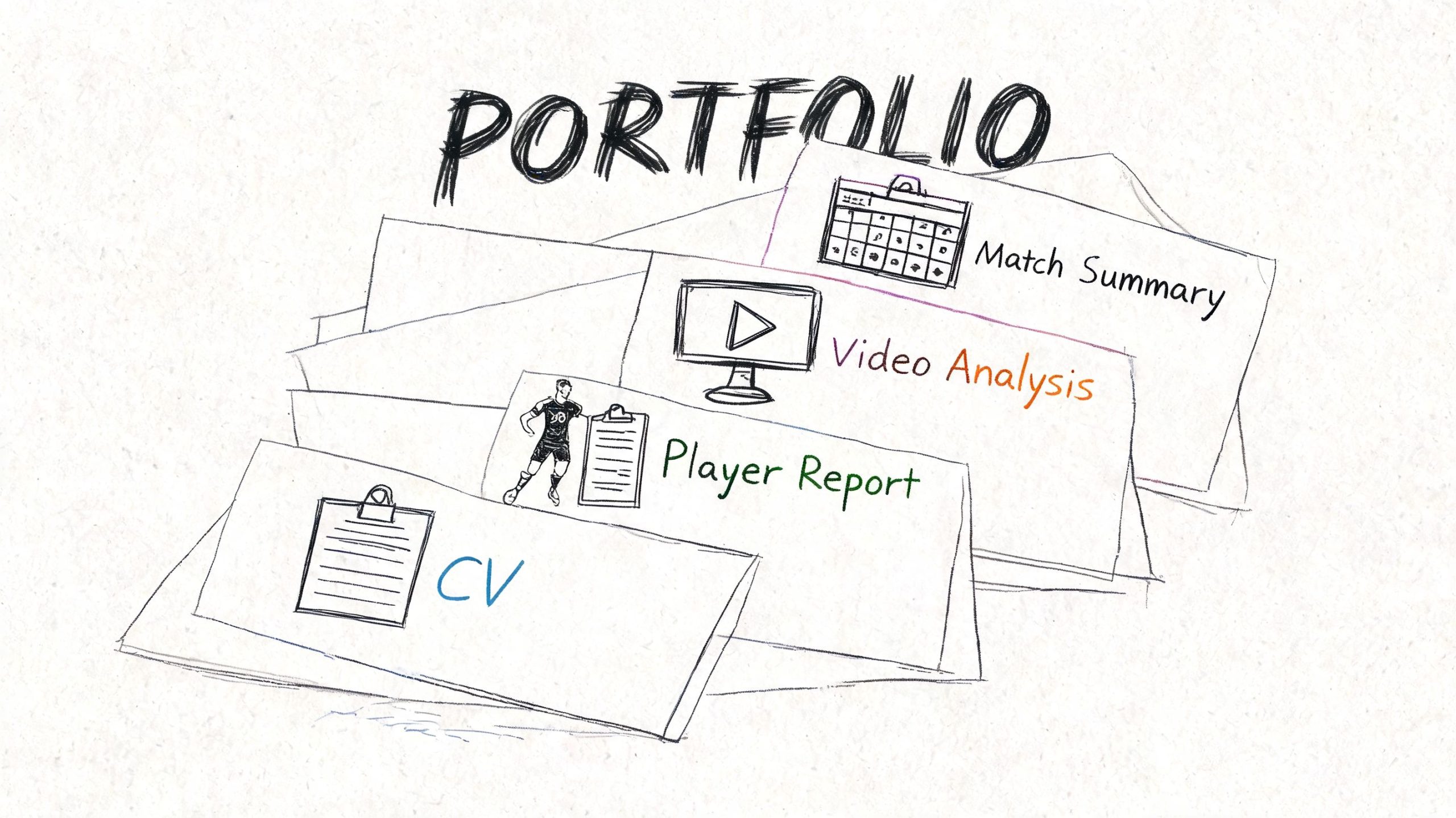
Your portfolio is the part of the application that proves you can already do the work. A CV gets opened. A portfolio gets remembered.
Most weak portfolios fail in the same way. They confuse enthusiasm with evaluation. They include broad player praise, generic heatmaps, screenshots without interpretation, or reports that say “excellent potential” without showing what that means in football terms. Recruitment staff see that immediately.
Build reports that can be challenged
One of the most important findings in youth talent identification is how unreliable loose judgement can be. Research on scouting practice reported in the Journal of Sports Sciences study on youth football talent identification found that unstructured, general assessments produced only 40 to 60% agreement among scouts, while breaking player assessment into independent sub-predictors could boost reliability by 25 to 30% and reduce false positives.
That should shape how you build every report.
Don’t open with “overall impression.” Open with components. Split the player into categories that can be observed and argued about separately. Technical execution. Tactical behaviour. Physical capacity in context. Psychological response under pressure. Then finish with the overall recommendation after the parts have been assessed.
A cleaner report structure looks like this:
Player context
Age group, position, footedness, team style, and role in possession and out of possession.Technical profile
First touch, passing range, carrying, finishing, duel technique, and weak-foot use.Tactical profile
Positioning, timing, scanning, support angles, pressing behaviour, and adaptability.Physical and competitive profile
Acceleration, repeat actions, balance, contact tolerance, and intensity without the ball.Projection and fit
Best role, likely ceiling, transition risks, and suitable game model.
“Overall impression” should be the last line in the report, not the method you use to write it.
What to put in the portfolio
A hiring manager doesn’t need twenty reports on random players. They need a small set of strong samples.
Include a mix such as:
- One full live-scout style report with a clear recommendation.
- One video-led report that uses clips to support key claims.
- One positional comparison between two players in the same role.
- One short opposition or recruitment memo written for speed and clarity.
- A customized CV that highlights scouting, analysis, coaching, and communication work before unrelated employment history.
It also helps to include a sample that shows you understand role fit inside elite football. A strong example can be built by studying a modern hybrid full-back profile, which is why a piece like this Rico Lewis scout report and data analysis is a useful benchmark for the level of positional detail clubs expect.
How to present work professionally
Presentation matters because it signals whether you’re easy to work with. Use clear headings. Keep visual design clean. Label clips properly. Write recommendations in direct language. If you’re unsure how to package that material coherently, Eztrackr's advice for getting hired offers practical guidance on structuring a professional portfolio around real outputs rather than filler.
The CV itself should be selective. Remove vague claims like “passionate football analyst.” Replace them with work evidence. Published report samples. Match analysis projects. Video coding. Coaching roles. Database work. Languages spoken if they matter for regional scouting.
What works is proof. What doesn’t is personality branding without substance.
Finding Football Scout Jobs and Building Your Network
Individuals often search for football talent scout jobs in the wrong order. They start with job boards, send generic applications, then wonder why nobody responds. The better approach is parallel. Track openings, yes. But also build visibility in the circles that shape hiring before a role becomes public.
Where roles actually appear
Openings show up in several places, and each type serves a different purpose.
Official club websites are the clearest source for formal roles. LinkedIn is useful for analyst, recruitment support, and operations jobs. Specialist football and performance networks can surface contract work or internships. Data providers and platform companies also hire people with scouting logic, especially when the job sits between product, analysis, and client support.
A practical weekly routine looks like this:
- Check club career pages directly: Recruitment departments don’t always advertise broadly.
- Track football-tech employers: Hudl, Wyscout, and similar companies often value people who understand both workflow and football.
- Follow recruitment staff publicly: Sporting directors, heads of analysis, and club operations people often signal what kind of thinking they rate.
- Read elite recruitment work consistently: Studying strong examples sharpens your own standard, and Manchester City Analysis recruitment coverage is one place where positional fit and squad planning are discussed in the right language.
Networking that isn't begging
Good networking in this field doesn’t start with “Can you get me a job?” It starts with useful conversation and visible competence.
If you post analysis on X, LinkedIn, or a personal site, make it specific. Clip a sequence and explain the decision-making. Compare two roles. Write a short note on why a player fits one structure and not another. People in football respond better to evidence than self-promotion.
A few habits help:
- Ask narrow questions: Busy professionals can answer a precise question. They usually ignore broad requests for “advice.”
- Send work only when it’s relevant: A specific report on a role they recruit is far better than a folder of random PDFs.
- Stay consistent: One solid post every week beats a burst of noise followed by silence.
Networking works best when the other person can see how you think before you ask for anything.
Mentorship matters too, but informal mentorship is more common than official schemes. Sometimes that means a scout replying to your report. Sometimes it means an analyst telling you your framework is too loose. Treat that as value. In recruitment, credible correction is often more useful than praise.
Progression From Academy Scout to Elite Strategist
One of the least explained parts of this profession is what happens after the first role. That gap is real. Indeed’s overview of football scout job listings and career-path gaps highlights how little clarity the industry gives on progression from academy or college roles into professional scouting, and on how scouts specialise inside elite structures.
That lack of clarity causes two problems. New entrants underestimate how long credibility takes to build. Others drift sideways because they never choose a direction.
The ladder is rarely linear
A typical path might begin with local academy exposure, part-time regional coverage, or support work around reporting and video. From there, some scouts deepen into territory responsibility. Others move into age-group specialisation, opposition analysis, loan monitoring, or recruitment operations.
The key is that advancement usually follows trust, not title. Clubs promote the scout whose work is dependable under pressure. That means your reports are consistent, your recommendations are proportionate, and your communication doesn’t create extra work for everyone else.
Promotion often depends on whether you can handle harder versions of the same task:
| Stage | What the club starts expecting |
|---|---|
| Entry-level scout or analyst | Clean observation, basic reporting discipline, reliability |
| Regional or full-time scout | Better filtering, stronger live judgement, market awareness |
| Senior specialist | Role expertise, strategic recommendations, internal influence |
| Recruitment lead or strategist | Squad planning, department alignment, decision ownership |
How elite clubs think about progression
At an elite club, specialisation becomes unavoidable. The department grows around different problems. First-team succession planning is not academy identification. Loan management is not opposition analysis. Set-piece analysis is not cross-border recruitment. The higher you go, the more valuable it becomes to be excellent at a narrower slice while still understanding the whole structure.
Manchester City are the obvious model here because elite clubs now operate with layered departments and role-specific expertise. If you want to work in that world, build toward one of these identities early:
- The strong live evaluator who consistently spots behaviours others miss.
- The data-literate scout who can move between event data, video, and recommendation.
- The role specialist in areas like full-backs, youth development, or transitional forwards.
- The strategic communicator who can present difficult decisions clearly to coaches and executives.
Interview preparation should reflect that reality. Don’t turn up with generic passion. Bring a report you can defend. Expect to explain why you weighted certain traits more than others. Be ready to discuss what you missed on first viewing and how later evidence changed your recommendation. That kind of honesty reads as maturity, not weakness.
The long-term prize isn’t just “working in football.” It’s becoming someone a club trusts when the decision is expensive, political, or time-sensitive. That trust is the true career path.
If you want recruitment and tactical thinking presented at elite-club standard, Manchester City Analysis is worth following. It’s one of the better places to study how player fit, squad planning, and tactical context connect in modern football.