Liverpool still owns the long historical edge in this fixture, even though the modern rivalry often feels like a coin flip. Across 201 total meetings, Liverpool have 95 wins, Manchester City have 53, and there have been 53 draws, according to the historical rivalry record. That single frame changes how this matchup should be read. It isn’t just a Guardiola-era duel between title contenders. It’s a rivalry that has evolved across eras, and the current tactical story is really about how City have narrowed a historically uneven relationship through structural adaptation.
That is what makes a proper manchester city vs liverpool analysis more interesting than a standard big-match preview. The surface narrative usually stays at personality level. Guardiola against Liverpool. Control against intensity. Possession against transition. But the more revealing layer sits underneath that language. The rivalry has shifted because both sides have changed the way they solve the same problems: how to beat the press, how to protect central space after losing the ball, and how to generate entries into the half-spaces without exposing the back line.
Recent results underline that split identity. The last 10 meetings listed by StatMuse show a sequence with wins for both clubs and draws mixed in, including heavy scorelines in both directions. That volatility matters. It suggests these matches aren’t decided by one team’s general superiority alone. They are decided by whose structure survives game-state swings better on the day.
For a coaching staff, that is the useful lens. This fixture has become a live test of structural resilience. The decisive question isn’t who has more of the ball. It’s whose positioning gives the opponent fewer clean references.
For a current statistical companion to the striker and between-line roles discussed below, compare Erling Haaland’s match-by-match output with Alexander Isak’s scoring and minutes record, then examine Florian Wirtz’s creative output. Keep the season and minutes played consistent when drawing comparisons. These profiles can help test whether a tactical role is producing repeatable attacking returns; they do not describe the positioning or pressing sequences on their own.
Table of Contents
- INTRODUCTION
- FORECASTING THE TACTICAL BLUEPRINTS
- ANALYZING THE BUILDUP AND POSSESSION PHASES
- DISSECTING THE DEFENSIVE AND PRESSING SYSTEMS
- IDENTIFYING THE PIVOTAL INDIVIDUAL MATCHUPS
- THE CRITICAL ROLE OF TRANSITIONS AND SET PIECES
- CONCLUSION
INTRODUCTION
Recent meetings have been decided less by raw shot volume and more by which side can control the phase immediately after pressure is broken. That shift explains why Manchester City against Liverpool now feels different from the rivalry’s earlier peak years. The contest is no longer defined mainly by one team imposing order and the other forcing chaos. It is defined by how both teams have revised their structures to deny the opponent’s preferred route through the game.
That change has narrowed the gap between legacy and present performance. Historical head to heads still shape the public framing, but for coaching staffs the more useful question is how each system has evolved in response to the other. Liverpool’s old advantage came from turning the match into repeated transition duels. City’s answer was not just to keep the ball longer. It was to improve occupation around the ball, protect central spaces after loss, and create cleaner access into the half-spaces before Liverpool’s press could lock the touchline.
The rivalry has therefore moved from broad football philosophies to structural detail. Small adjustments now decide whether a pressing trap holds or collapses, whether a buildup shape attracts pressure or bypasses it, and whether a receiver between the lines can turn or is forced backward. That is the more useful lens for this game, and it also fits the broader pattern of Guardiola’s recent tactical tinkering and its trade-offs.
Three details frame the modern version of this fixture:
- Pressing access: The first line is no longer just chasing the ball. Its angle determines whether the pivot remains available and whether the next pass enters the inside lane.
- Rest-defence security: The team attacking with better cover behind the ball can commit numbers forward without turning every turnover into a race toward its own goal.
- Half-space timing: The problem is not only finding the channel between full-back and centre-back. It is finding it with enough support around the receiver to sustain the attack after the first touch.
One pattern keeps appearing. The side that organizes the second phase better usually gains control of the match, even if the first duel is split.
City have become more exact in where they place supporting players around possession. Liverpool, in response, have had to refine the spacing and timing of the press rather than rely on intensity alone. That structural evolution is what now defines Manchester City versus Liverpool.
FORECASTING THE TACTICAL BLUEPRINTS
In recent meetings between these sides, possession volume has stopped being the clearest separator. The split sits in how each team builds access to the next line and how much protection it keeps behind the ball once that access is gained.
The Comparison At A Glance
| Team | Base attacking reference | Possession profile | Key structural priority | Main defensive concern |
|---|---|---|---|---|
| Manchester City | Fluid central occupation with layered support | Sustained circulation designed to move the press before the decisive pass | Create controlled entries through inside lanes | Protect space behind advancing wide support |
| Liverpool | A front structure built around a central striker, a high-level connector behind, and direct wide threats | Possession mixed with earlier forward release once central access appears | Join the first progression to the final action quickly | Keep the press connected to the midfield line |
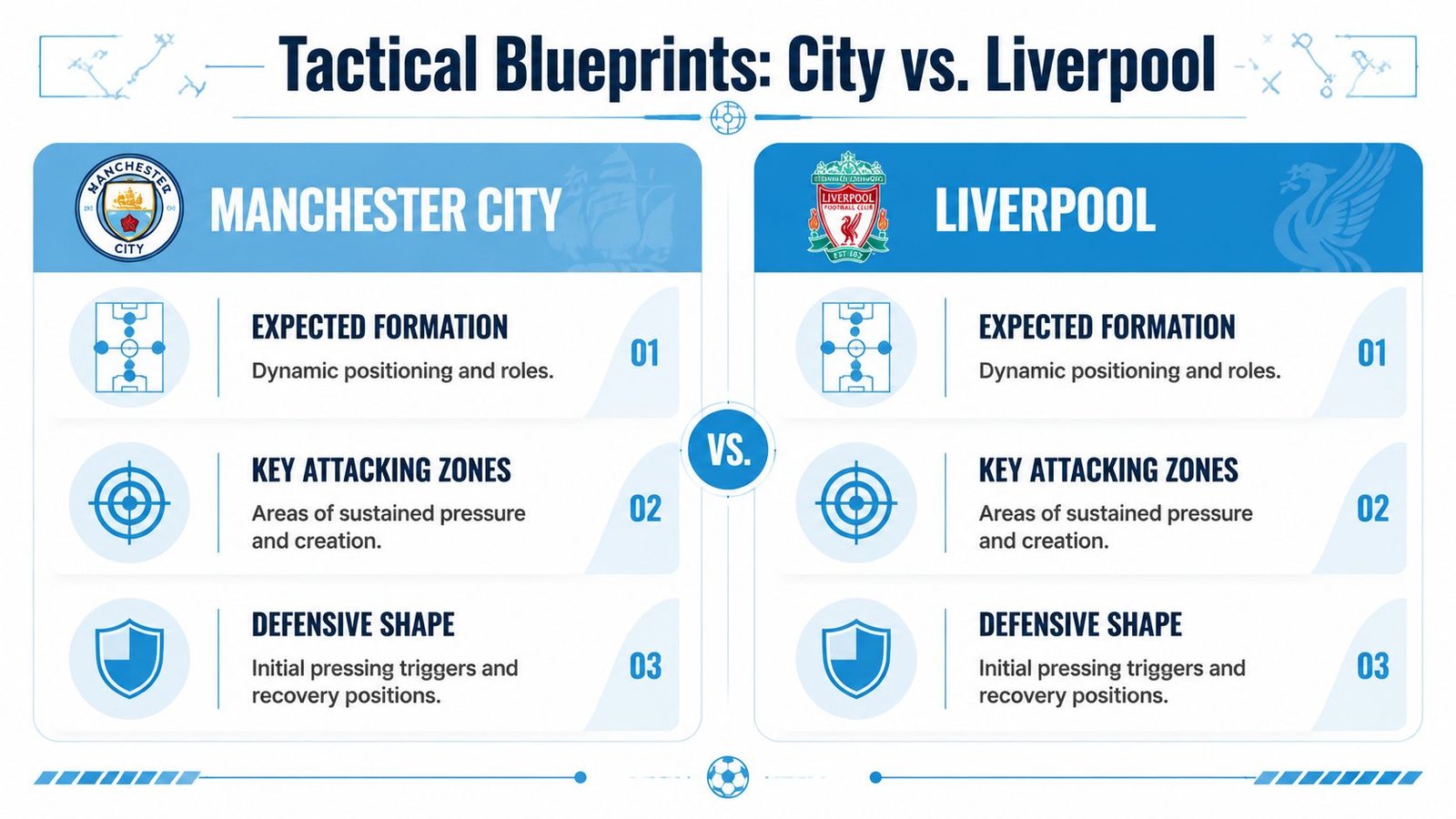
That distinction matters because the rivalry has shifted. Earlier versions of this fixture were framed as control against chaos. The current version is closer to a contest over which side can create cleaner conditions for its preferred rhythm.
City now build with more attention to spacing around the ball than to the visual neatness of the nominal formation. The aim is to keep short support available in the inside channels, draw one presser out of line, and then attack the space opened by that movement. That wider pattern also fits Guardiola’s recent structural tinkering and the trade-off between control and fluency. If City get the distances right, they can progress without exposing the centre on the next turnover.
Liverpool’s adaptation has been different. Rather than pressing every phase with the same aggression that defined the rivalry a few years ago, they are more selective about when to jump and when to hold the midfield line in place. That change is partly a response to City’s use of interior overloads. If Liverpool commit too early, City can find the free player behind the first pressure. If they delay too much, City can settle possession and pin them deeper.
Why The Shapes Matter More Than The Labels
City’s attacking shape is a mechanism for reference-breaking. A narrow interior occupation can drag Liverpool’s midfield and centre-backs toward the ball, but the purpose is not solely to collect central touches. It is to force a defensive choice. Step into the inside lane and leave the outside runner free, or hold width and allow the receiver between the lines to turn.
Liverpool pose a different structural problem. Their front line can threaten depth, but the more important feature is the link player operating behind the striker. That role changes the sequence of the attack. Instead of progressing wide and crossing early, Liverpool can connect the first vertical pass to the next action inside, which gives their wide forwards a better platform to attack a moving back line rather than a set defence.
One detail often decides whether that plan works. The receiving angles around the half-space.
If City’s interior players receive on the half-turn with close support, they can keep Liverpool’s midfield chasing the second action. If Liverpool find their connector in that same corridor with runners already moving beyond him, City are forced to collapse centrally and leave the far side exposed. The rivalry has evolved in that exact zone. Both teams still want territory and pressure after loss, but each now uses different structures to get there and to survive the moment possession breaks.
ANALYZING THE BUILDUP AND POSSESSION PHASES
Across the last few meetings, possession has mattered less as a volume metric than as a structural test. The side that gets its first progression into midfield with support underneath the ball usually gets the game state it wants: either sustained pressure against a retreating back line or direct access into an unsettled defensive unit.
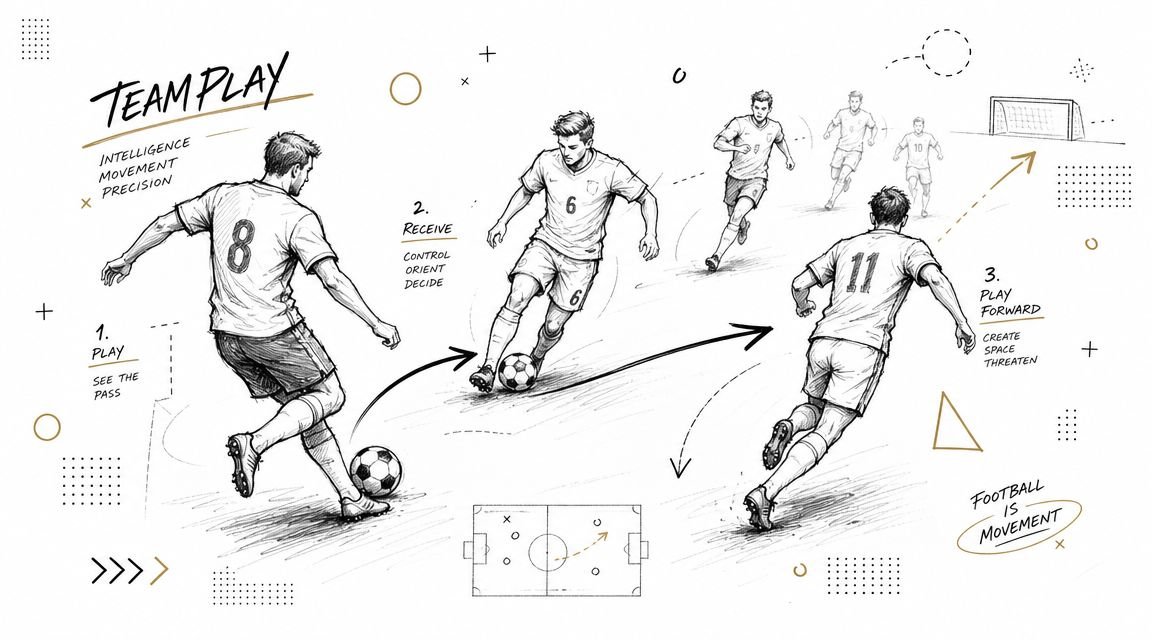
City’s Controlled Access Into Advanced Zones
City have adjusted their buildup in this rivalry to solve a specific problem. Liverpool used to press City’s first line with enough speed to make wide circulation feel safe but sterile. The response has been a more interior-first attacking shape, with the front line narrowing early, central midfielders positioned to receive between Liverpool’s midfield and defence, and width arriving later.
That change is about reference manipulation. A narrow front three forces Liverpool’s centre-backs and midfielders to defend smaller distances in more crowded lanes. If a centre-back steps in, the outside channel opens for the delayed wide runner. If Liverpool hold the line, City can feed the inside receiver on the half-turn and attack the gap before the full-back can recover outward.
The important detail is the order of actions. City no longer want width as the starting picture. They want central occupation first, then width as the release. That sequence pins Liverpool’s full-backs narrower and makes the next pass longer to defend.
A related midfield issue sits underneath all of this. City’s problems without Rodri in the first phase of possession show why the first central connection matters so much. If the six cannot secure the first pass under pressure, the narrow structure never gets set, the full-backs cannot advance on time, and the rest-defence line is exposed to Liverpool’s first transition ball.
What City Usually Need From The First Two Passes
- A secure first outlet: The first receiver must stay open on a different line from Liverpool’s front press and play forward without forcing the tempo.
- A midfield jump from Liverpool: Drawing one midfielder toward the ball creates the interior passing lane City want.
- A late width trigger: The wide player or full-back arrives once Liverpool have already compressed centrally.
- Rest-defence balance behind the ball: City need enough cover and counter-press access to stop Liverpool attacking the space left by the buildup shape.
Liverpool’s More Vertical Route Into Possession
Liverpool have also changed. Earlier versions of this fixture often featured direct attacks from regains and immediate wide releases. The current version is more selective. Liverpool can still go forward quickly, but the buildup now places more emphasis on creating a turning reception in the inside channel before the decisive pass.
That subtle shift matters against City because City defend territory through occupation. If Liverpool play around the outside too early, City’s block can shuffle across and defend the touchline. If Liverpool find the connector between the lines first, City’s defenders have to collapse inward, and the far-side lane opens a beat later.
Salah’s positioning is usually central to that mechanism. He may start wide, but the danger often comes when his movement inward coincides with a midfielder or advanced midfielder receiving in the half-space. The pass is less spectacular than the run it enables. Once that inside connection is made, Liverpool can attack City’s last line while it is still adjusting its spacing rather than after it has reset.
Two Different Possession Models
| Phase | Manchester City | Liverpool |
|---|---|---|
| Early buildup | Use short spacing to attract pressure and open the middle | Secure the first pass, then search quickly for the turning receiver |
| Progression | Create central overloads first, release width second | Connect inside, then send runners beyond or switch into the weak side |
| Wide use | Width is often the consequence of central compression | Width can be the next action after an inside reception |
The main coaching point is that both teams now build with the other’s pressing habits in mind. City shape possession to distort Liverpool’s man references before releasing wide. Liverpool shape possession to attack the moment City narrow around the ball. That is the structural evolution of the rivalry. The buildup phase is no longer about who keeps it longer. It is about who can force the opponent’s compactness to become a weakness.
DISSECTING THE DEFENSIVE AND PRESSING SYSTEMS
The defensive battle in this fixture is no longer a simple contrast between City control and Liverpool aggression. Both teams still defend proactively, but the core issue is how much collective compression they can sustain after the first press is beaten.
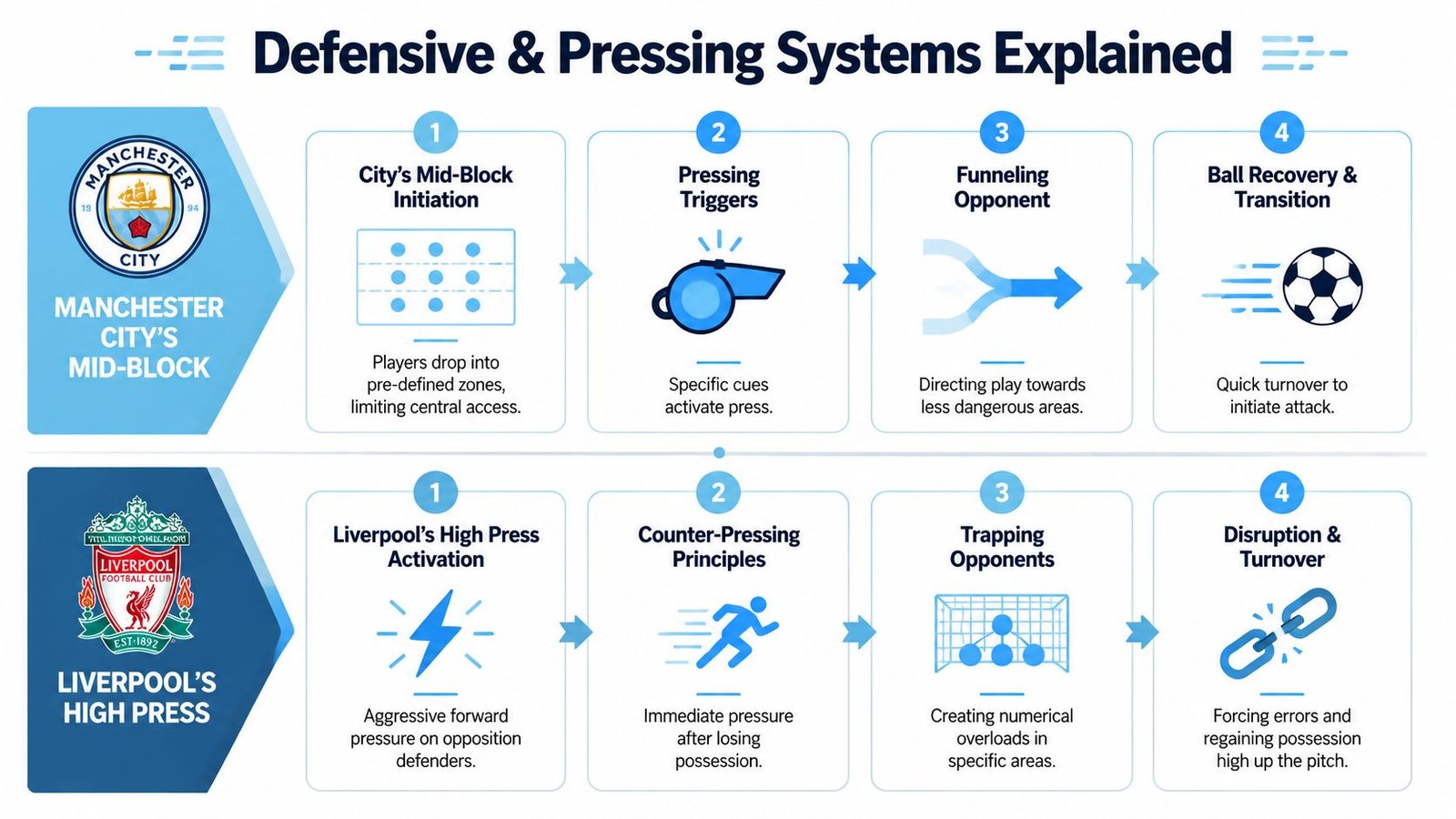
Where Liverpool’s Press Has Changed
One of the clearest indicators in the current rivalry is that Liverpool’s press doesn’t appear to recover the same way it once did. Recent reporting notes that the team is making fewer combined tackles and interceptions than in any of its last seven Premier League seasons, that all six midfielders and forwards from last season’s title-winning group are registering fewer pressures and counter-pressures, and that City ran nine kilometres more than Liverpool in the cited match, according to Sky Sports’ analysis of Liverpool’s physical and intensity issues.
That doesn’t mean Liverpool no longer press. It means the press may be arriving with poorer support distances, weaker second-wave protection, or less synchronized jumping from the midfield line. Those are structural issues before they become emotional ones.
Three consequences follow from that shift:
- The first line can be bypassed more cleanly. If the ball-carrier survives the initial pressure, the next pass often has more room.
- Counter-pressing loses bite. The nearest players may still attack the ball, but the trap behind them isn’t always set.
- Defensive recovery becomes longer. If the press breaks, the back line has to defend space while retreating.
How City Turn Pressure Into Traps
City’s out-of-possession work often looks calmer, but that calm hides intent. Rather than chasing every first pass, City frequently organise the block to reduce central access and wait for a predictable touch or body shape before accelerating. The target is not pressure for its own sake. The target is pressure that arrives after the opponent has fewer exits.
That is why City can appear compact even when they are aggressive. The midfield and back line are positioned to contest the next ball, not just the first one. Against Liverpool, that matters because so much of Liverpool’s danger comes from the immediate pass after regaining possession.
Coaching takeaway: The best press in this fixture isn’t the highest one. It’s the press that leaves the fewest emergency defending actions if the opponent escapes.
City’s narrower attacking occupation also supports this. If possession is lost with players already closer to the centre, the team can close interior lanes quickly and force play wide. Liverpool’s challenge is the opposite. Their best pressing moments still come when they create local overloads around the ball, but those moments are more fragile if the initial jump lacks collective timing.
The tactical evolution is clear. Earlier versions of this matchup often hinged on whether Liverpool could make the game unstable. Now they also have to stop City from using that instability against them.
IDENTIFYING THE PIVOTAL INDIVIDUAL MATCHUPS
Over the last few seasons, this fixture has become less about isolated one-versus-one superiority and more about which player can disrupt the opponent’s spacing first. The individual battle matters because it sits inside a larger structural problem. If one defender is forced to leave the line, track deeper, or narrow too early, the whole block changes shape.
The Central Striker Against The Last Line
The centre-forward’s first job in this matchup is to manage Liverpool’s defensive depth. Earlier versions of the rivalry often gave Liverpool licence to defend aggressively from the front because the last line trusted itself to hold high and squeeze the pitch. City’s adjustment has been to use the striker less as a fixed finisher and more as a reference point who threatens the space behind, pins a centre-back, and prevents easy compression.
That changes the picture for Liverpool’s midfield. If the centre-backs cannot step up on time, the midfield line loses the short distances it needs to jump onto City’s interior receivers. The result is not only more room between the lines. It is a slower defensive chain reaction.
The Between-Line Receiver In The Right Half-Space
A second matchup sits around the player receiving just beyond Liverpool’s first midfield screen, often in the half-space rather than in a classic number 10 zone. This is one of the clearest signs of the rivalry’s tactical evolution. City have increasingly looked to provoke Liverpool inward, then find a receiver on the blind side of the nearest midfielder, where the next action can attack either the centre-back’s front shoulder or the full-back’s inside channel.
If that receiver turns, Liverpool’s back line has to solve two problems at once. One defender must engage the ball. Another must protect the run beyond. That split-second hesitation is usually enough for City to create the next pass, not always the final one, but the pass that forces the defence to lose its compactness.
The value of that area becomes even clearer when City pair it with their set-piece and aerial advantages in key match phases. Repeated half-space entries do not just create open-play chances. They also produce blocked crosses, rushed clearances, and territorial pressure.
The Wide Runner Attacking The Full-Back Channel
The outside duel is still important, but it tends to be the consequence of central manipulation rather than the starting point. When Liverpool’s back four narrow to protect the interior lane, the far-side full-back is left judging distance, timing, and support while defending a larger corridor.
That is where City’s structural changes have been sharpest against Liverpool. Instead of relying on early, obvious width, they often delay the wide run until Liverpool’s line has already shifted inside. The runner then attacks a defender who is half-turned and protecting two spaces at once.
For a coaching staff, these matchups are best read by function:
- The central striker sets Liverpool’s line height.
- The half-space receiver tests the connection between midfield and defence.
- The wide runner attacks the moment that connection breaks.
The important point is the sequence. City are not just trying to win more duels. They are trying to stage-manage where the duel happens, which defender is isolated, and how much cover remains once the first movement is followed. That is the deeper change in this rivalry. The contest has shifted from direct confrontation to structural dislocation.
THE CRITICAL ROLE OF TRANSITIONS AND SET PIECES
Across this fixture’s recent high-level meetings, the result has often swung less on settled possession volume than on how each side manages the next five seconds after possession changes. That trend reflects the rivalry’s structural evolution. Earlier versions were driven by full-throttle pressing exchanges. The newer version is more selective. Both teams now build with greater attention to rest defence, counter-press coverage, and the protection of the central lane, because each has learned how severely the other can punish one loose spacing error.
Transitions matter here because the pressing structures are designed to force play into narrow zones, then attack the loose touch or second ball. If City commit numbers ahead of the ball without pinning Liverpool’s first outlet, Liverpool can release the transition through the inside-left channel before City’s back line is set. If Liverpool’s press jumps too early and the midfield line cannot compress behind it, City can carry through the first pressure and attack a retreating defence with runners arriving on different heights.
The pattern is repeatable:
- Turnovers near the touchline often favour the pressing team, because the boundary helps close the angle of escape.
- Central recoveries are more dangerous for the team that wins them, because the first forward pass can access both half-spaces.
- Second balls after direct clearances frequently decide territory, which then affects set-piece volume and defensive fatigue.
That last point is usually underrated. In this rivalry, transitions and set pieces are linked rather than separate phases. A broken attack becomes a recovery run. A recovery run becomes a rushed clearance. A rushed clearance becomes a corner, a wide free kick, or another entry against a disorganized line.
Set pieces then act as scoreboard multipliers. They reduce the value of long spells of territorial control and place the emphasis on blocking assignments, starting positions, and the timing of first contact. City have adjusted over time by treating these moments as an extension of their territorial game rather than a pause from it. Sustained pressure against Liverpool’s last line increases the number of restarts taken against a defence that has just had to sprint toward its own goal. That physical context changes duel quality.
A related tactical breakdown appears in this analysis of City’s aerial dominance on set pieces. The broader coaching point is clear. The team that controls post-turnover spacing usually controls the next restart as well.
For staff reviewing this matchup, the question extends beyond who transitions faster. The better question is which side has arranged the pitch so that its transitions start with support, while the opponent’s start with exposure. In a game of narrow margins, that distinction often decides both the cleaner chance and the easier set-piece delivery.
CONCLUSION
The most useful conclusion from this rivalry is that its evolution has been structural, not merely cyclical. Liverpool still hold the historical advantage, but the modern version of the matchup has changed because City have become better at attacking the exact spaces Liverpool once protected through pressure and compression. The rivalry no longer turns only on intensity. It turns on spacing, support distance, and the quality of occupation between the lines.
For coaches, three takeaways stand out.
First, buildup has to be designed for the opponent’s press shape, not just for ball retention. City’s narrower occupation and late width are effective because they distort Liverpool’s reference points before the decisive pass.
Second, pressing quality depends on the structure behind the press. Liverpool’s issue isn’t usefully described as a lack of fight. The more revealing problem is whether the second wave and recovery line remain close enough to protect the first jump.
Third, the biggest scoreline swings often come from moments that look least controllable. Transitions, second balls, and set pieces don’t sit outside the tactical plan. In this fixture, they are where the tactical plan is either validated or exposed.
That is why a serious manchester city vs liverpool analysis can’t stop at formations or star names. The strategic edge comes from understanding how one team’s adjustment changes the next action for every player around the ball. When these sides meet, the outcome usually belongs to the team that makes the opponent defend unfamiliar pictures.
For readers who want more of this level of tactical detail, Manchester City Analysis offers in-depth breakdowns of City’s structure, match plans, and strategic trends across major fixtures.