
On the touchline at an elite match, the modern coach rarely works from instinct alone. One glance now moves from the pitch to a tablet, from a player's body shape to a live clip, from a passing lane to a data pattern that had already been flagged before kickoff.
That shift explains why technologies in football now matter far beyond televised debates about officiating. The heart of the revolution sits inside training design, match preparation, recruitment, recovery, and the constant effort to turn information into a repeatable competitive edge.
Table of Contents
- INTRODUCTION
- THE MODERN FOOTBALL TECHNOLOGY STACK
- FROM DATA POINTS TO DECISIONS WITH PLAYER TRACKING
- HOW TECHNOLOGY SHAPES MODERN TACTICS
- THE MANCHESTER CITY CASE STUDY A DATA-DRIVEN DYNASTY
- IMPLEMENTATION CONSIDERATIONS FOR COACHES AND ANALYSTS
- CONCLUSION THE NEXT FRONTIER IN FOOTBALL TECHNOLOGY
INTRODUCTION
Elite football used to depend heavily on memory, handwritten notes, and a coach's eye for detail. Those elements still matter, but they no longer operate alone. In top environments, technology has become part of the coaching process itself.
The easiest mistake is to reduce the topic to VAR. Officiating technology is visible, so it dominates public conversation. Inside clubs, though, the most important technologies in football are often the least glamorous: tracking systems, video platforms, workload monitoring tools, shared databases, and decision-support workflows that help staff act faster and with more consistency.
A useful benchmark comes from another football code. In 2014, the NFL introduced Surface tablets and the Sideline Viewing System for faster in-game coaching decisions, while also allowing RFID transmitters in each player's shoulder pads to collect real-time position, speed, and distance data during games, as outlined by the NFL's technology and the game overview. That mattered not only because of the hardware, but because it showed what happens when a sport operationalizes data for live decision-making rather than treating technology as a post-match accessory.
Practical rule: Technology changes football only when it shortens the distance between observation and action.
That is the prominent story in elite association football. Analysts no longer just review what happened after the fact. They structure training around physical outputs, build opponent models from video and tracking, refine spacing principles, and help coaches judge whether a tactical idea is sustainable over ninety minutes, not just attractive on a tactics board.
Manchester City offers a useful lens for this. The club's football under Pep Guardiola is often described in stylistic terms: control, positional play, circulation, pressure after loss. Yet those ideas become stable only when a club can measure them, monitor them, and repeat them under changing conditions. That is where football technology becomes decisive. It doesn't replace coaching intelligence. It gives coaching intelligence a sharper operating system.
THE MODERN FOOTBALL TECHNOLOGY STACK
The phrase technologies in football can sound too broad to be useful. Inside a club, it helps to think in layers. Each layer solves a different problem, and the strongest clubs connect them rather than treating them as separate departments.
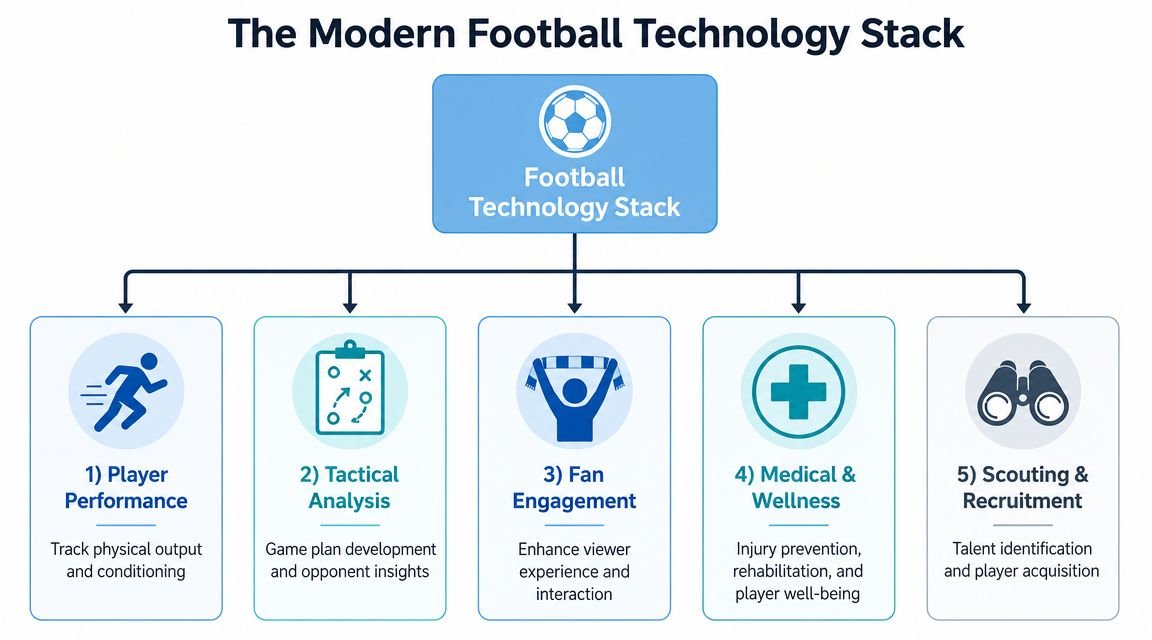
A performance analyst usually sees five core categories: player performance, tactical analysis, fan-facing systems, medical and wellness tools, and scouting infrastructure. Some are used directly on the training ground. Others sit in back-room workflows. Together, they create the club's operating stack.
THE CORE CATEGORIES
Player performance tools monitor how much work a player is doing and how that work is distributed. Tactical analysis platforms convert footage into searchable clips and structured reports. Medical systems track readiness, rehabilitation, and warning signs that training stress may be getting ahead of recovery. Recruitment databases narrow huge pools of players into realistic targets that fit a team's game model.
Fan engagement belongs in the same stack even if it sits outside technical staff workflows. Broadcast enhancement, live graphics, and officiating systems shape how the sport is consumed, explained, and judged. They also influence the pressure around coaching decisions because every call can now be replayed, slowed down, and framed as evidence.
The point isn't that every category has equal tactical value. It's that modern football operations depend on shared information. A winger's sprint profile, a clip of weak-side rotations, a rehab update, and a recruitment short list all become more useful when the club can connect them.
| Technology Category | Primary Function | Example Application |
|---|---|---|
| Player Performance | Track physical output and conditioning | Monitoring distance, speed zones, and accelerations in training |
| Tactical Analysis | Support game model design and opponent study | Tagging build-up patterns and pressing sequences from video |
| Fan Engagement | Improve viewing and match interpretation | Broadcast overlays and officiating review systems |
| Medical & Wellness | Manage readiness, rehabilitation, and risk | Tracking recovery status alongside training load |
| Scouting & Recruitment | Identify players who fit tactical and physical demands | Filtering targets by role profile and game model fit |
WHAT EACH LAYER ACTUALLY DOES
A common error is to think these tools only collect more information. Strong clubs use them to reduce ambiguity.
- Player tracking systems: They answer whether a role's physical demand matches the player selected for it.
- Video platforms: They answer whether the team is executing a pattern consistently or just occasionally.
- Analytics workflows: They answer which events deserve attention instead of drowning staff in every event.
- Medical systems: They answer whether availability can be protected before a problem becomes visible.
- Recruitment tools: They answer whether a new signing fits the football idea, not just the highlight reel.
The best technology stacks don't produce more reports. They produce fewer arguments about what the team actually saw.
That matters for clubs with a clear positional identity. A side that wants to dominate territory, counterpress aggressively, and maintain narrow distances between units can't rely on generic information. It needs role-specific information. The full-back's movement is judged differently from the holding midfielder's. The same data has to mean different things depending on the tactical task.
WHY THE STACK MATTERS TACTICALLY
The tactical consequence is larger than most fans assume. Once a club builds a connected stack, it stops treating recruitment, training, and matchday as separate activities. They become one loop.
A recruitment team can search for players whose movement tendencies fit the coach's structure. Analysts can verify whether those tendencies appear under pressure in match footage. Performance staff can test whether the physical demands of the role are sustainable. Medical staff can monitor whether the player is coping with the load. That is how elite clubs turn a football philosophy into daily practice.
FROM DATA POINTS TO DECISIONS WITH PLAYER TRACKING
On a touchline, a coach might see a full-back arrive half a second late, or a midfielder leave too much space behind the first press. Across 90 minutes, those small errors decide whether a structure controls the match or starts to fray. Player tracking changed elite analysis because it records those moments continuously rather than leaving them to memory or selective clips.
That matters because football is a game of timing and distance as much as technique. Video shows the action. Tracking adds the positional layer underneath it, showing whether the same movement happened at the right moment, with the right speed, and in relation to the rest of the team.
WHAT THE RAW DATA REPRESENTS
The raw output is only useful if staff connect it to tactical questions.
A centre-back stepping out two metres too late can open the lane the opposition wanted. A winger receiving on the same line as his full-back can kill the inside passing option before the ball even arrives. A holding midfielder can seem available on screen while still being badly placed if the distances around him make the next pass predictable. Tracking helps analysts judge the structure beneath the visible event.
FIFA's overview of electronic performance and tracking systems shows why clubs value these systems so highly. They are designed to measure physical output and positional behaviour at a level that can support coaching, performance, and medical work. The competitive edge comes from combining those readings with the team's game model.
For analysts, a few categories usually carry the most tactical value:
- Distance and speed profiles: Useful only when tied to role demands. A wide player asked to press the full-back and threaten the channel should produce a different running pattern from a central controller.
- Accelerations and decelerations: These often explain why a player looks sharp for an hour and late to every duel after that. Repeated braking and re-acceleration can expose fatigue before total distance does.
- Space occupation: This helps staff test whether the team keeps the intended width, depth, and compactness across different phases.
- Movement lanes and recurring positions: These show whether players are arriving in the zones the coach wants, or drifting into areas that weaken spacing.
The important point is simple. Tracking does not just measure effort. It measures whether effort serves the structure.
HOW CLUBS TURN TRACKING INTO ACTION
Elite clubs use tracking well when the analysis starts with the role, not with the spreadsheet.
A positional side will judge a holding midfielder by his support angles, distances to the centre-backs, and capacity to close central exits after possession loss. The same data collected from a transition-heavy winger would be interpreted very differently. Good analysis begins by defining what the role is supposed to solve inside the system.
From there, the process becomes more practical:
- Set role-specific references. Analysts define what acceptable spacing, repeat sprint capacity, and positional discipline look like for that role.
- Review moments where structure broke down. Tracking helps isolate whether the problem came from one player's timing or from a chain reaction across the unit.
- Compare first-half and late-game behaviour. This often reveals whether the tactical idea remains physically repeatable under fatigue.
- Pair metrics with clips. Coaches and players usually respond faster when the positional pattern and the video evidence appear together.
Manchester City offer a clear example of why this matters. Their control rarely comes from possession alone. It comes from how consistently players occupy the right distances to sustain circulation, stop transitions, and recover the ball quickly after loss. For readers interested in how those team-level patterns show up in practice, Manchester City's 2023-24 data and stats analysis provides a useful reference point.
THE HIDDEN ADVANTAGE OF TRACKING
The deeper shift is not that clubs have more numbers. It is that they can test whether a tactical idea survives real match conditions.
A coach may want aggressive counterpressing, narrow support around the ball, and immediate rest defence behind the attack. Tracking allows staff to check whether those distances hold after repeated sprints, whether the second line still arrives on time in the 75th minute, and whether a player's physical output still matches the tactical demand of the role. That turns abstract ideas into something staff can verify, challenge, and refine.
The best clubs use tracking to reduce guesswork between departments. Tactical analysts, conditioning staff, and coaches can examine the same sequence and ask sharper questions about execution. That is where data stops being descriptive and starts shaping selection, training design, and match strategy.
HOW TECHNOLOGY SHAPES MODERN TACTICS
Tactics used to be discussed as if they lived mainly in a coach's imagination. In reality, modern tactics are shaped by what clubs can observe, clip, compare, and rehearse. Technology hasn't made football less creative. It has made creativity easier to stress-test.
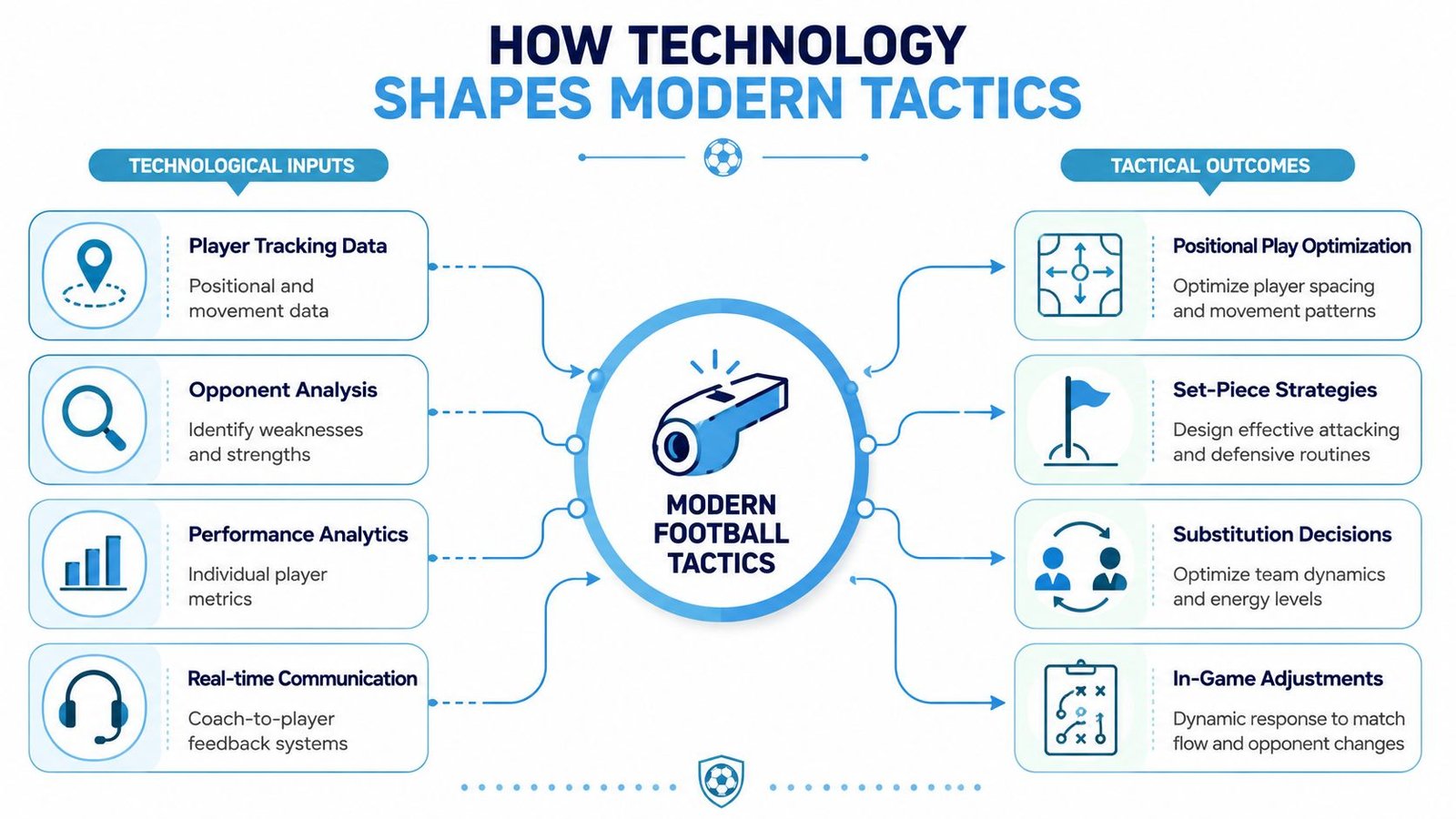
The key shift is this: tactical choices are no longer built only from broad ideas like “press higher” or “stay compact.” Staff can examine whether the front line jumps on the right cue, whether the back line follows quickly enough, and whether the distances between units survive once the opposition changes angle or tempo.
PRESSING BECOMES A MEASURED BEHAVIOUR
One of the clearest tactical consequences appears in pressing. Coaches have always wanted coordinated pressure, but technology lets them define the details more precisely. The analyst can isolate when the press should start, who should jump, and what happens to the supporting line behind the ball.
That changes the conversation after matches. Staff no longer settle for “the press looked disjointed.” They can examine whether the trigger was missed, whether recovery runs arrived late, or whether the opposition manipulated the first line by changing their build-up spacing.
Video platforms are central here because they allow recurring moments to be tagged and grouped. Tracking adds context by showing distances and speed of movement around the event. Together, they answer a tactical question that pure video often cannot: was the problem conceptual, or was the idea correct but executed too slowly?
POSITIONAL PLAY GETS MORE PRECISE
For possession-heavy teams, technology shapes spacing as much as speed. A positional coach wants players to occupy zones that stretch the opponent without disconnecting the team. That sounds simple in theory. In practice, the distances are fragile.
A wide player standing too high can isolate the full-back behind him. An advanced midfielder drifting too close to the striker can collapse the interior lane. A centre-back carrying too far without support can create a vulnerability in rest defence. These aren't dramatic mistakes, but they can distort an entire possession structure.
Clubs use clip libraries, freeze frames, and positional data to coach those details. If a team repeatedly loses access to a central progression route, the issue might not be technical quality. It might be body orientation, timing of occupation, or poor staggering between lines. For a tactical explanation of how shape and occupation interact in a common structure, this analysis of the 4-2-3-1 formation provides a useful reference point.
Good tactics depend on clean distances. Technology helps staff see when those distances are only almost right.
OPPONENT ANALYSIS CHANGES MATCH PREPARATION
Technology also altered how teams scout opponents. The old model relied heavily on a scout's notes plus edited video. That still has value, but elite clubs now build opposition plans from layered evidence.
A typical report may combine:
- Video clips of repeat patterns: build-up habits, pressing structure, set-piece routines.
- Positional tendencies: where full-backs invert, where midfielders receive, where the back line leaves space.
- Physical clues: whether intensity drops in certain phases or whether substitutes are usually needed to preserve pressure.
- Role interactions: which pairings create overloads or expose weak zones.
The tactical consequence is that preparation becomes more selective. The analyst's real job isn't to show everything. It's to isolate the patterns most likely to matter against the team's own game model.
IN-GAME DECISIONS BECOME FASTER
The final tactical change happens during the match itself. Staff can review sequences quickly, compare them with pre-match expectations, and identify whether the opposition has changed shape or assignment. That doesn't mean every elite football bench uses technology in the same visible way, but it does mean the modern technical area is increasingly an information hub.
The strongest teams gain an edge not because they have more clips. They gain it because they know which clips deserve intervention and which should be ignored.
THE MANCHESTER CITY CASE STUDY A DATA-DRIVEN DYNASTY
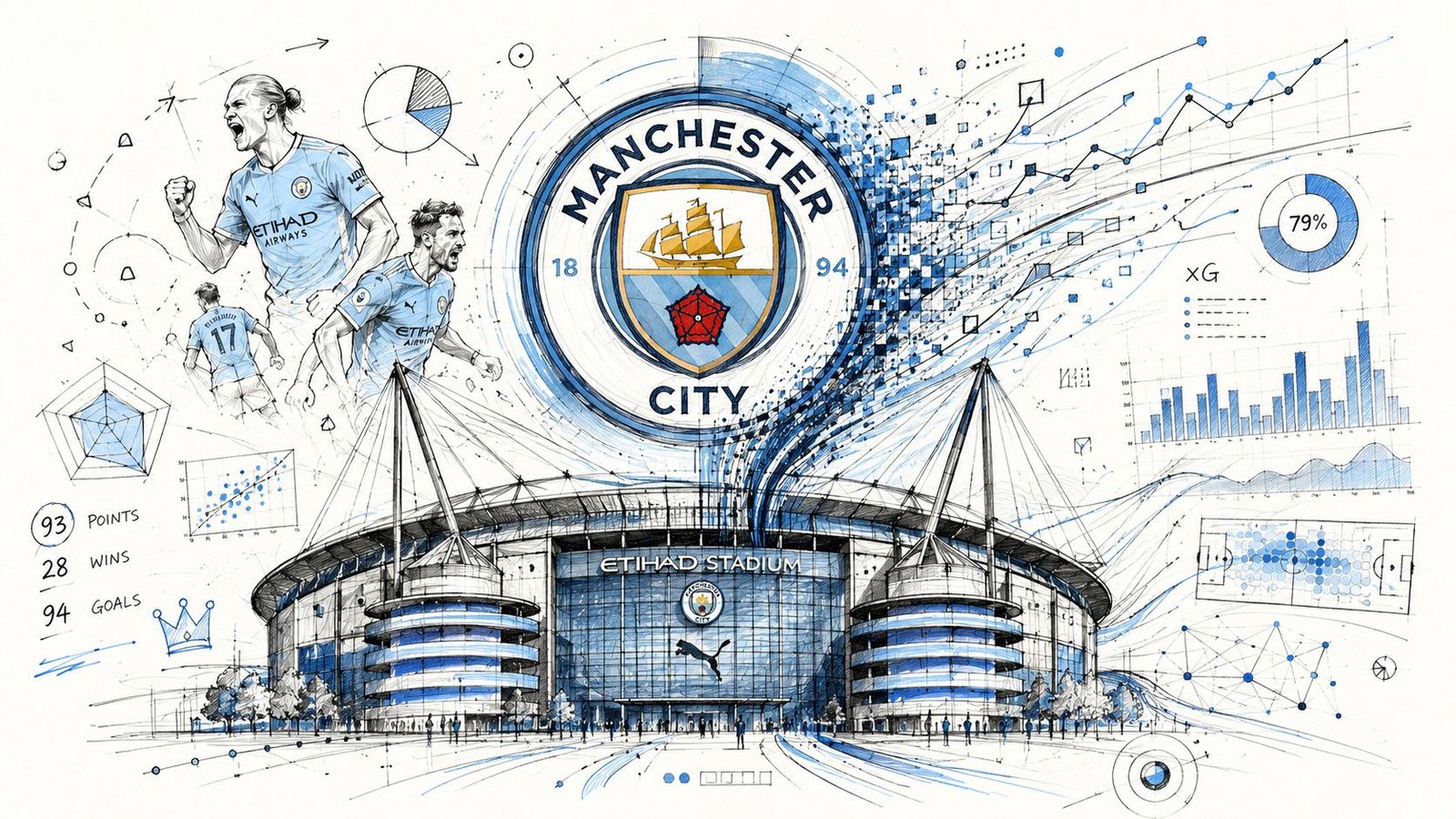
At Manchester City, a five-metre gap is not a small error. It can break rest defence, delay the counterpress, and turn a controlled attack into an open transition. That is why City make a useful case study for football technology. Their margin for tactical error is narrow, so the value of analysis is easier to see.
Manchester City's dominance under Guardiola is often described in stylistic terms: positional play, patient circulation, central overloads, and immediate pressure after losing the ball. The deeper point is operational. Those behaviours depend on repeated, measurable actions across training, selection, and recruitment. Technology matters here because it helps staff preserve the conditions that make the game model work.
TRAINING LOAD AND TACTICAL IDENTITY
City's style asks for precision under fatigue. Full-backs may invert into midfield, the front line must react instantly to possession loss, and the players behind the ball have to hold stable spacing while attacks develop. If the physical output drops even slightly, the tactical structure usually suffers first in transition moments.
That makes workload monitoring part of tactical maintenance, not just injury prevention. Analysts and performance staff track whether players can still repeat the short accelerations, recovery runs, and orientation changes the system requires. Coaches then adjust session design or individual minutes to protect the behaviours they care about most. In elite football, freshness is not a medical detail. It is part of the tactical plan.
The same logic appears in match rhythm. A side built on territorial control needs players who can keep circulating the ball with concentration late in games, then attack the ball immediately after a turnover. Availability is a tactical resource.
RECRUITMENT FOR ROLE FIT
City's recruitment has looked coherent for years because the club tends to sign for function before reputation. That is a harder task than finding good players. It means defining the job in tactical terms, then filtering for players whose habits match it.
A City centre-back is not only asked to defend. He may need to hold a high line, defend large spaces, progress possession without forcing the structure to bend, and stay composed when the press tries to lock one side of the pitch. A midfielder may need to receive under pressure, release the ball at the right tempo, and still arrive in the correct zone when possession is lost. Those are role-specific demands, and technology helps staff compare them across leagues and contexts before video review narrows the picture further.
For readers interested in how those role definitions connect to squad building, this look at Guardiola's winning philosophy and elite squad shows how individual profiles support the wider model.
The tactical consequence is easy to miss. Good recruitment reduces the number of compensations a coach has to make. If players fit the role, the team can keep its spacing, timing, and pressing references. If they do not, the structure starts bending around individual limitations.
WHY CITY IS THE RIGHT EXAMPLE
City show that the advantage lies not in collecting more information. It is connecting information to repeatable football decisions. The club's analysis function has a clear reference point: preserve positional superiority, control transitions, and keep the same principles visible from recruitment to matchday.
That alignment matters because elite clubs often have the opposite problem. They own strong tools but weak translation. Video sits in one workflow, physical data in another, and scouting notes somewhere else. The football idea gets lost between departments. The broader software problem is similar to what teams building products face in practical data design for shipping AI. Data only helps when the structure around it makes decisions faster and cleaner.
City's lesson is straightforward. Technology changes football most when it is tied to a specific tactical identity. At that point, analysis stops being a support function in the background and becomes part of how on-pitch dominance is produced.
IMPLEMENTATION CONSIDERATIONS FOR COACHES AND ANALYSTS
Technology doesn't fail in football because the tools are weak. It usually fails because the club hasn't decided what problem the tool is supposed to solve.
A coaching staff should start with a football question, not a shopping list. Does the team need clearer load management, better opponent prep, faster post-match review, or stronger recruitment filtering? Without that clarity, even expensive systems become background noise.
START WITH THE DECISION, NOT THE DEVICE
Good implementation begins by identifying the decision that needs support.
- Training decisions: Which sessions create the right physical stress without compromising weekend freshness?
- Tactical decisions: Which recurring patterns deserve intervention and which are just variance?
- Squad decisions: Which roles are undersupplied, and what movement profile fits them?
- Communication decisions: How will staff turn dense data into language players can use immediately?
Many clubs struggle because they buy multiple systems that each produce valid information, but the data never meets in one practical workflow.
INTEGRATION MATTERS MORE THAN VOLUME
The hidden challenge is integration. Video may sit in one platform, tracking in another, wellness data in a third, and scouting reports in a fourth. If the analyst has to manually stitch everything together, speed disappears.
That isn't unique to football. The broader software lesson is that systems work only when the data model is designed around the end decision. A useful reference from outside sport is Zephony's piece on practical data design for shipping AI, which explains why structured inputs and clear operational flows matter before advanced tools can produce reliable outputs. The same principle applies inside a football department. A messy pipeline creates slow, inconsistent coaching.
The most expensive mistake is collecting data that no one can translate into a training adjustment.
AVOID PARALYSIS BY ANALYSIS
Coaches and analysts also need restraint. More dashboards do not automatically create better decisions.
A practical implementation model usually includes:
- A small set of agreed metrics linked to the game model.
- A reporting rhythm that matches coaching timelines.
- Visual feedback that connects every key number to a clip or tactical moment.
- Staff roles that define who interprets what.
Specialist editorial and tactical platforms can also help as one input among many. Manchester City Analysis publishes tactical breakdowns and opinion that can support discussion around structures, roles, and match patterns, especially for readers who want football interpretation rather than raw software output.
The best departments stay disciplined. They know that technology is there to sharpen judgement, not bury it.
CONCLUSION THE NEXT FRONTIER IN FOOTBALL TECHNOLOGY
Elite football has already crossed the line where technology is optional only in theory. In practice, the modern club depends on it. Training load, match preparation, tactical correction, recruitment fit, and recovery planning now sit inside a shared technical environment.
Change isn't just the presence of new tools. It's the way those tools connect different football problems. Tracking data informs sports science. Sports science protects tactical identity. Video sharpens coaching feedback. Recruitment systems search for players who can live inside the same model. The strongest clubs build continuity across all of it.
WHAT COMES NEXT
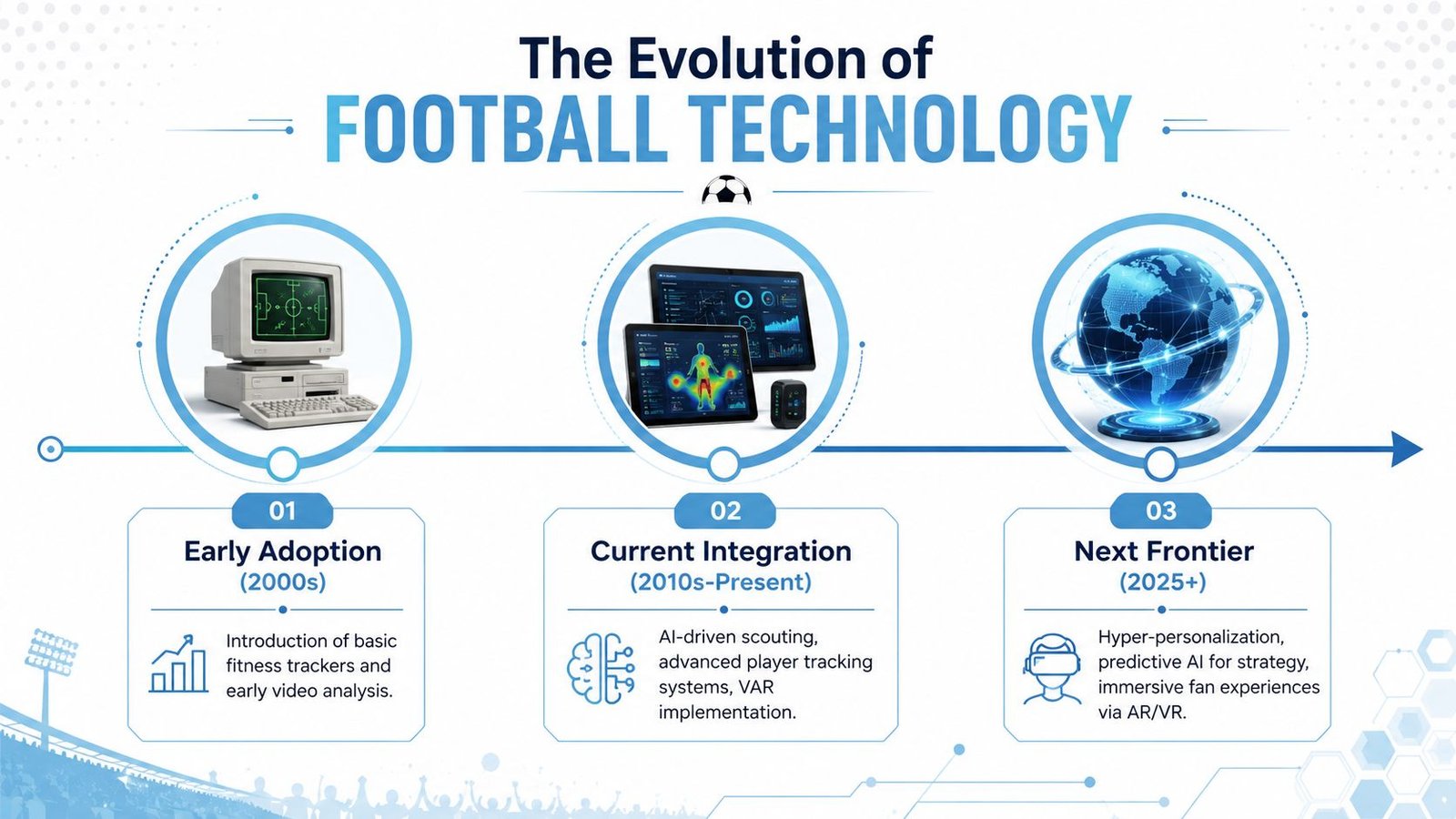
The next frontier will likely be defined by speed and personalization rather than by entirely new categories of hardware. Clubs will keep pushing toward faster tactical review, better role-specific feedback, and more intelligent ways to model match scenarios before they happen.
That future will probably include more simulation, more automated clip generation, and tighter links between physical monitoring and coaching interventions. But the essential principle won't change. Data on its own doesn't win matches. Staff win matches when they interpret the right data at the right moment.
A timeline helps place that trajectory in context.
THE LASTING LESSON
The deepest tactical effect of technologies in football is that they make precision scalable. A coach can define a playing idea. Technology helps a club repeat it across training, across staff meetings, across recruitment cycles, and across the stress of a long season.
That is why Manchester City is such a revealing example. The club's football often looks fluid, but the fluidity rests on structure. And structure becomes more durable when performance analysts, coaches, and sports scientists can see the same game through compatible tools.
Football will stay human. Coaches will still judge context. Players will still solve problems on the pitch. But the elite game now runs on a richer layer of evidence than at any point in its history. The clubs that handle that evidence best won't just collect more information. They'll make better football decisions, faster, and with more consistency.
For readers who want club-specific tactical context alongside broader industry thinking, Manchester City Analysis offers match analysis, opinion, and structural breakdowns that help translate elite football concepts into practical insight.