
You’re probably doing one of two things right now. You’re either trying to work out whether barnet fc academy is a genuine talent source worth tracking, or you’re trying to separate academy marketing language from the details that matter to coaches and scouts.
That distinction matters. In the lower leagues, the headline isn’t usually the best clue. The useful signals sit underneath it: training density, coaching licenses, drill design, positional education, and whether the pathway is visible enough to trust. Barnet is an interesting case because the club appears to offer a structured youth environment with clear developmental intent, yet several of the outcome markers an analyst would normally expect to review remain difficult to verify publicly.
For an elite recruitment department, that creates a familiar tension. The academy may be doing important work in technical and tactical development, but without clearer reporting on progression and broader social impact, the model has to be judged more by its process than by its published output. That doesn’t make the academy insignificant. It makes it a sharper analytical exercise.
Table of Contents
- Introduction A Scout's Perspective on Hidden Value
- Deconstructing the Barnet FC Academy Structure
- Inside the Coaching and Development Model
- The Talent Identification and Recruitment Process
- Mapping the Pathway to Professional Football
- Notable Graduates as Strategic Case Studies
- Conclusion An Analyst's Verdict on the Model
- Frequently Asked Questions
Introduction A Scout's Perspective on Hidden Value
A scout in the National League and League Two space rarely starts with glamour. The job starts with scarcity. Limited public footage, partial academy information, small sample live viewings, and a constant question: is this club building players, or just organising youth football neatly?
Barnet sits directly in that gap. The academy isn’t presented to the analyst as a polished elite machine with a fully published graduate ledger. Instead, it appears as a system with enough visible structure to invite serious attention. That’s often where hidden value lives. Not in the clubs with the loudest pathway claims, but in clubs that teach repeatable habits before the wider market notices.
What a scout notices first
The first useful clue is usually not a name. It’s a pattern. You watch one Barnet youth player receive on the half-turn under pressure, then another who scans well before the ball arrives, then a midfielder who opens passing lanes instead of merely occupying them. Those are not accidental traits if they show up repeatedly across age groups. They usually point back to coaching design.
Practical rule: When several players from the same environment solve pressure in similar ways, assess the academy before you assess the individual.
That’s why Barnet deserves analysis beyond a standard club profile. The interest isn’t only whether a player can help Barnet’s first team. The interest is whether the academy environment produces transferable habits that a higher-level club could inherit and accelerate.
Why Barnet matters to an elite benchmark
For coaches and scouts working with Premier League reference points, lower-league academies become useful when they train modern actions early. That means receiving under pressure, progressing through central congestion, rotating in midfield, and making faster decisions in small spaces. Barnet’s publicly described methods suggest that kind of orientation.
The harder question is output. A structure can be coherent and a methodology can be intelligent, yet the model still needs evidence of conversion into professional careers. That tension runs through any serious assessment of barnet fc academy. The process looks worth studying. The proof remains less visible than it should be.
Deconstructing the Barnet FC Academy Structure
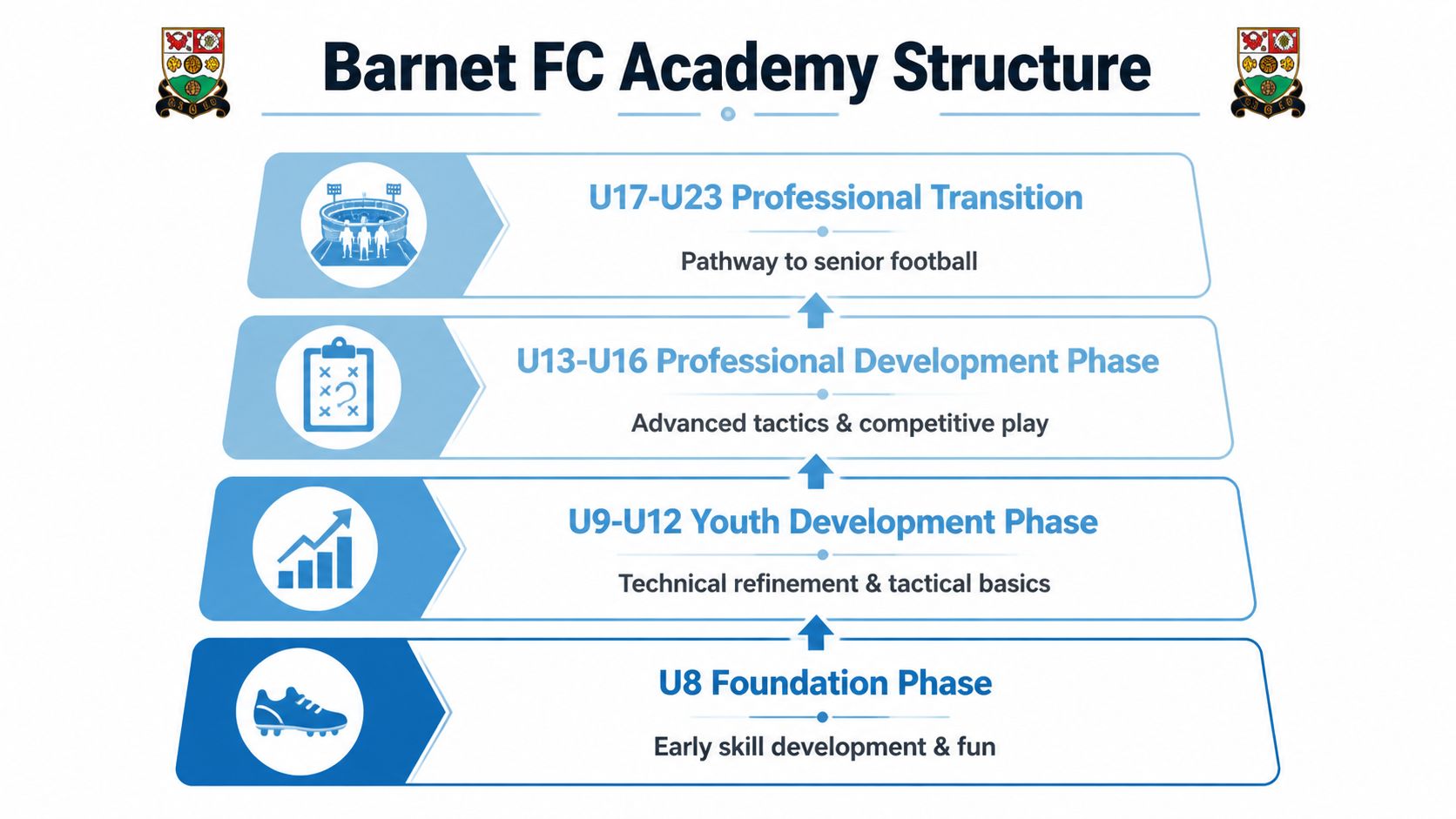
Barnet’s academy is best understood as a progression model, not as one youth squad with add-on teams around it. The pathway begins with early entry at younger ages and extends into an upper-stage development programme aimed at older players approaching senior football. That matters because structure shapes behaviour. A player develops differently in an environment that treats each age band as a connected stage rather than an isolated season.
A layered pathway rather than a single team
At the base, the academy presents a foundation-phase logic. Younger players enter a setting built around early technical familiarity and developmental exposure. That kind of start matters because clubs that want future tactical flexibility have to establish clean first touch, comfort receiving in different body shapes, and basic game understanding before the professional-development years begin.
The broad structure can be read like this:
| Programme/Age Group | Focus | Training Frequency |
|---|---|---|
| U8 Foundation Phase | Early skill development and enjoyment | Not publicly specified |
| U9-U12 Youth Development Phase | Technical refinement and tactical basics | Not publicly specified |
| U13-U16 Professional Development Phase | Advanced tactical learning and competitive development | Not publicly specified |
| U16-U19 Elite Development Programme | Transition toward scholarship and senior standards | Three sessions weekly plus one match |
That upper band is the clearest part of the model. Barnet states that its Elite Development Programme is coached by UEFA A/B License staff and runs on a schedule of three sessions per week plus one match, targeting U16-U19 pathways through a professionalised environment, as described in Barnet’s Elite Development Programme intake information.
What the upper tier tells us
The most revealing feature isn’t only the number of sessions. It’s what that frequency implies. A high-contact week gives coaches more chances to layer tactical ideas, revisit errors quickly, and build habits that can survive match pressure. The same Barnet programme description notes that comparable programmes yield 15-20% higher progression rates to full-time contracts versus low-volume setups, which is a useful benchmark when assessing whether training density is likely to matter in practice.
Parents who want a broader framework for judging football environments, not just chasing badges or club names, may find this parents' guide to elite soccer helpful because it frames what a structured academy experience should actually deliver.
For scouts, the takeaway is simple. Barnet’s structure suggests intention. It doesn’t look like a casual extension of community football. It looks like an academy trying to formalise progression from early age groups into a late-teen transition zone where scholarship, education, and professional standards begin to merge.
Inside the Coaching and Development Model
The most persuasive part of Barnet’s academy profile is its training language. When a club specifies drills rather than hiding behind generic phrases like “technical excellence,” analysts get something real to interrogate.

Barnet’s published technical curriculum includes drills such as “Passing – Playing forwards through tight passing channels” and “Possession (Playing out from the back) – Midfield rotation to receive high and low open up passing channels”, as outlined in the academy breakdown on Player Scout. That same source states that data from similar Category 3 academies indicates this methodology can lead to a 25-30% improvement in pass completion rates.
Why the technical language matters
Those drill titles are valuable because they reveal the intended player profile. Barnet is not merely training boys to complete patterns unopposed. The design points toward three specific competencies:
- Forward passing through congestion: Players must identify narrow windows and execute with control rather than defaulting sideways.
- Rotational support in build-up: Midfielders learn to move in relation to pressure, not just hold a fixed starting point.
- Body shape before contact: Receiving “high and low” to open channels suggests a coaching emphasis on orientation and next action, not just ball retention.
That blend is relevant in any elite context. A midfielder who can shift a marker by rotating to create a passing lane is already closer to senior tactical football than one who only looks technically clean in static drills.
The best youth possession work doesn’t teach players to keep the ball for its own sake. It teaches them how to move defenders, create the next angle, and advance the game.
The Guardiola comparison is about function not branding
Barnet’s methodology invites comparison with positional-play environments because the principles overlap. The link is not cosmetic. It is functional. Rotations to receive, creating central access, and progressing under pressure are all behaviours that matter in elite possession systems.
For readers interested in how those principles scale at the very top, this breakdown of Guardiola's winning philosophy and elite squad structure gives a useful reference point for the tactical demands Barnet’s drills seem to anticipate.
A short look at training footage also helps frame what this type of development can look like in practice.
What coaches and scouts should test for
If I were assessing Barnet players live, I wouldn’t start with highlight actions. I’d track whether the coaching model shows up in repeatable moments:
- Reception under pressure. Does the player prepare early and reduce touches naturally?
- Midfield spacing. Does he rotate to support the ball carrier or wait for service?
- Risk selection. Does he recognise when the forward pass is on, not just when it is safe?
- Exit routes from the back. Does the team open lanes through movement, or rely on individual improvisation?
That’s where barnet fc academy becomes interesting to analysts. The curriculum appears designed to produce football intelligence, not just effort and athletic compliance. If the methodology is coached consistently, the academy should generate players who are easier for higher-level clubs to project into complex structures.
The Talent Identification and Recruitment Process
Recruitment tells you what an academy believes can be developed and what it thinks must already exist. In Barnet’s case, the visible structure suggests a club trying to recruit for coachability and tactical growth, not only for immediate dominance at youth level.
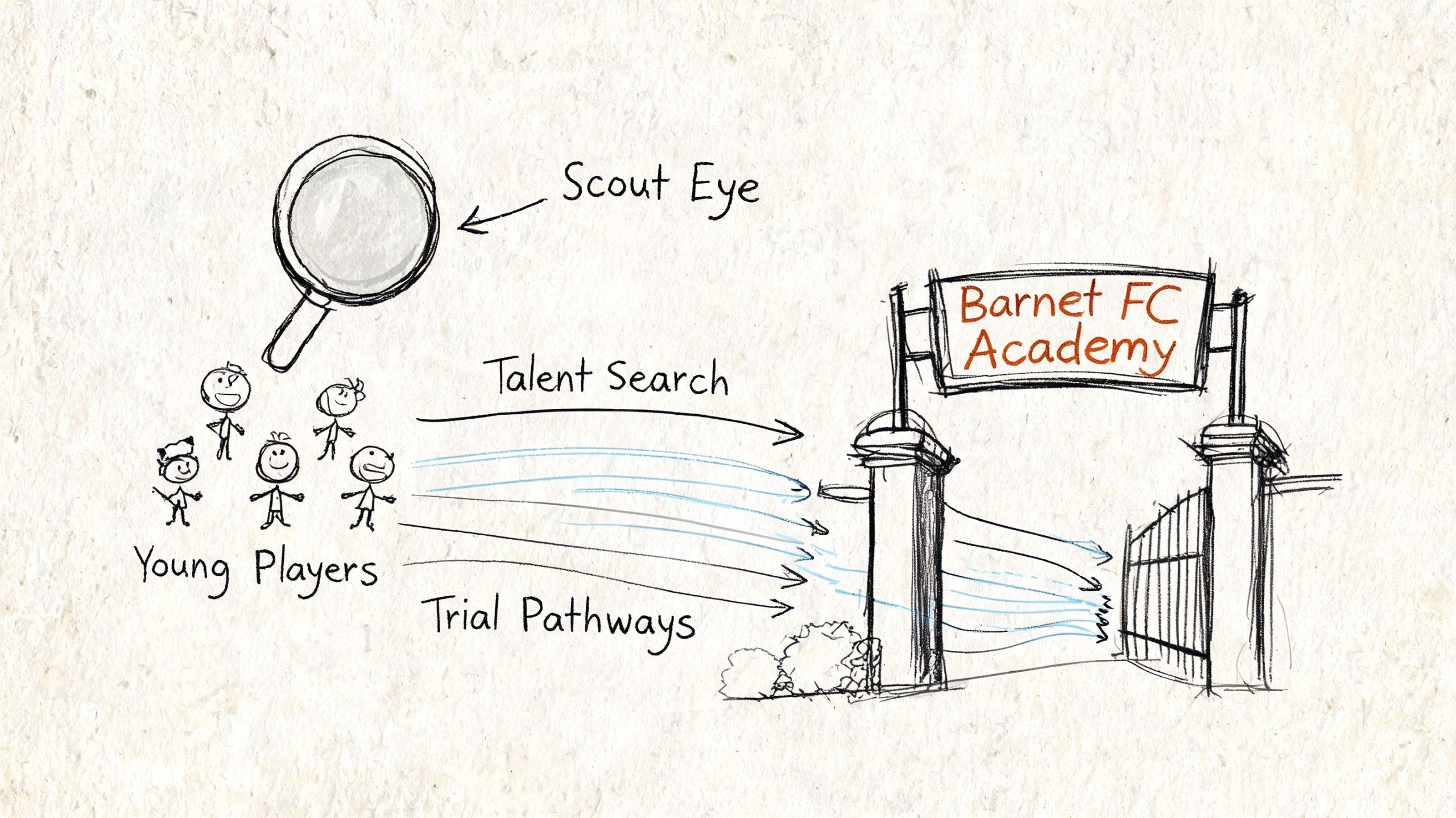
The likely entry points are familiar to anyone who works around academy football: grassroots observation, referrals, development contacts, and formal trial opportunities. But the central analytical question isn’t how a player gets in. It’s what Barnet’s staff appear to value once he’s there.
What recruiters are really screening for
At a club with a technical curriculum like Barnet’s, recruitment should prioritise players who can absorb structured coaching quickly. In practice, that means looking for:
- Clean first actions: The first touch should improve the next picture, not just stop the ball.
- Scanning habits: Players who check shoulders early tend to adapt faster to possession-based coaching.
- Pressure behaviour: Some prospects panic in small spaces. Others reorganise their feet and keep playing.
- Positional responsiveness: The player doesn’t need perfect tactical schooling, but he must react to shape and teammates.
Trial environments often mislead parents and even some coaches. A trial isn’t just a contest to see who scores or wins duels. It’s a compressed screening process for learning speed. The player who understands a new instruction by the second repetition can be more valuable than the player who dominates one chaotic game.
Why intake quality shapes everything after it
Even a strong academy model can’t rescue poor profile fit. If Barnet wants to keep building players for modern football, recruitment has to remain aligned with the academy’s technical language. A direct, transition-only player can still develop there, but only if he shows the adaptability to play through tighter spaces and more connected team structures.
For coaches thinking about the physical side of identification, this is also where performance work becomes relevant. Strength and speed matter, but the better question is how physical outputs support technical execution. That’s why some practitioners will find VBT for clinicians and coaches useful as a reference for linking athletic profiling to football development rather than treating gym work as a separate silo.
Scouts who want a broader framework for player profiling across clubs can compare those intake ideas against wider examples in recruitment analysis. Barnet’s challenge is the same as every ambitious academy outside the top tier: identify players whose ceiling is hidden by context, then place them in a model strong enough to reveal it.
Mapping the Pathway to Professional Football
Every academy sells a pathway. The analyst’s job is to separate an intended pathway from a demonstrated pathway.
Barnet clearly positions its upper-stage development as preparation for scholarship-level and senior-facing progression. That is coherent with the academy structure and with the type of technical curriculum already discussed. The difficulty appears when you try to verify what happens next. Publicly, the academy doesn’t provide the kind of graduate outcome detail that would let scouts measure the pathway with confidence.
A pathway described and a pathway evidenced are different things
That distinction matters more than most academy marketing acknowledges. A player can train in a professional environment, work with licensed coaches, and still enter a bottleneck where the jump to contracts, first-team exposure, or higher-level movement becomes hard to track from the outside.
The strongest single point here is not a positive or negative verdict. It is an information gap. As reported in the Sky Sports feature on Kinetic Academy, Kinetic has documented 62 professionals, while no specific player success metrics are provided on Barnet’s official site, leaving analysts without equivalent evidence of effectiveness in graduate progression. That comparison appears in this Sky Sports report on the south London football academy helping disadvantaged young players.
If an academy wants to be judged as a pathway, it should publish pathway evidence. Squad photos and programme descriptions aren’t enough for serious benchmarking.
What scouts should conclude from incomplete output data
The absence of public progression data doesn’t prove the pathway is weak. It does change the burden of proof. An elite scout now has to rely more heavily on direct observation, informal network intelligence, and live player assessment rather than trusting the academy’s published story.
That shifts how Barnet should be used as a benchmark. Coaches can study the model for its developmental logic. Recruiters can monitor the environment for technically educated prospects. But analysts should resist overclaiming its output until the club or wider reporting makes that output easier to inspect.
A practical scouting response would be:
- Track individuals over time, not just one trial or one match.
- Assess carryover into senior speed, especially first-touch quality and pressure resistance.
- Ask what the pathway produced, not what it intends to produce.
- Treat opacity as neutral information, not automatic failure or hidden success.
That is the fairest reading of barnet fc academy at present. The route toward professional football appears thoughtfully designed. The public evidence for how often that route converts remains limited.
Notable Graduates as Strategic Case Studies
This is the point in most academy articles where a list of success stories appears. With Barnet, that’s exactly where the analysis becomes more revealing, because the public record available here doesn’t support a conventional graduate showcase.
Why the missing case studies matter
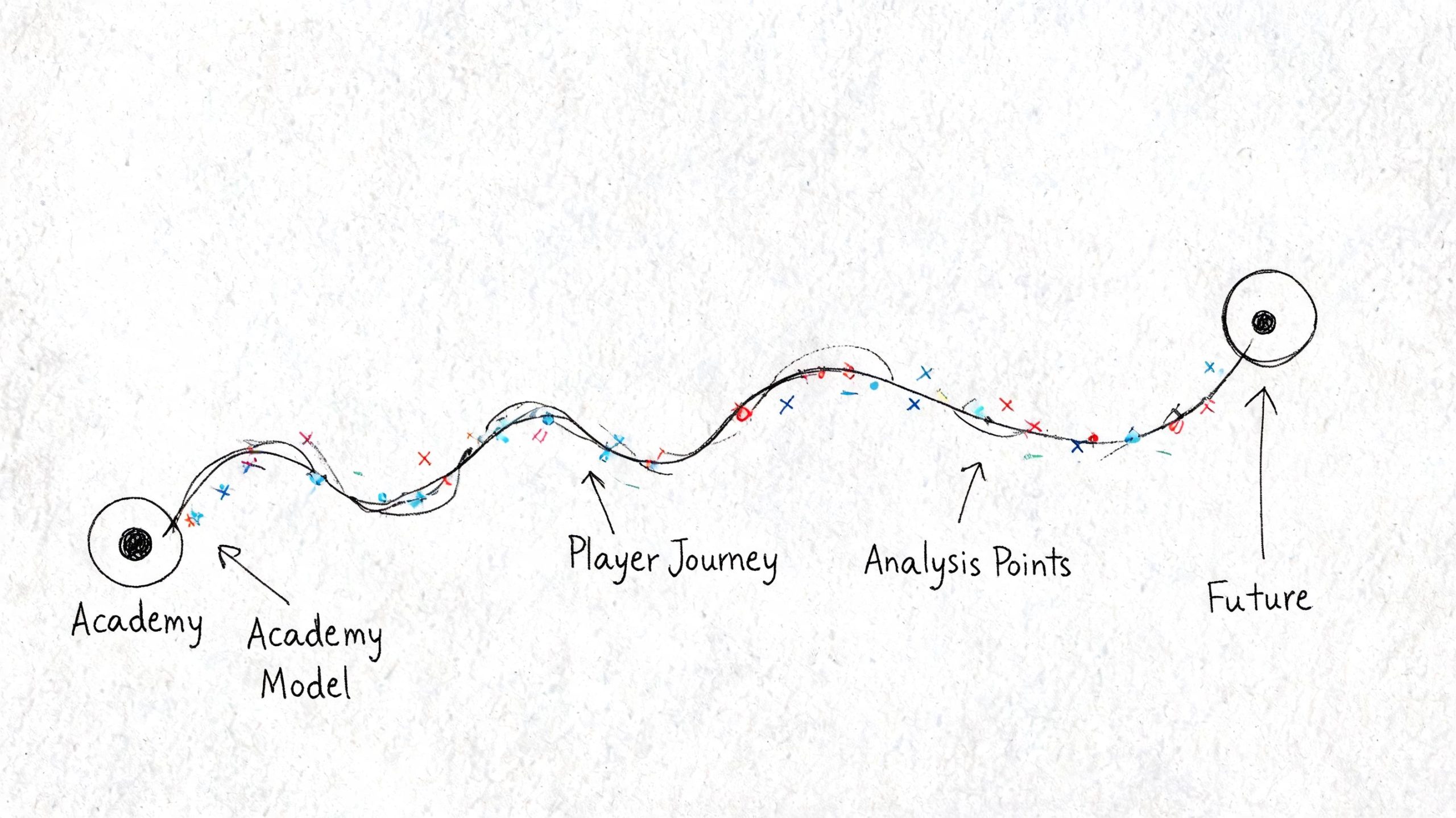
Without a transparent, named set of graduate outcomes attached to the academy’s public profile in the material available here, analysts lose one of the best tools for validating a development model. Individual graduates serve as stress tests for methodology. A midfielder progressing well can support the idea that the academy teaches perception and passing effectively. A full-back struggling to step up physically can expose a missing layer in athletic development. The point isn’t hero worship. It’s model verification.
That’s why Barnet’s lack of clear graduate case studies should not be treated as a trivial communications flaw. It affects how scouts interpret the academy’s claims. If you can’t map the output player by player, you can’t easily identify whether the programme is especially strong in certain positions, game models, or developmental stages.
How to evaluate the academy without a graduate ledger
In the absence of a strong public list, the analyst has to reverse the method. Start from the academy’s visible design, then test whether current players display the qualities that design should produce.
A useful framework would look like this:
| Analytical lens | What to look for in Barnet prospects |
|---|---|
| Technical transfer | Can the player execute cleanly under pressure, not just in controlled phases? |
| Tactical schooling | Does he understand rotation, spacing, and support angles naturally? |
| Development projection | Can his current habits scale upward into faster, more complex football? |
| Senior readiness | Does he show the mentality and physical base to survive the jump? |
This is also where comparisons with elite academy outcomes become instructive. A player like Phil Foden in this scout report is useful not because Barnet should produce the same volume or profile, but because he shows what a fully evidenced pathway looks like when technical education, tactical fit, and senior translation all become visible.
Barnet’s academy can still be respected without a public hall of fame. But until individual outcomes are clearer, every judgement about strengths and weaknesses remains more provisional than it would be at a more transparent club.
Conclusion An Analyst's Verdict on the Model
My verdict on barnet fc academy is cautiously positive. The structure looks credible. The coaching language is specific enough to take seriously. The technical curriculum points toward modern football actions that matter in higher-level environments, especially around passing through pressure, build-up support, and midfield rotation. That alone makes the academy worth watching for scouts who care about hidden technical value.
The hesitation comes from transparency, not from the apparent logic of the model. The pathway is easier to describe than to verify publicly. For an academy to earn full trust as a talent pipeline, it should make progression evidence more accessible. That doesn’t mean publishing hype. It means publishing outcomes clearly enough for coaches, scouts, and families to judge the model on more than intention.
A second caution sits outside pure football output. Questions about inclusivity and access also remain hard to answer from the available public information. The Hive Foundation material highlights community-facing activity, yet the broader concern remains that Barnet’s content lacks diversity data and documented impact for disadvantaged players, which leaves analysts with an incomplete picture of how far the academy contributes beyond elite selection, as reflected in the information available through The Hive Foundation.
That last point matters. A strong academy isn’t only a machine for first-team assets. It is also a local institution. If Barnet can pair its existing structural clarity with better reporting on graduate outcomes and broader inclusion, it would become much easier to rate the academy as both a development model and a strategic talent source. Right now, it looks organised, methodical, and worth scouting. It does not yet look fully evidenced.
Frequently Asked Questions
How can a player join barnet fc academy?
The practical route is usually through trials, scouting, or club-led development intake opportunities. For younger players, that often means entering through foundation or development age groups. For older players, the late-teen programme is the clearest visible route in the public material.
What ages does the academy appear to cover?
The pathway appears to begin from U8 and extend into an older transition stage that includes U16 to U19 players. The broad structure suggests a long-form development pipeline rather than a short-term trial-only setup.
What should players prepare before a trial?
Players should arrive ready to show more than effort. Coaches in this kind of environment are likely to value:
- Decision-making: Can you solve simple football problems quickly?
- First touch: Can you receive cleanly and play the next action?
- Coachability: Do you adapt after feedback?
- Position sense: Do you support teammates with your movement?
Does the academy combine football with education?
The public programme information indicates that the upper-stage development offer includes BTEC Diploma integration alongside football development. That suggests Barnet understands the dual-track reality of youth development, where education and football have to work together rather than compete.
Is Barnet a strong option for scouts to monitor?
Yes, but with a condition. It looks like a useful scouting environment for technically trained players, especially those comfortable in possession-based structures. Scouts should still do their own work on progression history because the public evidence on graduate output is limited.
If you value this kind of evidence-led football writing, Manchester City Analysis is worth bookmarking. It offers tactical breakdowns, recruitment thinking, and clear performance analysis for readers who want more than surface-level football coverage.