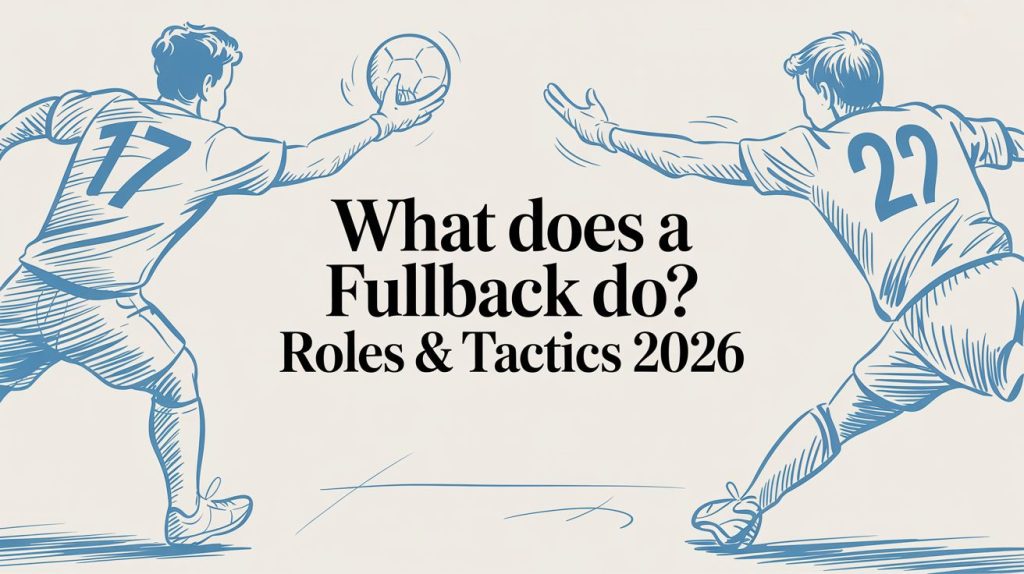
You’re probably here because you watched a modern match, saw the right-back step into midfield, the left-back arrive in the final third, and then heard someone still describe fullbacks as “just defenders.” That description doesn’t survive contact with elite football anymore.
It also doesn’t help that search results for what does a fullback do often drift into American football, where the position means something completely different. In gridiron terms, the fullback is usually a blocker with limited box-score visibility, and in 2025 NFL usage fullback carries accounted for less than 5% of team yards according to this fullback overview on Wikipedia). In association football, the position has moved the other way. It has become more influential, not less.
Manchester City offer the clearest example. A modern soccer fullback can defend wide spaces, help build possession in central zones, and shape the entire attacking structure. That’s why a player like Nathan Aké, who averaged 1.8 tackles and 1.2 dribbles per 90 in the 2025-26 season according to that same fullback overview on Wikipedia, matters far beyond the old image of a touchline defender who stops crosses.
The key shift is tactical. The fullback used to complete the team’s defensive line. Now the fullback often completes the team’s midfield, supports its rest-defense, and activates its width. In some systems, especially under Pep Guardiola, the position functions like a pressure valve and a playmaking hinge at the same time.
That’s why this role is so misunderstood. People still talk about where fullbacks start on the team sheet. However, the question is where they go, when they move, and what their movement changes for everyone around them.
Table of Contents
- Introduction The Most Misunderstood Player on the Pitch
- The Foundational Duties A Fullback's Dual Mandate
- Anatomy of the Modern Fullback Three Key Roles Explained
- The Guardiola Blueprint How Man City Redefined the Position
- The Role in Pressing and Transitions
- Evaluating Fullback Performance Beyond Goals and Assists
- Conclusion The Fullback as a Tactical Chess Piece
Introduction The Most Misunderstood Player on the Pitch
Watch a top-level match with one eye on the ball and one eye on the fullbacks. The game starts to look different.
When the centre-back receives under mild pressure, the fullback might hold width to stretch the press. If the winger stays high, the fullback may underlap into midfield. If the holding midfielder is marked, the fullback can become the spare man. If possession is lost, that same player may be the first shield against the counter. That’s not a side character. That’s a structural player.
The confusion comes from language. “Fullback” means different things across sports, and football discourse still treats the soccer version as if it were a static defensive role. That’s outdated. The position now sits at the junction of three game states: settled buildup, wide defending, and transition control.
Modern fullbacks don’t just occupy a lane. They connect phases of play.
That matters because the position now carries tactical instructions that used to belong to other roles. A fullback may need the scanning habits of a midfielder, the timing of a winger, and the duel discipline of a defender. When coaches trust the role, they don’t just improve one flank. They improve the whole geometry of the team.
Manchester City have pushed this further than almost anyone. Their fullbacks haven’t merely adapted to the modern game. They’ve helped redefine what the position can be.
The Foundational Duties A Fullback's Dual Mandate
A fullback still begins with two core obligations. Defend your side of the pitch. Support your team’s attack. Everything more advanced grows from those two tasks.

Defending the flank without breaking the line
Defensively, the fullback’s job isn’t just “stop the winger.” That’s too narrow. Their broader task is to protect the outside channel while preserving the line behind the ball.
That means judging distance constantly. Step too early and the winger can bounce the ball inside. Stay too deep and you invite progression. Follow a runner too far and you open a gap beside your nearest centre-back. Elite fullback defending is mostly timing, body shape, and awareness of support.
Three baseline duties define the role:
- Control the 1 v 1 duel: The fullback must angle the attacker away from the most dangerous route, usually the inside lane toward goal.
- Track movement behind: Wide forwards and overlapping fullbacks try to create hesitation. The defender has to pass runners on or carry them without tearing the back line apart.
- Provide cover for central defenders: When a centre-back shifts wide, the fullback often tucks in or drops to maintain balance.
If you want to see how those relationships change inside a back four, this 4-2-3-1 shape breakdown is useful because it shows how the fullback’s decisions affect both the winger ahead and the pivot inside.
Attacking by creating width and support
In attack, the traditional fullback gives the team width when inside players narrow. That can be an overlap outside the winger, an underlap into the half-space, or a supporting position that keeps circulation alive.
The broad trend in elite football shows how much more important this attacking side has become. From 2012-13 to 2021-22, the share of fullback touches in the attacking third rose from 22.7% to 26.8%, while their share of team chance creation increased from 15.9% to 20.4%, according to The Analyst’s study of the rise of the full-back. Those numbers matter because they show a role migration, not just a stylistic preference.
Practical rule: If your winger comes inside, the fullback must decide whether to supply width, support under the ball, or attack the space behind. Standing still solves nothing.
A useful way to think about the position is this. The fullback defends space when the team is without the ball and creates space when the team has it. That dual mandate is still the foundation, even in the most complex systems.
Anatomy of the Modern Fullback Three Key Roles Explained
One reason people struggle with the question what does a fullback do is that there isn’t a single modern answer. The job changes with formation, coach, and game model.

Traditional fullback
This player stays closest to the old template. He defends wide, supports circulation from deeper zones, and joins attacks selectively rather than constantly. Coaches often use this profile when they want back-line stability first.
The traditional fullback usually fits teams that defend in a compact block and don’t want both sides flying forward at once. He values secure positioning over adventurous movement. Think less about highlight actions and more about preventing the opponent from finding clean entries down the flank.
Attacking wing-back
The wing-back is almost a different species. In systems with three centre-backs, he can start higher because someone else covers the outer centre-back channel behind him. That freedom turns the role into a full-lane job.
Here, the player has to repeat long sprints, arrive in crossing zones, and still recover quickly enough to defend the far post or back-post runner. If you work with players in this mold, physical preparation matters as much as tactical instruction. A good outside reference for that is this guide to sport performance for athletes, especially for understanding why repeat acceleration, deceleration, and change-of-direction capacity shape the position.
Inverted fullback
This is the role that changed elite football discussion. Instead of advancing outside the winger, the fullback steps inside during possession and acts like an auxiliary midfielder.
The payoff is structural. According to Total Football Analysis on the modern full-back, the inverted full-back creates midfield overloads, and elite examples like João Cancelo in 2021-22 posted passing accuracy above 90% while helping block counter-attacks and producing 2-3 extra ball recoveries per game in central zones. That tells you why coaches love the role. It helps the team attack and defend with the same movement.
A quick comparison makes the differences clearer:
| Archetype | Main position in possession | Primary value | Main risk |
|---|---|---|---|
| Traditional fullback | Wide and deeper | Defensive security | Limited central influence |
| Attacking wing-back | High and wide | Width, crosses, final-third presence | Space left behind |
| Inverted fullback | Narrow and central | Midfield control, rest-defense, circulation | Exposed flank if rotation fails |
The inverted fullback isn’t just moving inside for style. He’s changing the numbers around the ball.
If you want a player example that captures the role’s technical demands, this João Cancelo 2021-22 analysis shows why a fullback with midfield passing habits becomes so valuable in a possession-heavy side.
The Guardiola Blueprint How Man City Redefined the Position
Pep Guardiola didn’t invent the idea that a fullback can do more than defend. He did help turn that idea into a repeatable system principle.
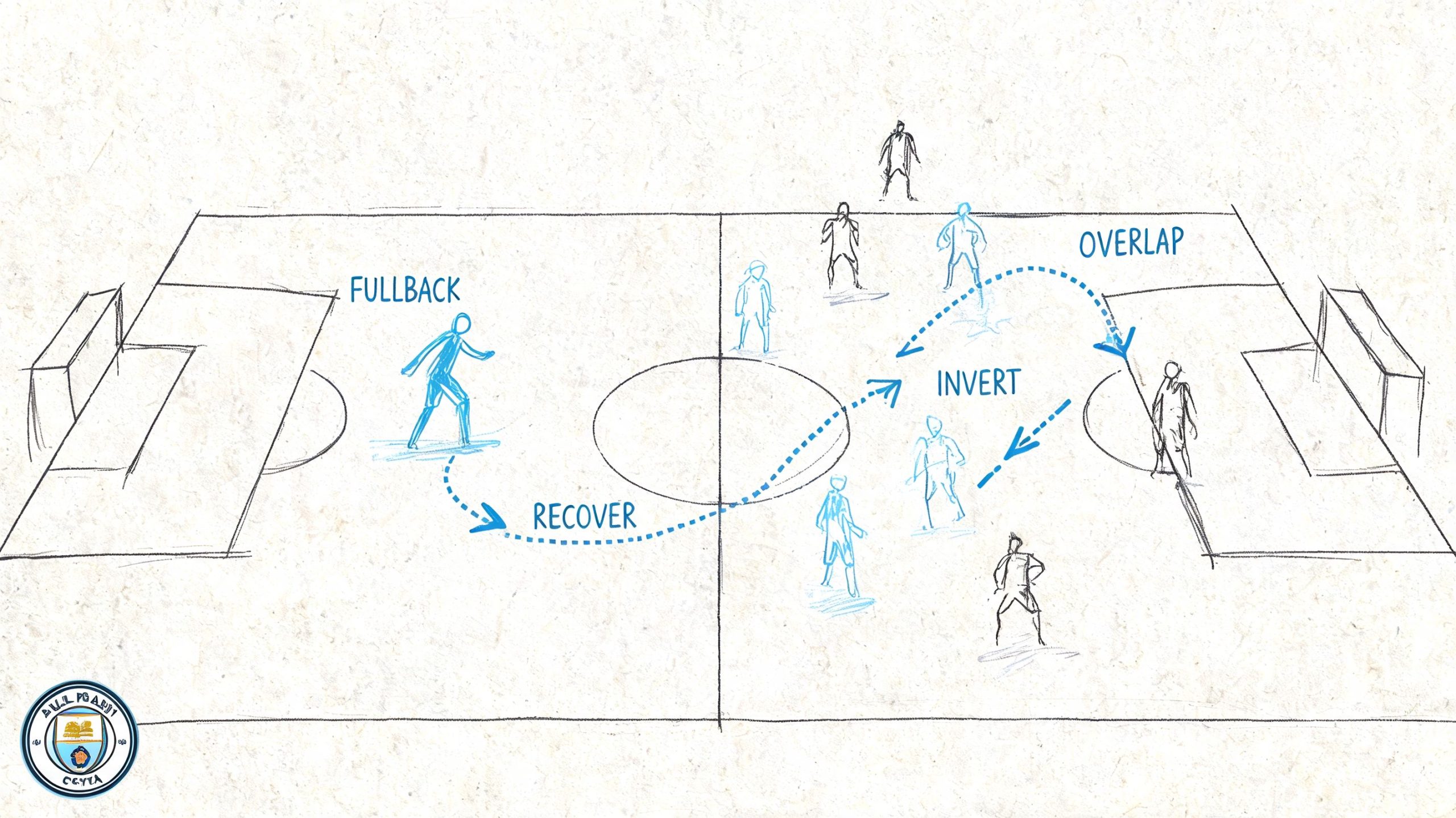
Why Guardiola pulls fullbacks inside
The first reason is numerical superiority. If the opposition presses with a front line that blocks the pivot, the inverted fullback creates another central option. That can turn a difficult first pass into a clean progression.
The second reason is spacing. When City’s wingers stay high and wide, they pin the opposing fullbacks. If City’s fullback also stayed wide underneath them, the same corridor would be crowded. By stepping inside, the fullback opens the flank for the winger and occupies the space the opponent wants to protect in front of midfield.
The third reason is control after loss. Guardiola’s teams prioritize where players stand when possession breaks down. An infield fullback starts closer to the area where counters begin, which means he can press the receiver, block the next pass, or at least slow the break.
What City gain in possession and after loss
The measurable side of this shift is telling. In Guardiola’s system, Kyle Walker in an inverted role recorded 2.1 key passes per 90 and 85% pass accuracy in midfield zones in the 2025-26 season projection cited by Throw Deep Publishing, while City averaged 68% possession in Premier League matches, as noted in this fullback role discussion. Even if you strip away the headline numbers, the tactical relationship is the point: central access from the fullback helps City sustain the ball.
When you watch City closely, the movement often follows a pattern:
- Centre-back receives: The fullback initially holds a position that invites the opponent’s winger to hesitate.
- Pivot gets screened: The fullback slides into the inside channel to offer a safer angle.
- Winger holds width: The opponent’s back line stretches laterally.
- Ball enters midfield: City now attack from a more stable shape, with protection against the immediate counter.
That’s why the fullback has become a system-defining piece. He doesn’t just complete a pass map. He changes what passes are available to everyone else.
A good companion read on the wider consequences of these adjustments is this discussion of Guardiola’s tactical tinkering and its risks. The value of innovation is obvious. So is the danger when rotations lose their timing.
The film below helps show how these movements look at match speed, where the distinction between fullback and midfielder often disappears.
A Guardiola fullback often solves a midfield problem before the midfielder receives the ball.
City’s use of João Cancelo, Kyle Walker, Nathan Aké, and Rico Lewis has demonstrated different versions of the same principle. The position is no longer defined by the touchline. It’s defined by what the team needs in a given phase.
The Role in Pressing and Transitions
Most casual analysis of fullbacks focuses on settled play. Elite coaches care just as much about the unstable moments, especially the second the ball changes hands.
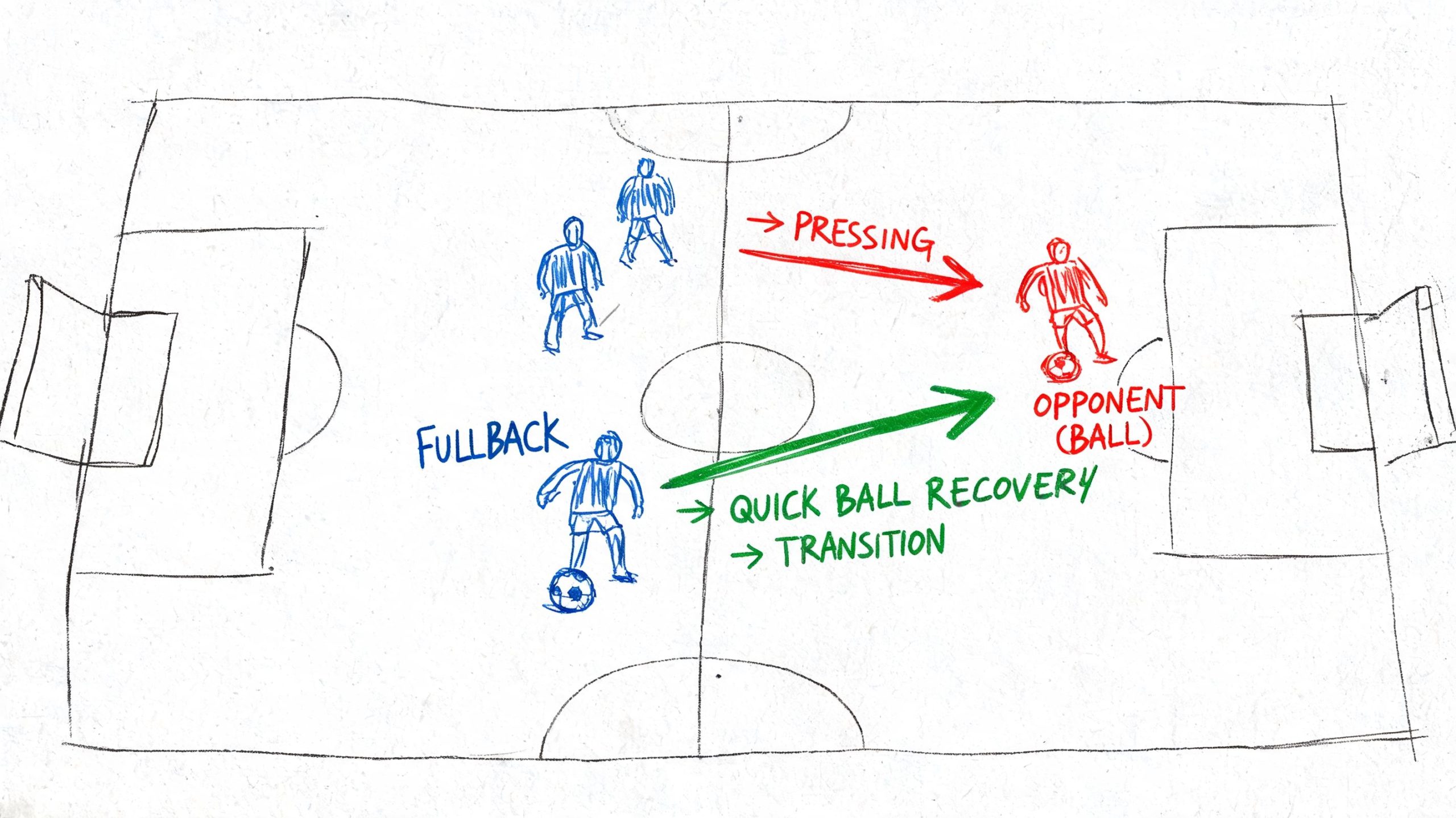
Pressing cues from the fullback zone
A fullback often acts as a pressing trigger because the touchline reduces the opponent’s options. If the ball travels to the opposing wide defender with a poor body angle, your fullback can jump aggressively, knowing the sideline is helping contain the play.
That movement affects the whole team. The near winger can lock the return pass. The nearest central midfielder can jump onto the inside option. The back line can shift across behind the press. The fullback’s decision starts a chain reaction.
Common triggers include:
- A slow pass into the opposition fullback: The receiver is forced to control first, which gives the press time to arrive.
- A backward first touch toward the touchline: That body shape usually limits forward progression.
- An isolated winger ahead of the ball: The defending fullback can step higher because the recovery route behind is shorter and clearer.
The first two seconds after the turnover
Transitions reveal whether a fullback understands the game or only the position. The best players process the turnover before the ball moves.
When their team wins it, they don’t always sprint forward. Sometimes the right action is to stay connected beneath the ball and become the secure outlet. Other times the best option is a first-time run beyond the winger because the opponent’s structure is still disorganized.
When their team loses it, they face a sharper decision. Counter-press or recover. The answer depends on distance to the ball, support behind them, and where the danger sits.
If the fullback is close enough to affect the next touch, press. If he’s late, he should recover and narrow the route to goal.
This is why coaches value fullbacks who scan early. The role demands anticipation more than reaction. A player who reads the likely turnover zone can arrive balanced. A player who watches the pass and then thinks is already behind the play.
Evaluating Fullback Performance Beyond Goals and Assists
If you judge fullbacks only by goals and assists, you’ll miss most of the position.
The cleaner method is to evaluate role execution. Did the player provide the width the structure required? Did he protect central space when the pivot was marked? Did he close the winger’s inside shoulder in defensive duels? Did he arrive on time in support, or just wander into advanced areas without improving the team?
What to watch on tape
Start with body orientation. A fullback who receives side-on can play forward, protect the ball, or bounce it inside. A player who receives square to the touchline often kills the next action. Then watch scanning. Does he check the winger, interior midfielder, and far-side spacing before the pass arrives?
Useful evaluation points include:
- Positioning before the action: Was he in a spot that gave his teammate a clear passing lane?
- Timing of movement: Did he overlap after the winger fixed the defender, or too early when the lane was still closed?
- Defensive footwork: Did he stay balanced in the duel, or open the gate inside?
- Recovery decisions: After loss, did he choose the right response for the team’s shape?
A smart analyst also separates volume from value. A fullback can see a lot of the ball without improving the team. Another might touch it less often but make the pass that opens up the next line.
What usually goes wrong
The most common errors aren’t dramatic. They’re positional.
One is getting caught between roles. The fullback starts to invert, then hesitates, and ends up blocking the midfielder’s lane while still being too far inside to defend the flank. Another is poor runner management. The player watches the ball and loses the winger moving off the blind side. A third is attacking without reference to rest-defense, which leaves the nearest centre-back exposed to wide counters.
Coaching note: Don’t ask whether the fullback looked active. Ask whether his movement improved the team’s spacing.
For informed fans, that’s the best lens. Fullback play is often about invisible value. Good positioning makes the next pass easier, the next press shorter, and the next recovery faster. Those actions rarely headline the match report, but they often decide whether a system works.
Conclusion The Fullback as a Tactical Chess Piece
The fullback used to be one of the easiest positions to describe. Defend the wing, support the attack, recover into line. That description still contains a truth, but not the whole truth.
Modern football has turned the role into something far more demanding. A fullback may still defend wide and overlap outside, but he might also step into midfield, stabilize buildup, protect rest-defense, and dictate where the opponent can press. Manchester City have shown this with unusual clarity. Under Guardiola, the position doesn’t merely serve the system. It helps define it.
That’s the answer to what does a fullback do. He manages space on the outside, numbers on the inside, and risk between the two. He is part defender, part connector, part playmaker.
When you watch the next match, don’t just follow the winger or the No. 8. Track the fullback. His starting position will tell you less than his next movement. His next movement may tell you how the entire team wants to play.
If you want more match-level tactical breakdowns, player role analysis, and Manchester City-specific explanations written for serious fans and coaches, visit Manchester City Analysis.
Generated with Outrank