Tuesday night arrives, the cones are down, the bibs are split, and the session still feels wrong. Players are waiting for the next instruction. The first drill has intensity but no connection to the weekend game. The second looks good on paper but teaches habits you don’t want under pressure. By the end, everybody has worked, but not enough has been learned.
That’s the point where a sports session planner stops being a convenience and starts becoming a coaching tool. At elite level, training doesn’t begin with equipment. It begins with a tactical problem, a session objective, and a clear route from simple action to match-real behaviour. The best planners help you build that route before players step onto the pitch.
Sport Session Planner sits in that space well because it isn’t just a whiteboard replacement. Coaches using advanced planning tools like Sport Session Planner report an 85% reduction in administrative time and a 92% improvement in session consistency across different teams and age groups according to Sport Session Planner. That matters because time saved in planning should become time invested in better coaching detail.
Professional teams don’t train as a collection of disconnected drills. They train as a sequence of linked problems. If you want to move from amateur session design to a professional, data-informed process, your planner has to reflect that. It has to hold your game model, your principles, your constraints, and your review process in one place.
Table of Contents
- Introduction From Chaotic Sessions to Tactical Clarity
- Defining Your Session Objectives and Principles
- Designing the Modern Football Session Structure
- Using Progressions and Constraints to Drive Improvement
- Sample Sports Session Planner Templates in Action
- Measuring Success with Metrics and Post-Session Review
- Conclusion Your Planner Is Your Coaching Edge
Introduction From Chaotic Sessions to Tactical Clarity
Saturday’s opponent builds with a single pivot, your staff wants to press high, and Tuesday’s training ends up as a passing pattern, a finishing line, and an unrelated small-sided game. The players work hard. The team still looks disconnected on match day because the session never trained one clear football problem.
That is the gap between amateur planning and professional planning. A sports session planner should hold the logic of the session. What problem are we solving, which behaviours are we repeating, and how will staff check whether those behaviours showed up under realistic pressure?
At senior level, the planner has to serve the game model. If the objective is cleaner progression, the practice must produce the right distances between units, receiving angles around pressure, third-man options, and the cues that trigger the next pass. If the objective is better box occupation, the session must create repeated pictures for timing of arrivals, weak-side positioning, cutback zones, and protection behind the ball when the attack breaks down.
The best teams do not organise training as a collection of drills. They organise it around repeatable tactical ideas that can shift shape without losing intent. That is the same logic behind Manchester City's tactical flexibility against different opponents. The structure changes. The principles stay clear.
Sport Session Planner fits that level of work because it lets coaches build and store 3D session plans, match preparation documents, player evaluations, training reports, and match analysis in one place. Good planning is not only about coaching intent. It also depends on what staff record after the session, what they clip, what they rate, and how those notes change the next training day.
Practical rule: If a drill cannot be linked to a match problem, remove it.
Players do not need more variety for its own sake. They need repeated exposure to the right actions, in the right zones, against the right pressure, with coaching points that carry into Saturday. A proper planner gives that process structure and makes adaptation faster when the squad, opponent, or weekly schedule changes.
Defining Your Session Objectives and Principles
A session starts badly long before the warm-up if the objective is vague. “Work on passing” isn’t an objective. It’s a theme. An objective tells players what problem they’re solving and tells staff what evidence to look for.
Start with the game model
At senior level, planning begins with your principles of play. You need to know what your team is trying to become before you decide what today looks like.
A useful split is this:
- Macro objective means the block-level target. Over several weeks, you may want cleaner progression through midfield, better counterpress spacing, or stronger rest defence behind the ball.
- Micro objective means today’s coaching outcome. It might be receiving on the half-turn under pressure, finding the spare player in a wide overload, or improving the timing of third-man runs.
The mistake many coaches make is jumping straight to a favourite drill. That reverses the process. Elite planning starts with the behaviour, then selects the exercise.
If you study a side that adapts structure without losing principles, the value of this approach becomes obvious. A team can alter build-up shape, pressing line, or occupation of zones from match to match while still protecting core ideas. That’s the kind of thinking highlighted in this analysis of Manchester City’s tactical flexibility against West Ham.
Write objectives that change behaviour
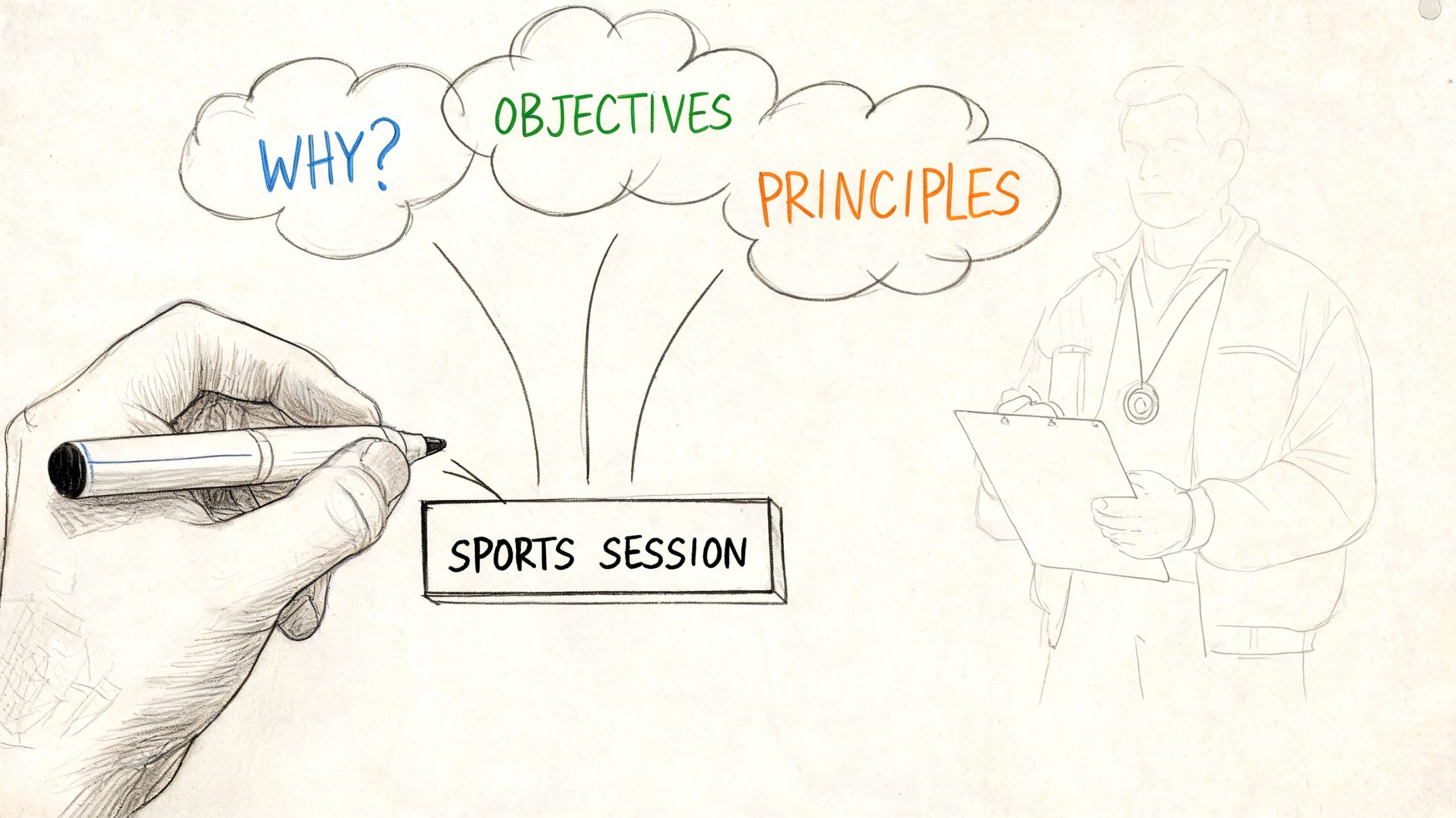
A strong sports session planner entry should answer three questions before the session begins:
- What match problem are we addressing?
- What behaviour do we want to see more often?
- What will show us the session worked?
That turns a broad topic into something coachable. For example:
| Session theme | Weak objective | Strong objective |
|---|---|---|
| Build-up play | Improve passing | Create the free player through midfield with support angles behind the first press |
| Attacking in wide areas | Work on crossing | Create overloads outside, then attack the box with delayed runs |
| Defensive transition | Improve reactions | Lock central spaces within the first seconds after losing possession |
Good objectives also need language players understand. “Occupy the half-space to disorganise the block” may be right in analysis. On the pitch, many groups respond better to “pin the full-back, hold the inside lane, arrive late.”
The best sessions give players one clear picture, then repeat it in different forms.
Keep the planner clean. Write the objective, note the principle behind it, then attach coaching points that are observable. If the principle is support under pressure, your details might be body orientation, scanning before reception, and next action speed. If the principle is circulation to break a block, your details might be width discipline, weak-side awareness, and the timing of the switch.
Without that discipline, the planner becomes a diary. With it, it becomes a coaching model.
Designing the Modern Football Session Structure
The structure of the session decides whether your ideas survive contact with the pitch. You can have strong principles and still lose the group if the session rises and falls in the wrong places, or if each phase feels unrelated to the next.
Build the session from the problem backward
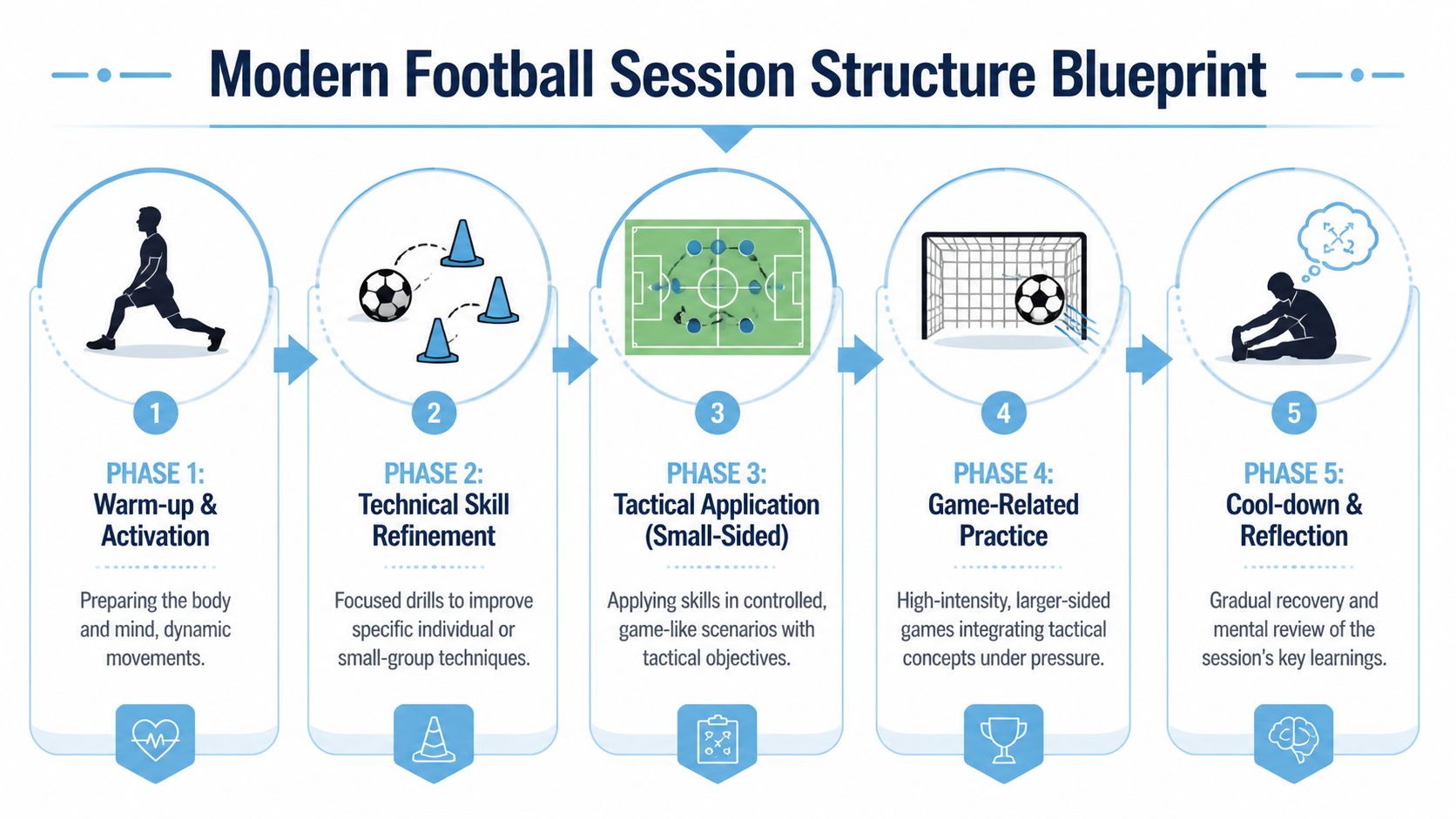
A modern football session should flow from simple recognition to pressured execution. That doesn’t mean every practice must be rigidly scripted, but it does mean each phase should prepare the next one.
Here’s a structure that works well for senior squads:
Activation with the ball
Start with movements and passing actions that prepare the specific mechanics you need later. If the main theme is press resistance, use rondo shapes, checking movements, and body orientation early. Don’t waste the opening on generic laps and static habits that don’t transfer.Technical repetition linked to the session theme
Detail gets sharpened. For passing work, the progression matters. The recommended sequence is target scanning, eye on the ball, optimal approach angle, non-kicking foot placement, and a centre-strike, with 20-25 repetitions per player recommended for skill acquisition, while retention drops below 60% when players do fewer than 15 reps, according to the SSP technical passing guidance video.Small-sided tactical application
Move quickly into opposed practice. If the technical action was receiving and releasing under pressure, the next phase must force that action in a game-like frame.Larger game-related phase
Open the space, increase realism, and test whether the behaviour survives when players have more options and more fatigue.Reflection and recovery
Cool-down is useful, but the debrief matters more. Capture what appeared, what didn’t, and which individuals need another exposure.
One reason Sport Session Planner is useful here is its practical build process. Coaches can select a pitch in a 360-degree 3D interface, place players and equipment with drag-and-drop tools, add text, and save the session with metadata for later sharing or export. That level of visual organisation is particularly helpful when you’re building role clarity into structures such as a 4-2-3-1 formation, where distances between lines and occupation of central spaces matter.
For staff who want off-pitch conditioning support to complement football-specific loading, resources such as BionicGym performance training can help frame how to support physical output without replacing the tactical value of ball-based work.
What ruins session flow
Most weak sessions break down for one of three reasons.
Too many ideas in one practice
If you coach pressing triggers, final-third combinations, and defensive line management in one session, players keep switching reference points.Poor exercise sequencing
A finishing drill that has no link to the prior possession exercise creates a reset in the players’ minds. The session stops feeling like one story.Complexity without purpose
The planner may look impressive, but the players only need the details that shape behaviour.
Add detail only if it changes a player’s decision or execution.
A clean sports session planner usually beats a clever one. Use enough information to give the staff alignment and the players clarity. Anything else is decoration.
Using Progressions and Constraints to Drive Improvement
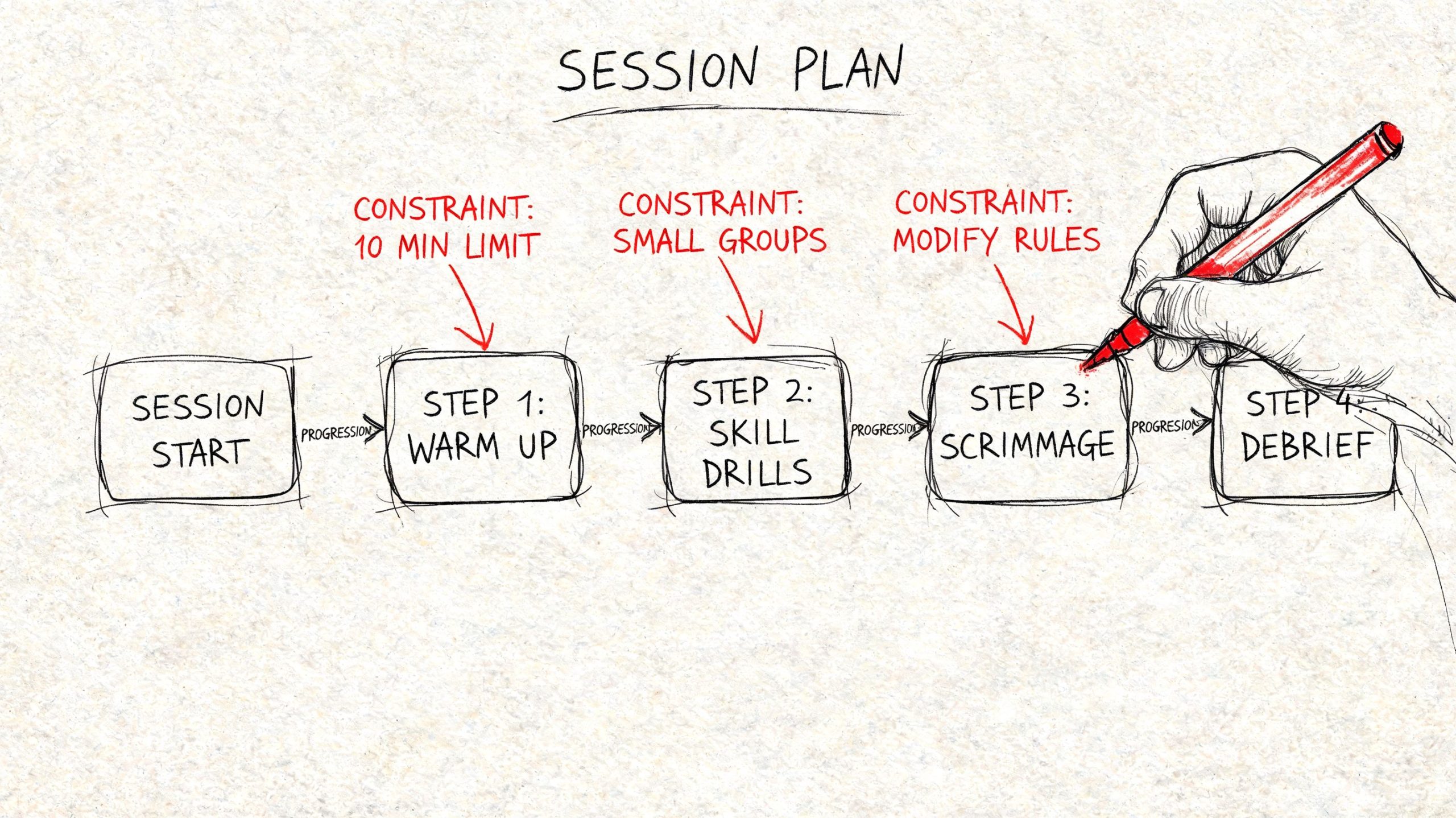
The session plan should never be static once players start moving. The best coaches adjust the task without changing the theme. That’s where progressions, regressions, and constraints are most effective.
A lot of online session plans still stop too early. They present a youth-level support angle drill, but they don’t explain how to scale it for senior football or connect it to actions such as half-space occupation and dynamic support on the move. That gap is noted in this review of support-angle session content, which also points to data such as optimal sprint angles of 15-20° from UEFA reports.
Progressions must serve the picture
A progression should make the game problem clearer, not merely harder.
If your base exercise is a positional possession game designed to improve support angles, useful progressions include:
- Add a pressing player so the receiver must scan earlier and reposition.
- Reduce the space so timing and body shape become more demanding.
- Lock one player to a zone so the team has to solve occupation around a fixed reference.
- Require the next pass to break a line so possession has direction.
Regressions matter just as much. If players can’t complete the intended action, remove a defender, widen the area, or add a neutral player. That isn’t lowering standards. It’s preserving the learning target.
A simple rule helps. If the session loses the behaviour you came to coach, the task is wrong for the moment.
Use constraints to coach without constant stopping
Constraints are often more effective than speeches. A good rule changes behaviour immediately and lets the game teach.
Useful examples include:
| Constraint | What it coaches |
|---|---|
| Two-touch limit in midfield zone | Faster scanning and release speed |
| Extra point for finding weak-side player | Switch awareness |
| Forward pass only after third-man support | Timing of supporting angle |
| Wide player must stay high until trigger | Width discipline and lane occupation |
These rules are especially useful when you want to recreate elite attacking structures. Senior squads need more than a passing square. They need to understand when to support underneath, when to rotate around the ball, and when to fix an opponent before releasing a teammate.
Don’t correct every action with your voice. Change the task and let the players feel the answer.
The video below is useful because it shows how quickly session design changes when coaches think in pictures rather than isolated actions.
A good sports session planner should leave space for these live adjustments. Put the base practice in the plan, but also note likely progressions, likely regressions, and the constraints that match your principle. That turns the planner into a working document rather than a fixed script.
Sample Sports Session Planner Templates in Action
Theory only matters if it survives a real week of coaching. These templates show how a sports session planner can move from broad idea to pitch-ready structure.
Youth development template
Theme: Ball mastery and 1v1 confidence
Context: U12 players who need more comfort in duels and tighter control under light pressure
Open with individual ball work and changes of direction. Then move into paired confrontation where one player attacks a gate and the defender applies delayed pressure. The key is not to rush toward full contact. Young players need repeated touches, visible success, and clear encouragement to commit to the move.
A useful progression is to move from isolated execution into a directional small-sided game where extra value is placed on beating the first defender. Keep coaching points simple: first touch out of feet, change of pace, protect the ball on contact.
Senior technical template
Theme: Passing patterns and finishing
Context: First team session where circulation must connect to end product
Begin with a structured passing pattern that rehearses support underneath, third-man release, and wide timing. Then add a finishing action from the final pass, ideally with one movement attacking the front space and another arriving late.
For senior players, avoid sterile pattern play. Every repetition needs decision pressure. Change the starting angle, alter the defender’s position, or vary the receiving foot. The planner should note not just the route of the ball, but the body shape and trigger for the next movement.
If your broader coaching interest also includes dead-ball detail, there’s useful tactical crossover in this breakdown of set-piece importance and aerial dominance. It reinforces a wider point. Session planning improves when coaches connect separate game moments instead of treating each one as isolated.
Senior tactical template
Theme: Pressing triggers and defensive shape
Context: Preparing a team to defend against a side that wants to build short and draw pressure
The session should begin with compactness references, not full-pitch chaos. Use a reduced area where the pressing team works on distances between the front line and midfield. Focus on triggers such as a poor first touch, a backward pass, or a wide receiver facing their own goal.
Then expand into a larger game where the defending team must decide when to jump, when to screen, and when to lock the opponent on one side. The planner requires staff notes for these situations. Who leads the press. Who protects the central lane. What happens if the first jump is broken.
A simple table keeps that structure visible.
| Phase | Activity | Duration | Key Coaching Points |
|---|---|---|---|
| Arrival | Passing activation in pairs and trios | Short | Open body shape, receive across body, scanning before touch |
| Phase 1 | Positional rondo against pressure | Medium | Support angles, third-man option, play away from pressure |
| Phase 2 | Directional game against a mid-block | Medium | Fix one side, switch at the right moment, attack gap between lines |
| Phase 3 | Conditioned game with pressing triggers | Medium | Jump together, protect central spaces, recover compactly |
| Finish | Free game with coaching on stoppages only when needed | Short | Let behaviours emerge, reinforce successful cues |
The strongest template is rarely the most detailed one. It’s the one that gives players a clear tactical picture and gives staff the right points to observe.
Measuring Success with Metrics and Post-Session Review
On Tuesday, the session can feel sharp. Ball speed is good, players are talking, the staff walk off satisfied. Then Saturday arrives, the opponent presses with real intent, and none of the trained behaviours show up. That gap is usually a review problem, not just a coaching problem.

Elite environments do not grade training on mood. They review whether the session produced the game behaviour it was built to train.
For senior football, that means measuring transfer. If the objective was to play through pressure like a top positional side, the review has to focus on actions that matter in that tactical picture. Did the six receive on the half-turn often enough. Did the full-back recognise the moment to invert. Did the first line find the third man under genuine pressure, or only when the practice gave them too much time.
A useful review starts with a small set of observations staff can capture live or on video:
- Quality of support around the ball, especially whether the receiver had clear angles ahead, behind, and inside
- Outcome of actions under pressure, not just clean execution in unopposed moments
- Speed of recognition on key cues, such as when to switch, when to bounce, and when to counterpress after loss
- Carryover into the final game, where spacing, fatigue, and decision-making look closer to match conditions
Consistency matters more than volume. Track the same behaviours across multiple sessions and patterns appear quickly. If one principle looks good in the practice block but disappears in the game block, the session design probably lacked a realistic transfer task. If the back line applies the idea and the midfield does not, that often points to role definition, spacing, or timing between units.
I use a simple rule with staff. Review the action, then review the context. A completed pass means little if the player ignored the better option that would have broken a line.
That is where a sports session planner becomes more than a timetable. It becomes the record of intent, execution, and correction. The best planners let coaches log what was trained, what was observed, and what needs adjusting next time, so the week builds instead of resetting after every session.
A practical scoring model for small-sided games
Small-sided games need more than a final score if you want useful feedback. In elite work, especially in teams modelled on Manchester City style principles, the target is rarely just "win the game." The target might be to create central access, pin the far-side winger, or regain within a short window after loss.
Score those actions.
For example, in an 8v8 directional game built around finding the free player between lines, staff can award points for behaviours linked to the objective:
- playing into the central pocket under control
- receiving between units with body shape set to play forward
- third-man combinations that beat the press
- regains in the first few seconds after losing possession
- forced play wide when coaching the defensive block
The exact numbers matter less than the logic. Keep the model simple enough to record in real time and specific enough to shape player behaviour. If every action carries the same value, players chase volume. If the key tactical action scores higher, attention shifts toward the principle you are trying to build.
This is one of the clearest differences between amateur planning and professional planning. Amateur review often counts touches, passes, or goals. Professional review ties the metric to the idea.
A short post-session review sheet is enough if it is honest:
- Which target behaviour appeared regularly
- Where the behaviour failed under realistic opposition
- What needs repeating, correcting, or progressing in the next session
That final point matters. Review should change the next plan. If players reached the central pocket but could not turn, the next session may need tighter opposition on the receiver and clearer support underneath. If the counterpress was late, reduce space and coach the nearest three players as a unit rather than correcting individuals in isolation.
The wider physical picture also has to sit alongside those football observations. If decision speed drops late in the week, training review can be stronger when paired with readiness and recovery markers. For coaches looking at that side of the process, this guide to an athlete sports blood test UK gives one example of the broader monitoring work serious performance staff now consider.
Used properly, post-session review keeps the planner alive. It stops being a document you print before training and turns into a working model for how your team learns.
Conclusion Your Planner Is Your Coaching Edge
Saturday, 2 p.m., your team starts well for ten minutes, then the distances go, the press loses timing, and the session themes from Tuesday never appear. That usually tracks back to the plan. Sessions that carry into matches are built around clear football problems, clear behaviours, and the right training detail at the right moment.
That is a key value of a sports session planner. It gives structure to your ideas so the week connects. The objective shapes the practice. The practice rehearses match actions. The review sharpens the next session. At elite level, including environments influenced by clubs such as Manchester City, that chain is rarely left to feel or habit. The plan is used to train principles, adjust to the squad in front of you, and keep the work aligned with how the team wants to play.
For senior squads, that matters even more. Players switch off quickly if the session lacks relevance, tempo, or tactical honesty. A strong planner helps the staff protect standards while still adapting on the pitch. If the overload is too easy, space changes. If the central access is blocked, the task shifts to third-man support or opposite-side circulation. If the game state changes, the coaching points change with it. That is not rigid coaching. It is prepared coaching.
The planner also gives the staff a common reference point. Analysts, assistants, and physical performance staff can all see what the session is trying to produce and judge whether it materialized under pressure.
Readiness and recovery still sit alongside the football work. For coaches who want to think more broadly about monitoring away from the pitch, this guide to an athlete sports blood test UK is one example of the wider performance picture serious practitioners consider.
A planner will not rescue poor coaching or solve a weak game model. It will give good coaching a better chance of surviving the week and appearing on match day.
If you want more elite-level football detail, Manchester City Analysis offers tactical breakdowns that help coaches, analysts, and serious fans connect training concepts to how top-level football is played.